


Google Commerce Four Rethink Retail 2026 outlines four priorities for retailers navigating AI-assisted shopping: richer product information, stronger measurement, AI-powered campaigns, and commerce infrastructure. Google’s Rethink Retail program highlighted the framework as a practical way to plan for the 2026 holiday season, not as evidence that every feature is new or universally available. This analysis from H2T Media Group explains what the pillars cover, where reporting ends and bidding begins, and what retailers should check before acting.
 Key Takeaways
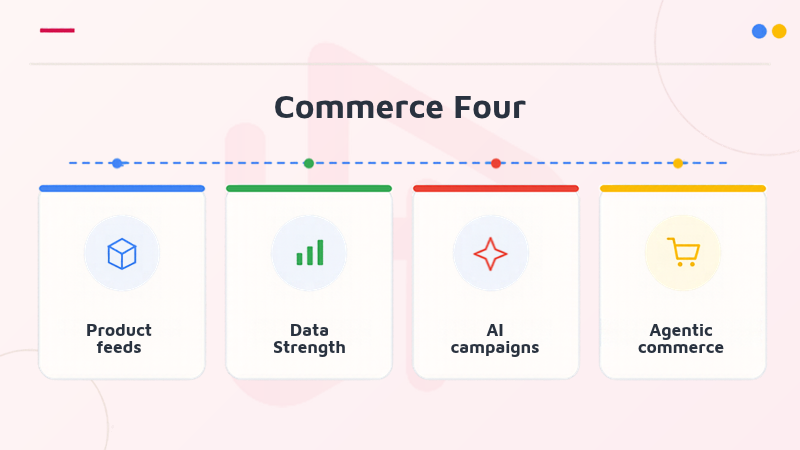
Google Commerce Four at Rethink Retail 2026 organizes four retail priorities: product feeds, Data Strength, AI campaigns, and agentic infrastructure.
Essential facts about Commerce Four
- Rethink Retail 2026 highlighted Commerce Four; a first-launch claim is not established.
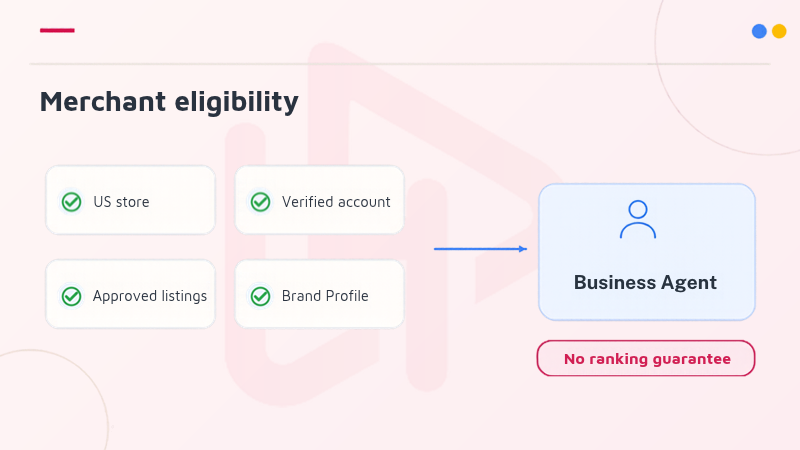
- Business Agent does not guarantee prominent AI-result placement and has market requirements.
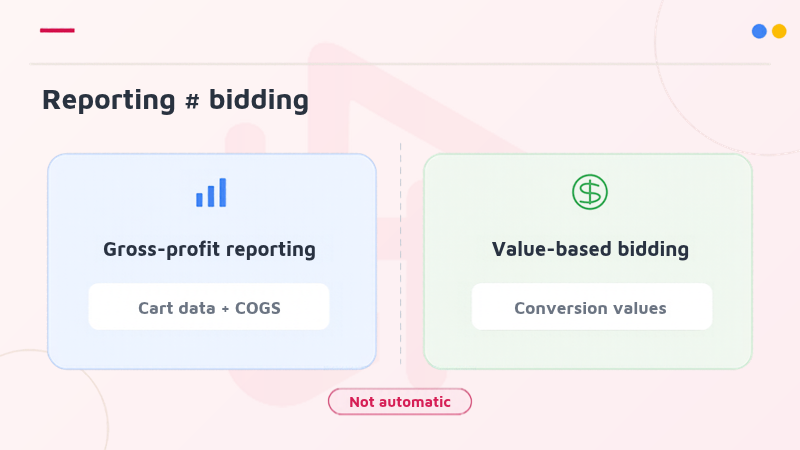
- Conversions with cart data plus COGS supports gross-profit reporting, not automatic net-profit bidding.
- Google tag gateway can improve measurement resilience, but it does not recover every event.
- UCP and agentic checkout depend on market and merchant eligibility.
1. What Google highlighted at Rethink Retail 2026
Google’s Rethink Retail 2026 hub organizes its retail guidance around a four-part framework it calls Commerce Four. Its priorities connect the quality of merchant information with advertising signals, campaign distribution, and emerging AI-assisted purchasing. The emphasis is operational: retailers need accurate inventory and product details before advanced automation can work with dependable inputs.
Commerce Four also appears in Google’s Google Marketing Live 2026 resources. Accordingly, it would be inaccurate to present Rethink Retail as the proven first announcement of the framework. The relevant news angle is how Google emphasized the four priorities for holiday retail planning and agentic commerce, while different products retain their own rollout requirements.
Read more:
Rethink Retail 2026 — Google
Google Marketing Live 2026 — Google
2. The four pillars of Google’s Commerce Four
The framework is not a single Google Ads campaign type or a ready-made switch in Merchant Center. It groups four disciplines that retailers can evaluate at different stages of readiness. The first two govern product information and measurement quality; the remaining two concern campaign activation and the systems that may support more direct shopping transactions.
2.1. Product feeds and brand presentation
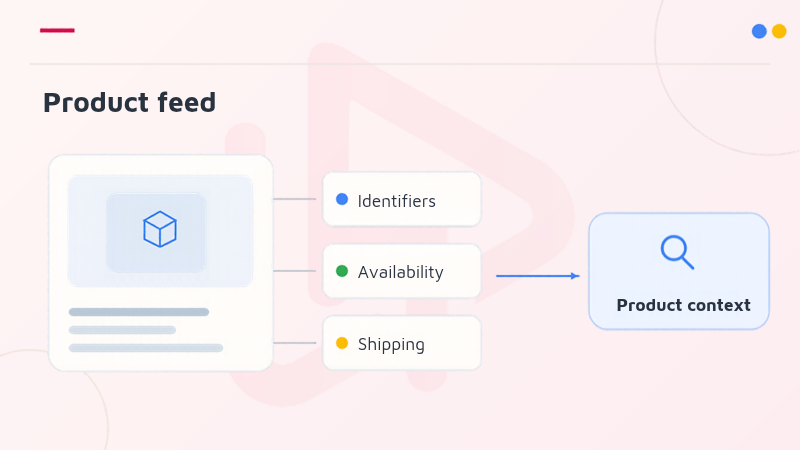
Google places Merchant Center product data at the start of Commerce Four. Retailers should review titles, descriptions, product identifiers, images, shipping information, availability, and any useful attributes supported for their products. More complete and accurate data gives Google’s shopping systems better information to interpret a product and show relevant details. It does not guarantee inclusion or a preferred position in AI-generated results.
Brand Profiles help eligible merchants describe their brand presence on Search. Business Agent is a distinct conversational experience for qualified merchants; it can answer shoppers’ questions using brand and product information. Neither feature should be described as a way to purchase priority placement across Gemini or AI Overviews.
2.2. Data Strength and cart-level measurement
The second pillar connects data sources and conversion measurement. Google identifies Data Manager, Google Tag Gateway, and conversions with cart data as complementary tools. Data Manager helps organize supported first-party data connections. Google Tag Gateway can serve Google tags through the advertiser’s own website infrastructure to improve measurement resilience, but it is not a promise that all blocked or lost events will be recovered.
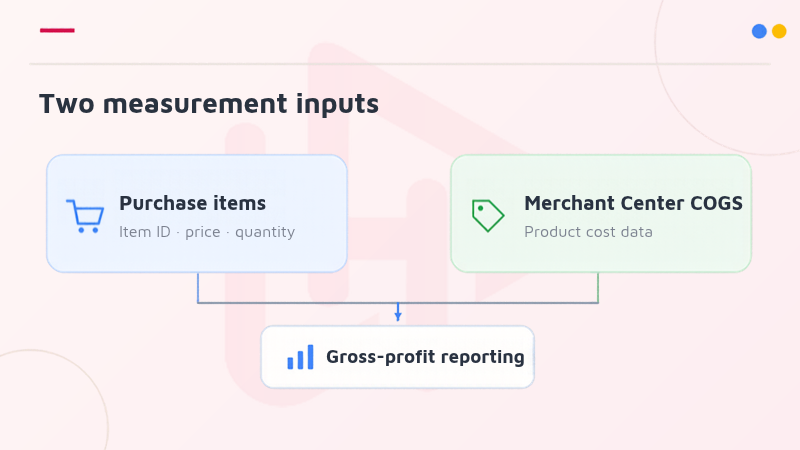
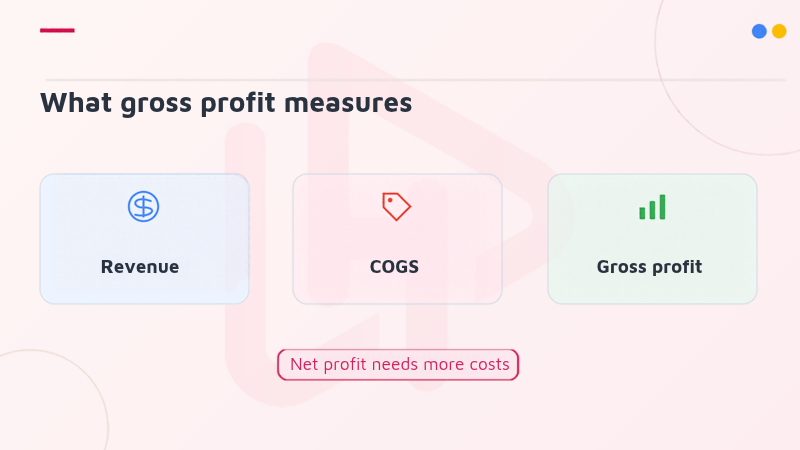
Conversions with cart data add purchased-item information to recorded purchase conversions, including item IDs, prices, and quantities. When linked to Merchant Center product data containing the cost-of-goods-sold attribute, these records can support sales and gross-profit reporting. That additional reporting does not, by itself, mean Smart Bidding automatically optimizes for net profit.
2.3. AI campaigns across Search, Shopping, and video
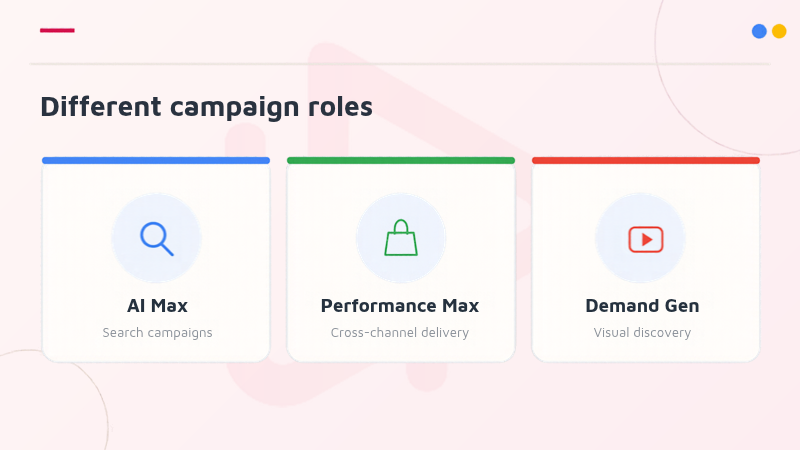
For campaign activation, Google names AI Max for Search, AI Max for Shopping, Performance Max, and Demand Gen. They serve different campaign contexts and should not be treated as one combined product. Demand Gen can use product feeds and creative assets to support shopping discovery across visual Google surfaces; Performance Max operates across eligible Google channels; AI Max capabilities need to be evaluated by campaign type and account eligibility.
A retailer should choose campaigns according to available inventory, creative, conversion quality, profitability targets, and budget controls. Flexible budgets are a planning option, not permission to remove spending limits or a guarantee that every incremental impression is profitable. For further creative context, see H2T Media Group’s analysis of Google Asset Studio’s multimodal video rollout.
2.4. Agentic commerce and checkout readiness
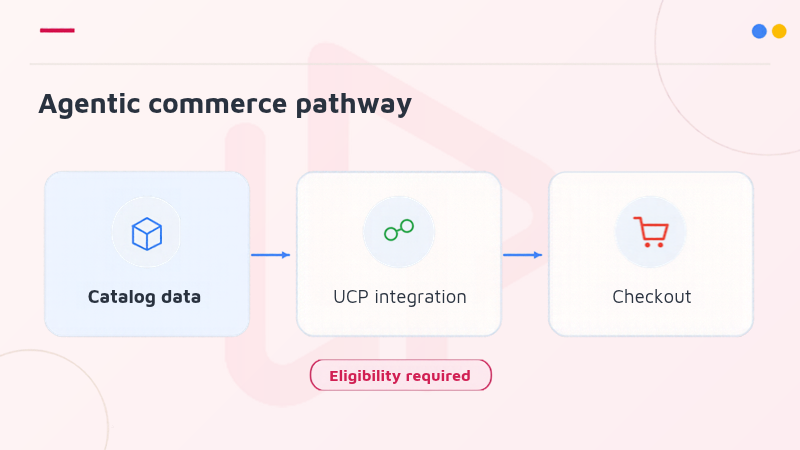
The fourth pillar asks merchants to assess Universal Commerce Protocol (UCP) and convenient payment options such as Google Pay. UCP is an open standard intended to help commerce systems and AI agents exchange information and support transactions. It does not mean an AI agent will select every compliant retailer or complete purchases without eligibility, consumer consent, and the necessary integrations.
Retailers should treat UCP as a staged technical opportunity: understand their checkout architecture, maintain reliable stock and fulfillment data, review the onboarding route, and assess support from their commerce platform. Google Pay can reduce some checkout friction where supported, but no universal percentage-point lift should be asserted without measured evidence.
Read more:
The Commerce Four to drive sales — Google
3. Availability and implementation boundaries
The four pillars operate on different timelines. Basic feed maintenance and conversion-quality checks are broadly useful, while some conversational or agentic features depend on country, merchant qualifications, platform support, or invitation-based access. Before assigning a launch date, teams should separate an announced capability from an enabled feature in their own Merchant Center and Google Ads accounts.
3.1. Business Agent is not a global ranking entitlement
Google’s Merchant Center documentation describes Business Agent as a conversational Search experience that began its US rollout with merchant eligibility requirements. For customization, Google lists a US-based e-commerce store, a verified Merchant Center account, at least 50 approved free listings, and a claimed Brand Profile among the criteria. Availability and detailed requirements may change; teams should check the current product documentation and their account rather than assume worldwide access.
3.2. Cart data reporting is not profit-based bidding by default
To implement conversions with cart data, purchase events must contain correct item-level parameters. Google specifies an items array with identifiers, price, and quantity, while cost of goods sold can be supplied through the Merchant Center feed or a supported feed method. Missing, mismatched, or approximate COGS values affect how confidently teams can interpret gross profit.
The distinction matters: gross profit reporting describes estimated sales revenue less COGS for recorded product sales. Net profit would also account for additional operating costs, and bidding toward profit requires an intentionally designed conversion-value strategy. Retailers should validate attribution, returns, margins, and value mapping before changing automated bidding objectives.
3.3. Tag gateway and UCP require separate technical checks
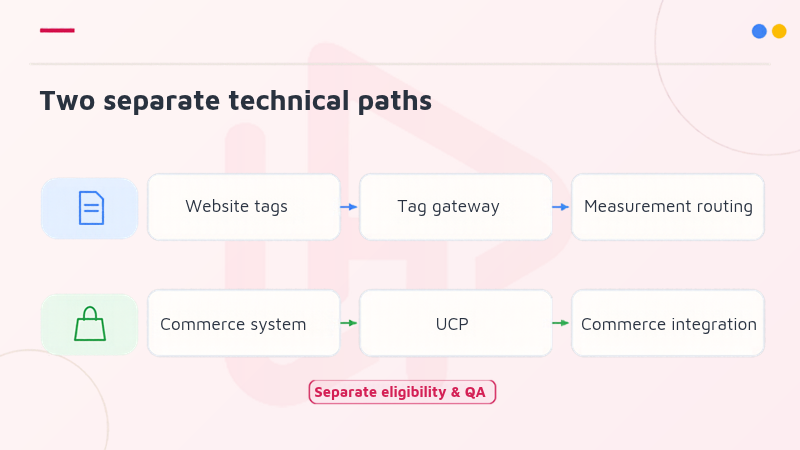
Google tag gateway improves how supported Google tags are served through first-party website infrastructure; it does not replace consent obligations, tagging QA, or server-side event design. UCP requires a different assessment: integration feasibility, marketplace availability, security, payment responsibilities, and current onboarding access. Google’s Commerce Four resource lists a US scope for Business Agent and a US, Australia, and Canada scope for UCP at the time stated on that resource. Google’s UCP integration guidance also describes select-merchant and early-access conditions for particular checkout experiences.
Read more:
Business Agent eligibility — Google Merchant Center Help
Google tag gateway for advertisers — Google Ads Help
UCP integration and early access — Google for Developers
4. What cart data can (and cannot) prove about profitability
Commerce Four encourages retailers to use richer data, but reporting and optimization are different tasks. A dashboard may show revenue attributed to ads and an estimate of gross profit while a campaign still bids against a separate purchase conversion value. Finance, merchandising, and advertising teams should agree on what each metric represents before interpreting automated bidding performance.
| Layer | What the available data can support | What it does not establish by itself |
|---|---|---|
| Cart-level purchase data | Items sold, quantities, order composition, cross-sell reporting | Complete margin or net-profit measurement |
| Merchant Center COGS | Estimated gross profit and gross-profit margin when item data matches | All fulfillment, returns, taxes, and operating costs |
| Conversion values and bidding | Campaign optimization toward the selected eligible value signal | Automatic net-profit optimization simply from enabling cart data |
| UCP and payments | Technical preparation for supported agent-assisted checkout | Guaranteed agent selection, market eligibility, or sales lift |
Google documents distinct cart-data metrics, including orders, revenue, COGS, and gross profit. Those figures can be incomplete when item identifiers or COGS inputs are missing. For a useful audit, reconcile a sample of purchase events against the store’s orders and product feed before treating any profit column as decision-grade.
Read more:
Conversions with cart data parameters — Google Ads Help
COGS reporting — Google Merchant Center Help
Metrics with conversions with cart data — Google Ads Help
5. Commerce Four versus Search Four: different conversion models
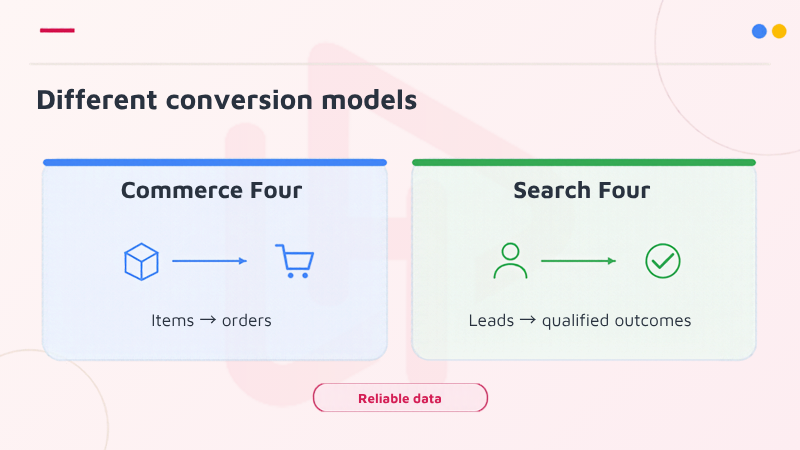
Commerce Four is tailored to retail product discovery, shopping carts, and transaction infrastructure. Search Four, in contrast, is a useful framework for evaluating lead-generation journeys where qualified leads, CRM stages, and eventual sales outcomes matter more than item-level baskets. The two frameworks share an emphasis on data quality and AI-powered campaigns, but their conversion objects and measurement requirements are not interchangeable.
For a closer look at lead generation, read H2T Media Group’s Google Ads Search Four analysis. Retail teams should keep this article focused on what Commerce Four means at Rethink Retail 2026 rather than duplicating a full implementation playbook for all Google Ads accounts.
6. A practical Q4 2026 retailer checklist
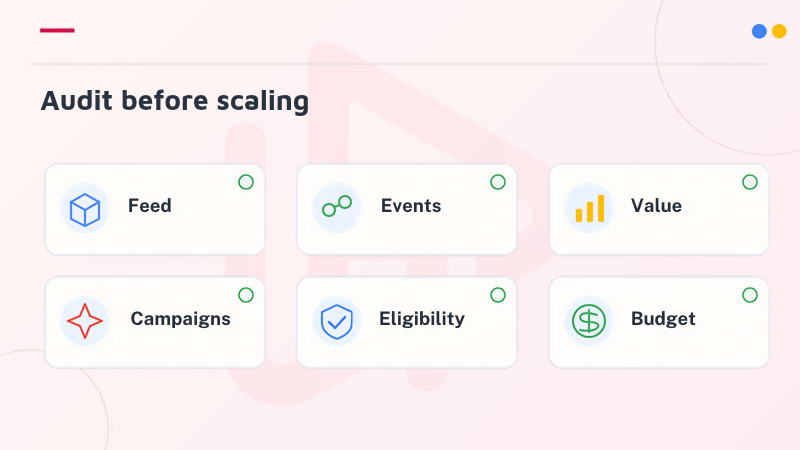
The following order is an H2T Media Group editorial recommendation, not a Google-mandated deployment sequence. Each step should be adapted to business size, market availability, available engineering resources, and campaign economics.
- Audit the Merchant Center feed.
Check identifiers, prices, availability, shipping details, images, and missing attributes for high-value SKUs. - Reconcile purchase measurement.
Confirm transaction IDs, item IDs, prices, quantities, and product-feed joins using test orders. - Check profitability definitions. Separate reported revenue, estimated gross profit, and any value actually used by Smart Bidding.
- Review campaign fit.
Assess AI Max, Performance Max, and Demand Gen only where the account, assets, and business goals justify adoption. - Assess future-facing features.
Check Business Agent and UCP eligibility before committing staff or development budget to an assumed launch. - Maintain budget safeguards.
Set evaluation windows and cost guardrails appropriate to seasonal volatility instead of automatically lifting caps.
7. Frequently asked questions
These answers summarize the framework’s practical boundaries. Account settings and regional eligibility should always be checked against current Google documentation before implementing a feature.
Not established. Google featured Commerce Four in its Rethink Retail materials and also in Google Marketing Live 2026 resources. This article treats Rethink Retail as an event-specific emphasis on the framework, not its verified debut.
No. It is a conversational experience for eligible merchants, not a published ranking entitlement. Its capabilities and eligibility must be checked in Merchant Center.
No. Cart data and COGS can enrich sales and estimated gross-profit reporting. Optimization depends on the configured conversion goals and values; net profit requires a broader cost definition.
No. Google’s published materials describe geography and participation limits. Merchants should review UCP onboarding, platform support, and checkout eligibility before planning a rollout.
Conclusion
Google Commerce Four at Rethink Retail 2026 offers a useful way to prioritize retail readiness: correct product information, reliable measurement, fit-for-purpose AI campaigns, and measured preparation for agentic checkout. It is not a universal launch checklist and does not guarantee sales, profit, or AI visibility. H2T Media Group recommends validating feed and purchase data first, then assessing campaigns and emerging features against documented availability and business outcomes.
Explore further analysis in our Google Ads category, connect with H2T Media Group on Facebook, and follow H2T Media Group on LinkedIn for ongoing platform analysis.

bichthao
H2T Media Group decodes every meaningful platform update for advertisers and affiliate partners across APAC, EU and North America — always with a practical "H2T take" you can act on.
More about H2T →