

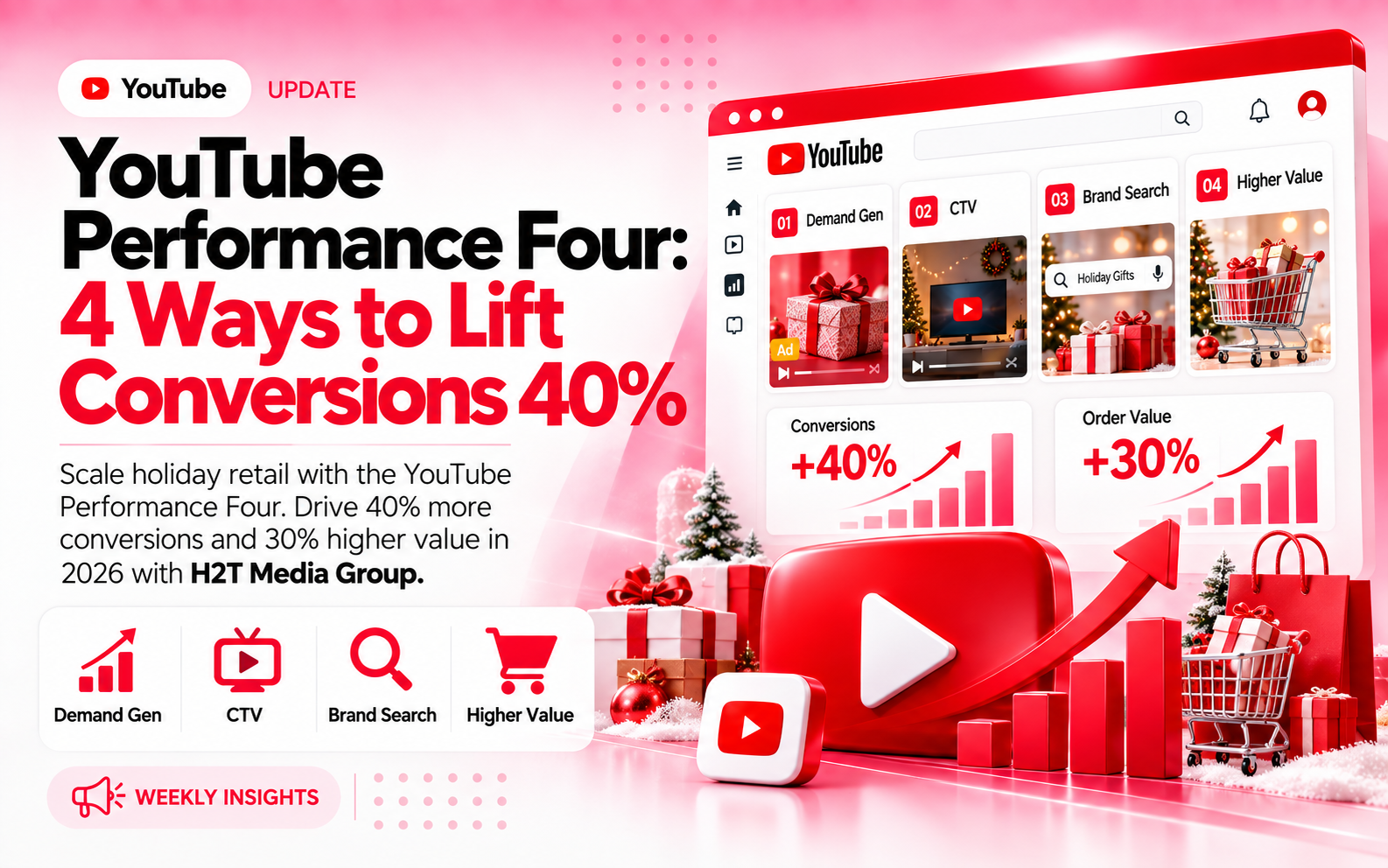
Welcome to the commercial video growth insights hub by H2T Media Group. YouTube Performance Four is Google’s core Demand Gen framework engineered to increase conversion volume by over 40% and total conversion value by 30% for e-commerce brands during peak shopping seasons. By mastering its four interconnected pillars Data, Volume, Targeting, and Creative retailers can efficiently transform passive video viewers into high-margin transactions while maximizing campaign ROAS. Below is H2T’s technical analysis and the operational blueprint required to scale your business performance.
 Key Takeaways
The YouTube Performance Four is Google’s retail blueprint engineered to drive 40%+ more conversions and 30% higher order value on Demand Gen.
Essential Framework Pillars
- Pillar 1 (Data): Establish resilient tracking foundations via Enhanced Conversions and Google Tag Gateway.
- Pillar 2 (Volume): Maintain continuous conversion data streams to feed Google AI bidding models.
- Pillar 3 (Targeting): Deploy Value-Based Bidding (tROAS) and New Customer Acquisition rules.
- Pillar 4 (Creative): Integrate vertical Shorts (9:16), horizontal (16:9), and dynamic GMC product feeds.
- Performance Lift: Global empirical data proves aligning all four pillars expands aggregate shopping cart value by 30%.
1. Empirical Reality: Capturing 40% Conversion Lift via YouTube Performance Four
Longitudinal internal data compiled by Google across global retail campaigns between April 2024 and December 2025, finalized for 2026 execution, validates a critical operational shift in consumer video behavior.
1.1. Global retail benchmarks: +40% conversions and +30% cart value
Enterprise accounts deploying the standardized four-step Demand Gen framework achieve substantial financial expansion. By systematically executing this core structure, brands can turn passive video engagement into measurable, high-margin revenue:
- Over 40% higher total conversion volume compared to accounts deploying isolated, single-format video campaigns.
- 30% higher total conversion value, proving that YouTube audiences demonstrate an increased propensity for higher Average Order Value (AOV) transactions when engaged through native shoppable formats.
1.2. Transforming passive browsing into high-value transactions
YouTube occupies a unique decision-making position within the modern digital customer journey: users navigate the platform with high research intent. The exact moment an audience consumes an unboxing review, product demonstration, or gift guide is the moment purchase intent peaks. The YouTube Performance Four framework provides growth marketers with a standardized operational protocol to monetize this visual attention without introducing friction into the consumer viewing experience. According to verified insights from YouTube for Business Brands & Beyond, establishing these four pillars prior to peak seasonal shopping surges is the primary differentiator separating profitable retail brands from margin compression.
2. Deconstructing the 4 Pillars of the YouTube Performance Four Framework
The Performance Four architecture operates as an interconnected “Recipe for Growth,” harmonizing Data, Signal Volume, Intent Targeting, and Creative Production:
2.1. Pillar 1 (Data): Establishing a resilient First-Party measurement foundation
Clean data serves as the foundational fuel powering Google’s machine learning models. Fragmented tracking pipelines force algorithms into inaccurate bidding.
- Upgrading Enhanced Conversions: Activate hashed first-party user data streams (Hashed Email, Phone Number) to elevate conversion match rates consistently above 85%.
- Deploying Google Tag Gateway: Migrate website tag architecture to server-side containers, insulating conversion tracking against client-side ad-blockers and browser privacy restrictions.
- Synchronizing Google Data Manager: Automate API pipelines connecting enterprise CRMs and offline Point-of-Sale (POS) databases directly into Google Ads.
2.2. Pillar 2 (Volume): Feeding steady conversion density into Google AI
A frequent operational error committed by media buyers is segmenting capital into fragmented micro-campaigns, starving individual ad groups of critical conversion volume.
Google’s Smart Bidding engine relies on a minimum “Data Velocity” threshold to effectively optimize campaign bidding parameters. Maintaining a steady stream of conversion events ensures machine learning algorithms have sufficient data to stabilize performance and maximize ROAS:
- Maintain a minimum baseline of 30 to 50 conversion events per month per individual Demand Gen campaign.
- Avoid erratic intraday budget modifications exceeding 20%, ensuring machine learning bid models maintain algorithmic stability during high-volume auction surges.
2.3. Pillar 3 (Targeting): Pinpointing high-AOV customers via Value-Based Bidding
Transition your audience targeting strategy from acquiring cheap, low-value leads to capturing the highest-value commercial cohorts. By focusing on intent-driven signals and lifetime customer value, brands can optimize spend to attract buyers with the highest propensity for profitability:
- Deploying Value-Based Bidding (VBB): Implement Maximize Conversion Value paired with Target ROAS constraints, integrated with Conversions with Cart Data.
- Activating New Customer Acquisition (NCA): Assign dedicated bid multipliers for first-time buyers, preventing bidding algorithms from wasting media spend retargeting existing brand loyalists.
- Leveraging Custom Intent Segments: Target high-intent prospects based on recent search queries executed across Google Search.
2.4. Pillar 4 (Creative): Multi-format asset diversification and Product Feeds
Creative assets represent the primary operational targeting valve in modern video advertising. By effectively engaging users, they directly dictate Click-Through Rates (CTR) and long-term audience retention:
- Multi-Format Aspect Ratio Coverage: Every Demand Gen asset group must include vertical video (9:16 for Shorts), horizontal video (16:9 for In-Stream and CTV), and square imagery (1:1 / 4:5).
- Connecting Dynamic Product Feeds: Attach Google Merchant Center (GMC) product catalogs directly to video units, rendering live pricing and shoppable cards beneath active video streams.
- Front-Loading the 3-Second Hook: Deliver the core value proposition within the opening three seconds to convert passive viewers into active buyers.
3. Scaling Demand Gen Funnels via Shoppable Product Feeds
During competitive fourth-quarter shopping surges, conversion speed dictates market share. Combining short-form vertical video with dynamic product catalogs drives unmatched checkout velocity.
3.1. Dominating YouTube Shorts via 9:16 vertical assets
YouTube Shorts represents the fastest-growing surface across the modern digital video ecosystem. As audience attention shifts heavily to short-form content, it commands increasingly competitive CPM auction environments.
Deploying native 9:16 vertical video captures 100% of mobile screen real estate, eliminating visual distractions. Utilizing generative AI tools like Gemini Omni inside Asset Studio allows creative teams to transform existing static catalog photography into high-converting Shorts assets without studio overhead.
3.2. Integrating dynamic Google Merchant Center product cards
Linking GMC feeds to active Demand Gen campaigns transforms standard video ads into an interactive, shoppable storefront. This integration allows viewers to dynamically browse live product catalogs and complete purchases directly alongside active video playback:
- Best-selling holiday items and promotional discounts render automatically in a dynamic product carousel beneath the video player.
- Prospects evaluate live pricing, verify inventory availability, and execute direct checkouts, compressing the purchase journey by 50%.
4. Technical Specifications Matrix: The YouTube Performance Four Architecture
The technical matrix below outlines the operational requirements and core performance impacts of each pillar. This detailed breakdown provides digital marketers with a structured reference to guide effective campaign optimization:
| Performance Four Pillar | Mandatory Technical Action | Primary Google Technology | Direct Operational Impact |
|---|---|---|---|
| 1. Data | Deploy Enhanced Conversions; implement Tag Gateway. | Google Tag Manager Server-Side, Data Manager. | Elevates match rates >85%; secures first-party signals. |
| 2. Volume | Maintain 30–50 conversions/month; pace budgets smoothly. | Smart Bidding Engine, Consolidated Structure. | Stabilizes machine learning; reduces CPA volatility. |
| 3. Targeting | Transition to Target ROAS; enable NCA & Custom Intent. | Value-Based Bidding, New Customer Acquisition. | Expands cart value by 30%; captures high-AOV buyers. |
| 4. Creative | Deploy 3 ratios (9:16, 16:9, 1:1); link GMC Product Feeds. | Asset Studio, Gemini Omni, Merchant Center. | Drives 40%+ conversion lift; dominates YouTube Shorts. |
5. The Enterprise Operational Action Blueprint by H2T Media Group
To deploy the YouTube Performance Four framework ahead of peak 2026 retail surges, H2T Media Group mandates a structured 3-phase technical roadmap. This operational blueprint ensures seamless integration across measurement infrastructure, creative asset optimization, and demand-led scaling:
Phase 1: Measurement Foundation and Feed Standardization (September – October)
- Audit Google Merchant Center catalogs, ensuring verified GTINs, lifestyle imagery, and holiday promotional attributes are fully populated.
- Deploy Google Tag Gateway via server-side containers and validate Enhanced Conversions data streams.
- Consolidate fragmented ad account structures to prepare for conversion volume accumulation.
Phase 2: Creative Asset Compilation and Value Bidding (October – November)
- Utilize Gemini Omni to render high-resolution 9:16 vertical video assets for Shorts and 4K horizontal assets for Connected TV.
- Configure Demand Gen campaigns linked directly to dynamic GMC product feeds.
- Transition bidding strategies to Maximize Conversion Value with Target ROAS floors calibrated to gross contribution margins.
Phase 3: Demand-Led Scaling and New Customer Acquisition (November – December)
- Activate Demand-Led Budgets, removing artificial daily caps during peak promotional surges (BFCM, Cyber Week, Christmas).
- Enable New Customer Acquisition bidding rules to aggressively capture first-time holiday shoppers across YouTube.
6. Frequently Asked Questions
The framework is engineered specifically for Demand Gen campaigns and Video Action campaigns operating across YouTube, Shorts, Discover, and Gmail.
For emerging accounts with limited conversion density, begin with Maximize Conversions to accumulate 30 to 50 validated events before transitioning to Target ROAS value optimization.
Advertisers can utilize the multimodal Gemini Omni tool integrated natively inside Google Ads Asset Studio to convert existing static product imagery into production-grade vertical narrative videos.
No. Linking an approved Google Merchant Center product feed to Demand Gen campaigns is an integrated native capability available at zero supplemental media cost.
The YouTube Performance Four framework delivers the definitive operational blueprint for scaling retail e-commerce revenue throughout the 2026 holiday shopping season. Unifying pristine first-party data infrastructure, consistent conversion signal volume, value-based targeting models, and dynamic multi-format creative assets empowers brands to capture a documented 40% conversion lift and 30% higher cart value. Standardize your video advertising operations today to transform passive YouTube engagement into sustainable commercial revenue.
To access proprietary video scaling playbooks and advanced multi-touch attribution frameworks, explore our technical repository on the Insights hub at H2T Media Group. Make sure to consistently follow our dedicated YouTube to master the tactical marketing strategies dictating success across global video advertising ecosystems.

bichthao
H2T Media Group decodes every meaningful platform update for advertisers and affiliate partners across APAC, EU and North America — always with a practical "H2T take" you can act on.
More about H2T →