

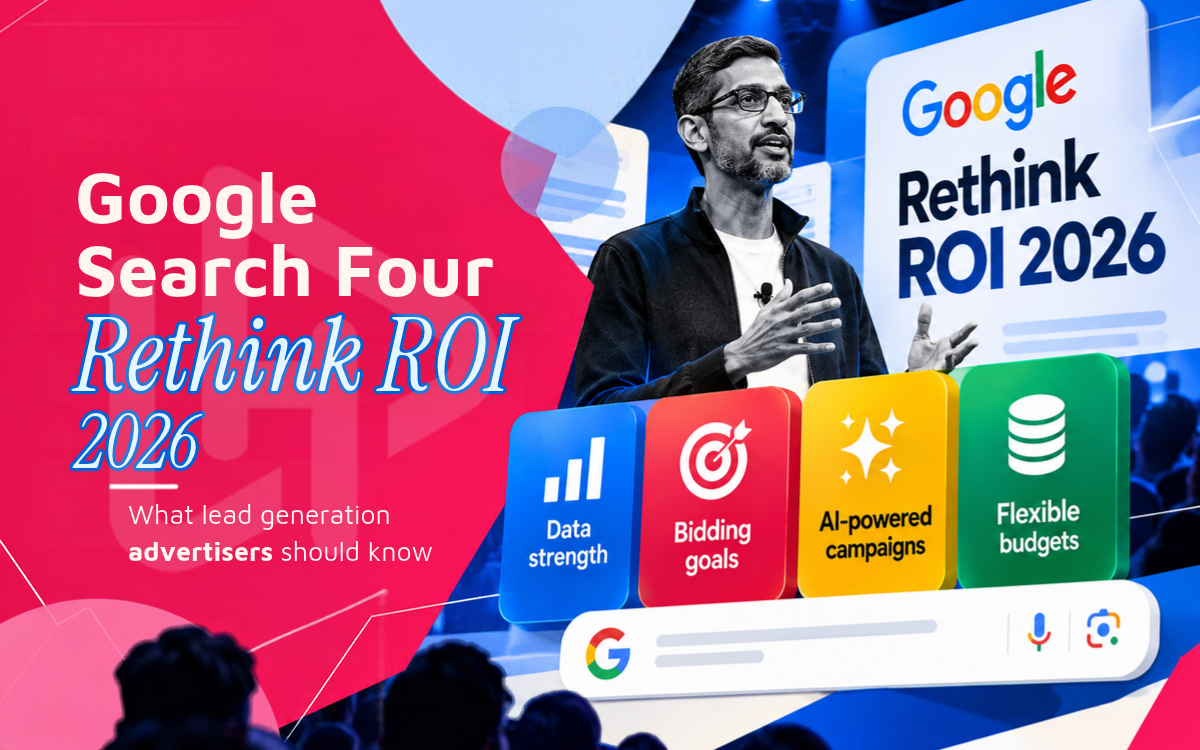
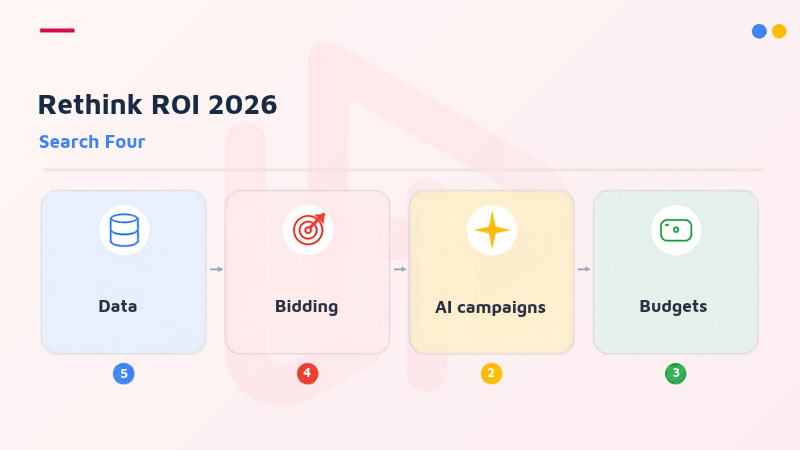
Google Search Four at Rethink ROI 2026 brings together four actions for lead generation advertisers: strengthen measurement data, align Smart Bidding with business outcomes, use AI-powered campaign capabilities, and plan budgets around demand. Google presented the framework as guidance for the lead-to-sale journey – not as a single new product or a promise of lower acquisition costs. H2T Media Group reviews what the event established, how the components fit together, and what teams should verify before applying them.
 Key Takeaways
Google Search Four at Rethink ROI 2026 — Google presented four connected priorities for lead generation advertisers: stronger conversion data, business-aligned bidding, AI-powered campaigns, and flexible budgets.
Essential facts about Google Search Four
- The Search Four is a lead generation framework, not a single newly launched campaign type.
- Google Data Manager and Google Tag Gateway support different parts of conversion measurement.
- The choice between tCPA and value-based bidding depends on conversion signals and business objectives.
- AI Max adds capabilities within Search campaigns; Performance Max uses inventory across Google channels.
- Flexible budgets still require account eligibility, performance monitoring, and financial guardrails.
1. What Google presented at Rethink ROI 2026
Google listed Rethink ROI highlights in its September 17, 2026 product-announcement recap. Its event hub describes the Search Four as four steps to lead generation on Google Search. The distinction matters: the framework combines technologies and operating practices that advertisers may already know, including Data Manager, Smart Bidding, AI Max, Performance Max and flexible budgets. It is not evidence that Google simultaneously launched four entirely new tools.
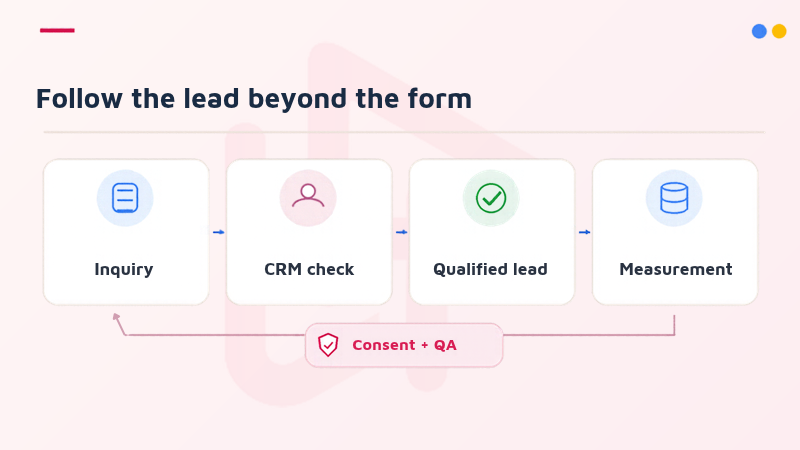
The common thread is the path from an ad interaction to a meaningful sales result. A form fill can indicate interest, but businesses often need additional CRM outcomes to distinguish inquiries from qualified opportunities and completed sales. Google positions stronger first-party measurement as an input to campaign optimization; whether that improves business performance depends on data coverage, configuration, lead quality, and economics.
Read more:
Rethink ROI 2026: The Search Four
Google Ads product announcements, September 17, 2026
Google Ads Decoded: Building data strength for lead generation
2. The four pillars of the Search Four framework
Google organizes the Search Four around data, bidding, campaign capabilities, and budget flexibility. Each pillar addresses a different constraint in lead generation. They work together, but none eliminates the need for human-defined conversion goals, account-level checks, or performance evaluation.
2.1. Build data strength across the lead journey
The first pillar starts with mapping the lead-to-sale journey. Instead of reporting only the initial contact form submission, advertisers can use Data Manager and eligible offline conversion integrations to connect subsequent milestones, such as qualified leads and completed sales. Google Tag Gateway for advertisers lets you serve Google tags and route some measurement requests through first-party infrastructure on a website domain.
Google Tag Gateway is not synonymous with server-side Google Tag Manager, and neither implementation guarantees that every form submission will be observed. Teams still need to validate tags, consent handling, CRM matching, deduplication, conversion delays, and diagnostic reports. Google’s lead-generation guidance recommends choosing conversion actions that reflect business goals and importing offline data regularly where relevant.
Read more:
Google for Developers: Google tag gateway for advertisers
Google Ads Help: Best practices for generating high-quality leads
2.2. Align Smart Bidding with the outcome that matters
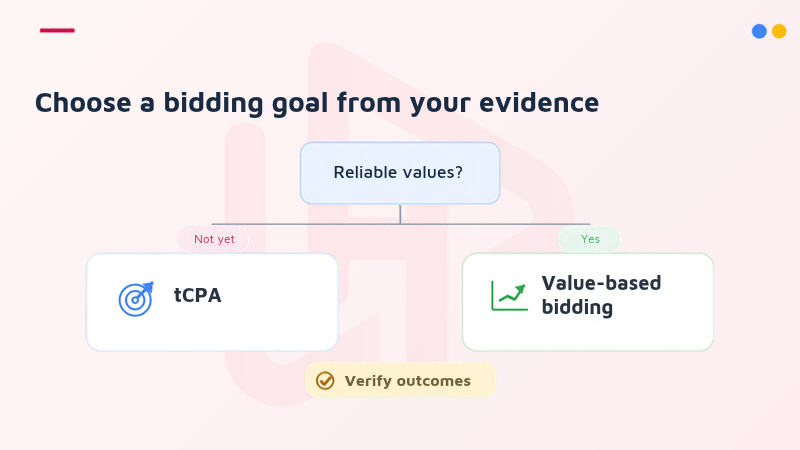
The second pillar connects the campaign’s optimization target to what a lead is worth. If conversions have genuinely different business values, Maximize conversion value or a target ROAS setting may help prioritize higher-value outcomes. If lead quality matters but differentiated values are not reliable, Google also identifies target CPA for qualified or converted leads as a valid option. There is no universal requirement to migrate all lead generation campaigns from tCPA to tROAS.
A practical review starts with conversion definitions, which actions are primary for bidding, CRM qualification rates and the lag between click, lead, and sale. Before switching goals, inspect signal volume and value quality. Artificially assigned values or a sudden goal change can distort campaign learning rather than make it smarter.
Read more:
Google Ads Help: Best practices for generating high-quality leads
2.3. Adopt AI Max, Performance Max and suitable lead formats
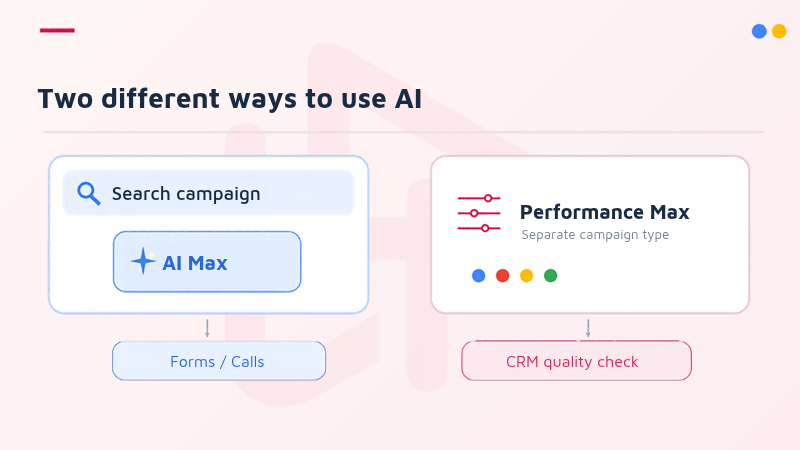
The third pillar highlights AI Max for existing Search campaigns, Performance Max across Google inventory, and native lead routes such as forms and calls. AI Max is an optimization layer within Search—not a separate campaign type. Its search-term matching, text customization, and final URL expansion introduce additional reach and automation, subject to the controls available in the account.
Advertisers should inspect brand settings, location intent, URL exclusions, generated assets and search-term reporting before treating expanded reach as incremental qualified demand. Performance Max serves a different cross-channel role; native lead formats should be assessed for availability and for the quality of their downstream CRM outcomes. More submitted forms are not automatically more sales-ready leads.
Read more:
Google Ads Help: How AI Max for Search campaigns works
Google Ads Help: Set up AI Max for Search campaigns
Rethink ROI 2026: The Search Four
2.4. Match budget flexibility to measured demand
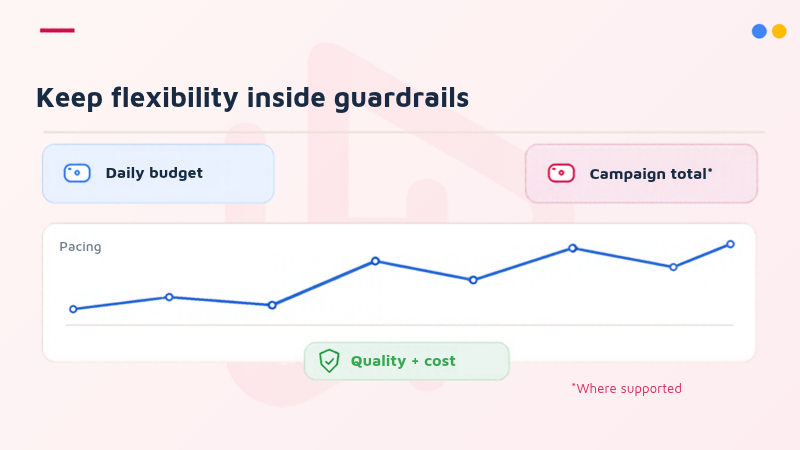
The fourth pillar calls for budgets that can respond to valuable demand instead of remaining constrained by an arbitrary schedule. Google mentions both daily and flighted budgets. Campaign total budgets, where supported, let advertisers specify a fixed total for a defined start-to-end period, while Google automatically manages pacing within that limit.
Budget flexibility does not mean removing financial safeguards or capturing every profitable conversion. Teams should verify eligibility, pacing rules, spending limits, cash-flow tolerance, marginal acquisition cost and the quality of additional volume. Expanding spend without reliable lead-quality feedback may simply scale unqualified inquiries.
Read more:
Google Ads Help: About campaign total budgets
Google Ads Help: Campaign total budgets FAQs
3. What Search Four means for lead generation measurement
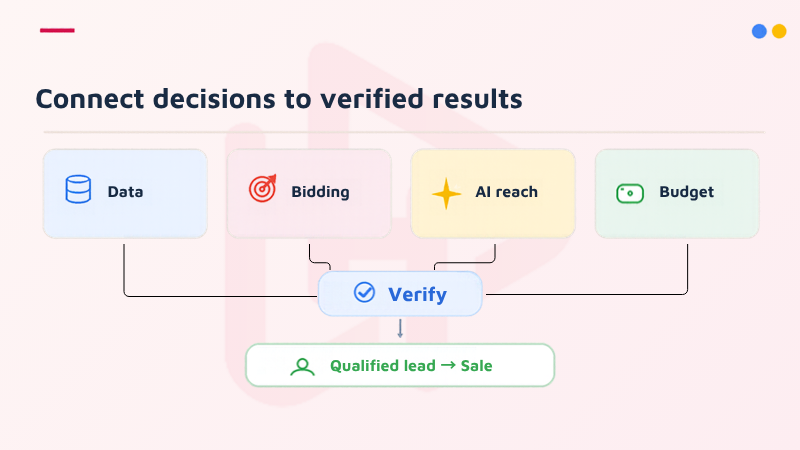
The Search Four shifts the operating conversation from campaign-interface metrics toward a connected lead-to-sale view. This is an interpretation of Google’s framework, not an independent performance benchmark. A useful decision framework separates early conversion signals, validated downstream outcomes, and budget decisions instead of assuming one dashboard captures the full customer journey.
| Decision layer | What to verify | Why it matters |
|---|---|---|
| Data | Form event, consent, CRM match and import diagnostics | Missing or duplicate signals can bias optimization |
| Bidding | Primary goals, qualification stage and credible values | Targets should represent business outcomes |
| Campaigns | Search terms, brand/URL controls and lead-form eligibility | Expanded reach requires quality checks |
| Budget | Pacing, marginal CPA and sales capacity | More spend is useful only when outcomes justify it |
For example, a business may first measure form submits, then import verified qualified-lead events as its sales team classifies inquiries. The right optimization stage depends on data reliability and the time needed to observe outcomes. Neither the four pillars nor Google’s event page guarantees a particular close-rate increase, cost-per-acquisition reduction, or revenue uplift.
Read more:
Google Ads Help: Best practices for generating high-quality leads
Google Ads Decoded: Building data strength for lead generation
4. What the Search Four announcement does not guarantee
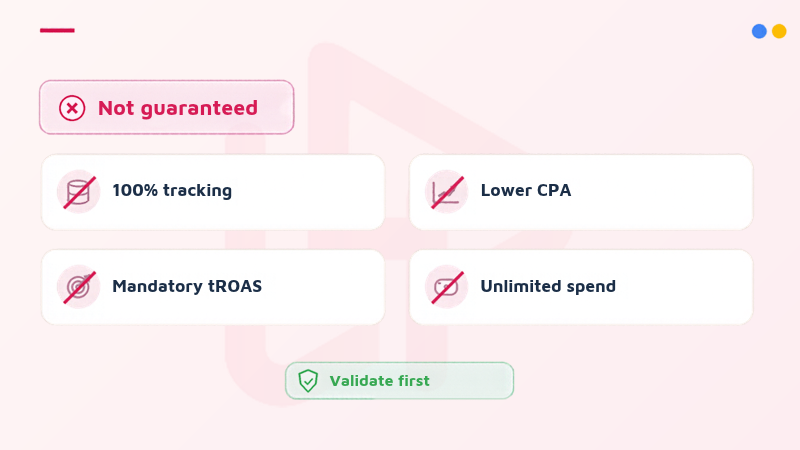
A framework announcement can be mistaken for a required migration checklist. Google’s official material supports the four-part approach, but the following limitations remain essential when evaluating the business case:
- No universal 100% measurement coverage: Google tag gateway and offline imports improve the measurement foundation but do not eliminate consent, technical, or identity-matching limitations.
- No mandatory bidding switch: tCPA remains a legitimate choice when lead values cannot be differentiated reliably; value-based bidding requires trustworthy values.
- No guaranteed zero-junk-lead pipeline: validation, lead routing and CRM qualification remain the advertiser’s responsibility.
- No unlimited-budget instruction: daily and campaign-total budgets have spending rules, and incremental performance should be reviewed against margins and operational capacity.
- No blanket feature availability assumption: verify campaign type, account eligibility, geography and product rollout before committing to a format or control.
Google’s September event recap should therefore be read as strategic guidance. Product availability and technical prerequisites need separate checks in current Help documentation; case-study results, where published, should not be turned into universal forecasts.
Read more:
Google Ads Help: Best practices for generating high-quality leads
Google Ads Help: About campaign total budgets
Google Ads Help: How AI Max for Search campaigns works
5. A practical Search Four evaluation checklist
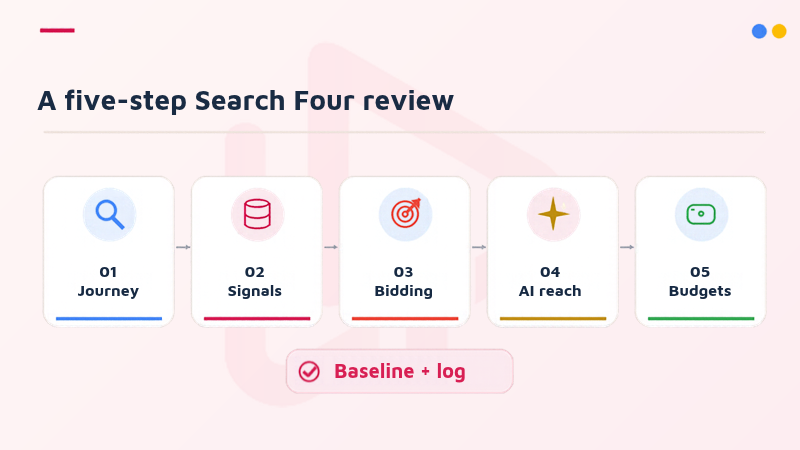
A measured rollout starts with diagnosis rather than switching all features at once. H2T Media Group recommends the following review sequence as an operational interpretation of the four pillars:
- Document the conversion journey.
Name each stage from inquiry to qualified lead and sale, the system recording it, and the typical delay. - Audit first-party signals.
Check tag diagnostics, Data Manager connections, consent procedures, offline import timeliness, and duplicate events. - Align the bidding goal.
Compare optimization actions against CRM qualification and sales outcomes; decide whether volume-based or value-based bidding has sufficient evidence. - Evaluate AI reach with guardrails.
Review AI Max settings, Performance Max role, native format eligibility, and search-term/landing-page quality. - Define budget review rules.
Set a time-bound test, spend limits, a quality threshold, and a process for escalating when marginal qualified-lead cost deteriorates.
Keep a baseline and change log before testing. Interpret results after accounting for conversion lag and volume; do not attribute every movement in sales results to a single Search Four feature. This checklist is H2T Media Group’s proposed audit sequence, not a Google-mandated implementation schedule.
6. Frequently asked questions
No. Google presents Search Four as an organizing framework for lead generation. It brings together existing and evolving technologies and practices; individual product announcements have their own timelines.
No. Google also recommends target CPA for qualified or converted leads when different conversion values cannot be assigned reliably. The correct choice depends on lead economics and measurement readiness.
No. It serves Google tags in a first-party context and can be used alongside server-side tagging, but their configurations and responsibilities are not identical. Neither guarantees complete measurement.
No. Budget flexibility can reduce avoidable constraints, but the impact on acquisition cost and lead quality depends on demand, bidding targets, measurement and operational capacity.
Not solely for keyword matching. URL changes require a separate review of search performance, canonical signals, internal links and backlinks; a permanent redirect is appropriate only after deciding that the page has genuinely moved.
Conclusion
Google Search Four at Rethink ROI 2026 is best understood as a connected set of decisions about data strength, bidding goals, AI-powered reach, and budgets 0 not a guaranteed revenue playbook. Advertisers should first establish reliable lead outcomes, then evaluate campaign automation and spending against those outcomes.
Explore more reporting and campaign updates in the Google Ads category from H2T Media Group. For ongoing discussion, connect with H2T Media Group on Facebook and follow H2T Media Group on LinkedIn.

bichthao
H2T Media Group decodes every meaningful platform update for advertisers and affiliate partners across APAC, EU and North America — always with a practical "H2T take" you can act on.
More about H2T →