

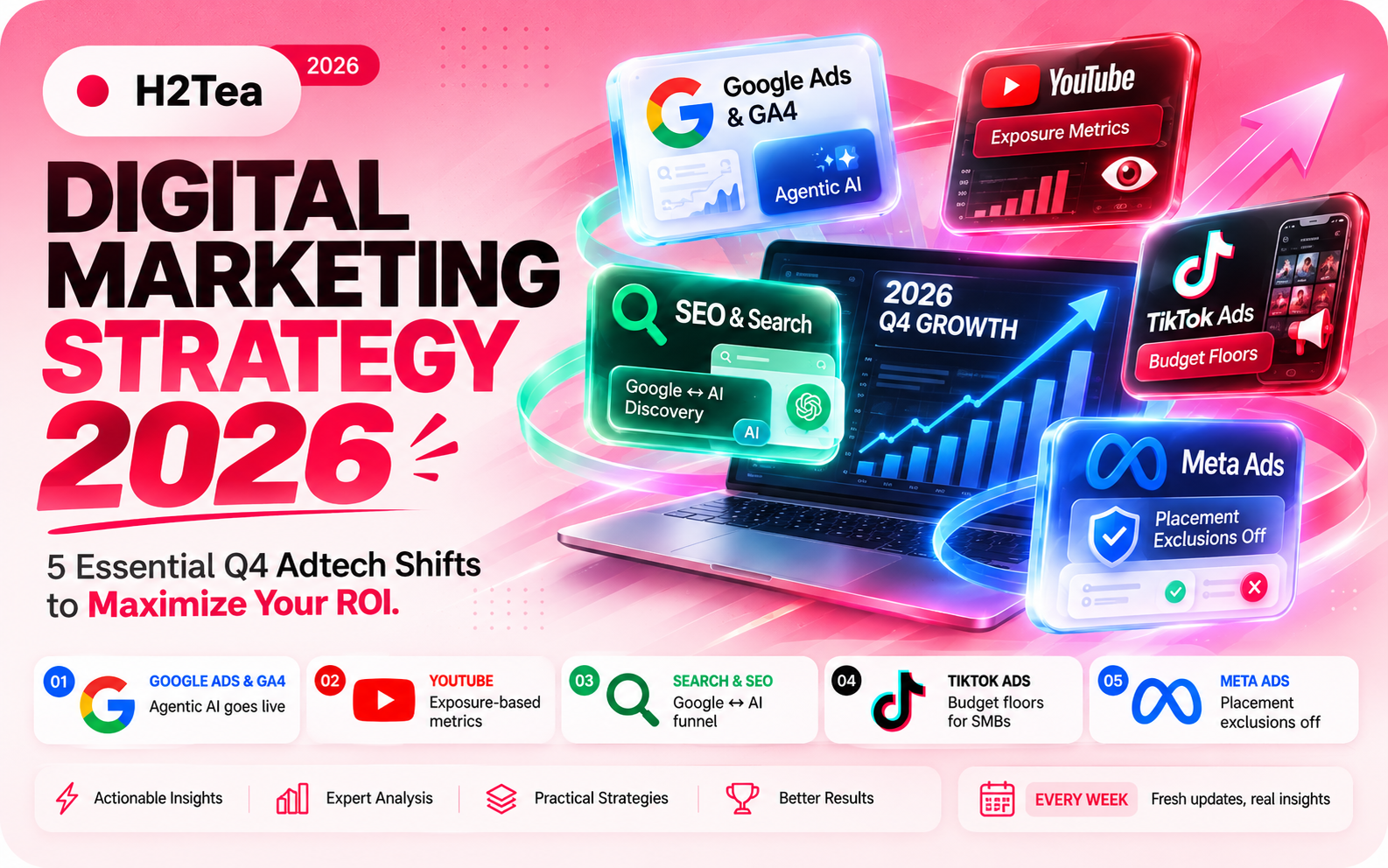
Building a scalable digital marketing strategy 2026 requires growth leaders to adapt immediately to 5 critical adtech infrastructure shifts across Google, YouTube, Technical SEO, TikTok, and Meta. To defend net contribution margins and scale revenue in Q4, enterprise brands must transition from superficial campaign tweaks to semantic product feed engineering, edge-level bot governance, and real-time server-side data pipelines. Below, this edition of the H2Tea digest by H2T Media Group dissects the underlying technical mechanics of each platform update and delivers an actionable operational blueprint for your business. Read on to optimize your digital strategy for 2026!
 Key Takeaways
The H2Tea Digital Marketing Digest EP.09 highlights five mission-critical infrastructure transformations across Google, YouTube, Technical SEO, TikTok, and Meta that fundamentally redefine modern full-funnel performance.
Essential Facts About This Week’s 5 Shifts
- Google Ads: Product feeds function as AI prompts; enforce a strict feed freeze 3 weeks prior to BFCM.
- YouTube: Unveiled 5 direct-response upgrades, headlined by native AI Business Agents and search attribution.
- Technical SEO: Enforce bot governance at the Edge WAF rather than delegating robots.txt to automated CDN toggles.
- TikTok Ads: The “Limited Inventory” tier triggers an artificial 30%-50% eCPM penalty; default to Standard Inventory.
- Meta Ads: Project Petal (1 Pbps subsea cable) eliminates AI auction clearing latency and preserves CAPI data integrity.
1. Google Ads: Product Feeds as Core AI Prompts in Agentic Commerce
The opening technical shift this week centers on Google Ads re-engineering the operational function of Google Merchant Center (GMC) feeds in response to conversational consumer shopping habits.
1.1. Semantic product feed architecture
Holiday shoppers in 2026 no longer rely on single-keyword search queries. Discovery occurs through conversational prompts within Google Gemini and AI Overviews: “Recommend a leak-proof insulated tumbler keeping water cold for 24 hours on a winter hike”.
Google AI ingests product feeds as continuous prompt context rather than basic spreadsheets:
- Product titles must follow an enriched semantic structure: [Brand] + [Product Type] + [Core Attributes] + [Use Case/Seasonal Context].
- Populate the lifestyle_image_link attribute to ensure visual assets are prioritized within dynamic AI Overviews and Google Discover product carousels.
1.2. The pre-holiday feed freeze protocol (Pre-BFCM)
A widespread operational mistake among e-commerce retailers involves altering core product feed data right on the eve of Black Friday and Cyber Monday promotions. Because ad network algorithms require substantial time to re-index and re-approve updated product details, these last-minute changes disrupt campaign learning phases and severely jeopardize performance when traffic is highest.
Altering primary product identifiers (IDs, Titles, URLs) triggers automated compliance re-crawls by Google’s crawling bots. In peak shopping weeks, this can result in catastrophic merchant center disapprovals or account suspensions due to temporary price discrepancies.
- The H2T Operational Rule: Freeze all primary product feed attributes at least three weeks prior to Black Friday. Execute holiday price drops and temporary promotional badges exclusively via Supplemental Feeds and Google Promotion Builder.
2. YouTube: 5 Next-Gen Direct-Response Tools from Rethink 2026
At the annual Rethink 2026 executive summit, YouTube for Business released its “Next Wave of Performance” feature suite, permanently merging video storytelling with closed-loop commercial checkout.
2.1. In-stream AI Business Agents and Disclaimer Ads
Two breakthrough features systematically eliminate historical conversion friction:
- AI Business Agent: Embeds an interactive conversational AI assistant directly beneath the active video ad unit. Viewers query product specifications, verify local stock, and receive direct checkout links without exiting the video stream.
- Disclaimer Ads on Demand Gen: A standardized compliance container rendering seamlessly across YouTube Shorts and In-Stream inventory. Users tap to expand full legal disclosures in an overlay without terminating video playback, unlocking low-competition Shorts inventory for heavily regulated sectors (Finance, Pharma, Legal).
2.2. Mathematical Attributed Branded Searches
YouTube officially deployed Attributed Branded Searches, programmatically connecting upper-funnel video ad exposures with downstream Google Search query behavior. This measurement framework mathematically isolates the search volume driven by video views, providing marketing leaders with transparent cross-channel attribution to scale media spend.
This feature mathematically proves the exact volume of branded search queries stimulated by video impressions, equipping Chief Marketing Officers (CMOs) with the quantitative attribution required to justify scaling video media investments.
3. Technical SEO: Edge-Level Bot Governance and the CDN Sync Trap
Enterprise digital assets experienced severe citation losses across generative AI engines this week due to webmasters delegating robots.txt management to Cloudflare’s automated “Bot Preference Sync” toggles. This blanket automation inadvertently restricts vital AI search crawlers alongside training harvesters, causing brands to immediately drop out of generative search results and recommendation engines.
3.1. Advisory protocols vs. Edge WAF enforcement
Many technical directors operate under the flawed assumption that declaring Disallow: / inside robots.txt establishes a security firewall.
- The robots.txt file operates strictly as an Advisory Protocol (Honor System). Malicious scraping bots systematically ignore these directives, consuming origin server bandwidth.
- Furthermore, automated CDN bot sync tools categorize crawlers with broad brushes, inadvertently blocking valuable conversational AI search crawlers like OAI-SearchBot and PerplexityBot.
3.2. Enforcing governance at the network edge
To protect proprietary data while capturing high-intent AI search citations:
- Disable automated CDN robots.txt synchronization toggles.
- Manually script robots.txt to selectively permit live AI search retrieval bots while restricting foundational model training harvesters (GPTBot, Bytespider).
- Deploy hard blocking rules (Action: Block) at the Edge Web Application Firewall (WAF) to terminate rogue scrapers before they reach your origin infrastructure.
4. TikTok Ads: The Brand Suitability Paradox and the eCPM Inflation Penalty
TikTok for Business expanded its Brand Safety and Suitability framework across TikTok Shop and creator Profile Feeds. However, misconfigured suitability controls are severely inflating media acquisition costs.
4.1. The financial penalty of the “Limited Inventory” tier
Driven by corporate risk aversion, brands frequently enforce the “Limited Inventory” tier across all active campaigns to eliminate potential brand safety exposure. However, this overly strict filtering removes up to 40% of available ad placements, contracting auction liquidity and driving baseline eCPMs up by 30% to 50%.
- The Operational Consequence: The Limited tier removes up to 40% of available auction placements, severely contracting auction liquidity.
- This liquidity reduction forces bidding models into hyper-competitive auctions, driving baseline eCPMs up by 30% to 50% and eroding campaign ROAS.
4.2. Balancing brand governance and auction liquidity
The standardized operational framework by H2T Media Group:
- Establish the Standard Inventory filter as the default baseline for conversion campaigns. This tier delivers verified brand safety rates exceeding 99% according to independent audits by Integral Ad Science (IAS) and DoubleVerify.
- Deploy surgical in-flight category exclusions and creator Profile Feed Exclusion Lists to eliminate adjacency to sensitive topics without sacrificing auction liquidity.
5. Meta Ads: Project Petal – The 1-Petabit Subsea Physical Infrastructure Moat
Meta Engineering officially unveiled Project Petal on September 21, 2026, launching the world’s first petabit-class transoceanic subsea fiber-optic cable spanning 7,000 kilometers between North America and Europe. This massive hardware upgrade establishes a dedicated, ultra-high-bandwidth connectivity moat engineered specifically to synchronize distributed AI compute clusters and power next-generation ad-serving infrastructure across continents.
5.1. The architectural leap from Terabits to Petabits
Project Petal deploys advanced Space Division Multiplexing (SDM) packing record counts of fiber pairs to achieve an unprecedented transmission throughput exceeding 1 Petabit per second (1,000,000 Gbps). This physical hardware infrastructure was engineered specifically to connect distributed GPU computing clusters across continents, powering foundational AI models like Llama and the Andromeda ad-serving engine.
5.2. Direct impact on ad auction velocity and CAPI reliability
For global cross-border e-commerce brands:
- Project Petal compresses transatlantic data transmission latency to under 20 milliseconds.
- Server-Side Conversions API (CAPI) payloads stream into Meta’s authentication servers in near real time with zero packet loss.
- The Andromeda and Lattice AI serving engines receive pristine conversion signals, allowing predictive conversion rate models (pCVR) to stabilize auction bidding during peak holiday shopping surges.
According to official technical documentation on the Meta Engineering Blog, sovereign subsea infrastructure grants the platform an insurmountable advantage in distributed AI compute efficiency.
6. Technical Specifications Matrix: Synthesizing the 5 Weekly Platform Shifts
The technical matrix below outlines the core updates, algorithmic mechanisms, and mandatory operational directives across all five platforms:
| Advertising Platform | Core Technical Upgrade | Algorithmic Mechanism Shift | Mandatory Enterprise Action Protocol |
|---|---|---|---|
| Google Ads | Agentic Commerce Feed Architecture. | AI parses Merchant Center feeds as natural prompts. | Enrich semantic titles; enforce feed freeze 3 weeks before BFCM. |
| YouTube | 5 Rethink 2026 Performance Tools. | Direct conversion via AI Agents and Search lift. | Deploy Disclaimer Ads; track Attributed Branded Searches. |
| Technical SEO | Edge-Level Bot Governance. | Separates model training crawlers from AI search bots. | Disable CDN sync; allow citation crawlers; enforce Edge WAF blocks. |
| TikTok Ads | Brand Suitability Liquidity Paradox. | Limited Inventory tier contracts auctions, inflating eCPMs. | Default to Standard Inventory; apply surgical category exclusions. |
| Meta Ads | Project Petal 1-Petabit Subsea Cable. | 1 Pbps bandwidth eliminates GPU sync and CAPI latency. | Deploy Server-Side CAPI Gateway to match physical speeds. |
7. The Enterprise Q4 Execution Blueprint for Growth Leaders
To translate this week’s technical updates into scalable Q4 commercial revenue, H2T Media Group mandates the following 3-pillar operational roadmap:
Pillar 1: Standardize Product Feeds and Enforce Freeze Protocols Audit Google Merchant Center and TikTok Shop catalogs immediately. Populate verified GTINs, granular material attributes, and lifestyle imagery. Enforce a complete primary feed freeze prior to Black Friday to eliminate compliance disruption risks during peak volume days.
Pillar 2: Deploy Granular Edge Bot Access Controls Segregate AI bot permissions at the origin server. Explicitly permit live AI search retrieval bots to capture citation traffic while deploying hard Web Application Firewall (WAF) blocking rules at the network edge to prevent unauthorized model training scrapers from harvesting proprietary data.
Pillar 3: Optimize Auction Liquidity and Server-Side Streaming Avoid over-constraining media auctions with blunt inventory filters. Maintain healthy auction liquidity on TikTok and Meta while pairing delivery with real-time Server-Side CAPI and Events API pipelines to feed machine learning models clean conversion signals.
8. Frequently Asked Questions
Altering core feed attributes forces Google’s bots to re-evaluate and re-approve your catalog. During high-traffic periods, processing delays or automated misclassifications can temporarily suspend product listings during peak revenue windows.
Yes. Viewers can tap the native disclaimer badge on Shorts and In-Stream ad units to open a slide-up drawer displaying the full compliance documentation on the advertiser’s domain without terminating video playback.
Audit origin server access logs and filter traffic by User-Agent strings like GPTBot or Bytespider. If these bots crawl extensive directories daily without generating referral sessions or search citations, suppress them at the Edge WAF.
The cable does not lower base auction bids directly, but eliminating CAPI signal latency accelerates machine learning calibration, which indirectly depresses effective Cost Per Acquisition (CPA) by matching ads to higher-intent buyers.
Executing a winning digital marketing strategy 2026 requires growth leaders to look beyond superficial dashboard tweaks and rebuild their core data infrastructure. As ad platforms automate front-end mechanics, enduring competitive advantages belong to enterprises that master semantic feed engineering, edge-level governance, and sovereign data pipelines. Audit your technical architecture today to capture maximum market share this Q4.
To access proprietary technical frameworks and advanced full-funnel performance playbooks, explore our full repository on the Insights hub at H2T Media Group. Make sure to consistently follow our dedicated H2Tea to master the executive briefings dictating success across global digital advertising ecosystems.

bichthao
H2T Media Group decodes every meaningful platform update for advertisers and affiliate partners across APAC, EU and North America — always with a practical "H2T take" you can act on.
More about H2T →