


Meta Ads landing page testing compares destinations while keeping the ad promise and measurement as consistent as possible. A strong click-through rate can coexist with weak purchases, so media buyers need to examine what happens after a click rather than immediately rewriting the creative. This guide explains what pages to compare, how to limit test bias, and how to judge results with purchase economics. Explore the practical framework from H2T Media Group below.
 Key Takeaways
Meta Ads landing page testing isolates page destinations after the creative is stable. The winning page should be evaluated through post-click purchase outcomes, not CTR alone.
Essential facts about Meta Ads landing page testing
- Validate the ad promise before isolating the landing-page destination.
- Compare product, collection, homepage, persona, and advertorial pages according to buyer intent.
- Equal-budget manual ad sets can reach overlapping audiences; randomized assignment supports stronger causal inference.
- Evaluate landing page views, add-to-cart, and purchases alongside CPA and revenue.
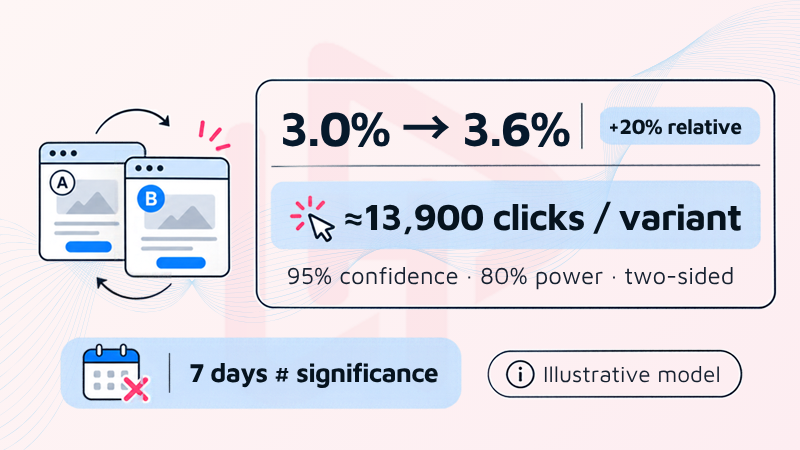
- Approximately 13,900 clicks per variant applies only to the illustrative 3.0% → 3.6% purchase CVR scenario—not a universal Meta benchmark.
1. Why post-click performance needs its own test
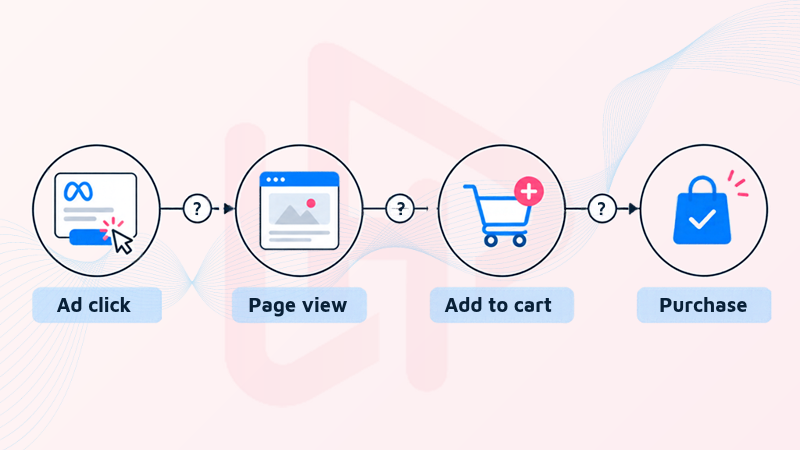
A campaign result is a chain of events: someone sees an ad, clicks, loads a page, evaluates an offer, and may eventually purchase. Treating that chain as a single CTR number hides several distinct failure points. Landing-page testing focuses on the destination while recognizing that traffic quality, pricing, and tracking can still affect performance.
1.1. CTR is not evidence that a landing page converts
CTR measures clicks relative to ad impressions; it does not establish whether a visitor read the page, reached checkout, or completed a purchase. Compare outbound clicks with landing page views first. A large discrepancy can suggest slow loading, accidental clicks, measurement issues, or user behavior that needs investigation rather than one proven cause.
Then inspect add-to-cart and purchase events. Strong add-to-cart with weak purchases can indicate checkout or pricing friction, but it may also reflect inconsistent event tracking. Use this diagnosis to choose a test hypothesis rather than treating any metric as a self-explanatory verdict.
1.2. Establish a usable creative baseline first
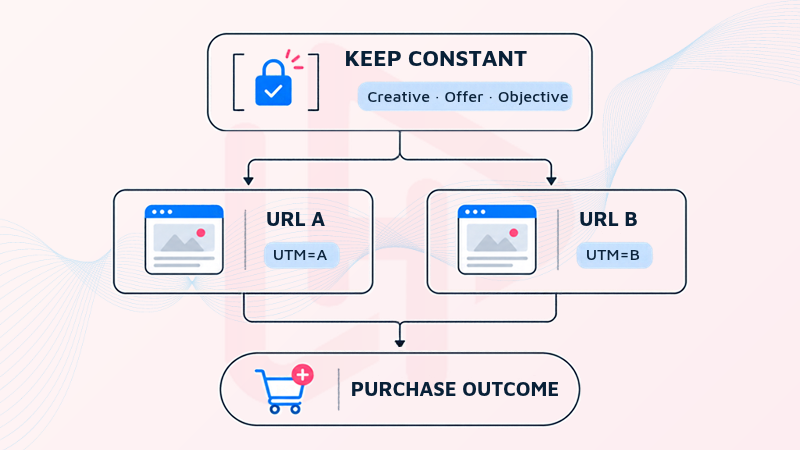
The Ad Library guide recommends validating the ad creative before experimenting with the destination URL. Record the working hook, copy, visual, CTA, objective, offer, and targeting conditions. Otherwise, a change in both creative and page makes it difficult to identify which one explains a performance difference.
A stable ad is a practical control, not a guarantee that all traffic will be equivalent. Document the creative version and relevant delivery context before comparing page variants. For broader campaign architecture issues, consult H2T Media Group’s Meta Ads campaign structure analysis.
2. Which landing pages should you compare?
Choose pages with meaningfully different roles in the buying journey, not several cosmetic variations with no clear behavioral hypothesis. The right comparison depends on whether a visitor is learning about the brand, weighing options, or already trying to buy a specific product.
2.1. Compare destinations by buyer intent
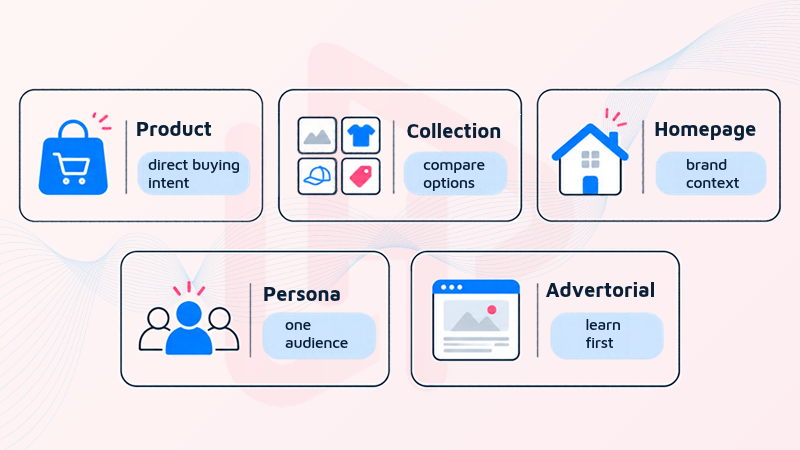
The source identifies homepage, collection, product, persona-specific, and advertorial pages as candidate destinations. None is a universal winner. Each should answer a distinct question that the audience brings from the ad.
| Page variant | Likely visitor need | Test hypothesis |
|---|---|---|
| Product page | Inspect one item and its offer | A direct buying path reduces unnecessary steps. |
| Collection page | Compare several products | Broader choice helps exploratory shoppers. |
| Homepage | Understand the brand and credibility | Brand context helps unfamiliar visitors. |
| Persona page | Resolve role-specific objections | Specific proof improves relevance for a segment. |
| Advertorial | Learn before committing | Education addresses unanswered concerns. |
For example, a cold audience responding to an educational ad may need a different destination from a returning visitor clicking a product-specific offer. Segment only where the audience definition and traffic volume support a fair comparison.
2.2. Treat message match as a testable variable
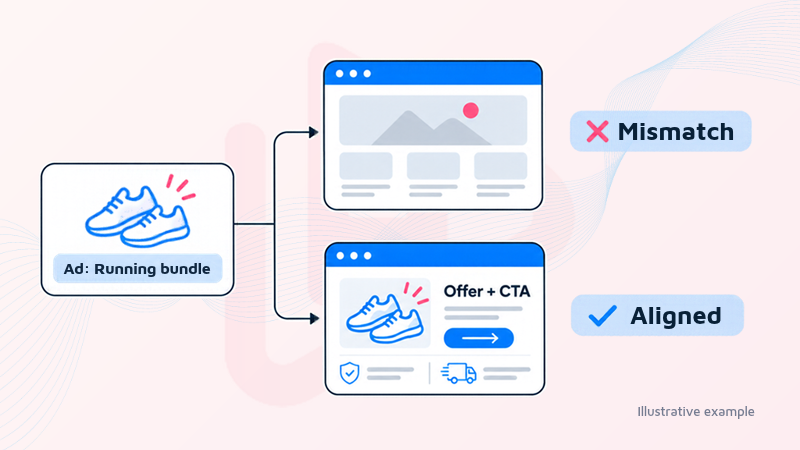
Message match is the continuity from ad hook to landing-page headline, supporting proof, offer, and CTA. If an ad promises a running bundle but the destination opens with a generic welcome, the page forces the visitor to rediscover the offer. A clearer hypothesis is: a bundle-focused page will reduce uncertainty compared with a generic entry page.
Keep examples labeled as illustrations. A headline that repeats the ad promise is not guaranteed to improve conversion rate, and the source does not establish a universal uplift. Before publishing, verify that claims, prices, availability, and visual proof remain accurate on both pages.
3. How to design a credible landing-page experiment
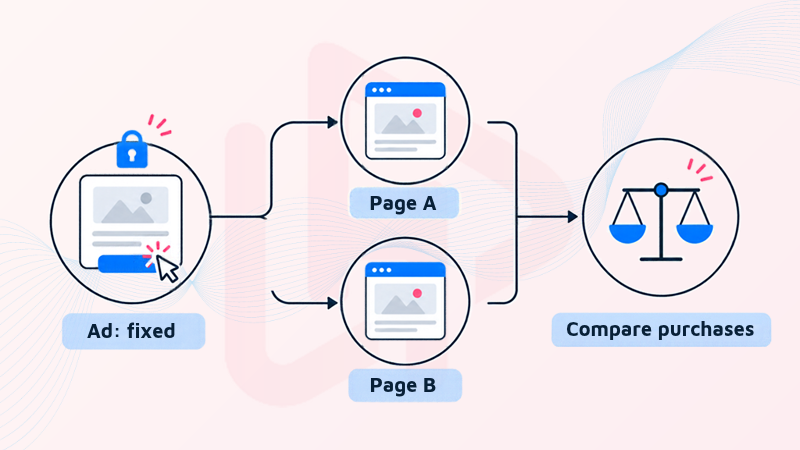
The original article describes a practical manual structure: duplicate one validated ad across URL-specific ad sets, align budgets and campaign settings, tag the variants, and compare outcomes. That setup is useful operationally, but equal settings are not the same as random assignment. Design choice determines how confidently a team can interpret the difference.
3.1. Hold the ad and measurement definitions constant
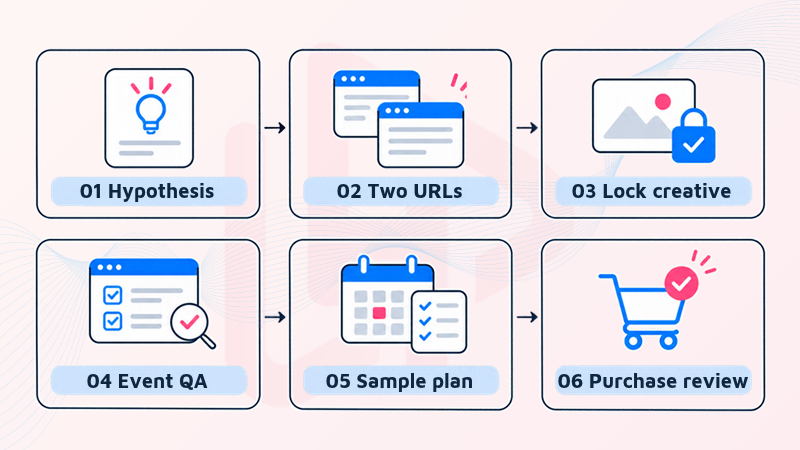
Write one falsifiable hypothesis and select two genuinely different URLs. Keep the ad visual, copy, CTA, offer, optimization objective, audience definition, placements, attribution setting, and test window aligned where possible. Record any exception in a test log so later readers know what else changed.
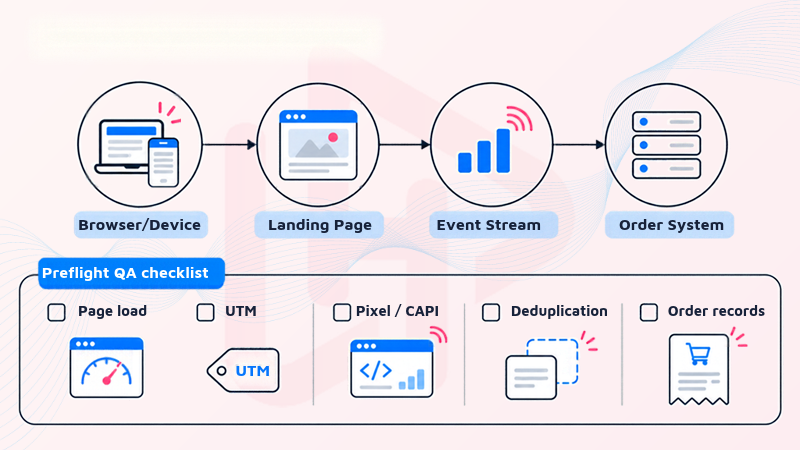
- Assign a distinct UTM value to each page variant and preserve attribution definitions.
- Check that each URL loads on the target devices, markets, and browsers.
- Set the primary success measure before launch: typically purchase count or cost per purchase for ecommerce.
- Avoid editing headlines, prices, or checkout flows mid-test unless an error requires intervention.
3.2. Separate manual comparisons from randomized A/B tests
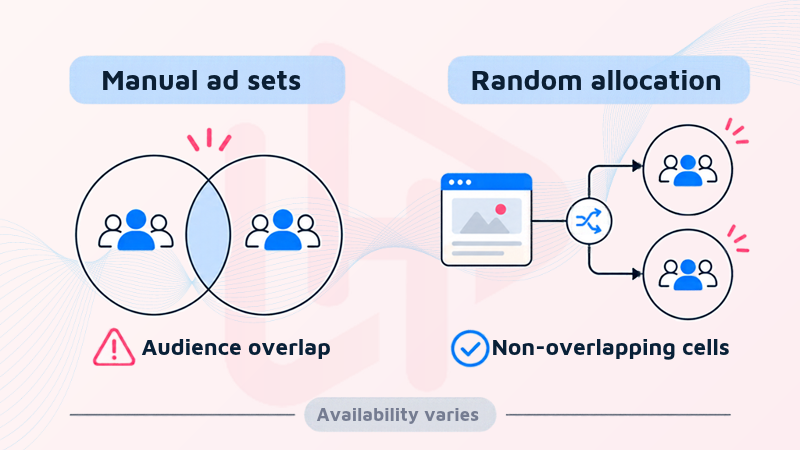
Two ad sets with identical budgets can still reach overlapping users or receive different auction opportunities. They may produce useful directional observations, but the resulting gap is not automatically causal. When supported by the account and technical setup, use a mutually exclusive randomized experiment at the ad-delivery layer or an appropriately engineered on-site split.
| Method | What it supports | Key limitation |
|---|---|---|
| Separate manual ad sets | Quick comparison of URL-specific ad delivery | Audience overlap and delivery bias remain possible. |
| Randomized platform experiment | Stronger isolation between assigned test cells | Eligible variables and setup must be confirmed in-product. |
| On-site random page assignment | One incoming campaign can feed two page experiences | Requires implementation and analytics QA. |
A controlled A/B test is more than two ads side by side. Meta Experiments guidance emphasizes minimizing overlap and changing one variable. However, this does not prove that every account can run a native URL-only test; verify the available configuration before claiming that capability.
Read more:
Jon Loomer — How to create an A/B test in Meta Experiments
3.3. QA page delivery and conversion events
Run a preflight test before allocating paid traffic. Confirm each destination loads, preserves the expected offer, and sends the same conversion event definitions. Check Pixel events and any server-side Conversions API integration, including deduplication where both sources are used. Do not interpret missing purchase events as real zero sales without an independent order-system check.
The related H2T Media Group Meta Verified conversion-rate testing analysis illustrates why visible trust cues and actual conversion evidence should not be conflated. A page can look credible while its pricing, shipping, or checkout experience remains the bottleneck.
4. How to read results without declaring a false winner
The purpose of a page test is not to collect attractive CTR screenshots. It is to select a destination that better serves the defined business outcome under a documented set of conditions. That requires both funnel-level diagnostics and a realistic view of statistical uncertainty.
4.1. Trace the journey from landing page view to purchase
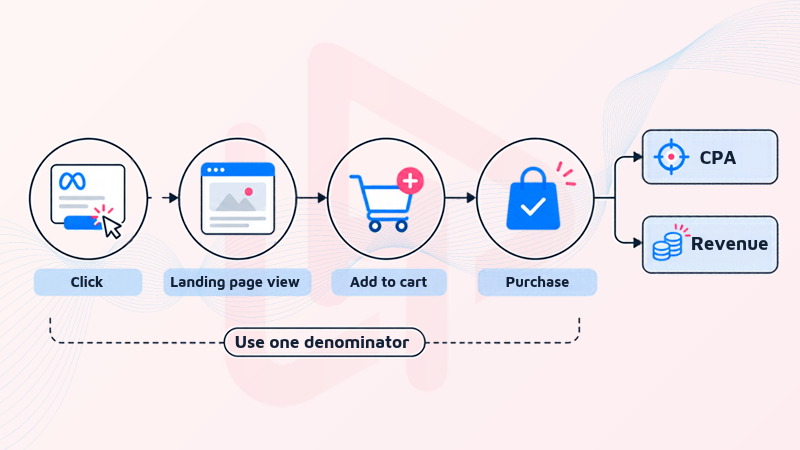
Compare click and landing-page-view counts, add-to-cart rates, purchase rates, cost per purchase, purchase volume, and revenue when available. If add-to-cart improves but purchases do not, inspect shipping costs, product availability, checkout steps, and event integrity before making a page-level win claim.
Always specify the denominator. Purchase conversion rate per landing page view differs from purchase conversion rate per click, especially if pages load at different speeds. Report the denominator consistently across variants and disclose differences in traffic composition.
4.2. Plan sample size and duration before launch
The AdLibrary article offers a planning example: with a 3.0% baseline purchase conversion rate, detecting a rise to 3.6% (+20% relative) requires approximately 13,900 clicks per page under conventional two-sided 95% confidence and 80% statistical power assumptions. This is an estimated sample requirement, not observed Meta campaign performance or a fixed threshold for every account.
The article also suggests allowing at least seven full days. A calendar duration can help include weekday patterns, but seven days alone does not ensure statistical significance. Lower conversion rates, smaller effects, multiple comparisons, uneven allocation, or correlated observations can raise the needed sample. Small tests can reveal promising directions without identifying a definitive winner.
5. A practical launch and decision checklist
For teams working under budget constraints, prioritize one high-value question instead of splitting spend across many near-identical pages. Use a written test card that can be reviewed by media buying, analytics, and web teams.
- Define the page problem and the purchase outcome you are trying to change.
- Select two destination URLs that differ in an intentional, documented way.
- Freeze the validated creative and choose an assignment method whose limitations are understood.
- Validate mobile speed, URL parameters, consent behavior, Pixel/CAPI events, and purchase records.
- Set the minimum useful effect, sample plan, primary metric, and stopping criteria in advance.
- Review purchase economics, capture caveats, and roll out a promising page gradually while continuing to monitor results.
If none of the destinations change qualified purchases, revisit the hypothesis. The constraint could be the offer, product-market fit, audience quality, price, or checkout rather than page design alone.
6. Frequently asked questions
Keep the ad and measurement stable, compare meaningful URLs, and preferably randomize assignment without overlapping test cells. If you use manual ad sets, report the comparison as directional unless the design supports stronger conclusions.
Neither is universally better. A product page may suit specific purchase intent; a homepage may help visitors who need brand context. Frame the choice as a hypothesis and test it using purchase outcomes.
The number depends on baseline conversion rate, detectable effect, power, test design, and allocation. The cited 13,900 clicks per page applies only to the illustrative 3.0% to 3.6% scenario.
They can help diagnose funnel friction and may be useful leading indicators when purchases are sparse, but they do not prove better purchase economics. Use order-system evidence when available.
Not necessarily. Seven days is a scheduling heuristic from the source. A decision also depends on sample sufficiency, tracking quality, effect size, and the predefined stopping rule.
Conclusion
Meta Ads landing page testing works best when the creative promise, destination hypothesis, traffic assignment, and purchase measurement are defined separately. Use a stable ad to ask a clear question about the page, distinguish exploratory comparisons from controlled experiments, and make decisions on downstream economics rather than CTR alone.
For more implementation frameworks, explore the Meta analysis in Insights hub and connect with H2T Media Group on Facebook or follow H2T Media Group on LinkedIn. H2T Media Group recommends auditing the post-click journey before making the next major creative or budget change.

bichthao
H2T Media Group decodes every meaningful platform update for advertisers and affiliate partners across APAC, EU and North America — always with a practical "H2T take" you can act on.
More about H2T →