


Meta Verified conversion rate is not a proven growth metric: a verified badge signals that Meta has authenticated an account, but the reviewed sources do not establish a badge-specific increase in conversions or return on ad spend (ROAS). For advertisers, the practical question is whether the badge is visible, changes customer confidence, and produces measurable business value. This H2T Media Group analysis separates official product facts from hypotheses and explains how to evaluate the effect responsibly.
 Key Takeaways
Meta Verified authenticates an eligible account; it does not establish a conversion-rate or ROAS lift.
Essential facts about Meta Verified and conversions
- Meta One Essential starts at US$14.99/month for eligible creator/business bundles; terms and availability vary.
- The badge is an account-identity cue, not a product endorsement or an established advertising-auction boost.
- adlibrary.com did not identify published controlled evidence of a badge-specific conversion lift in its September 2026 review.
- Cold-audience trust effects remain hypotheses; a raw before/after change cannot establish causation.
- Qualified CVR, CPA and ROAS – where relevant – matter more than CTR alone.
1. What the Meta Verified badge actually confirms
Verification has a defined role within Meta’s identity and subscription products. Before assigning it a performance budget, marketers should separate the authenticity check from the wider subscription features and from claims about advertising outcomes. The distinction matters because a business can value account protection and identity assurance even when incremental sales remain unknown.
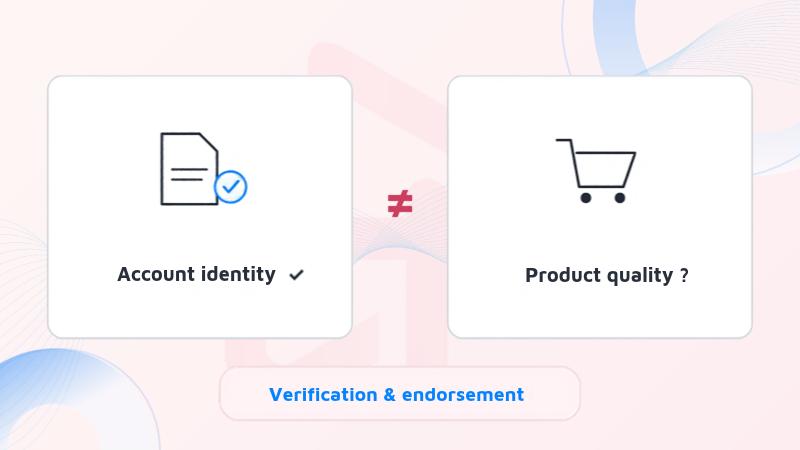
1.1. Account authenticity is not a product endorsement
Meta describes business verification as validation of the account or business, supported by an identity badge and impersonation safeguards. This helps answer one specific question: is this account representing the business it claims to be? It does not certify pricing, delivery reliability, product quality, customer service, or the likelihood that a visitor will purchase.
A visible badge can be a useful identity cue. Yet the validity of a company profile and the persuasiveness of its offer are different components of the customer journey. A trustworthy-looking identity cannot replace verifiable testimonials, clear policies, informative creative, or an effective landing page. Nor is the badge an established shortcut to preferential delivery in Meta’s paid ad auction.
Read more:
Meta — Expanding Meta Verified to businesses
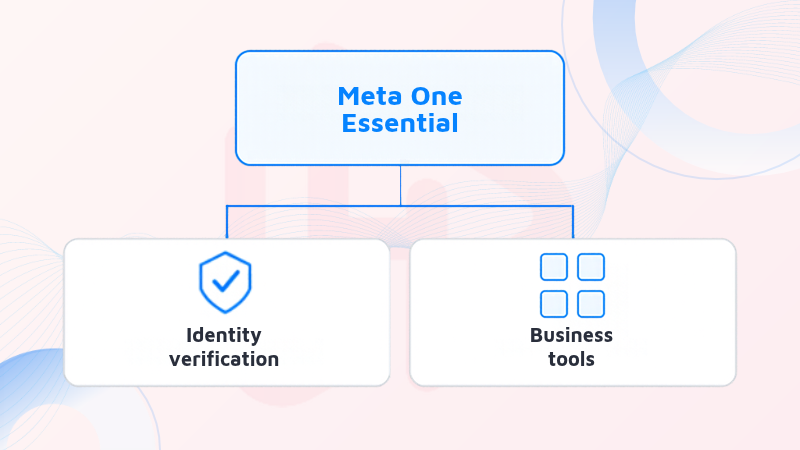
1.2. Meta One bundles verification with other tools
On September 15, 2026, Meta announced Meta One subscription bundles. Its Essential plan for eligible creators and businesses starts at US$14.99 per month and includes a verified badge after successful verification, alongside presence-management tools and access to Meta Business Agent features. The amount is a starting bundle price, not a universal fee for a standalone checkmark.
Meta states that plans, prices, benefits, and availability may differ by region, app, and account. Teams comparing tiers should therefore review their own eligibility screen and evaluate the full bundle: identity protection, operational features, and support needs should not be confused with an unproven conversion lift.
Read more:
Meta — Introducing Meta One
2. Where the badge could influence a buying decision
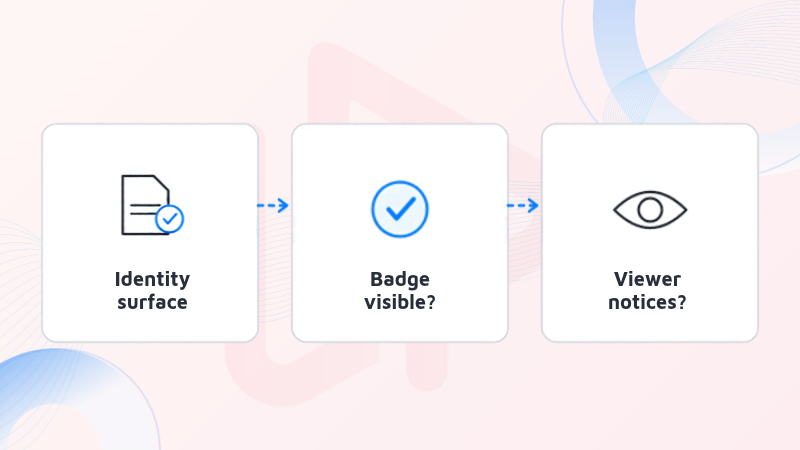
The argument for a conversion benefit is a plausible trust mechanism rather than an observed result. A buyer must first encounter the identity cue, notice it, and consider it meaningful before it could influence behavior. Those steps are not guaranteed across interfaces or audiences, so any business hypothesis has to start with actual exposure.
2.1. Visibility is a prerequisite, not an assumption
The badge belongs to account identity, not to the pixels of an uploaded image or video. Source analysis suggests users may see it near an advertiser name on relevant surfaces, but visibility varies by placement and presentation. Marketers should inspect their own live ad and profile experiences on relevant devices rather than assume the symbol appears in every format.
Build a short placement inventory: where does the business name appear, is the badge visible, and could a normal user notice it before deciding to click or investigate? A hypothesis about conversion is weak if the target audience cannot reliably encounter the proposed trust cue.
2.2. Brand familiarity changes the hypothesis
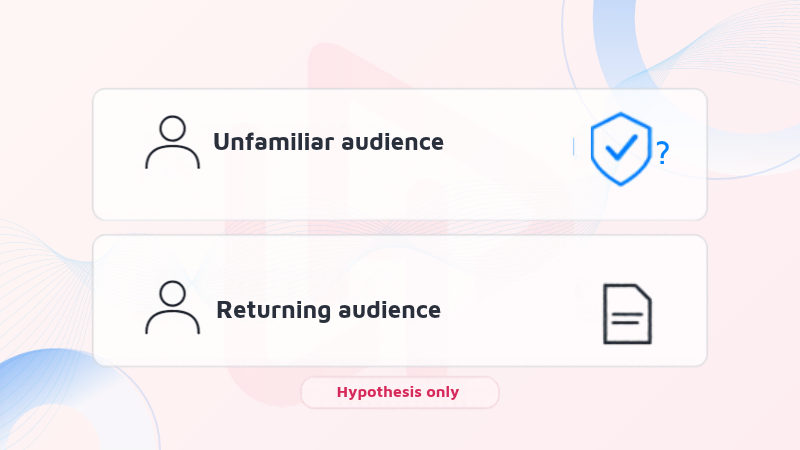
For an unfamiliar business reaching a cold audience, the central obstacle may be perceived legitimacy. A verification mark might reduce that uncertainty. A repeat customer, by contrast, may already trust the merchant through past purchases, customer support, and word of mouth. The same badge could add little new information in that context.
These are sensible expectations to test, not proven segment rankings. In addition, warm and cold audiences differ in purchase intent, prior exposure, and targeting conditions. Comparing their conversion rates does not isolate the effect of verification. Customer reviews, first-party proof, and transparent policies remain independent trust-building levers that can be assessed separately.
3. What the published evidence does (and does not) show
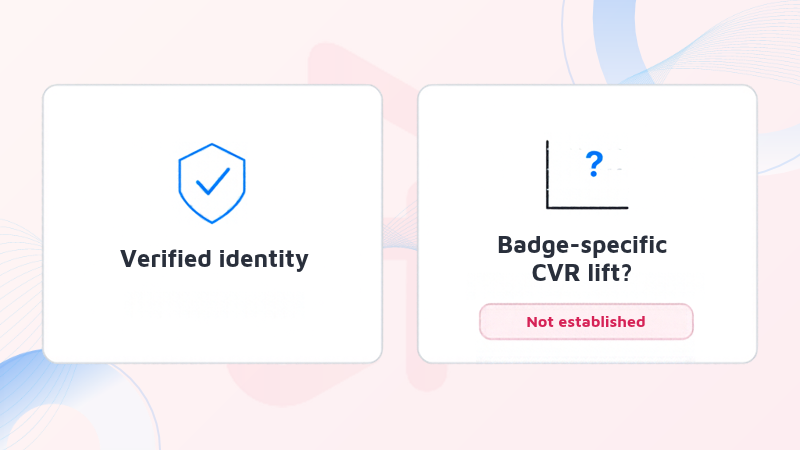
In its September 20, 2026 review, adlibrary.com reported that it could not identify credible published controlled evidence attributing an advertising conversion-rate lift specifically to Meta Verified. That assessment supports a careful statement: a badge-specific lift has not been established by the evidence reviewed. It does not demonstrate that the true effect is zero, negative, or positive for every account.
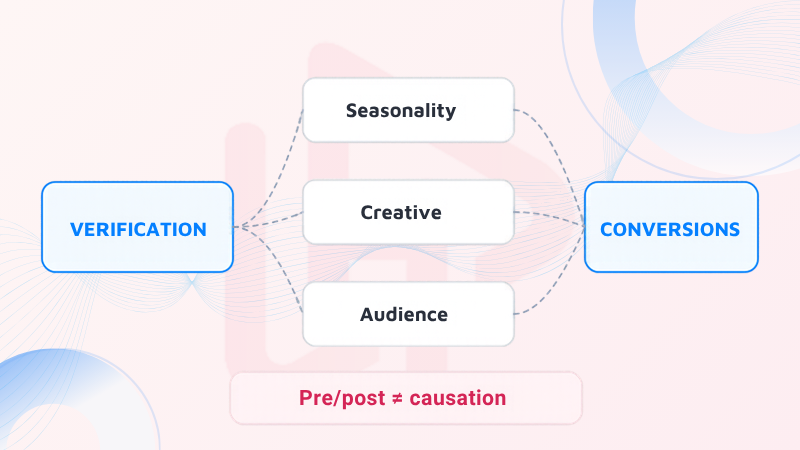
There is adjacent research on verification marks, perceived trust, and social-media behavior. But a study of influencer credibility or sharing intentions is not a controlled business-ad experiment measuring purchases or qualified leads. Similarly, a case study showing stronger results after a business subscribed cannot establish causation if creative, seasonal demand, offers, budgets, or tracking also changed.
The appropriate editorial boundary is clear. Do not quote an unsupported percentage, promise increased ROAS, or suggest that verification improves paid auction priority. Ask instead whether an incremental effect exists for a defined population, on a visible surface and with a defensible comparison.
Read more:
adlibrary.com — Does the Meta Verified badge move conversion?
Related academic study — Verified badges, trust and social behavior
4. How to test conversion impact without inventing a lift
A useful audit starts before the account subscribes and ends with measured business outcomes – not just clicks. Because verification is an account-level condition, a textbook user-level experiment may not be feasible. H2T Media Group therefore recommends a staged evaluation that records exposure, defines a baseline, and makes the limitations of each comparison explicit.
4.1. Audit exposure and record a reliable baseline
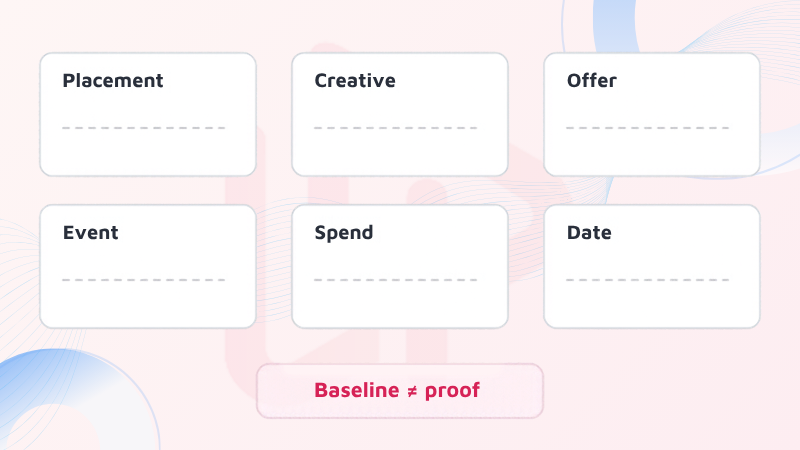
First, document eligibility, relevant placements, and badge visibility. Record the dates of any verification change, the offer, destination, creative, spend, audience composition, and attribution setup. Where feasible, separate audiences by prior brand familiarity without assuming that those segments are perfectly comparable.
Keep measurement events consistent and verify that qualified leads or purchases are captured reliably. This is an opportunity to revisit the existing Meta Ads campaign structure and tracking setup; changing the event definition during the review would invalidate an apparent before/after difference. Baselines describe the setting. They do not prove why later results moved.
4.2. Choose a comparison that can support the claim
A raw before/after report is particularly vulnerable to seasonal changes, auction conditions, and simultaneous creative updates. Two different brands – one verified, one unverified – also have different reputation, pricing, and audience histories. Neither comparison automatically identifies a badge effect.
Where operationally possible, use comparable account groups, stable intervention timing, matched characteristics, or a credible holdout design. Predefine the hypothesis, inclusion criteria, observation period, and minimum useful effect. If the account-level nature of verification makes a clean control impossible, present the work as a directional observational audit, not an incrementality experiment. Report confounders rather than masking them behind a precise-looking uplift figure.
4.3. Prioritize qualified outcomes over surface metrics
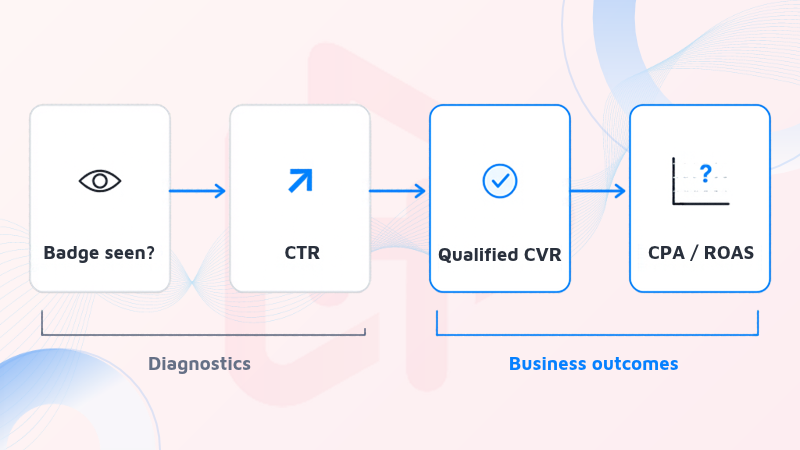
Click-through rate can help diagnose attention, but it cannot establish commercial value by itself. Teams should specify which conversion event is meaningful, what quality threshold applies, and whether revenue can be measured consistently. Decide how results will be interpreted before seeing the outcome, and report uncertainty when the sample is too small.
| Measure | Decision question | Interpretation limit |
|---|---|---|
| Badge exposure | Was verification actually visible? | Visibility is not persuasion. |
| Qualified CVR | Did eligible visits become valuable actions? | Requires consistent event definitions. |
| Qualified CPA | What did each useful outcome cost? | Changes may reflect spend and auction mix. |
| ROAS, where relevant | Did attributed revenue justify spend? | Attribution is not proof of incrementality. |
5. When should verification receive budget?
The decision should reflect more than a proposed uplift. Account protection, brand impersonation risk, customer communication, and the actual value of bundled tools may justify a subscription independently of advertising conversion rates. Assess those operational benefits on their own terms, not as a badge effect credited to an unmeasured uplift.
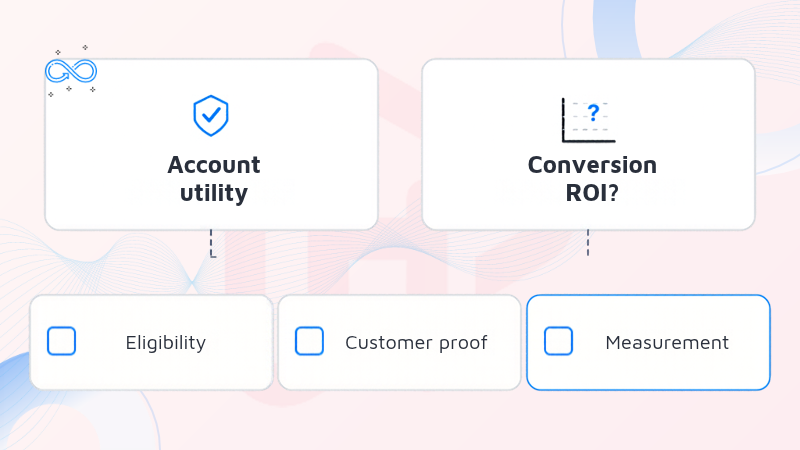
For acquisition teams with limited resources, compare verification against higher-priority work such as clearer offers, better landing-page evidence, authentic customer proof, and accurate conversion measurement. The right comparison isn’t whether a subscription seems inexpensive; it is which intervention delivers useful, testable value in the current funnel.
A separate H2T Media Group analysis of Meta One Max subscription economics addresses the cost of a larger operational bundle. That is a different ownership topic from whether the verification badge itself improves conversion rate. Keep the two ROI questions separate.
6. Frequently asked questions
No reviewed controlled evidence establishes a specific conversion lift caused by the badge. A trust mechanism is plausible, but its impact on an individual advertiser remains unmeasured without a credible comparison.
The cited announcements do not establish a paid-auction priority benefit from the badge. Identity and certain discovery features should not be treated as proof of preferential ad delivery.
Meta One Essential starts at US$14.99 per month for eligible creator/business bundles under Meta’s September 2026 announcement. Regional, app, account, and plan differences apply; the price is not necessarily a standalone badge charge.
Do not assume so. Badge visibility depends on the identity surface and actual placement rendering. Check the formats your audience sees before attributing any response to verification.
Verification occurs at account level, making clean user-level randomization difficult. A matched or holdout design may help when comparability is defensible; otherwise report an observational analysis with its limitations.
Conclusion
The Meta Verified conversion rate question remains an evidence problem, not a badge-design problem. Treat authenticity as one potential trust cue, confirm whether customers encounter it and demand qualified conversion evidence before claiming incremental revenue. H2T Media Group recommends prioritizing clear offers, customer proof, and reliable measurement alongside any verification decision. Explore the Insights hub for more Meta performance analysis, and connect with H2T Media Group on Facebook or H2T Media Group on LinkedIn for ongoing discussions.

bichthao
H2T Media Group decodes every meaningful platform update for advertisers and affiliate partners across APAC, EU and North America — always with a practical "H2T take" you can act on.
More about H2T →