

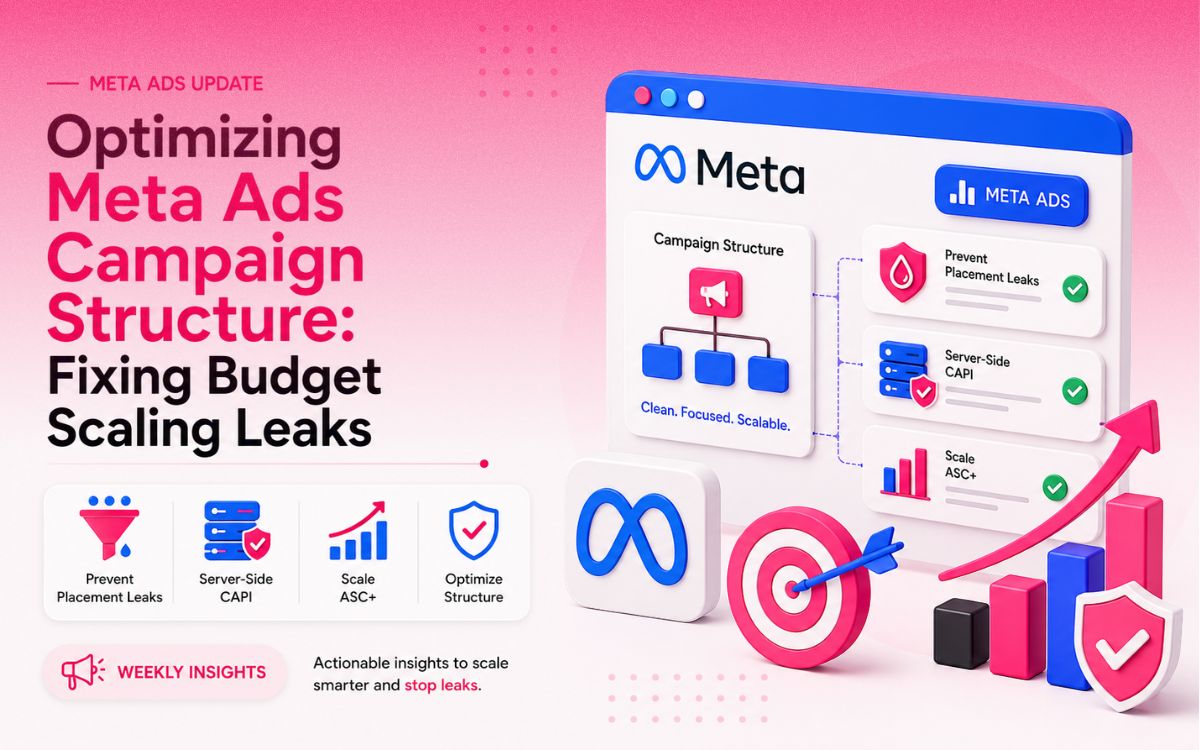
A high-performing Meta Ads campaign structure in 2026 requires strict placement guardrails, vision-AI creative alignment, and robust server-side CAPI integration to prevent algorithmic budget leaks. For scaling e-commerce brands facing severe margin compression, relying solely on unconstrained Advantage+ defaults quietly siphons capital into low-intent inventory while starving your primary conversion feeds. To protect profit margins and maintain stabilized ROAS, media buyers must implement a controlled digital allocation model. Explore the full technical analysis and operational framework from H2T Media Group below.
 Key Takeaways
Building a high-performing Meta Ads campaign structure in 2026 requires strict placement guardrails, creative-led targeting, and server-side CAPI integration to eliminate algorithmic budget leaks.
Essential Technical Insights
- Placement Cannibalization: Unrestricted Advantage+ Placements silently siphon up to 42% of scaling budgets into low-intent inventory like Audience Network and junk search placements.
- Creative as Targeting: Meta’s Vision AI parses audio, OCR, and frame metadata, making hyper-specific creative assets the primary filter to segment high-AOV buyers in broad targeting pools.
- Server-Side CAPI Standard: Relying solely on browser pixels suppresses conversion data; implementing CAPI with an Event Match Quality (EMQ) score of 8.5/10+ is mandatory to eliminate attribution blind spots.
- 3-Tier Scaling Framework: Systematically structure ad accounts with Data Sanitization (Tier 1), Dynamic Creative Sandboxing via 3:2:1 testing (Tier 2), and ASC+ scaling with a 5-10% existing customer budget cap (Tier 3).
1. The Allocation Trap: When “Auto-Placements” Becomes a Financial Vulnerability
The most pervasive operational error committed by Media Buyers resides in the unchecked exploitation of the Advantage+ Placements functionality devoid of strict technical guardrails.
1.1. The Phenomenon of Placement Cannibalization
When an operations manager configures a Meta Ads campaign structure utilizing unrestricted Advantage+ Placements, they unconditionally surrender capital allocation authority to the bidding algorithm. The foundational directive of this machine learning system is to exit the “Learning Phase” and fulfill daily budget delivery quotas while maintaining the absolute lowest Cost-Per-Mille (CPM) possible.
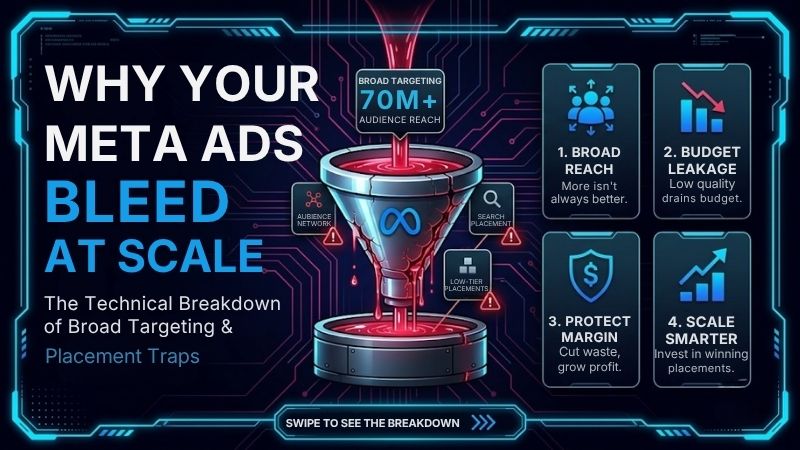
The systemic consequence is structural budget leakage. The algorithm autonomously siphons liquidity toward low-cost, low-intent display environments – predominantly the Audience Network, the Messenger Inbox, and obscure Search placements.
Across numerous technical audits, H2T has documented scenarios where up to 42% of scaling budgets were dumped into these low-tier environments. Bot traffic and “fat-finger” (accidental) clicks originating from this junk inventory generate astronomical Landing Page Bounce Rates, frequently exceeding 89.4%. Concurrently, high-intent, premium conversion real estate such as the Facebook Feed and Instagram Reels are literally starved of the necessary liquidity to function.
| Placement Tier | Channels / Environments | Traffic Behavior | Conversion & ROAS Impact |
|---|---|---|---|
| Low-Intent Inventory (Junk) | Audience Network, Messenger Inbox, Search Placements | High bot traffic, “fat-finger” clicks, Bounce Rate > 89.4% | Siphons up to 42% of budget with near-zero conversions |
| High-Intent Inventory (Premium) | Facebook Feed, Instagram Reels, Main Feeds | Active discovery, high engagement, qualified intent | Starved of budget if Advantage+ runs without guardrails |
1.2. Operational Solution: Implementing Placement Guardrails
To architect a commercially viable Meta Ads campaign structure, implementing manual placement guardrails is an absolute prerequisite for campaigns operating under ABO (Ad Set Budget Optimization) or CBO (Campaign Budget Optimization) frameworks.
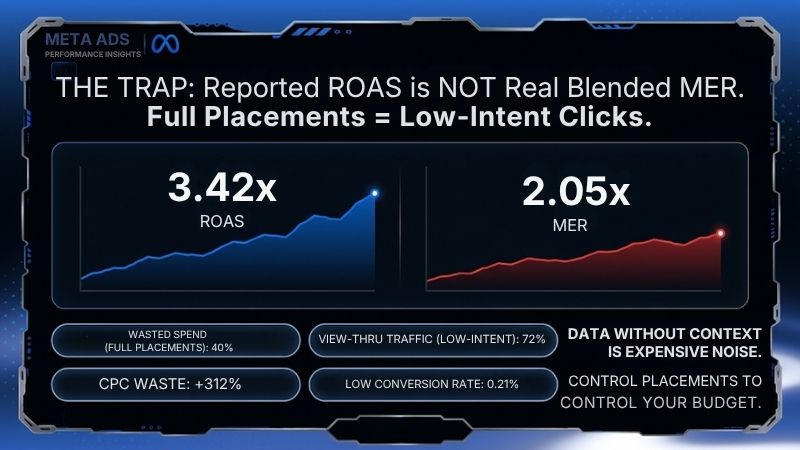
Media buying teams must enforce a rigorous weekly Breakdown by Placement data analysis protocol. If a specific placement inventory consumes greater than 10% of ad spend while yielding a Conversion Rate (CVR) inferior to 0.5%, it must be immediately blacklisted and excluded from the distribution pool to protect enterprise investment capital.
2. The New Paradigm: Content Functions as the Targeting Mechanism
Deploying Broad Targeting to audiences exceeding 60 to 70 million individuals is not inherently an erroneous strategy; the failure lies entirely in how an enterprise utilizes creative assets to navigate that vast demographic pool.
2.1. Algorithmic Self-Segmentation via Vision AI
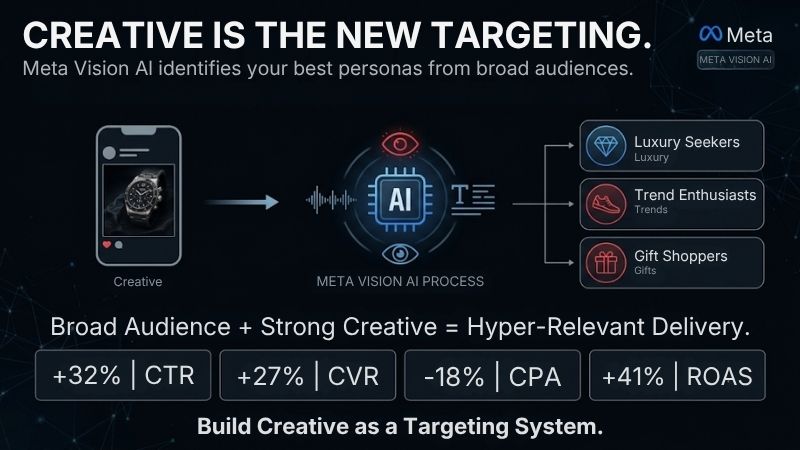
In the current digital era, Meta’s Graph API and sophisticated Vision AI models do not merely analyze click-through metrics. They autonomously parse comprehensive audio transcripts, execute Optical Character Recognition (OCR) on visual text, and evaluate frame-by-frame metadata.
Consequently, within a broad Meta Ads campaign structure, the actual targeting mechanism is no longer defined by traditional interest sliders, but by the specific Creative Angles deployed. If you push a generalized, generic advertising message into a 70 million user pool, the AI experiences “hallucination,” optimizing delivery toward user cohorts exhibiting the lowest resistance to cheap clicks. Conversely, if your visual asset is engineered with a hyper-specific message targeting high-Average-Order-Value (High-AOV) consumers, the algorithm utilizes the creative asset itself as an exclusionary filter to eliminate low-intent, unqualified viewers.
2.2. Engineering the Creative Sandbox Environment
A fundamental rule of media buying: Never inject untested creative assets directly into a primary Scaling Campaign. Agencies must establish an isolated Sandbox Environment. Deploy the 3:2:1 dynamic testing formula (3 Hooks, 2 Angles, 1 Format) to precisely identify which variable configuration yields the superior conversion rate. An asset is only deemed qualified for the primary scaling engine once it consistently generates a minimum of 50 statistically significant conversion events under controlled testing conditions.
3. The Signal Ecosystem: The Mandatory Implementation of Server-Side CAPI
A theoretically sound Meta Ads campaign structure collapses entirely without the integration of a flawless digital measurement infrastructure.
3.1. The Blindness of the Browser Pixel
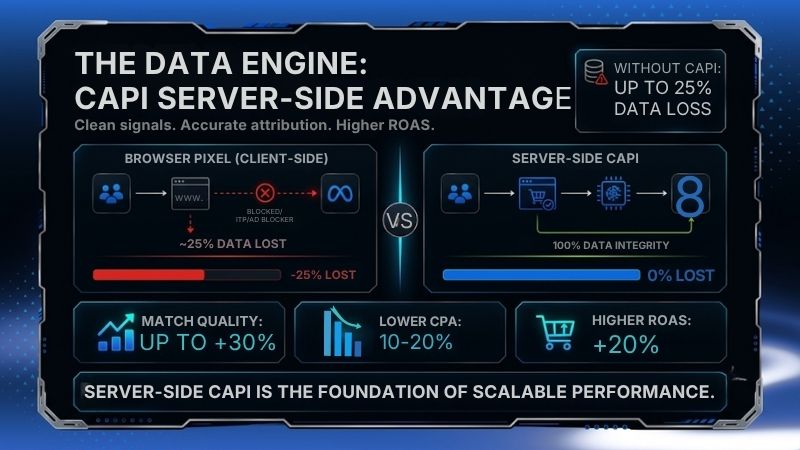
Relying exclusively on legacy Browser Pixel implementation constitutes financial suicide in an era defined by stringent data privacy protocols (iOS 14.5+ and beyond). Device-level signal blocking prevents Meta from accurately mapping the entire consumer purchasing journey, resulting in artificially suppressed conversion reporting. When the machine learning model is deprived of accurate “Winning Signals,” it is mathematically incapable of identifying and acquiring net-new customer profiles.
3.2. Server-Side CAPI Standards and the EMQ Metric
To neutralize data loss, enterprises must aggressively implement the Server-Side Conversions API (CAPI). This protocol transmits First-Party Data securely and directly from the enterprise server to Meta’s API endpoints.
However, merely activating CAPI is insufficient; the data payload must be pristine. Engineering teams must ensure the transmission of advanced data parameters: fbp (Browser ID), fbc (Click ID), IP Addresses, User-Agent strings, and cryptographically Hashed Emails.
The Operational Standard: Within an optimized Meta Ads campaign structure, the Event Match Quality (EMQ) score for the core ‘Purchase’ event must be maintained at a baseline of 8.5/10 or higher. Falling below this threshold generates severe attribution blind spots, subsequently triggering volatile and uncontrollable CPM inflation across the ad account.
4. The Enterprise Scaling Blueprint by H2T Media Group
Addressing these critical technical vulnerabilities, H2T Media Group proposes a comprehensive architectural Blueprint designed to construct and scale the Meta Ads campaign structure for global e-commerce operations.
Tier 1: Data Sanitization (The Signal Layer)
Fortify the entire data flow via rigorous Server-Side CAPI implementation. Configure advanced Deduplication protocols to ensure Meta accurately distinguishes between identical signals transmitted by both the browser and the server. Integrate Offline Conversion Tracking to feed Lifetime Value (LTV) signals back into the algorithm, training the system to acquire repeat purchasers rather than optimizing solely for low-value, single-transaction customers.
Tier 2: Dynamic Creative Sandboxing
Deploy isolated CBO campaigns specifically designed to sandbox and test vertical (9:16) and square (1:1) video formats. Utilize Dynamic Creative Optimization carefully to isolate and identify mathematically proven winning combinations of visual hooks and primary ad copy.
Tier 3: The Scaling Engine
Transition the fully validated assets (Proven Creatives) from Tier 2 directly into Advantage+ Shopping Campaigns (ASC+).
Core Operational Directive: ASC+ is an exceptionally powerful allocation engine, but it requires strict parameters. Always configure the ‘Existing Customer Budget Cap’ to a strict maximum limit of 5% – 10%. This forces the algorithm to allocate the remaining 90% of liquidity exclusively toward New Customer Acquisition, explicitly preventing the AI from artificially inflating surface-level CPA metrics through aggressive, cheap retargeting. Furthermore, run Manual CBO campaigns in parallel with ASC+ to maintain deterministic, manual control over premium Placement distribution for core budgets.
| Tier Level | Primary Objective | Technical Setup & Campaign Type | Core Operational Rule |
|---|---|---|---|
| Tier 1: Data Sanitization | Signal Fortification | Server-side CAPI + Browser Deduplication + Offline Tracking | Maintain EMQ score $\ge$ 8.5/10 for core Purchase events |
| Tier 2: Dynamic Creative Sandboxing | Asset Validation | Isolated CBO campaigns (3:2:1 Dynamic Creative Testing) | Graduate assets only after achieving $\ge$ 50 conversion events |
| Tier 3: The Scaling Engine | Aggressive Customer Acquisition | Advantage+ Shopping Campaigns (ASC+) + Manual CBO parallel | Cap Existing Customer Budget at strict 5% – 10% limit |
5. Frequently Asked Questions
Unrestricted Advantage+ Placements often siphon up to 42% of scaling budgets into low-intent inventory like Audience Network and Messenger Inbox, generating high bounce rates (>89.4%) and starving high-converting feeds.
Meta’s Vision AI analyzes audio transcripts, OCR text, and video frames, using your creative hooks and messaging as the primary filter to auto-segment high-intent, high-AOV buyers within broad audiences.
Browser pixels miss significant data due to privacy restrictions (like iOS 14.5+); implementing CAPI with an Event Match Quality (EMQ) score of $\ge 8.5/10$ eliminates attribution blind spots and stabilizes CPA.
Media buyers must cap the Existing Customer Budget at 5% – 10% within ASC+ to ensure 90%+ of spend goes toward incremental new customer acquisition rather than surface-level retargeting.
Engineering a highly profitable Meta Ads campaign structure in 2026 requires manual placement guardrails, Vision AI creative alignment, and robust Server-Side CAPI tracking to eliminate budget leaks and protect margins at scale. If your scaling performance is decaying, contact the media buying team at H2T Media Group for an account audit. Explore more technical frameworks in the Meta category within our Insights hub.

bichthao
H2T Media Group decodes every meaningful platform update for advertisers and affiliate partners across APAC, EU and North America — always with a practical "H2T take" you can act on.
More about H2T →