

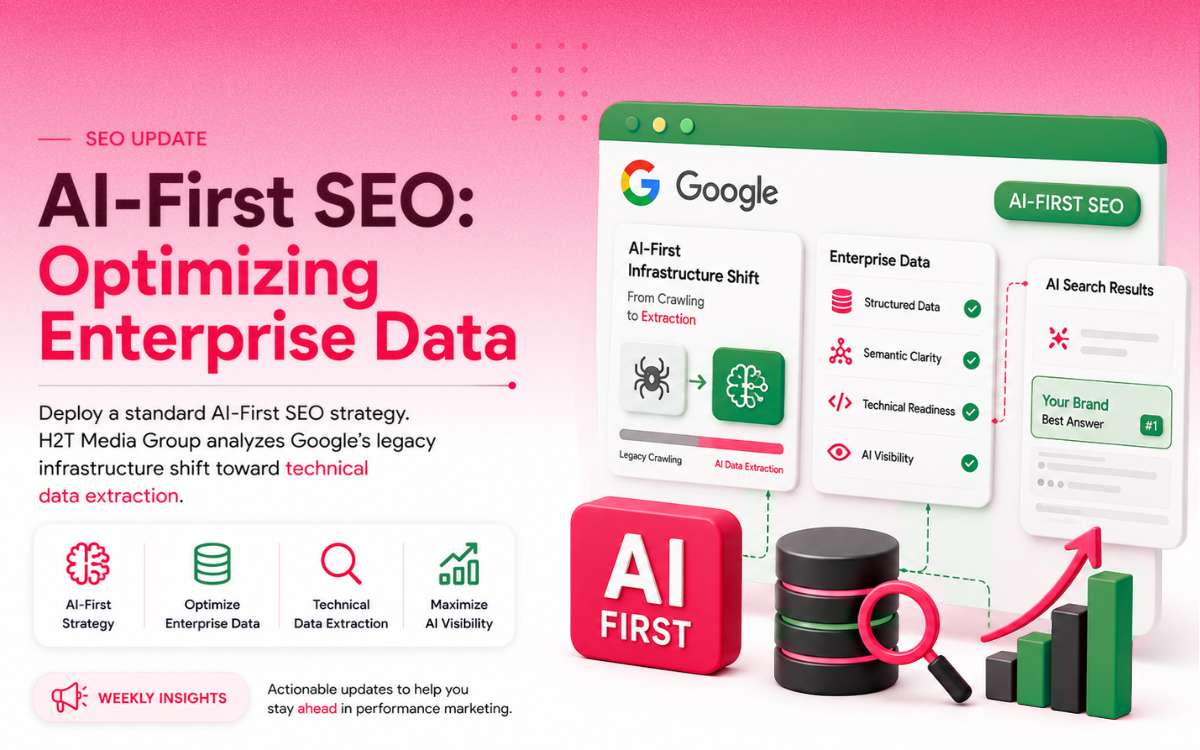
Welcome to the SEO performance insights hub by H2T Media Group. The deployment of AI-first SEO strategies is becoming a mandatory operational requirement as Google fundamentally rebuilds its search infrastructure around Large Language Models. The systematic departure of core engineering leadership marks the end of legacy keyword-matching and link-manipulation tactics.
If your Enterprise continues to rely on traditional, reactive algorithmic updates without optimizing technical data structures for LLM extraction, your site risks severe organic visibility drops. Below is H2T Media Group’s technical analysis, the breakdown of structural data parsing mechanisms, and the Technical Audit framework required to defend your organic traffic market share.
 Key Takeaways
AI-First SEO Ecosystem shift marks the end of legacy keyword matching and backlink reliance, requiring enterprises to transform their sites into structured databases for LLM extraction.
Essential Facts About This Update
- The End of Legacy Indexing: The departure of core engineers signals Google’s complete shift toward generative LLM-synthesized answers via AI Overviews.
- Futility of Algorithmic Prediction: Deep Learning algorithms dynamically adjust parameters daily, rendering traditional “update patching” obsolete.
- HTML Parsing Efficiency: LLMs bypass complex UI design to directly extract clean HTML, JSON-LD, and static
<table>structures. - Pivoting to Citations: Primary focus must shift to serving as high-fidelity citation sources in AI Overviews, driving higher-converting traffic.
- AI Readiness Audit: Compliance relies on three technical pillars: Expertise Verification (E-E-A-T), Nested Schema Architecture, and Above-the-Fold Commercial Intent Resolution.
1. Indicators of Restructuring: The Transition of Core Technology
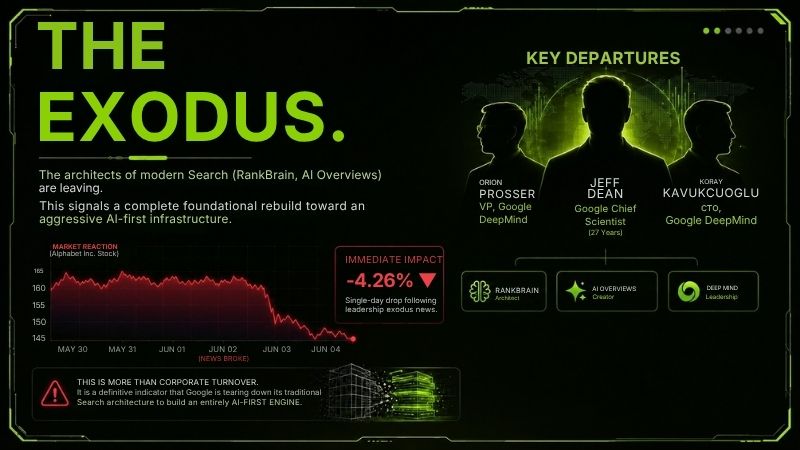
Over the past 15 years, Google’s ranking mechanisms have predominantly relied on external signals such as backlink volume, keyword density, and baseline on-page optimization protocols. These systems were architected and maintained by a generation of software engineers focused on Text Indexing.
The Conclusion of the Legacy Indexing Era
The departure of foundational platform engineers signals a definitive shift in capital investment toward internal Large Language Models (LLMs) like Gemini. The search engine is no longer merely executing keyword-matching between user queries and web documents. It is transitioning to a Generative model, wherein the system autonomously synthesizes information, establishes Entity Relationships, and delivers direct resolutions directly on the Search Engine Results Page (SERP) via AI Overviews.
The inevitable consequence: Black-hat SEO manipulation or procuring high volumes of backlinks to compensate for a website with poor coding structure will immediately cease to be effective.
2. Operational Errors: Predicting Algorithms Based on Legacy Signals
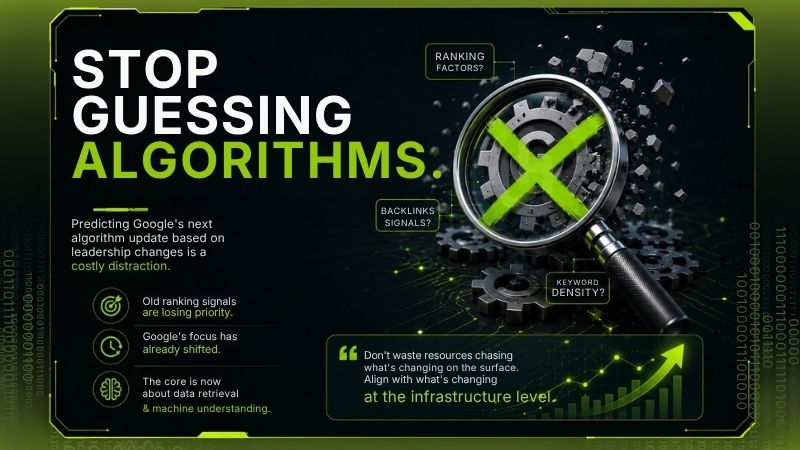
A prevalent strategic error among current In-house SEO teams is the continuous attempt to predict the volatility parameters of Core Updates and subsequently attempting to “patch” the website to restore rankings.
The Futility of Algorithmic Prediction
Modern Google algorithms are no longer composed of static scoring rules. With the integration of Deep Learning architecture, Google’s AI systems continuously and autonomously recalibrate their parameter weights based on the feedback from billions of daily queries. Even Google’s internal engineers cannot precisely quantify the exact percentage impact of a singular ranking factor. Therefore, evaluating performance based on traditional, isolated ranking signals constitutes a severe misallocation of operational resources.
3. The New Paradigm: Data Extraction Capability
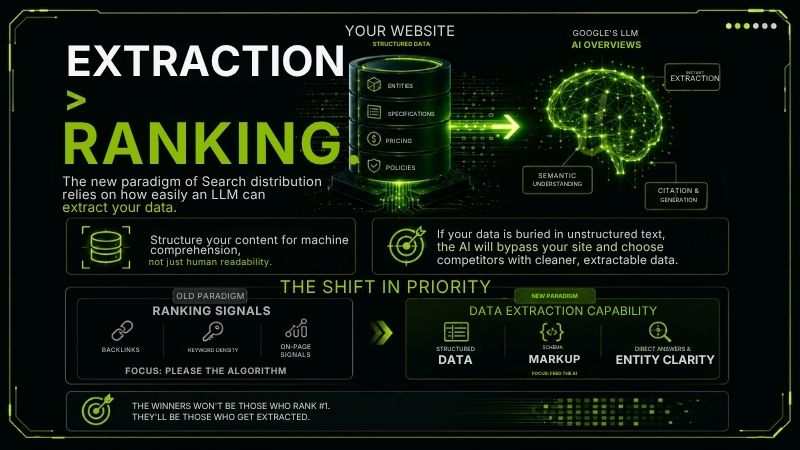
To remain viable within an AI-first ecosystem, Digital Managers must fundamentally alter their operational perspective: An enterprise website is not merely designed for human readability; it must be structured as a Database optimized for machine extraction.
3.1. The Parsing Mechanisms of Large Language Models (LLMs)
When a generative AI accesses a corporate domain, it does not experience the User Interface (UI) or graphic design (UX). It directly parses the HTML syntax and JSON datasets. If technical specifications for a product or the return policies for a service are buried beneath complex JavaScript rendering delays, or formatted as unstructured, monolithic text blocks, the LLM will automatically bypass that domain.
The algorithm will prioritize data extraction from a competitor’s website—even one with a significantly inferior visual design—provided it possesses clean code and a rigid data structure.
3.2. Pivoting from “Ranking Competition” to “Citation Competition”
Rather than concentrating resources on securing the Top 1 position via traditional blue links, the primary objective of Technical SEO is now to ensure the enterprise website provides high-fidelity input data. The goal is for the AI system to utilize the domain as a primary Citation source within its synthesized responses. The click-through traffic originating from these AI citations possesses a significantly higher Conversion Rate compared to generalized informational traffic.
4. The Technical Blueprint: The AI Readiness Audit
To ensure enterprise visibility does not degrade during this architectural transition, H2T Media Group mandates a systemic Audit focusing on three core operational pillars: Expertise Verification, Data Structuring, and Query Resolution.
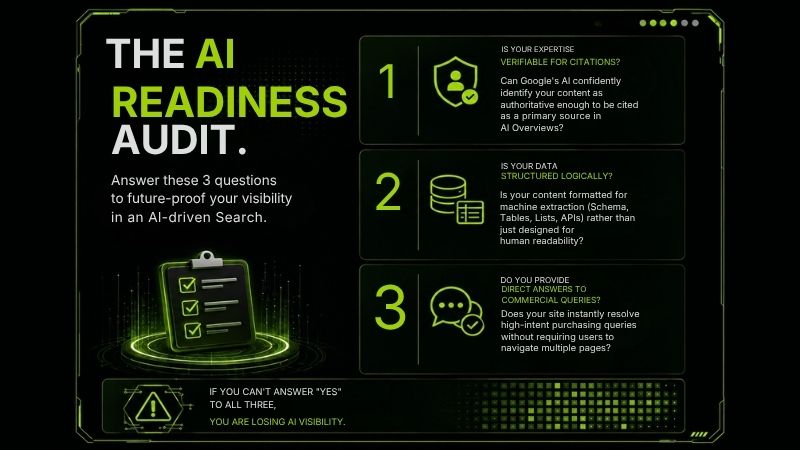
4.1. Expertise Verification
Google’s AI models are mathematically constrained to minimize Hallucination rates. Consequently, they are programmed to extract data exclusively from authoritative, verified sources.
Technical Implementation: Fully integrate comprehensive author bios, industry certifications, and entity-linked social profiles (e.g., corporate LinkedIn pages). Published content must be validated using Person or Organization Schema markup to establish Entity-level trust.
4.2. Deploying Nested Schema Architecture and Table Formatting
Implementing standard Schema markup is a baseline requirement, but it is operationally insufficient for dominance. To optimize extraction efficiency, developers must deploy nested data structures.
- Execution Example: Within a product category page, the Product Schema must be deeply nested with FAQPage Schema to proactively resolve technical inquiries. Furthermore, utilizing the SameAs attribute to link internal data points to open-source knowledge bases (such as Wikidata) enables the AI to precisely categorize the brand entity without expending inference resources.
- HTML Formatting: Strictly mandate the use of traditional <table> tags for all quantitative data (Pricing, dimensions, technical configurations) rather than relying on CSS-formatted <div> blocks. AI models extract static data tables with maximum computational efficiency.
| Tier | Technical Optimization | Target Extraction Mechanism | Primary ROI Outcome |
|---|---|---|---|
| Traditional Structure | Monolithic text blocks, CSS-styled <div> layout, basic keyword density | Legacy text indexing & Keyword-matching algorithms | Top 10 organic blue-link positions |
| AI-First Structure | Static <table> tags, nested JSON-LD Schema (Product + FAQPage), sameAs Wikidata linking | LLM direct parsing, Generative AI Overviews | Direct entity citation & higher conversion rates |
4.3. Direct Resolution of Commercial Intent
Search behavior is evolving; users demand terminal-level answers without the friction of navigating through multiple Landing Pages.
Information Flow Design: Enterprise landing pages must deliver direct, concise resolutions to commercial inquiries (What is the exact price? Is it in stock? What is the fulfillment timeline?). This data must be positioned Above the Fold as plain text, explicitly avoiding obfuscation within click-to-expand interactive elements.
5. Frequently Asked Questions
AI-First SEO prioritizes structuring website data for direct extraction by Large Language Models (LLMs) and AI Overviews, shifting the focus from traditional keyword density and backlink accumulation toward data clarity, clean HTML, and structured entity relationships.
Google’s search architecture now relies heavily on generative AI models that synthesize answers dynamically using authoritative source data, making legacy keyword manipulation and high-volume backlink building ineffective for securing search visibility.
Engineering teams must implement nested Schema markup (such as Product and FAQPage), utilize static <table> elements for quantitative data, and present essential commercial answers directly above the fold without complex JavaScript rendering blocks.
Ranking competition aims for traditional top blue-link positions, whereas citation competition focuses on earning direct citations inside AI-generated SERP summaries, which attracts higher-converting traffic directly to your enterprise domain.
The personnel restructuring at Google’s core engineering division marks the definitive termination of legacy search tactics, making the transition to an AI-first SEO framework mandatory for enterprise survival. Defending organic market share in 2026 demands an unbreakable integration between content strategy and database architecture. To stay ahead of continuous platform shifts, explore more technical analysis and strategic frameworks in the SEO category under the Insights page on the official website of H2T Media Group.

bichthao
H2T Media Group decodes every meaningful platform update for advertisers and affiliate partners across APAC, EU and North America — always with a practical "H2T take" you can act on.
More about H2T →