

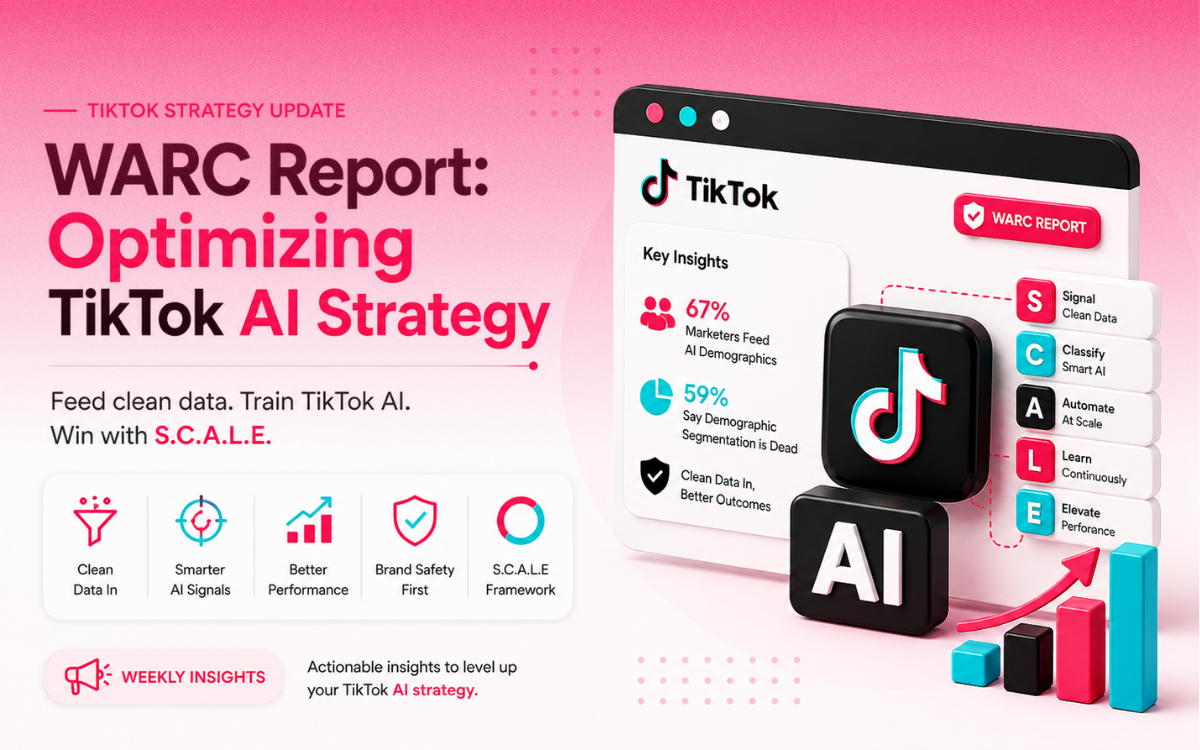
Welcome to the TikTok performance insights hub by H2T Media Group. Analyzing the WARC Report on Community Intelligence reveals the essential operational strategy to eliminate generic AI output and optimize campaign performance. Traditional demographic targeting (age, gender, location) has failed on TikTok’s Content Graph, forcing agencies to transition toward behavioral signals (search, comments, engagement) to train Large Language Models (LLMs).
If your team relies on obsolete targeting parameters to prompt AI scriptwriting, your ad pipeline faces high costs and low engagement. Below is H2T Media Group’s technical breakdown of the S.C.A.L.E framework, behavioral prompting SOPs, and actionable KPIs required to scale your ROI – read on to discover how to transform your creative production workflow!
 Key Takeaways
TikTok Content Graph Algorithm renders demographic targeting obsolete, making Community Intelligence essential to eliminate generic AI ad output and scale campaign performance.
Essential Facts About This Report
- The Data Paradox: 67% of marketers use demographic prompts for AI, even though 59% admit demographic segmentation no longer works on TikTok.
- Content Graph vs. Social Graph: TikTok distributes content based on behavioral subcultures (#TechTok, #CleanTok) rather than age or gender categories.
- The Intelligence Loop: Extract real platform data (search terms, viral comments) and inject them into LLM prompts to produce high-converting, native scripts.
- The S.C.A.L.E Framework: Execute the WARC operational blueprint—Signals, Communities, AI, Loop, and Execution—to systematically scale ad creative pipelines.
- Next-Gen KPIs: Shift focus from lagging indicators (CPA/ROAS) to leading creative metrics like Hook Rate (3-sec views) and Hold Rate (6-sec views).
1. The Data Paradox: The Systemic Failure of Demographic Segmentation
To optimize production margins, the majority of modern advertising agencies have integrated Large Language Models (LLMs) into their scriptwriting and ideation workflows. However, the percentage of advertisements generating a positive Return on Investment (ROI) has not scaled linearly with the volume of content produced. The WARC report identifies the core operational flaw driving this inefficiency.
1.1. Systemic Prompting Errors (Garbage In, Garbage Out)
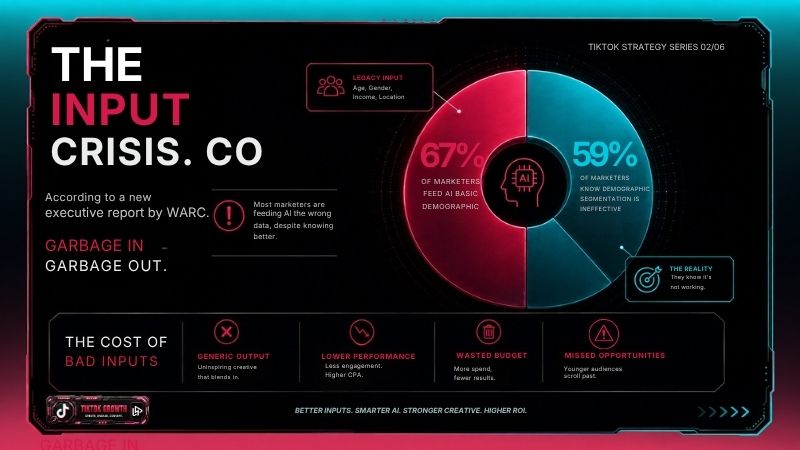
Data compiled by WARC indicates that 67% of marketers continue to utilize basic demographic metrics (Age, Gender, Geo-location) as the primary input parameters when prompting AI tools. Paradoxically, 59% of these exact same professionals acknowledge that traditional demographic segmentation is no longer an effective methodology.
The operational principle of machine learning models is absolute: Garbage In, Garbage Out. When a creative strategist inputs a prompt such as, “Write a 30-second TikTok ad script selling cosmetics to females aged 18-24,” the algorithm queries its training data to generate the broadest, most generic patterns associated with that demographic cluster. The resulting output is consistently hollow, highly stereotypical, and entirely devoid of the cultural resonance necessary to prevent a user from scrolling past within the crucial first three seconds.

1.2. The Structural Limits of Demographic Targeting on TikTok
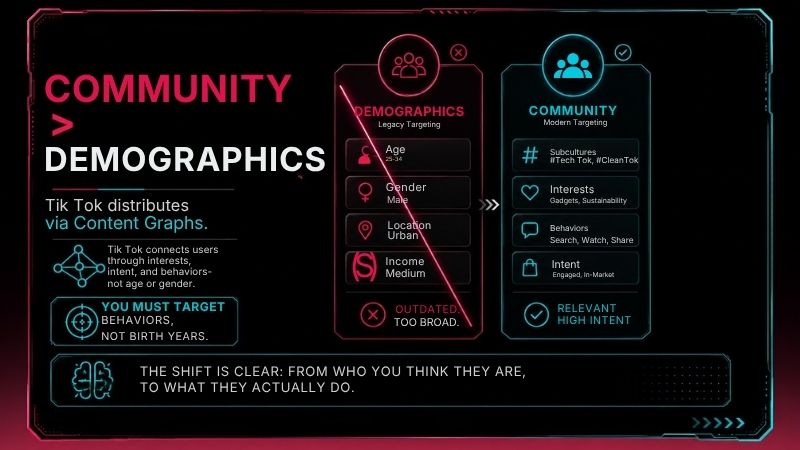
Unlike legacy social networking platforms (Facebook, Instagram) which were built upon the Social Graph (mapping connections between friends and family), TikTok operates exclusively via the Content Graph.
The platform’s distribution algorithm (the For You Page – FYP) does not prioritize whether a user is male or female, 20 years old or 40 years old. The platform categorizes user profiles based on the depth of their engagement within highly specific subcultures. A 45-year-old corporate executive and an 18-year-old student can share the exact same behavioral language and consumption patterns if they interact heavily within the #TechTok or #CleanTok communities. Grouping them strictly by birth year is a fundamental failure in data science application.
2. Operational Solution: Engineering the Intelligence Loop
To eliminate the generation of valueless AI content, advertisers must completely overhaul their methodology for collecting and formatting input data. Harnessing Community Intelligence requires replacing static demographic variables with dynamic Behavioral Signals.
2.1. The Anatomy of Platform Behavioral Signals
TikTok users continuously generate high-value intent data through a sequence of four core actions:
Search → Comment → Share → Buy
Instead of relying on generalized boardroom assumptions, operations teams must execute direct data scraping protocols. The recurring keyword clusters found within TikTok Search Insights, and the specific slang terminologies repeated across the comment sections of viral videos, represent the actual, unvarnished vernacular of the target community.
2.2. Integrating the Loop into AI Prompting Workflows
Once these raw data clusters are extracted, they must be formatted and injected directly into the LLMs. The Standard Operating Procedure (SOP) for prompting must evolve:
- Contextualization Phase: Feed the AI a scraped dataset consisting of the top 50 highly-rated comments from a direct competitor’s video.
- Task Assignment Phase: Instruct the AI to conduct sentiment analysis to identify the most recurring consumer pain points within that specific dataset.
- Tone Alignment Phase: Command the AI to generate a script that directly resolves those exact pain points, explicitly utilizing the semantic vocabulary extracted from the community, whilst strictly prohibiting the use of academic jargon or traditional sales copy.
This integration creates a continuous Intelligence Loop: Community data trains the AI -> The AI generates highly native content -> That content harvests new behavioral signals. This process drastically minimizes A/B testing expenditures and accelerates the scaling of winning creatives.
3. The Execution Blueprint: The WARC S.C.A.L.E Framework
To systematize the application of Community Intelligence for enterprise-scale operations, the WARC report introduces the S.C.A.L.E framework. At H2T Media Group, we translate this framework into the following technical execution protocols:
| Operational Phase | Mandatory Technical Action |
|---|---|
| S – Signals | Extract search velocity signals and query volume directly from native analytics tools. Identify the delta between what content users are actively seeking versus what is currently available in the marketplace. |
| C – Communities | Map out the specific subcultures relevant to the enterprise’s vertical. Precisely define the visual formatting, pacing, and audio trends characteristic of each distinct group. |
| A – AI | Utilize the datasets accumulated in steps S and C as strict system prompts for AI generation tools. Restrict the AI from falling back on generalized demographic templates, forcing it to produce culturally accurate narratives. |
| L – Loop | Establish a feedback measurement architecture. Analyze retention curves to identify exact drop-off points, then re-feed this performance data back into the AI to optimize the subsequent script iteration. |
| E – Execution | Compress the timeline from ideation to publication. Content lifecycles on TikTok are highly accelerated, requiring the production pipeline and ad budget deployment to function in near real-time. |
4. Restructuring Performance Measurement KPIs
The pivot from broad demographic targeting to precise community signaling forces advertising agencies to recalibrate their Key Performance Indicators (KPIs). Exclusively tracking Cost Per Acquisition (CPA) or Return on Ad Spend (ROAS) is operationally insufficient, as these are inherently lagging indicators.
4.1. Evaluating the Quality of AI Inputs
To determine if the community data fed into the AI is accurate, Media Buyers must monitor leading indicators at the individual creative level:
- Hook Rate (3-second views / Total Impressions): If the AI-generated script accurately deploys the specific language and perspective of the subculture, viewers perceive the content as native, non-intrusive material. This instantly drives the Hook Rate upward, minimizing wasted impression spend.
- Hold Rate (6-second views / 3-second views): This metric measures the AI’s ability to maintain a coherent narrative structure and logical pacing after successfully capturing the user’s initial attention.
4.2. Rejecting Obsolete Client Briefs
This technical evolution requires a fundamental shift in Account Management protocols. Elite agencies must possess the strategic authority to push back against legacy client briefs. When an enterprise requests a campaign targeting “Corporate females, aged 25-35, Tier-1 income,” it is the agency’s responsibility to conduct data analysis and translate that demographic persona into precise, actionable Community Signals (e.g., the #CorporateGirlies or #QuietLuxury communities) prior to initiating any AI or human creative production.
5. Frequently Asked Questions
TikTok operates on a Content Graph rather than a Social Graph, meaning the algorithm distributes content based on user engagement within specific behavioral subcultures rather than static demographics like age or gender.
When marketers prompt AI tools with broad demographic parameters, the LLM generates generic, highly stereotypical scripts that fail to capture user attention within the crucial first 3 seconds.
Operations teams must scrape real platform behavioral signals – such as TikTok search terms and viral comment sections – and inject this specific vocabulary and pain points directly into LLM prompts.
Media Buyers should focus on leading creative metrics like Hook Rate (3-second views / total impressions) and Hold Rate (6-second views / 3-second views) to evaluate the quality of AI input data.
Deploying next-generation AI tools will not automatically yield improved advertising performance if your foundational input data remains rooted in obsolete marketing paradigms. Implementing Community Intelligence based on the WARC Report and executing the S.C.A.L.E framework is a mandatory operational strategy to eliminate generic AI output and optimize campaign performance. Enterprises that successfully integrate this automated behavioral loop will secure a sustainable competitive advantage in acquisition costs and dominate content distribution on algorithm-driven platforms. For more in-depth performance analysis reports and standardized frameworks for global advertising, read more articles in the TikTok category under the Insights
section on the official H2T Media Group website!

bichthao
H2T Media Group decodes every meaningful platform update for advertisers and affiliate partners across APAC, EU and North America — always with a practical "H2T take" you can act on.
More about H2T →