

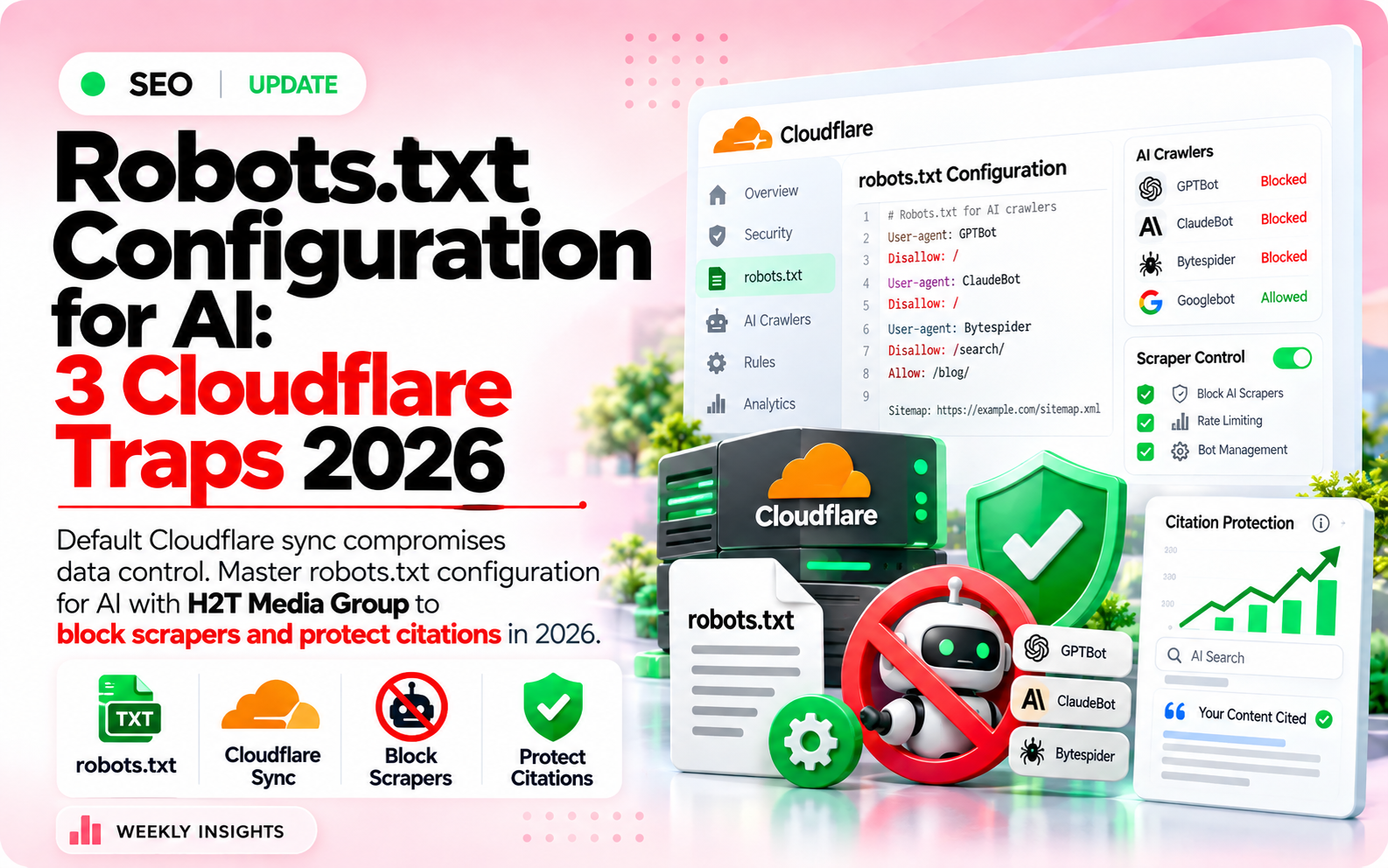
Welcome to the digital performance and technical search insights hub by H2T Media Group. A proper robots.txt configuration for AI requires enterprise teams to systematically separate model training crawlers from live search retrieval bots while enforcing hard Edge WAF rules instead of relying on automated vendor tools. Blindly activating Cloudflare’s “Bot Preference Sync” risks severing high-intent referral traffic from conversational AI engines like OAI-SearchBot or Perplexity, while leaving your site vulnerable to rogue scrapers.
Below is H2T Media Group’s technical analysis and the 10-minute audit framework required to secure your data sovereignty and maximize search visibility with H2T Media Group.
 Key Takeaways
A robust robots.txt configuration for AI requires granular, user-agent-level access management rather than relying on generalized automated vendor toggles.
Essential Operational Directives
- Blunt Sync Risk: Cloudflare’s automated sync enforces blunt category toggles, eliminating selective value exchanges.
- Citation Loss: Blocking live AI search crawlers (like OAI-SearchBot) completely destroys citation visibility.
- Training Bot Triage: Pure model training bots should be evaluated and suppressed if they yield zero return on investment.
- Advisory vs. Firewall: Malicious scrapers systematically ignore Disallow commands in robots.txt without edge firewall enforcement.
- Policy Synchronization: Audit live robots.txt files against edge security rules to eliminate 403-error indexing conflicts.
1. The Convenience Trap: Deconstructing Cloudflare’s Bot Preference Sync
To assist webmasters managing high-volume bot traffic, Cloudflare introduced “Bot Preference Sync,” a utility designed to automatically generate and maintain robots.txt based on three broad categories: Search, Agent, and Training.
1.1. The failure of broad-brush categorization
When an administrator enables this feature, Cloudflare autonomously overwrites the live robots.txt file utilizing generic global presets. Consequently, you lose selective control over your AI crawler permissions.
The structural failure: You lose the capability to execute a Selective Value Exchange.
- Disabling the generalized “AI Scrapers” category issues a blanket disallow directive across all AI user-agents.
- You inadvertently sever access to high-intent conversational discovery engines, such as OpenAI’s OAI-SearchBot or PerplexityBot, which actively direct high-converting referral traffic back to your domain.
Surrendering control of your crawl policy to an automated vendor toggle delegates critical choices to third-party assumptions. Consequently, your enterprise brand positioning and AI citation eligibility are left unprotected.
1.2. The loss of data sovereignty
Every commercial organization maintains distinct data monetization and intellectual property strategies:
- A subscription media publisher may choose to license proprietary content to OpenAI while categorically restricting Anthropic.
- An e-commerce retailer wants search AI bots to parse real-time catalog pricing for search citations, but demands the complete suppression of competitive price-scraping bots.
Cloudflare’s default switches cannot navigate these strategic nuances. Consequently, organizations are left either vulnerable to data exploitation or completely invisible within modern search.
2. Advisory Protocol vs. Edge Firewall: The Underlying Architectural Flaw
A pervasive technical misconception among IT leaders is assuming that declaring Disallow: / inside robots.txt constructs an impenetrable security barrier.
2.1. The voluntary nature of the robots.txt standard
The robots.txt protocol operates strictly on an Advisory Protocol (Honor System) basis. Reputable technology corporations (including Google, OpenAI, and Microsoft) respect these instructions. If your file declares a Disallow rule, their crawlers will honor the boundary and bypass those directories.
However, hundreds of unauthorized scrapers, content syndication bots, and commercial data harvesters deliberately ignore robots.txt. They continue scraping millions of pages daily, consuming server bandwidth and replicating your proprietary assets without consent.
2.2. The danger of policy mismatch between robots.txt and Edge WAF
A catastrophic operational error occurs when directives conflict across network layers:
- Your on-page robots.txt file declares an Allow directive for a legitimate AI search crawler.
- Concurrently, Cloudflare’s Edge Web Application Firewall (WAF) or Managed Bot Challenge misclassifies the crawler’s IP pool and blocks the request.
This policy asymmetry returns a 403 Forbidden error when the AI search engine attempts to retrieve your URL, resulting in the immediate removal of your domain from generative citation carousels.
According to official developer documentation within Cloudflare Bot Management Documentation, comprehensive bot governance requires strict synchronization between public robots.txt declarations and Edge WAF firewall rules.
3. Differentiating Model Training Crawlers from Live AI Search Bots
To engineer an authoritative configuration, technical directors must categorize AI user-agents into two functionally distinct groups. This segmentation separates foundational model training harvesters from live search retrieval bots.
3.1. Group 1: AI Model Training Crawlers
These bots crawl public web documents to ingest massive training corpora for foundational language models (e.g., GPT-5 or Claude 4):
- Examples: GPTBot, ClaudeBot, CCBot (Common Crawl), Bytespider.
- Characteristics: They consume substantial server compute and extract proprietary IP without returning direct referral traffic or branded search citations.
3.2. Group 2: Live AI Search & Retrieval Crawlers
These bots execute targeted, real-time data retrieval when an active user queries a conversational search interface:
- Examples: OAI-SearchBot (ChatGPT Search), PerplexityBot, Googlebot, Bingbot.
- Characteristics: They parse page content to synthesize live answers and explicitly embed clickable citation links back to your website. This represents the highest-converting traffic source in the modern digital ecosystem.
Deploying Cloudflare’s blunt category toggles to block all AI bots severs your primary pipeline to these high-intent buyers.
4. Technical Taxonomy: Major AI User-Agents in 2026
The technical matrix below outlines the operational profile and recommended governance directive for major AI crawlers:
| User-Agent Identifier | Operating Entity | Primary Functional Mandate | Direct Impact of “Allow” Directive | H2T Strategic Recommendation |
|---|---|---|---|---|
| GPTBot | OpenAI | Harvesting foundational LLM training datasets. | Ingests content; yields zero direct referral clicks. | Evaluate Disallow to protect proprietary IP. |
| OAI-SearchBot | OpenAI | Live index retrieval for ChatGPT Search queries. | Generates direct citation links and referral traffic. | Mandatory Allow to secure AI search presence. |
| ClaudeBot | Anthropic | Training data extraction for Claude models. | Ingests data; provides no live search citations. | Evaluate Disallow if compute bandwidth is finite. |
| PerplexityBot | Perplexity AI | Real-time conversational search grounding. | Drives high-intent B2B and technical referral clicks. | Mandatory Allow to capture research traffic. |
| Googlebot | Core search indexing and AI Overviews synthesis. | Governs 100% of organic search visibility. | Never block across any public-facing assets. | |
| Bytespider | ByteDance | Large-scale scraping for TikTok/Douyin AI models. | Aggressive crawl rates; high server load risk. | Block at Edge WAF to protect infrastructure. |
5. The 10-Minute Technical Audit Blueprint by H2T Media Group
To establish absolute data sovereignty while maximizing citation visibility across modern search, H2T Media Group mandates the execution of this 3-step technical audit:
Step 1: Audit Live robots.txt Against Cloudflare Settings (3 Minutes)
Navigate directly to yourdomain.com/robots.txt in a clean browser session. Cross-reference the rendered text against your Cloudflare dashboard under Security > Bots:
- Determine whether “Bot Preference Sync” has automatically injected broad disallow rules.
- If you identify restrictive directives blocking reputable search agents, disable the automated sync immediately (Toggle OFF Bot Preference Sync).
Step 2: Deploy a Custom, Granular robots.txt Architecture (4 Minutes)
Host a manually scripted robots.txt on your primary origin server, explicitly segregating permissions per verified User-Agent:
codeTxt

# Allow verified organic search and live AI discovery bots

User-agent: Googlebot

Allow: /

User-agent: OAI-SearchBot

Allow: /

User-agent: PerplexityBot

Allow: /

# Suppress uncompensated foundational training harvesters

User-agent: GPTBot

Disallow: /

User-agent: ClaudeBot

Disallow: /

User-agent: Bytespider

Disallow: /
Step 3: Enforce Hard Edge Firewall Rules via Cloudflare WAF (3 Minutes)
To neutralize malicious harvesters that intentionally ignore robots.txt directives:
- Navigate to Security > WAF > Custom Rules within the Cloudflare dashboard.
- Construct an explicit blocking rule (Action: Block) targeting aggressive scrapers based on the expression: http.user_agent contains “Bytespider” or unauthorized headless scraping signatures. This terminates the connection at the edge server before the bot reaches your origin infrastructure.
6. Frequently Asked Questions
No. Bot Preference Sync merely automates robots.txt text generation. Cloudflare’s core security systems—including DDoS mitigation, Managed Challenges, and WAF rules—operate independently and remain fully active.
Audit your origin server access logs or review Cloudflare’s Analytics dashboard, filtering request traffic by the User-Agent string containing OAI-SearchBot.
No. OpenAI explicitly separates these functions: GPTBot harvests foundational model training data, while OAI-SearchBot executes live retrieval and citations for ChatGPT Search.
No. B2B enterprises depend heavily on domain authority and third-party verification. Blocking live retrieval bots removes your brand from conversational buyer research workflows, directly degrading sales pipeline velocity.
Infrastructure tools should execute business strategy, not dictate it. Delegating your robots.txt configuration for AI to platform defaults surrenders data sovereignty and search visibility. True governance requires precision: granting access to high-value retrieval bots that drive citations, while deploying Edge WAF firewalls to block unauthorized scrapers. Execute this 10-minute audit today to secure your digital assets and command your position across the 2026 AI search landscape.
To access advanced technical SEO frameworks and proprietary entity governance playbooks, explore our full technical repository on the Insights hub at H2T Media Group. Make sure to consistently follow our dedicated SEO to master the strategies dictating authority across global digital search ecosystems.

bichthao
H2T Media Group decodes every meaningful platform update for advertisers and affiliate partners across APAC, EU and North America — always with a practical "H2T take" you can act on.
More about H2T →