

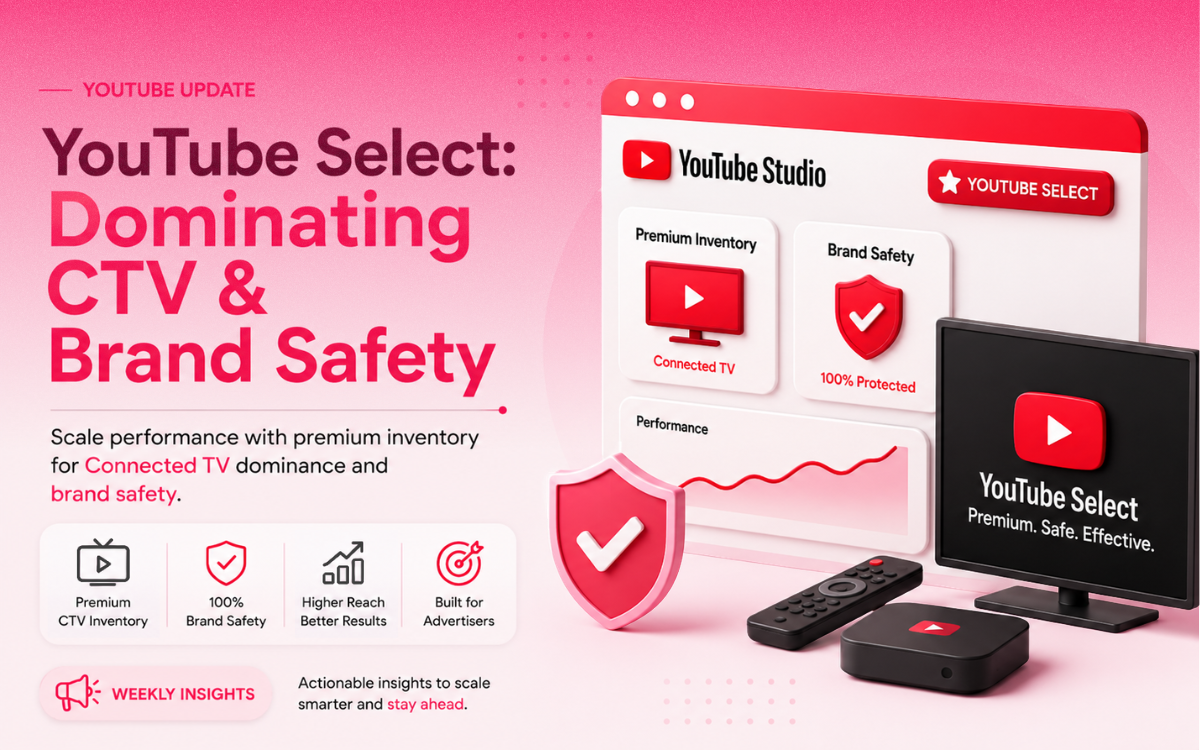
Welcome to the YouTube performance insights hub by H2T Media Group. Deploying a YouTube Select media buying strategy is the definitive solution for CMOs and global B2B enterprises to access the top 5% of premium YouTube content, eliminating brand safety risks and maximizing high-intent conversions. In this article, we break down the operational mechanics, Lineup contextual targeting, CTV-dominating strategies, and DV360 attribution frameworks to scale your ROI. Explore H2T Media Group’s technical analysis below to optimize your enterprise ad placement today.
 Key Takeaways
YouTube Select allows enterprise advertisers and B2B marketers to bypass standard open-exchange inventory vulnerabilities, guaranteeing placements strictly within the top 5% of premium platform content.
Essential Facts About YouTube Select Strategy
- Top 5% Inventory Guarantee: Isolates ad placements from low-quality UGC and brand safety risks while leveraging the “Halo Effect” of top-tier creators.
- Contextual Curation via Lineups: Replaces broad keyword targeting with curated industry verticals (e.g., Business & Finance) to filter out non-converting audience noise.
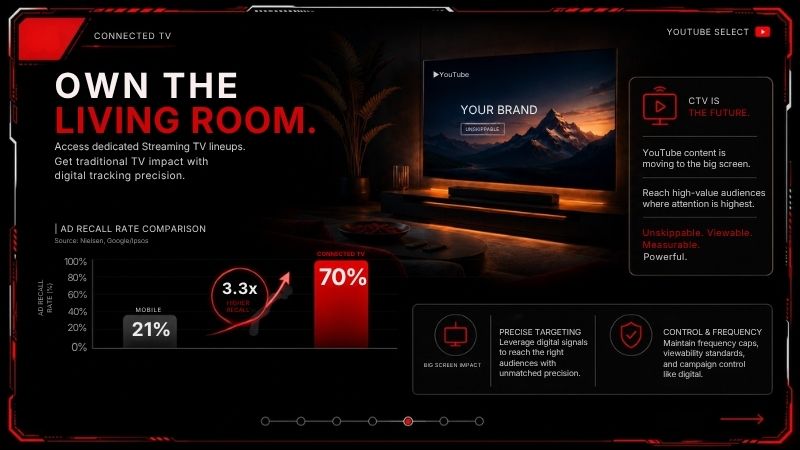
- Living Room Dominance (CTV): Capitalizes on Connected TV streaming environments, delivering unskippable, high-definition ads with 3.3x higher recall than mobile formats.
- Human Verification Protection: Combines machine learning with mandatory human content audits to ensure strict brand suitability for regulated enterprises.
- Advanced Attribution Framework: Evaluates campaign success using Cost Per Quality View (CPQV) and Brand Lift Measurement over raw, low-cost impression metrics.
1. Analyzing the Open-Exchange Flaw vs. The Top 5% Guarantee
Within the media buying ecosystem, the most prevalent operational error is prioritizing absolute reach volume over placement quality and contextual relevance.
1.1. The Vulnerability of Broad Inventory Allocation
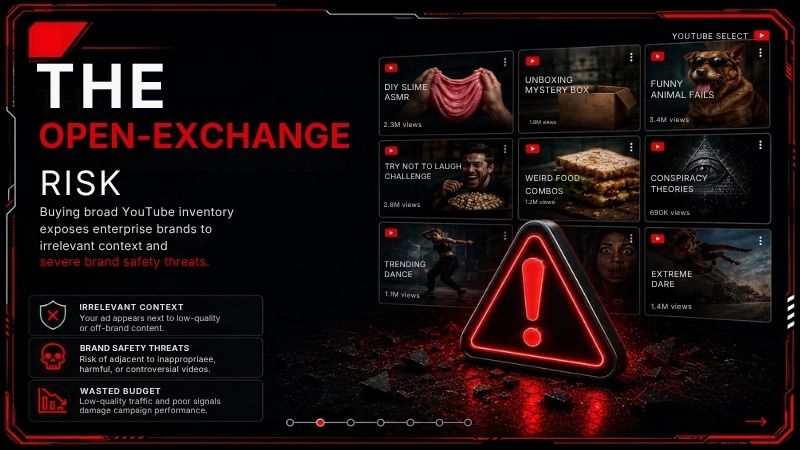
When operations teams execute YouTube campaigns through the standard Open-Exchange network, the algorithm autonomously seeks the lowest-cost inventory to optimize budget pacing. Consequently, high-end B2B SaaS or enterprise financial advertisements are frequently delivered preceding toy unboxing videos, low-quality user-generated content (UGC), or amateur vlogs.
- Cost: Low (Cheap CPM).
- Contextual Quality: Zero.
- Conversion Potential: Extremely low due to severe intent mismatch.
1.2. The Top 5% Segregation via YouTube Select
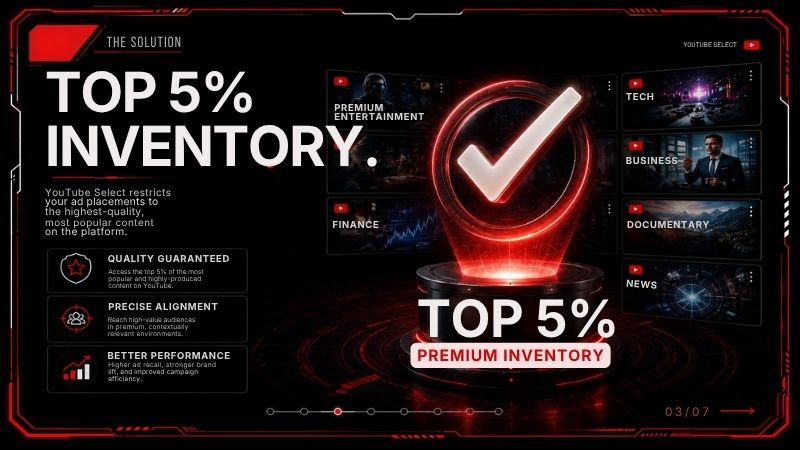
YouTube Select restructures the delivery paradigm. Instead of relying on randomized algorithmic distribution, this solution establishes a technical perimeter, guaranteeing that enterprise advertisements only access the Top 5% of the most popular, highly produced content on the platform. When a brand’s messaging is delivered alongside top-tier financial news networks or authoritative technology creators, the prestige of the core content automatically transfers to the advertised brand (The Halo Effect).
2. Contextual Engineering: Optimizing via Curated Lineups
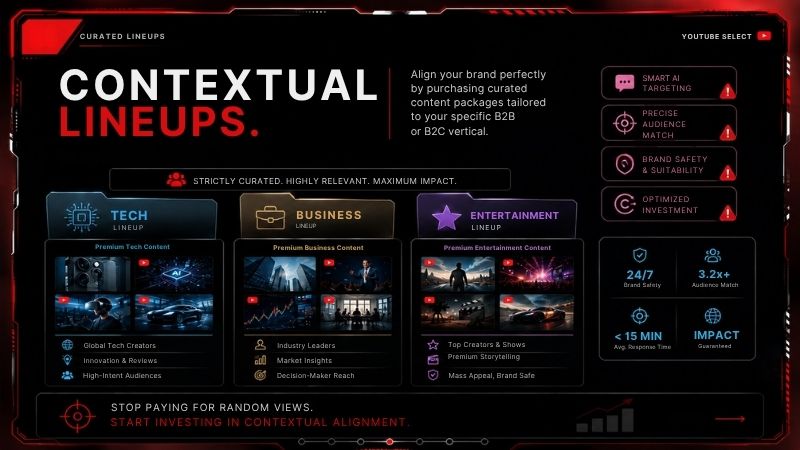
To precisely allocate budgets toward target demographic segments, YouTube Select bypasses standard keyword targeting methodologies. Instead, the system utilizes ‘Lineups’—rigorously categorized content packages.
2.1. The Architectural Structure of Select Lineups
Lineups are structured into specific industry verticals, such as Technology, Business & Finance, Premium Entertainment, and Sports.
| Evaluation Metric | Standard YouTube Targeting | YouTube Select (Lineups) |
|---|---|---|
| Curation Process | Automated AI classification. | Algorithmic sorting combined with manual human evaluation. |
| Destination Inventory | All platform videos containing relevant metadata. | Exclusively verified “Top Creators” or “Premium Publishers” within a specific vertical. |
| Delivery Stability | High volatility dependent on live auction dynamics. | Ensures maximum consistency regarding display context. |
2.2. Strategic Application for B2B Enterprises
A common misconception is that premium curation exclusively benefits massive Fast-Moving Consumer Goods (FMCG) conglomerates. In reality, Lineups function as an absolute noise-filtration tool for B2B enterprises. By exclusively purchasing the “Business & Finance” lineup, an enterprise software provider entirely eliminates wasted impressions on entertainment content. The advertisement plays concurrently with macroeconomic analysis programming, aligning perfectly with the psychological context of the C-level executives consuming that media.
3. Dominating the Living Room Experience: The Role of Connected TV (CTV)
The year 2026 marks a definitive behavioral shift regarding YouTube consumption, moving from mobile devices to large-format screens in the living room. YouTube Select provides dedicated Streaming TV Lineups specifically engineered to monopolize this environment.
3.1. The Convergence of Broadcasting and Digital Architecture
Connected TV advertising delivers the immersive, high-impact viewing experience characteristic of traditional linear television: large screens, high-definition resolution, and unskippable ad formats.
However, unlike legacy cable television (which lacks precise audience measurement), CTV on the YouTube infrastructure retains comprehensive digital analytics. Advertisers continuously receive granular reporting on View-Through Rates (VTR), user demographics, and integrated conversion tracking mechanisms.
3.2. Leveraging Attention Metrics
Behavioral measurement data dictates that Ad Recall metrics on Smart TVs are significantly higher compared to mobile scrolling environments. Audiences consuming YouTube via television are typically in a relaxed state, exhibiting prolonged session lengths. This quantifiable increase in user attention directly justifies the higher bid rates associated with CTV inventory.
4. Enterprise Risk Management: The Human Verification Standard
For organizations operating within heavily regulated sectors (Finance, Healthcare, Pharmaceuticals) or publicly traded corporations, Brand Safety is the primary barrier preventing heavy investment in open-video platforms.
4.1. The Limitations of Machine Learning Classification
Standard moderation tools rely on AI to parse titles, descriptions, and visual frames to filter toxic content. However, machine learning models frequently fail to detect nuanced contextual issues, satire, or politically polarizing material. An enterprise banking advertisement appearing before a controversial or unethical video can trigger an instantaneous public relations crisis.
4.2. The YouTube Select Protection Layer
The ad inventory secured within YouTube Select lineups is not solely classified by machine algorithms. The platform enforces a moderation protocol that incorporates direct Human Verification. Channels and specific videos must pass the most rigorous Brand Suitability assessments. For executive boards, this verification layer is considered a mandatory insurance policy protecting large-scale media expenditures.
5. Technical Operational Workflows: Google Ads, DV360, and ROI Measurement
To effectively execute a premium media buying strategy, operational teams must select the appropriate deployment platform and recalibrate their Key Performance Indicators (KPIs).
5.1. Platform Selection: Google Ads vs. Display & Video 360 (DV360)
- Via Google Ads (Standard): Google currently allows the procurement of select Lineups via Reservation Buying directly within the Google Ads interface. This provides operational convenience for mid-sized agencies.
- Via DV360 (Enterprise): For true enterprise-level campaigns, executing via DV360 (Google’s Demand-Side Platform) remains the mandatory standard. DV360 enables cross-exchange frequency capping, the integration of 3rd-party Data Management Platforms (DMPs), and complex audience exclusion lists to prevent budgetary waste.
5.2. Transitioning Measurement Methodologies (Justifying the CPM)
The primary obstacle in securing Chief Financial Officer (CFO) approval for YouTube Select is the higher baseline CPM compared to the open auction. Media Buyers must pivot the measurement perspective:
- Cost Per Quality View (CPQV): Rather than measuring the cost per raw impression, calculate the cost per completed view within a high-attention environment (CTV).
- Executing Brand Lift Studies: Discard short-term Click-Through Rate (CTR) metrics. Operations teams must deploy Brand Lift Measurement studies (available at no cost upon reaching spend thresholds) to mathematically prove that premium, curated content generates a significantly higher baseline lift in Purchase Intent compared to cheap, unverified inventory.
6. Frequently Asked Questions
YouTube Select is a curated media buying solution that guarantees ad placements strictly within YouTube’s top 5% of premium, highly viewed content, whereas standard open-auction buying distributes ads algorithmically across all eligible videos regardless of context.
Yes, enterprise B2B advertisers benefit significantly by leveraging targeted Lineups—such as “Business & Finance”—to eliminate wasted impressions on low-intent content and connect directly with key corporate decision-makers.
Beyond automated AI filters, YouTube Select incorporates direct human content audits to verify that channels meet stringent brand suitability standards, protecting enterprises from appearing next to controversial or non-compliant content.
CTV delivers unskippable, high-definition ad formats in a living-room environment with 3.3x higher ad recall than mobile scrolling, combining the high-impact reach of traditional television with precise digital attribution tracking.
Executing a YouTube Select media buying strategy is the ultimate framework for enterprise advertisers to bridge high-impact television reach with modern digital attribution precision. By securing placements within the platform’s top 5% of content, dominating Connected TV environments, and leveraging DV360 data models, brands effectively protect their identity while maximizing ROI. Dive deeper into our actionable guides and technical analysis within the YouTube category under the Insights section on the official H2T Media Group website to scale your performance marketing campaigns today.

bichthao
H2T Media Group decodes every meaningful platform update for advertisers and affiliate partners across APAC, EU and North America — always with a practical "H2T take" you can act on.
More about H2T →