

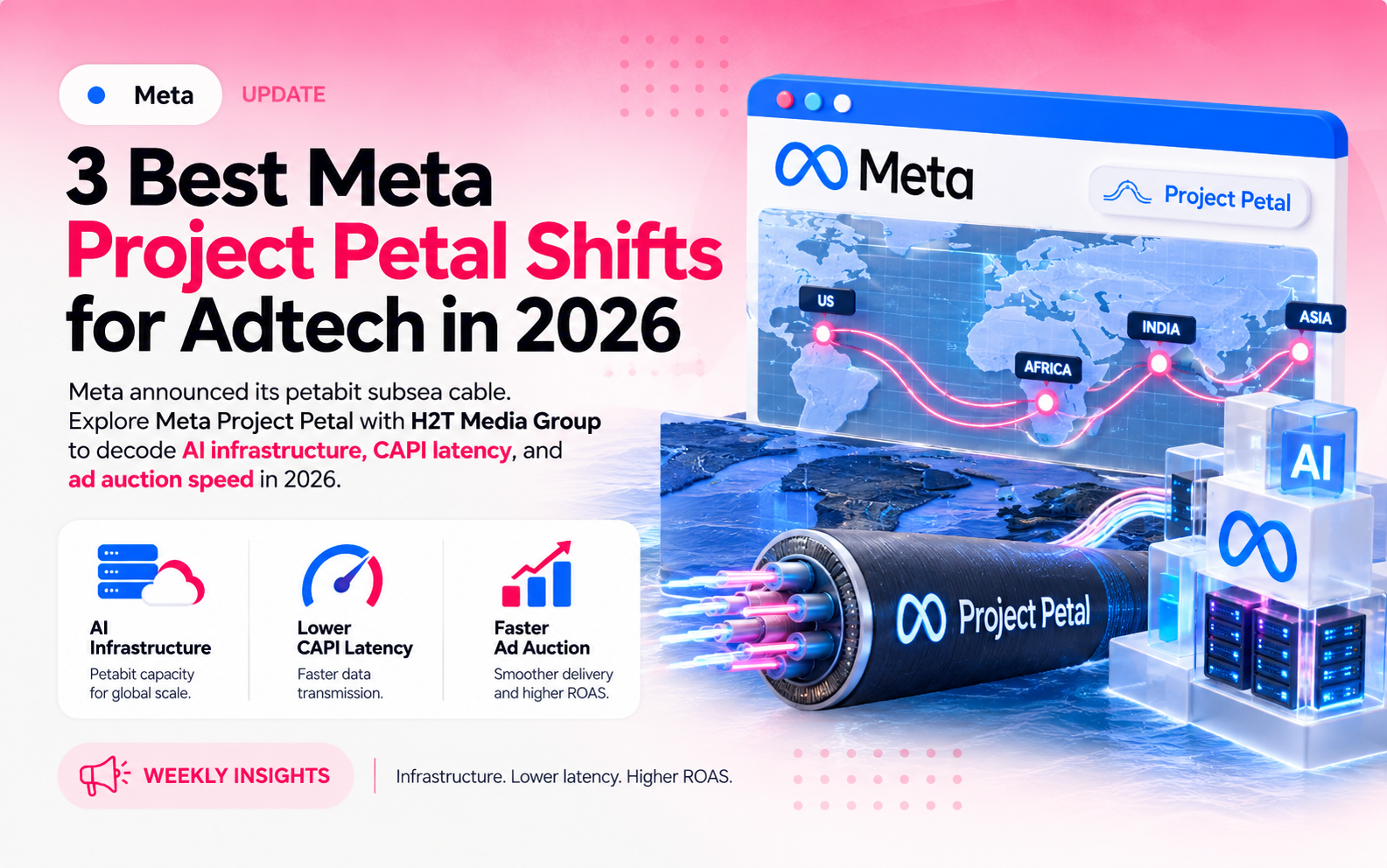
Welcome to the digital performance and technology infrastructure insights hub by H2T Media Group. On September 21, 2026, Meta Engineering officially announced Project Petal—the world’s first petabit-class transoceanic subsea fiber-optic cable. While telecommunications analysts view this as a historic transmission speed record across the Atlantic, enterprise growth leaders and programmatic Media Buyers must analyze the underlying commercial supply chain: Meta Project Petal functions as the direct physical backbone powering distributed supercomputing clusters, synchronizing the Andromeda ad delivery engine, and eradicating transatlantic signal latency for the Conversions API (CAPI).
 Key Takeaways
Meta Project Petal is the world’s first petabit-class subsea cable engineered to support distributed AI training and real-time global ad delivery.
Essential Technical Facts
- The world’s first subsea fiber-optic cable surpassing the petabit-per-second (Pbps) threshold.
- Directly connects massive AI compute data center clusters across North America and Europe.
- Deploys Space Division Multiplexing (SDM) with a record number of fiber pairs (24 to 48 pairs).
- Compresses transatlantic Server-Side CAPI data signal latency to under 20 milliseconds.
- Powers real-time auction machine learning for the Andromeda ad delivery engine and Llama models.
1. Engineering Architecture of Meta Project Petal Subsea Cable
To understand why a global software and social networking conglomerate invests billions of dollars laying physical glass cables along the ocean floor, one must examine the computational data requirements of modern artificial intelligence.
1.1. The generational leap from Terabits to Petabits
Legacy transatlantic fiber-optic cables typically command maximum design capacities ranging between 50 and 250 Terabits per second (Tbps).
With Meta Project Petal, Meta Engineering formally inaugurates the Petabit transmission era (1 Petabit = 1,000 Terabits = 1,000,000 Gigabits). This unprecedented bandwidth enables the instantaneous transmission of millions of concurrent 4K video streams and billions of machine learning model parameter updates within a single second.
1.2. Breakthroughs in optical fiber and subsea power architecture
Project Petal integrates cutting-edge optical engineering breakthroughs:
- Space Division Multiplexing (SDM): Maximizes the number of optical fiber pairs packed inside a unified cable housing to an unprecedented 24 to 48 pairs, multiplying total data throughput without expanding the physical cable diameter.
- High-Voltage Subsea Power Feeding: Delivers robust electrical power across thousands of kilometers along the ocean floor to sustain optical repeaters spaced every 50 to 70 kilometers in deep-sea trenches.
As documented in official technical releases on the Meta Engineering Blog, Petal is architected as an Open Cable System, allowing Meta to upgrade shoreside optical transponders continuously without disturbing the physical subsea infrastructure.
2. Why Physical Fiber Infrastructure Dictates Ad Machine Learning Speed
Many growth marketers operate under the assumption that advertising algorithms exist purely as abstract software code. In reality, modern adtech relies entirely on the physical speed of globally distributed server hardware.
2.1. Distributed AI supercomputing training clusters
Meta cannot concentrate hundreds of thousands of high-density GPU accelerators inside a single geographic data center due to power grid and cooling capacity constraints. Computational clusters must be geographically distributed across multiple US states and European nations (such as Ireland, Denmark, and Sweden).
When training multi-billion parameter foundational models like Llama or Muse, computing nodes separated by oceans must continuously synchronize trillions of parameter weights with sub-millisecond precision. If subsea fiber pipelines experience packet congestion or high latency, entire supercomputing clusters stall into GPU idle states, burning millions of dollars in compute waste. Meta Project Petal was specifically engineered to eradicate this cross-border data bottleneck.
2.2. Fueling the Andromeda ad-serving engine
Meta’s modern advertising delivery stack (Andromeda, GEM, and Lattice) no longer relies on static audience targeting tables.
The auction architecture continuously analyzes real-time user behavior, executes computer vision parsing on video frames, and calculates predicted conversion rates (pCVR) dynamically at the exact millisecond of the auction call. Possessing dedicated petabit-class bandwidth allows Meta to route global user behavioral signals into central inference clusters instantly, ensuring Advantage+ campaigns optimize delivery with absolute precision.
3. 3 Practical AdTech Advantages Delivered by Project Petal
For cross-border E-commerce brands and programmatic Performance Agencies, the Petal cable delivers immediate, quantifiable operational improvements:
3.1. Eliminating transatlantic Server-Side CAPI latency
When a consumer in Europe executes an e-commerce transaction on a digital storefront hosted on US-based cloud infrastructure:
- The conversion event transmitted via the Conversions API (CAPI) must cross the ocean to reach Meta’s primary authentication servers.
- Under congested public networks, signal latency can stretch from minutes to hours, depriving Smart Bidding models of real-time conversion signals during peak auction hours.
- Project Petal compresses transatlantic CAPI data transmission to under 20 milliseconds, ensuring transaction events are ingested into machine learning models almost instantaneously.
3.2. Elevating Event Match Quality (EMQ) scores
High-bandwidth physical data pipes allow advertisers to transmit richer, uncompressed First-Party Data payloads (including cryptographically hashed emails, IP configurations, fbp, fbc, and User-Agent strings) without risking packet drop. This stabilizes account Event Match Quality (EMQ) scores consistently above the 8.5/10 benchmark, directly depressing baseline CPMs and reducing true Customer Acquisition Costs (CAC).
3.3. Enabling instantaneous 4K multi-format creative delivery
With the rollout of generative video tools (such as Muse and Video Scene Extension), advertising assets delivered across Instagram Reels are rapidly shifting to high-definition 4K standards. Project Petal provides the massive bandwidth required to stream complex, high-bitrate video ads to mobile devices globally without buffering latency, preventing scroll-away bounces.
4. Comparative Matrix: Legacy Transatlantic Cables vs. Project Petal
The comparative matrix below illustrates the technical divergence between traditional subsea cables and Meta’s petabit-class infrastructure:
| Evaluation Dimension | Legacy Transatlantic Subsea Cables | Meta Project Petal Infrastructure |
|---|---|---|
| Design Bandwidth | 50 to 250 Terabits per second (Tbps). | Surpasses Petabit per second (Pbps) – 5x to 10x capacity expansion. |
| Fiber Architecture | Standard Wavelength Division Multiplexing. | Space Division Multiplexing (SDM) with 24–48 fiber pairs. |
| AI Compute Latency | High risk of packet bottlenecks during sync. | Ultra-low latency engineered for distributed GPU clusters. |
| CAPI Synchronization | Latency spans minutes via shared public routing. | Real-time under 20ms via dedicated private infrastructure. |
| Ad Delivery Impact | Potential auction bidding latency during spikes. | Powers Andromeda real-time ML and 4K Reels streaming. |
5. The Enterprise Data Infrastructure Implementation Blueprint by H2T Media Group
As Meta upgrades its physical transmission infrastructure to petabit standards, performance marketing organizations must modernize their own data architectures to match this processing velocity. H2T Media Group mandates the following 3-step roadmap:
Step 1: Migrate Entirely to Server-Side CAPI Gateway
Eliminate reliance on client-side browser tracking pixels. Deploy Conversions API Gateway instances hosted on high-performance cloud infrastructure (AWS or Google Cloud) situated near Meta’s primary network edge nodes to minimize data transit hops.
Step 2: Enforce Real-Time First-Party Event Streaming
Configure your CRM and digital payment gateways to cryptographically hash and transmit transaction events immediately upon checkout completion. Eliminate end-of-day batch processing to allow Meta’s Andromeda auction algorithms to optimize live bidding based on immediate purchase intent.
Step 3: Upgrade Video Creative Assets to High-Definition Standards
Leverage high-bandwidth delivery networks by producing high-resolution creative assets formatted specifically in 9:16 (Reels) and 4:5 (Feeds). Avoid destructive video compression; Meta’s Vision AI models actively assign higher quality scores to assets demonstrating crisp visual fidelity and studio-grade color balance.
6. Frequently Asked Questions
The project is currently undergoing subsea marine installation and is scheduled to begin commercial data routing between late 2026 and early 2027.
The cable does not lower auction base prices directly, but it optimizes campaign performance: it eliminates CAPI signal loss, accelerates algorithm learning, and improves audience matching, thereby lowering your effective Cost Per Acquisition (CPA).
Yes. All advertising accounts share Meta’s centralized auction infrastructure. When core data transmission pipelines accelerate, ad delivery precision improves universally across all spend tiers.
Constructing proprietary subsea cables grants Meta complete control over network routing, guarantees dedicated bandwidth for internal AI training workloads, and ensures end-to-end security for billions of commercial transactions.
Meta Project Petal marks the convergence of social platforms and global supercomputing infrastructure. In 2026, performance marketing victory is driven by subsea data transmission power rather than simple campaign tweaks. Businesses that modernize their First-Party server infrastructure to sync with Meta’s computational core will lead in speed and scalable profitability.
To access proprietary server-side data integration blueprints and advanced performance measurement frameworks, explore our technical repository on the Insights hub at H2T Media Group. Make sure to consistently follow our dedicated Category Meta to master the infrastructure strategies dictating success across global advertising ecosystems.

bichthao
H2T Media Group decodes every meaningful platform update for advertisers and affiliate partners across APAC, EU and North America — always with a practical "H2T take" you can act on.
More about H2T →