

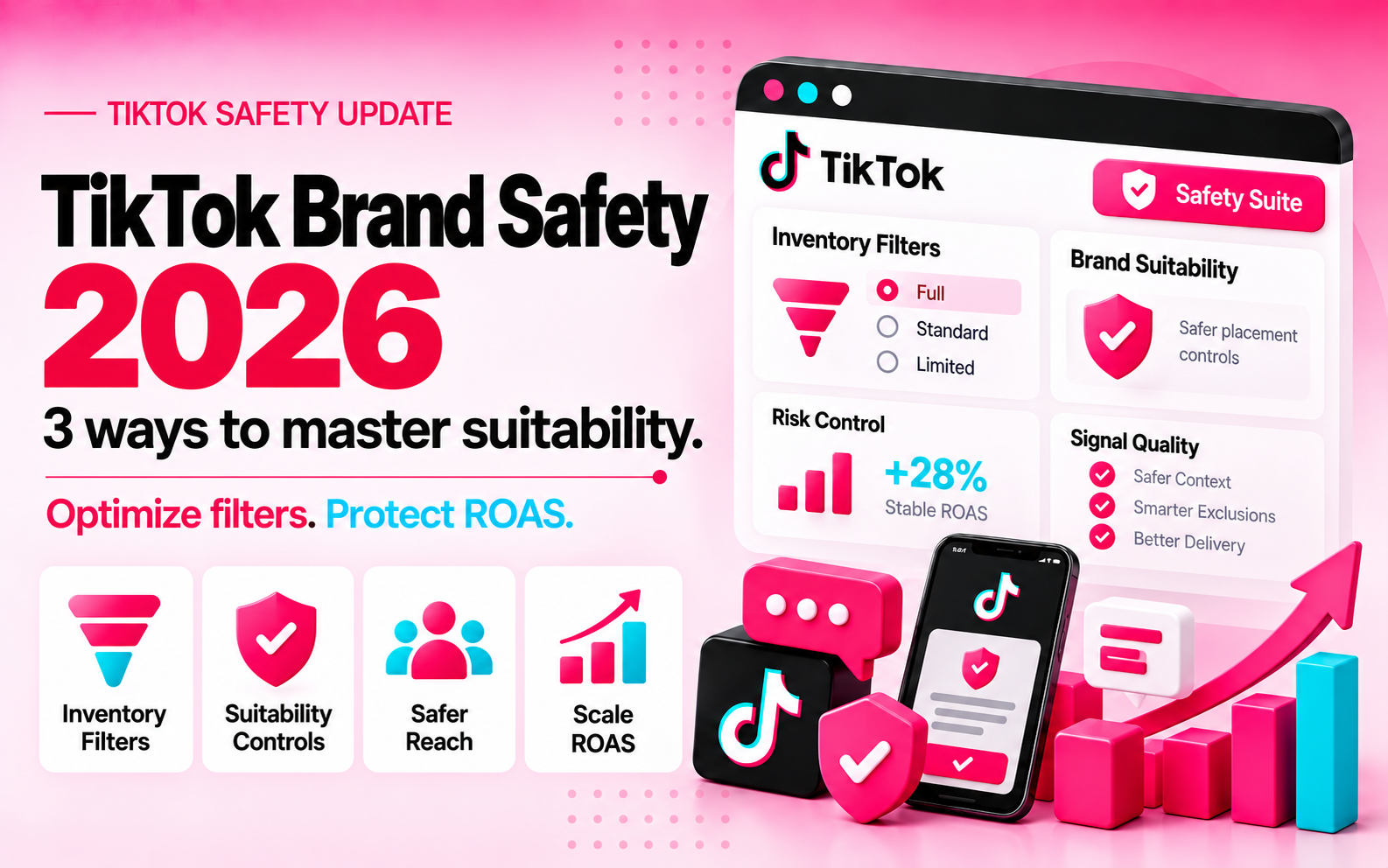
Welcome to the digital performance and social commerce insights hub by H2T Media Group. Mastering TikTok brand safety in 2026 relies on implementing TikTok’s expanded suitability framework across Pre-Campaign inventory tiering, In-Flight AI comment moderation, and Post-Campaign third-party verification. By enforcing strict content alignment across TikTok Shop and Profile Feeds, enterprise brands can eliminate wasted ad spend on high-risk impressions and protect their corporate equity. Below is H2T’s technical analysis and the operational blueprint required to scale media spend with complete brand governance.
 Key Takeaways
Modern TikTok brand safety encompasses a closed-loop 3-stage framework: Pre-Campaign prevention, In-Flight moderation, and Independent measurement.
Essential Governance Facts
- Expanded Inventory Filters: Governs ad adjacency across TikTok Shop and creator Profile Feeds.
- Vertical Sensitivity: Enables programmatic ad exclusion adjacent to sensitive industry topics.
- AI Comment Triage: Autonomously monitors, filters, and suppresses toxic spam in real time.
- Independent Verification: Integrations with IAS, DoubleVerify, and Zefr deliver 99%+ brand safety rates.
- Quality Score Lift: Rigorous suitability controls optimize audience quality scores and lower effective CPM costs.
1. The Architectural Evolution of Brand Safety on TikTok
Historically, brand suitability was frequently treated as an administrative checklist where media buyers configured basic negative keyword lists and assumed automated protection.
1.1. Extending suitability perimeters across TikTok Shop and Profile Feeds
Within the 2026 social ecosystem, commercial touchpoints have expanded far beyond the standalone For You Feed. Brands now engage high-intent consumers across emerging surfaces, including creator profile feeds, curated video streams, and closed-loop e-commerce storefronts.
Audiences interact across multiple high-intent surfaces: vertical streams inside creator profile tabs (Profile Feed), premium curated inventory via TikTok Pulse, and closed-loop e-commerce storefronts within TikTok Shop.
TikTok’s latest release expands native inventory filters across these emerging surfaces. Enterprises can now enforce rigid placement parameters ensuring video ads and catalog assets never render adjacent to controversial, graphic, or unverified creator content.
1.2. The integration of machine learning in Ad Integrity
TikTok’s Ad Integrity infrastructure operates utilizing advanced multi-layered neural networks. By analyzing visual frames, audio signatures, and landing pages concurrently, these intelligent models detect deceptive claims and policy violations before ad delivery initializes.
Rather than executing basic metadata scans, machine learning systems evaluate three concurrent layers: frame-by-frame visual elements (Computer Vision), acoustic signatures (Audio Hashing), and destination landing page compliance. The system proactively detects deceptive claims, counterfeit products, and unverified reviews before ad delivery initializes.
According to official technical releases on the TikTok for Business Blog, standardizing these suitability tiers equips enterprise brands with the confidence required to deploy high-velocity ad spend across the platform.
2. Deconstructing the 3 Full-Funnel Governance Stages
TikTok standardizes brand risk management into three continuous operational stages, encompassing pre-campaign controls, real-time mitigation, and independent third-party measurement. This comprehensive framework enables businesses to optimize advertising performance, eliminate low-quality traffic, and effectively protect brand equity.
2.1. Pre-Campaign Controls: Proactive Perimeter Defense
Configured directly at the Ad Set level within TikTok Ads Manager prior to campaign launch:
- TikTok Inventory Filter: Delivers three distinct alignment tiers: Full Inventory, Standard Inventory, and Limited Inventory. The Limited Inventory setting systematically eliminates ad delivery adjacent to mature themes, profane language, or unverified claims.
- Vertical Sensitivity: Empowers specialized commercial verticals (such as Financial Services, Healthcare, and Children’s Products) to exclude ad adjacency next to specific sensitive industry topics.
- Profile Feed Exclusion Lists: Enables media buyers to block ad delivery programmatically across specific creator profile handles.
2.2. In-Flight Tools: Real-Time Mitigation
Active controls operating continuously during live ad distribution:
- Intelligent Comment Management: Automated natural language processing (NLP) models scan, filter, and suppress malicious comments, competitor link spam, and abusive text in real time.
- Dynamic Exclusion Maintenance: Operations teams can update exclusion lists and category toggles on live ad sets without triggering algorithmic learning resets.
2.3. Post-Campaign Independent Measurement: Third-Party Verification
To guarantee complete reporting transparency, TikTok integrates authenticated API pipelines connecting to premier third-party ad verification leaders:
- Brand Safety and Suitability Verification: Direct integrations with Integral Ad Science (IAS), DoubleVerify (DV), and Zefr deliver independent post-campaign audits verifying brand safety rates consistently above 99%.
- Ad Collision Measurement: Prevents direct commercial competitors from rendering back-to-back within the same user session.
- Misinformation Measurement: Confirms that commercial impressions remain entirely isolated from unverified conspiracy or synthetic media narratives.
3. The Direct Impact of Brand Suitability on ROAS and CPM Efficiency
A common misconception among performance marketers is that enforcing strict suitability filters artificially restricts audience reach and inflates CPM pricing. However, empirical data proves the contrary by showing that these controls actually eliminate wasted ad spend and optimize campaign efficiency.
3.1. Eliminating capital leakage into low-intent junk inventory
When an advertisement renders adjacent to a toxic or disturbing video, consumers subconsciously transfer negative sentiment to the corporate brand. Click-Through Rates (CTR) and Conversion Rates (CVR) within these compromised contexts frequently contract below 0.1%.
Deploying strict inventory filters eliminates wasted ad spend on compromised impressions. Media capital is concentrated exclusively within high-quality contextual environments where consumers operate in an open, receptive psychological state.
3.2. Elevating ad account quality scoring
TikTok’s auction bidding models actively reward ad assets that maintain clean, high-engagement community interactions. By favoring campaigns with positive user sentiment and minimal policy flags, the platform allows brands to win competitive auctions at lower effective CPM costs.
Advertisements maintaining pristine comment sections, high visual retention, and zero policy flags earn superior account-level quality scores, allowing campaigns to win competitive auctions at optimized clearing CPMs.
4. Technical Specifications Matrix: 3 TikTok Brand Safety Stages
The technical matrix below outlines the operational parameters and performance marketing utility of the three governance stages:
| Campaign Lifecycle Stage | Integrated TikTok Native Technology | Third-Party Verification Partner | Primary Media Buying Advantage |
|---|---|---|---|
| 1. Pre-Campaign | Inventory Filter, Vertical Sensitivity, Category Exclusions. | Native Machine Learning Content Classifier. | Proactively restricts delivery to verified brand-safe inventory pools. |
| 2. In-Flight | Comment Management AI, Profile Feed Exclusion Lists. | Real-Time Natural Language Processing (NLP). | Autonomously purges comment spam and protects brand equity live. |
| 3. Post-Campaign | Brand Suitability Reporting, Ad Collision Analytics. | Independent Leaders: IAS, DoubleVerify, Zefr. | Provides audited, board-level compliance reports verifying 99%+ safety. |
5. The Enterprise Operational Action Blueprint by H2T Media Group
To establish an impenetrable brand suitability architecture, H2T Media Group mandates the following 3-step operational framework:
Step 1: Standardize Ad Set Inventory Configurations
For standard consumer brands, enforce the Standard Inventory filter as an absolute baseline. For heavily regulated verticals (Financial Services, Pharmaceuticals, Infant Care), mandate the Limited Inventory tier across 100% of active ad sets. Apply Vertical Sensitivity toggles to eliminate adjacency to high-risk content themes.
Step 2: Automate Conversational Triage Rules
Access the Comment Management module inside TikTok Ads Manager to input comprehensive negative keyword exclusion lists. Ingest competitor brand names, derogatory slang, and common spam triggers to allow the AI triage engine to suppress toxic commentary automatically.
Step 3: Activate Independent Third-Party Audit Pipelines
For campaigns scaling past $10,000 monthly, mandate the integration of IAS or DoubleVerify verification pixels within your campaign architecture. Utilize verified post-campaign audit logs to validate brand safety metrics and optimize subsequent media allocations.
6. Frequently Asked Questions
Limited Inventory typically reduces total addressable impressions by 5% to 10%, but it systematically filters out compromised placements, resulting in higher aggregate conversion rates across qualified audiences.
Native TikTok controls (Inventory Filters and Comment Management) deliver exceptional protection (98%+) for mid-market operators. Third-party integrations are primarily required by enterprise conglomerates demanding independent auditing for governance compliance.
Review the Brand Suitability breakdown within your Ads Manager analytics or consult third-party verification dashboards (e.g., Zefr or DoubleVerify) to inspect post-campaign placement logs.
Yes. Advertisers can compile a centralized list containing thousands of specific creator IDs and apply the exclusion rule across all active campaigns simultaneously.
The comprehensive evolution of TikTok brand safety in 2026 establishes an undeniable operational standard: Scalable performance marketing must always be anchored in uncompromised brand governance. Proactively deploying native inventory filters, automating conversational moderation, and validating delivery via independent verification partners empowers enterprise brands to scale media spend with total confidence. Safeguard your corporate reputation and maximize capital efficiency by building an impenetrable brand suitability foundation across every campaign.
To access proprietary social advertising scaling playbooks and advanced brand governance frameworks, explore our technical repository on the Insights hub at H2T Media Group. Make sure to consistently follow our dedicated TikTok to master the tactical marketing strategies dictating success across global advertising ecosystems.

bichthao
H2T Media Group decodes every meaningful platform update for advertisers and affiliate partners across APAC, EU and North America — always with a practical "H2T take" you can act on.
More about H2T →