

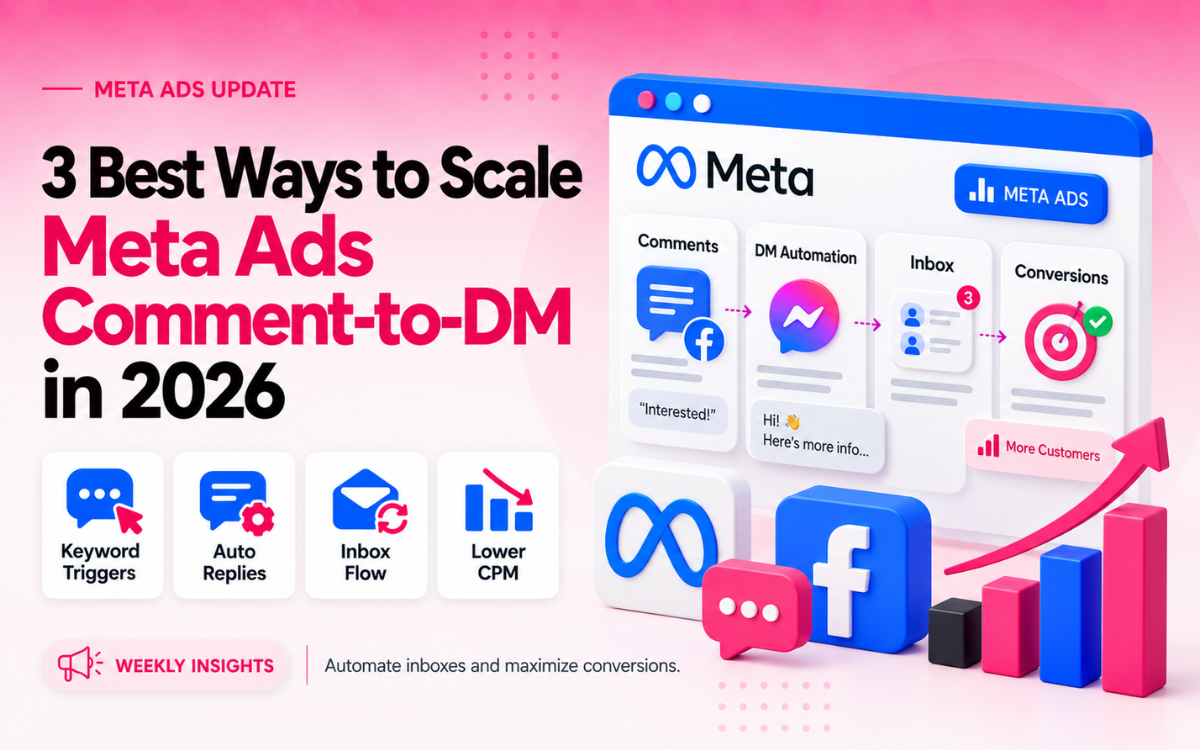
Welcome to the performance marketing insights hub by H2T Media Group. Meta has officially begun deploying one of its most anticipated native features directly inside Ads Manager: Meta Ads Comment-to-DM. Historically, Direct-to-Consumer (D2C) brands, service providers, and creators were forced to maintain expensive third-party subscriptions like ManyChat simply to bridge social engagement into direct-message sales pipelines.
Meta’s introduction of native keyword triggers within the new “Conversations” tab at the Ad level enables automated, instant direct messages whenever a prospect leaves a designated keyword in the comments. This operational shift transforms transactional advertisements into high-engagement organic-style posts, driving down baseline Cost-Per-Mille (CPM) metrics while elevating conversion intent.
However, triggering that initial message is only half the battle; managing the resulting inbox overflow without overwhelming your team represents the true operational bottleneck. This technical analysis dissects the mechanics of the update and delivers an enterprise blueprint for 2026.
 Key Takeaways
Meta Ads Comment-to-DM is a native Ads Manager feature that automatically dispatches private direct messages triggered by specific comment keywords.
Essential Facts About This Update
- Configure up to 5 designated keywords per ad unit to fire a unified automated message.
- Located natively at the Ad Level beneath the new Conversations configuration tab.
- High comment volume signals relevance to the auction algorithm, significantly reducing CPM costs.
- Currently lacks native branching logic; all configured keywords trigger identical copy.
- Requires downstream automation to prevent customer service bottlenecks when users reply.
1. Technical Mechanics of the Native Meta Ads Comment-to-DM Feature
The native rollout of Meta Ads Comment-to-DM represents a fundamental transition toward friction-free conversational commerce hosted entirely within the Meta ecosystem.
1.1. Interface location within the Conversations tab
This capability does not reside at the Campaign or Ad Set level; it is configured natively at the Ad level within Ads Manager.
During the creative compilation phase, media buyers navigate past the standard tracking parameters to locate a dedicated module titled “Conversations.” Toggling the “Reply to keywords” option activates the native listener, bypassing external webhook configurations entirely.
1.2. The 5-keyword, single-response architecture
The current operational framework enforces a lean parameter model: Up to 5 distinct trigger keywords mapped to 1 static direct message payload.
Advertisers input up to five strategic terms – for example: “DISCOUNT”, “DEAL”, “PROMO”, “ACCESS”, or “VIP”. When an active user inputs any of these designated strings in the public comment thread, Meta’s system fires the pre-configured direct message instantly into their Instagram Direct or Messenger inbox.
The critical technical constraint: The native feature currently lacks conditional branching logic. Whether a user comments “PROMO” or “ACCESS,” they receive the identical text payload. Consequently, primary ad copy hooks must perfectly align with the single downstream private message.
2. Why Comment-to-DM Drastically Lowers Platform CPMs
Traditional direct-response funnels encounter severe friction points: Users view a sponsored ad, execute an external click, endure mobile landing page load latencies, and confront lengthy registration forms.
2.1. Masking commercial ads as organic community discussions
Meta’s auction delivery algorithms heavily prioritize content that stimulates active, reciprocal community interaction across the platform.
Deploying Meta Ads Comment-to-DM fundamentally shifts the user Call-to-Action. Instead of demanding an immediate external click (“Visit Website”), the ad invites simple engagement: “Comment ‘CODE’ to receive your private access link.”
Leaving a single-word comment carries near-zero psychological resistance for mobile users. When an ad accumulates hundreds of authentic comments, the delivery algorithm interprets this velocity as a profound positive relevance signal. The platform rewards the campaign with prioritized auction placement and significantly reduced CPM rates.
2.2. Migrating sales transactions from the public feed to private DMs
The public advertisement functions primarily as an attention anchor, while the actual conversion mechanism is isolated within the private messaging interface.
A 1:1 conversational environment commands substantially higher user focus than a static, one-way landing page. The prospect receives their exclusive link or promotional code directly inside their primary messaging hub, eliminating external browser drop-offs and dramatically elevating downstream click-to-purchase intent.
3. Operational Bottlenecks: Solving the Inbox Overflow Challenge
While executing the initial message trigger is automated natively, high-velocity campaigns frequently encounter severe operational crises immediately downstream.
3.1. The limitation of static single-turn responses
Meta’s native tool functions exclusively as a single-turn trigger mechanism. If every consumer simply accepted the automated link and transacted silently, operations would remain streamlined.
However, modern consumers consistently reply to that initial private message with contextual inquiries:
- “Does this formulation work for combination skin?”
- “What is the fulfillment timeline for European shipping?”
- “Can this software integrate with our existing CRM setup?”
3.2. Human capital constraints in customer support
Consider an actual operational case study: A mid-tier skincare brand deployed an automated keyword campaign, successfully generating 1,200 automated DM deliveries within 48 hours. However, over 30% of recipients (more than 360 qualified prospects) replied directly to the automated message asking technical product questions prior to purchasing.
The brand’s support team was forced to manually respond to hundreds of repetitive inquiries over an entire weekend. Delayed responses led to severe intent decay, depressing overall campaign ROAS. Deploying Meta Ads Comment-to-DM without an automated downstream handling architecture merely transfers friction from creative generation to customer service.
4. Technical Comparison of Conversational Meta Ad Solutions
The matrix below compares Meta’s native trigger against legacy rule-based chatbots and modern AI-driven conversational layers:
| Technical Dimension | Native Meta Ads Comment-to-DM | Legacy Rule-Based Chatbots (ManyChat) | Advanced AI Conversational Agents |
| Software Overhead | 100% free; native within Meta Ads Manager. | Monthly recurring subscription based on subscriber tiers. | Usage-based token pricing or specialized platform licensing. |
| Setup Complexity | Zero-code toggle switch; configure 5 simple keywords. | Requires complex flowcharts, webhooks, and API tokens. | Ingests corporate knowledge bases, guidelines, and FAQ assets. |
| Branching Capabilities | None; all keywords trigger an identical message. | Extensive conditional logic trees based on specific triggers. | Dynamic context comprehension; zero keyword rigidity. |
| Downstream Follow-Up | Entirely manual; requires human support intervention. | Limited to rigid, pre-programmed menu buttons. | Autonomously resolves complex inquiries in real time. |
| System Stability | Zero latency; hosted natively on Meta server clusters. | Vulnerable to third-party API token disconnects. | Operates via secure webhooks and resilient cloud runtimes. |
According to operational guidelines within the Meta Business Help Center, response latency within messaging interfaces directly influences customer satisfaction metrics and subsequent account health scores.
5. 3 High-Converting Strategic Plays for Modern Advertisers
To maximize the performance of this native capability, creative teams must define the keyword trigger prior to finalizing visual production:
5.1. The D2C Play: Delivering exclusive discount codes
- Creative Format: High-contrast product showcase highlighting a limited-run collection.
- Call-to-Action (CTA): “Comment ‘CODE’ below and we will DM you a private 20% promotional link instantly.”
- Objective: Generates immediate transaction velocity during seasonal promotions while flooding the comment thread to depress delivery CPMs.
5.2. The B2B / Creator Play: Frictionless lead magnet distribution
- Creative Format: Short-form video breaking down an executive framework or technical checklist.
- Call-to-Action (CTA): “Want the complete implementation SOP? Drop ‘GUIDE’ in the comments to receive it directly in your inbox.”
- Objective: Captures high-intent enterprise prospects without demanding cumbersome multi-field web form submissions.
5.3. The Service Business Play: Direct qualification and booking
- Creative Format: Direct-to-camera breakdown resolving a core consumer operational bottleneck.
- Call-to-Action (CTA): “Ready to audit your setup? Comment ‘AUDIT’ to receive our direct calendar reservation link.”
- Objective: Isolates highly motivated prospects, directing them seamlessly into scheduling pipelines.
6. The Enterprise Automation Blueprint by H2T Media Group
To transform Meta Ads Comment-to-DM into an autonomous customer acquisition engine, H2T Media Group mandates the following 2-step operational integration:
Step 1: Align creative messaging with the singular response payload
Because native Ads Manager parameters prohibit branching logic, the initial direct message must completely fulfill the expectation established in the public ad copy. The private message must instantly deliver the promised link or code while terminating with an open-ended question designed to prompt secondary customer interaction.
Step 2: Deploy an autonomous AI operational layer downstream
When comment volume scales past hundreds of daily interactions, enterprises must deploy an integrated AI agent. This conversational layer ingests your brand guidelines, product specifications, and return policies. When prospects submit follow-up inquiries inside the messaging thread, the AI agent autonomously synthesizes accurate, human-grade responses within seconds, executing continuous 24/7 sales conversions.
7. Frequently Asked Questions
Meta is deploying this feature via phased global rollouts. If the “Conversations” module is not visible at the Ad level within your Ads Manager interface, monitor your dashboard over subsequent update cycles.
Advertisers can input a maximum of 5 distinct keywords or keyword phrases per creative unit.
No. Meta’s native listener operates as case-insensitive, recognizing user comments regardless of capitalization parameters.
Not necessarily. Meta’s native feature eliminates external tools exclusively for the initial message trigger. For complex multi-tiered lead nurturing, customer tagging, or prolonged automated sequences, dedicated conversational layers remain essential.
The introduction of native Meta Ads Comment-to-DM equips growth marketers with a powerful operational lever to drive down customer acquisition costs while elevating audience engagement. By converting standard promotional ads into natural community touchpoints, brands can capitalize on Meta’s delivery algorithms to secure significantly lower CPMs. However, capturing initial intent is merely the preliminary phase of modern digital commerce. Sustained profitability belongs to organizations that establish automated, intelligent support layers capable of transforming conversational interest into finalized revenue.
To access advanced full-funnel frameworks and empirical media buying blueprints, explore our technical repository on the Insights hub at H2T Media Group. Make sure to consistently follow our dedicated Meta category to master the platform updates actively defining global digital advertising performance.

bichthao
H2T Media Group decodes every meaningful platform update for advertisers and affiliate partners across APAC, EU and North America — always with a practical "H2T take" you can act on.
More about H2T →