

Google agentic commerce product feed guidance 2026 starts with a simple distinction: Google’s 16 September retail announcement introduced or expanded several shopping tools, but it did not announce a universal replacement for Merchant Center product feeds. Retailers still need accurate listings, and some AI-oriented capabilities are limited by country or release stage.
This H2T Media Group analysis separates confirmed announcements from implementation recommendations, explains optional product data enhancements, and identifies the measurements to check before allocating resources. Read on for the September 2026 rollout map and a practical response plan.
 Key Takeaways
Google agentic commerce product feed guidance 2026 — Google’s 16 September 2026 retail announcement expanded AI visibility reporting, YouTube shopping assistance and UCP checkout integration while underscoring the value of reliable Merchant Center product data.
Essential facts about Google’s retail update
- AI performance insights were announced for AU, CA, IN, NZ and US; its help page describes English-language queries.
- Business Agent for YouTube ads was a US beta invitation, not universal access.
- UCP hub improvements were rolling out in the US; AU and CA were named for early 2027.
- Conversational attributes are optional additions to existing product data.
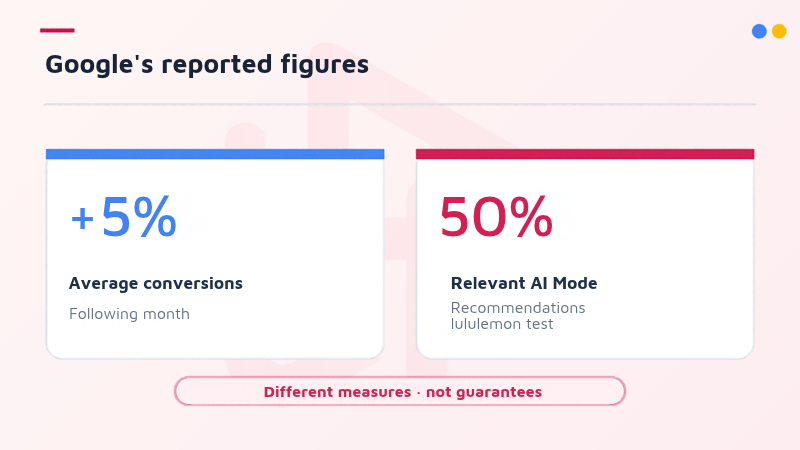
- Google reported a 5% average conversion increase for merchants adopting core feed practices; lululemon’s 50% pertains to a specific AI Mode recommendation test.
1. What Google announced for retailers in September 2026
Google’s 16 September announcement combined reporting, conversational shopping assistance, and checkout integration improvements. These developments belong to different parts of the retail journey. Before changing a feed or campaign, businesses should distinguish the feature, eligible market and deployment stage rather than interpreting the announcement as one worldwide Google Ads update.
1.1. AI performance insights: broader reporting, not a visibility guarantee
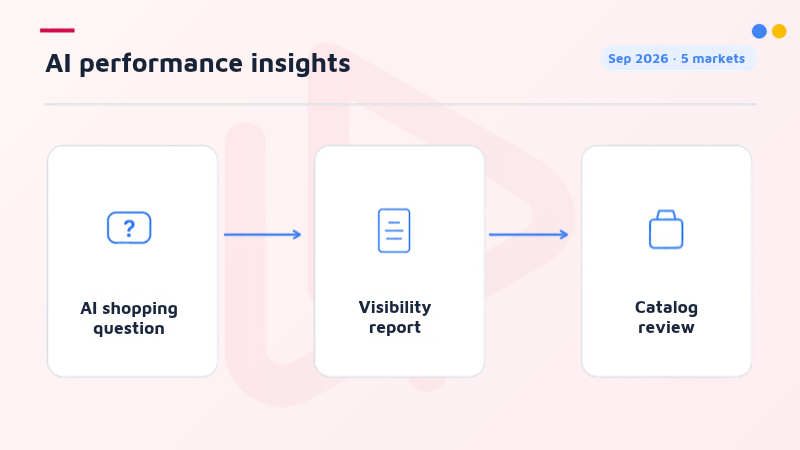
Google said AI performance insights in Merchant Center were available to businesses in Australia, Canada, India, New Zealand and the United States. The report examines discovery across shopping-related conversational experiences, including AI Mode and AI Overviews. Google’s help documentation further specifies English-language queries for accounts in those markets. A retailer outside this scope should not assume its account already has the same reporting interface.
The practical implication is diagnostic: teams with access can study how relevant shopping questions surface their brand, compare directional visibility signals, and decide whether product information needs improvement. This reporting capability does not establish that adding one attribute will produce a specific rank, AI citation, or impression volume.
Read more:
Google — September 2026 retail announcements
Google Merchant Center Help — AI performance insights
1.2. Business Agent for YouTube ads: a US beta
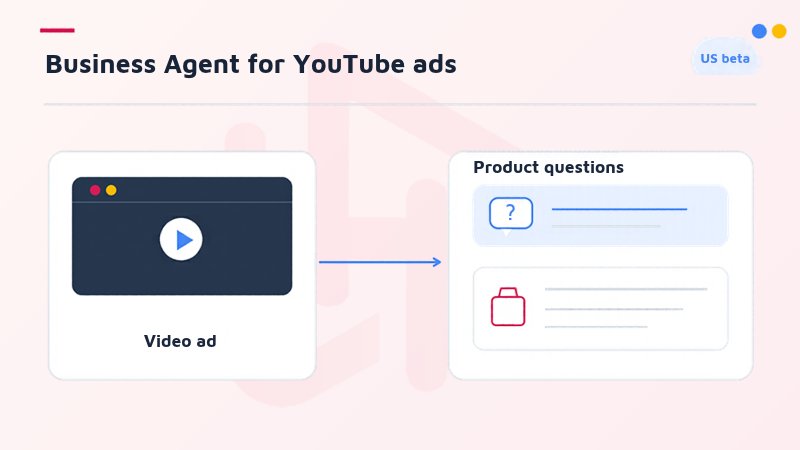
In the same announcement, Google invited retailers into a US beta for Business Agent embedded in YouTube ads. The experience is designed to let viewers ask product questions and receive brand-specific guidance without immediately leaving YouTube. This is an extension of Business Agent shopping assistance, not evidence that every advertiser can switch on an AI sales representative in an existing video campaign.
For an eligible merchant, useful preparation includes reviewing customer-facing answers, return and shipping policies, and product specifications for consistency. For merchants without access, these are readiness tasks – not a reason to promise a beta launch date or change the attribution model prematurely.
1.3. UCP integration hub: checkout capabilities with a phased rollout
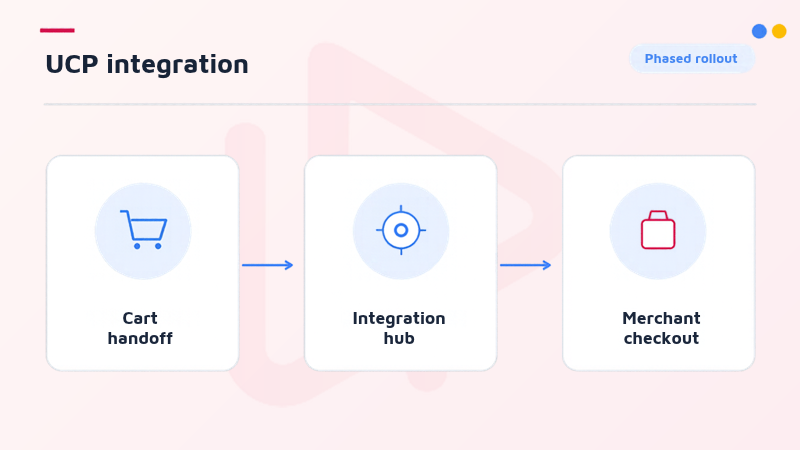
Google also described changes to the Universal Commerce Protocol (UCP) integration hub in Merchant Center, including cart transfer to a merchant site and improved checkout-flow testing for businesses using UCP-powered checkout. The announced additions were gradually rolling out in the US, with Australia and Canada named for an early-2027 expansion. UCP is an interoperability and transaction layer; it should not be confused with a new compulsory product title, GTIN, or bidding field.
A retailer evaluating UCP should separately verify market eligibility, supported checkout paths, payment operations, and post-purchase ownership. Standard Merchant Center feed accuracy remains relevant whether or not the merchant participates in UCP checkout.
| Feature | September 2026 status / scope | Recommended check |
|---|---|---|
| AI performance insights | Available: AU, CA, IN, NZ, US; English-language queries | Confirm Merchant Center account access and reporting scope |
| Business Agent for YouTube ads | US beta with invited retailers | Confirm invitation and product-information controls |
| UCP integration enhancements | Gradual US rollout; AU/CA targeted early 2027 | Validate integration and checkout eligibility |
| Conversational attributes | Optional Merchant Center product data | Pilot accurate attributes where genuinely useful |
| Video link | Optional video attribute; not a new September-only launch | Confirm supported URLs, quality and rights |
Read more:
Google — September 2026 commerce updates
Google — UCP introduction, January 2026
2. What the product feed guidance actually changes
The strongest feed-related takeaway is not a single mandatory “AI optimization score.” Google is encouraging merchants to keep standard product data reliable while adding useful context for conversational discovery. This distinction helps retail teams avoid replacing core compliance work with unverified claims about AI ranking or automated campaign performance.
2.1. Conversational attributes complement, rather than replace, core fields
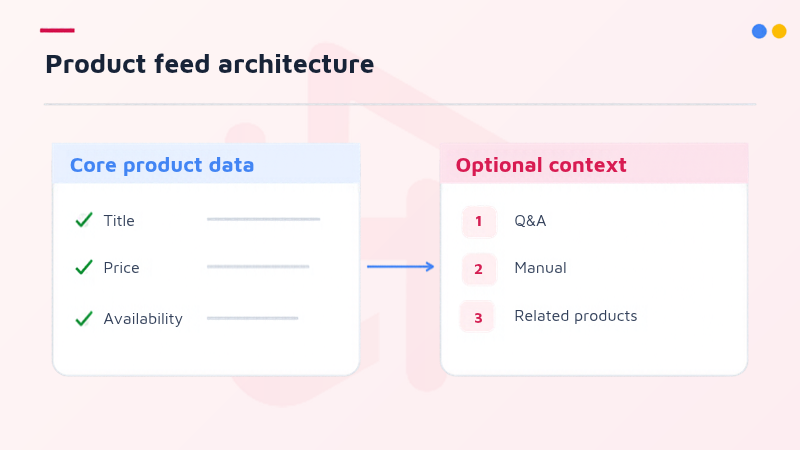
Google’s conversational attributes are explicitly optional and supplement primary Merchant Center specifications. Examples include question_and_answer for common product questions, document_link for accessible manuals, related_product for relevant accessories or substitutes, item_group_title and variant_option for clearer variant context, and popularity_rank. They can be submitted through a primary source, supplemental source, or Merchant API, where supported.
Before adding those fields, a catalog manager should verify factual descriptions, identifiers, prices, availability, and product URLs. A product that says “waterproof” in an AI-facing answer must be able to substantiate that property on its product page or accompanying documentation. Avoid duplicating details already covered by description, product_highlight or product_detail. Optional attributes provide additional context; they do not guarantee inclusion in AI Mode results.
Read more:
Google Merchant Center Help — conversational attributes
2.2. Product videos, loyalty information and reliable listings
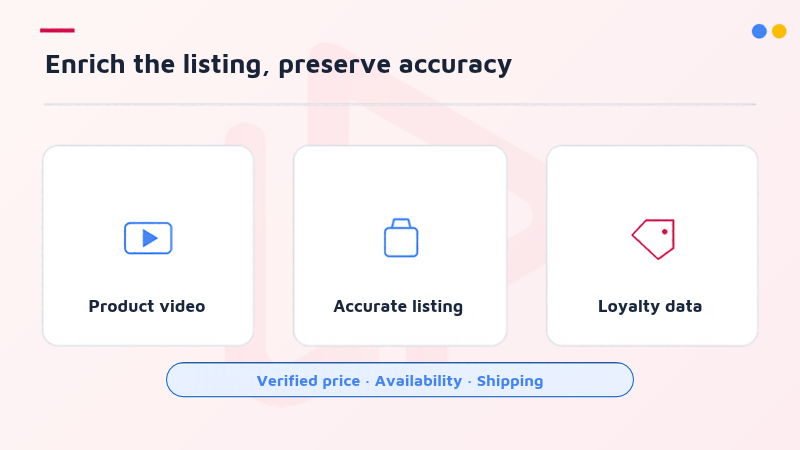
Google highlighted the video_link attribute as a way to supply additional product visuals, including demonstrations and in-use footage. This is distinct from image attributes such as lifestyle_image_link. The official video specification describes an optional field and requirements covering accessible video URLs, length, format, rights, and content quality. A valid video submission may broaden the assets Google can use; it is not a promise of distribution on a particular surface.
Google’s September briefing also mentioned connecting loyalty data in Merchant Center so member perks or member prices may be highlighted in eligible Google experiences. Merchants should validate program settings and applicable surfaces before promoting member-only benefits. Meanwhile, accurate price, availability, delivery, and return information remain foundational. An attractive video cannot correct a mismatched landing page or a disapproved item.
For how product feeds fit into adjacent video advertising formats, see H2T Media Group’s analysis of Demand Gen Drop #12. That campaign release is related context, not proof that all September Merchant Center capabilities were added to Demand Gen.
Read more:
Google Merchant Center Help — video link [video_link]
Google — September 2026 retail announcements
3. A measured response plan for ecommerce advertisers
An actionable response should begin with account diagnostics and proceed to controlled enrichment, not a wholesale rebuild of Performance Max or product titles. The sequence below is an H2T Media Group operational recommendation based on Google’s documented features. It is not presented as a Google-mandated checklist or a guaranteed formula for incremental ROAS.
3.1. Fix data integrity before experimenting with AI attributes
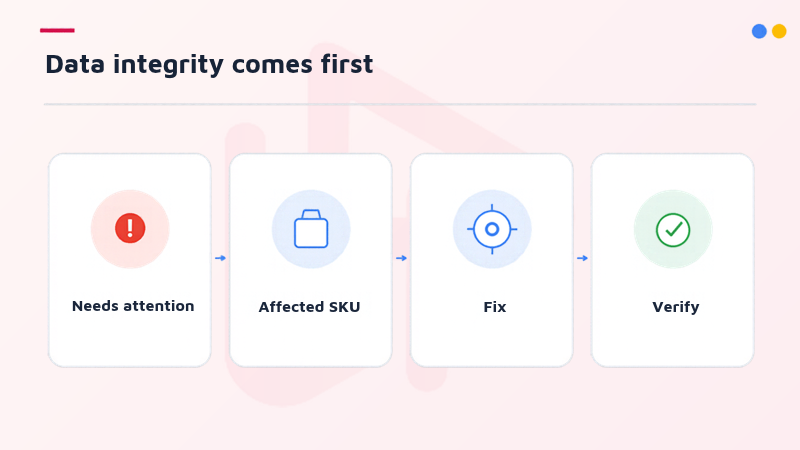
Start in Merchant Center’s Products > Needs attention area. Segment account-level and product-level issues, then prioritize disapprovals and material price or availability mismatches. Confirm that landing pages, identifiers, variants, shipping information, and images match the feed. Where automated updates are enabled, treat them as a safeguard rather than a substitute for a reliable primary data source and periodic reconciliation.
Build a short issue register with affected SKU count, market, suspected cause, owner, fix, and verification date. Record which products are eligible for Shopping or free listings before interpreting AI-related visibility changes. This baseline prevents teams from attributing ordinary approval recoveries to conversational attributes.
Read more:
Google Merchant Center Help — the Needs attention tab
3.2. Pilot enrichment and evaluate results without false attribution
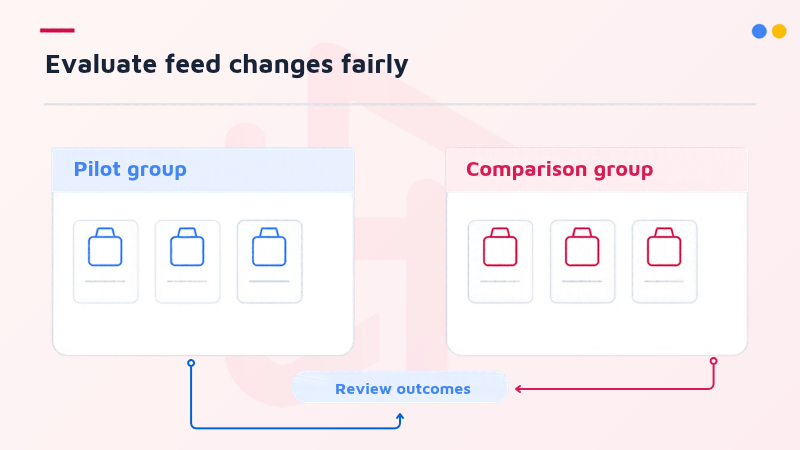
Select a manageable set of products with verified specifications and relevant shopper questions. Add only useful conversational attributes, videos, or loyalty information supported by the merchant’s systems. Keep a comparison group where operationally practical, document the rollout date, and watch approval status, impressions, clicks, product-level conversions, and customer-quality indicators. Metrics are subject to campaign mix, seasonality, and reporting access, so a short-term movement does not prove causality.
If the business is also revising shopping measurement, its decisions should be documented separately from feed edits. H2T Media Group’s broader Commerce Four discussion provides adjacent retail-planning context, but the September feed changes in this article should still be evaluated against their own source dates and eligibility conditions.
4. How to interpret Google’s 5% and lululemon 50% figures
Google reported that merchants adopting core Merchant Center feed best practices saw an average 5% increase in conversions in the following month. This is Google’s reported group-level observation; the public announcement does not establish that any individual retailer will gain exactly 5%, nor does it isolate every possible cause of the change. It should motivate better data hygiene, not become a forecast or contractual KPI.
Google also said that in a test with lululemon, submitted conversational attributes were incorporated in 50% of relevant product recommendations in AI Mode. The denominator is the relevant recommendations in that test, not all searches, ad auctions, or shoppers. The figure is not a 50% increase in conversion rate, click-through rate, or revenue. Both examples are useful signals, but neither substitutes for merchant-specific measurement and eligibility checks.
Read more:
Google — September 16, 2026: retail evidence and cases
5. Frequently asked questions
The following answers clarify the most common rollout and implementation misunderstandings. Availability can change after the September announcement, so final deployment decisions should be confirmed in the merchant’s own account and Google’s latest documentation.
No. Google calls them optional additions to its primary product data specification. Merchants should first meet the standard data and policy requirements for their products.
No. The September 2026 announcement listed Australia, Canada, India, New Zealand and the US; Google’s help page specifies English-language shopping queries. Check live account availability before relying on its metrics.
No. The optional attribute supplies product-video assets subject to technical and policy checks. Google may choose whether and where to use eligible content.
No. UCP supports interoperable commerce and checkout experiences, while a Merchant Center product feed describes offers and product information. They can work together but solve different problems.
Conclusion
Google agentic commerce product feed guidance 2026 is best understood as a September retail update with several distinct capabilities – not an instruction to rebuild every Google Ads campaign or a guarantee of AI recommendations. Retailers should prioritize valid Merchant Center listings, confirm rollout eligibility, enrich product information selectively, and measure outcomes against a documented baseline.
For more sourced retail advertising coverage, explore the Google Ads category from H2T Media Group. Follow H2T Media Group on Facebook and H2T Media Group on LinkedIn for further discussions on responsible platform adoption.

bichthao
H2T Media Group decodes every meaningful platform update for advertisers and affiliate partners across APAC, EU and North America — always with a practical "H2T take" you can act on.
More about H2T →