

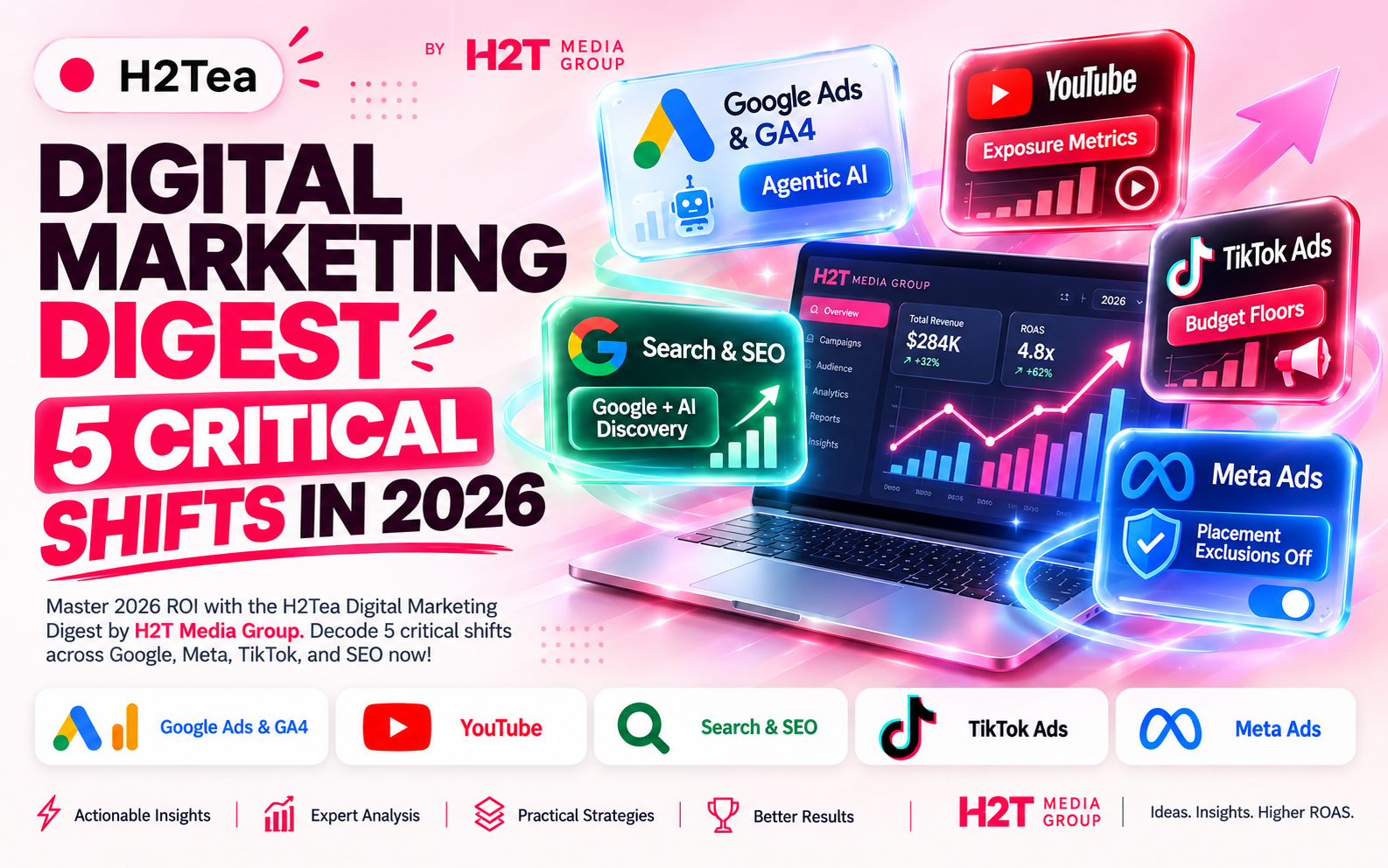
Welcome to this week’s edition of the H2Tea Digital Marketing Digest by H2T Media Group. Digital marketing strategy in 2026 is undergoing a foundational transition from manual interface toggles to server-side data infrastructure and real-time algorithmic serving. To maintain peak performance and maximize Q4 2026 ROI, growth leaders must deploy server-side tracking, transition to value-based bidding, leverage niche subcultural alignment, and master full-funnel AI serving engines across Google, TikTok, Meta, and SEO.
This edition dissects the core technical mechanics behind the 5 biggest adtech infrastructure shifts and delivers an enterprise execution playbook to help your brand dominate commercial performance. Read on to explore the complete landscape and master your strategy with the H2Tea Digital Marketing Digest by H2T Media Group!
 Key Takeaways
The H2Tea Digital Marketing digest (EP.08) synthesizes 5 critical adtech infrastructure transformations spanning Google, YouTube, SEO, TikTok, and Meta.
Essential Facts About This Week’s 5 Shifts
- Google Ads: Unveils “The Search Four,” shifting from flat tCPA form tracking to Value-Based Bidding via Tag Gateway and Data Manager.
- YouTube: Culture report proves 63% of young consumers build identity around specialized niche subcultures rather than mass broadcast TV.
- Local SEO: Automated spam filters trigger GBP review freezes; decentralizing reputation via owned on-page Schema is mandatory.
- TikTok Ads: Deploys Funnel HQ to eliminate last-click attribution bias via native Instant Forms and post-install app LTV modeling.
- Meta Ads: Meta One subscriptions do not alter ad delivery; the real Andromeda AI serving stack governs the auction.
1. Google Ads: “The Search Four” & Eradicating Lead Spam via VBB
The opening technical shift this week centers on Google Ads unveiling “The Search Four” framework at Rethink 2026, engineered to systematically resolve the enterprise lead quality crisis.
1.1. The failure of optimizing for raw lead volume
For years, B2B lead generation campaigns operated under the flawed premise of maximizing raw form fills. When configuring conversion goals around unvalidated form submissions using standard Maximize Conversions bidding, Google’s machine learning systems execute their mathematical directive: acquiring the highest volume of submissions at the lowest marginal cost.
The operational consequence is severe lead fraud: campaigns attract invalid phone numbers, fabricated emails, and automated bot submissions. Sales development representatives waste hundreds of hours qualifying spam, causing true Customer Acquisition Costs (CAC) to skyrocket despite artificially efficient dashboard CPL metrics.
1.2. Training Smart Bidding on closed-loop revenue milestones
Google mandates a complete transition toward Value-Based Bidding (VBB):
- Deploy Google Tag Gateway: Migrate website tagging to server-side proxy containers, guaranteeing 100% data capture resilient against browser tracking prevention.
- Synchronize Google Data Manager: Stream post-lead Offline Conversion Tracking (OCT) milestones directly from enterprise CRMs, explicitly categorizing marketing qualified leads (qualified_lead / MQL) and finalized sales (converted_lead / SQL).
- Calibrate Proxy Value Modeling: Assign fractional monetary values across pipeline milestones (e.g., $150 per MQL, $2,500 per closed deal). Smart Bidding algorithms autonomously suppress bids for low-intent form submitters while allocating aggressive liquidity toward high-value buyer cohorts.
2. YouTube: The Culture & Trends Report and the Rise of Niche Subcultures
The latest research published by YouTube Culture & Trends in partnership with NRG (surveying consumers aged 14–29) establishes an irreversible media reality: monolithic mass culture has fragmented.
2.1. The dissolution of centralized broadcast monoculture
Traditional top-down cultural distribution orchestrated by Hollywood studios and broadcast television has permanently decentralized:
- 63% of young consumers affirm that participating in specialized niche subcultures provides a significantly stronger sense of community identity than legacy mass-market media events.
- Audiences are distributed across thousands of distinct digital ecosystems: mechanical keyboard tuning, bespoke ceramic restoration, sustainable fashion thrifting, and indie animation lore.
2.2. The subcultural targeting imperative
Rather than executing generic broadcast campaigns targeting broad demographic buckets (such as “Men 18–34”), growth brands must aggregate passionate micro-communities:
- Deploy Custom Affinity segments grouping granular search terms directly within Demand Gen campaign asset groups.
- Co-create authentic video creative with micro-creators embedded within target subcultures, scaling high-definition 4K master cuts onto living room Connected TV (CTV) screens to capture shared household attention.
3. Local SEO: Automated GBP Review Lockdowns & First-Party Schema
Enterprise retail networks faced severe operational disruptions this week due to the deployment of aggressive automated review moderation algorithms by Google Business Profile (GBP). This development exposed major risks associated with relying entirely on third-party platforms for customer social proof.
3.1. Algorithmic velocity triggers and false-positive penalties
When Google’s neural spam classifiers detect sudden spikes in review acquisition velocity—frequently triggered by legitimate grand openings or customer service email sequences—the system executes an automated protective lockdown:
- Systematically purges authentic customer testimonials.
- Freezes public review submission mechanisms for a 7 to 14-day evaluation window without providing immediate manual appeals routing.
3.2. Decentralizing reputation sovereignty
This automated enforcement exposes the critical vulnerability of “Rented Land Syndrome.” Concentrating 100% of customer social proof within Google Maps leaves enterprise reputation vulnerable to algorithmic disruption.
- The H2T Operational Solution: Enterprises must construct owned, first-party review capture pipelines directly on their primary digital storefronts.
- Mark up on-site customer testimonials utilizing compliant JSON-LD Review and AggregateRating structured data. Generative AI engines (Gemini, ChatGPT Search) ingest these on-page machine-readable schemas independently, maintaining entity trust scores regardless of Google Maps platform freezes.
4. TikTok Ads: Funnel HQ Architecture & Dismantling Last-Click Attribution
TikTok for Business officially introduced “Funnel HQ Performance” to replace outdated single-touch attribution models with more advanced measurement tools. This technical framework addresses the multi-touch customer journey by combining native direct-response capabilities with assisted conversion modeling.
4.1. The failure of single-touch last-click measurement
Consumers routinely discover novel products via TikTok video, experience strong purchase conviction, but subsequently navigate to Google Search or enter a direct URL on desktop to finalize checkout. Evaluating performance exclusively through Google Analytics Last-Click Attribution misclassifies TikTok as an inefficient channel, triggering premature budget cuts that directly cause total enterprise sales volume to contract.
4.2. Closed-loop mobile conversion mechanics
TikTok Funnel HQ standardizes native direct-response tools:
- Native Instant Forms: In-app forms load instantly with pre-populated profile data, incorporating “Higher Intent” verification fields that compress mobile drop-offs and reduce blended CPL by 40% compared to external landing pages.
- App Lifetime Value Optimization (AEO/VBO): Transitions app promotion from low-cost install acquisition toward down-funnel in-app purchase revenue milestones.
- Assisted Conversion Modeling: Deploys geographic holdout testing to mathematically prove the causal incremental revenue generated by TikTok video impressions across the broader multi-touch customer journey.
5. Meta Ads: Debunking the Meta One Myth vs. The Real Andromeda Serving Engine
Widespread industry confusion emerged following Meta’s commercial rollout of the Meta One subscription bundle ($14.99 to $499/month), with speculation suggesting that paid subscribers receive preferential ad auction delivery.
5.1. Decoupling commercial SaaS from ad auctions
The technical reality is definitive: Meta One shares zero operational infrastructure with Ads Manager.
- Meta One is an organic software utility designed for profile verification, post scheduling, and customer service automation via the Meta Business Agent.
- Subscribing confers zero ad credits, zero CPM reductions, and zero priority within live ad auctions.
5.2. The real ad serving engine: The Andromeda AI stack
The true computational infrastructure governing ad delivery and auction pricing in 2026 is the Andromeda, GEM, and Lattice architecture:
- Andromeda: High-speed candidate retrieval engine filtering millions of active ads down to high-relevance candidate pools in milliseconds.
- GEM (Generative Engagement Model): Deploys computer vision and deep natural language processing to decode video keyframes, audio transcripts, and text copy, positioning creative assets as the primary targeting mechanism.
- Lattice: Multi-task deep neural network predicting conversion propensity and customer lifetime value (pLTV).
According to technical documentation from Meta Business Engineering Resources, scaling enterprise performance requires maintaining Server-Side Conversions API (CAPI) Event Match Quality (EMQ) scores ≥ 8.5/10 and engineering diverse visual creative variations rather than investing in superficial software bundles.
6. Technical Specifications Matrix: Synthesizing the 5 Weekly Platform Shifts
The technical matrix below outlines the core updates, algorithmic mechanisms, and mandatory operational directives across all five platforms:
| Advertising Platform | Core Technical Upgrade | Algorithmic Mechanism Shift | Mandatory Enterprise Action Protocol |
|---|---|---|---|
| Google Ads | “The Search Four” Framework. | Machine learning optimizes for verified CRM revenue. | Deploy Tag Gateway; stream MQL/SQL values via Data Manager. |
| YouTube | Culture & Trends Report 2026. | 63% of young consumers anchor in niche subcultures. | Target passion clusters via Custom Affinity and Shorts ads. |
| Local SEO | Automated GBP Review Lockdowns. | Algorithmic velocity triggers freeze public reviews. | Deploy on-site JSON-LD AggregateRating review schema. |
| TikTok Ads | Funnel HQ Performance Suite. | Replaces last-click bias with assisted conversion modeling. | Implement Instant Forms with Higher Intent; map in-app LTV. |
| Meta Ads | The Andromeda Serving Engine. | Computer vision parses creative to match buyer cohorts. | Diversify visual environments; maintain CAPI EMQ ≥ 8.5. |
7. The Enterprise Q4 Execution Blueprint for Growth Leaders
To translate this week’s technical updates into scalable Q4 commercial revenue, H2T Media Group mandates the following 3-pillar operational roadmap:
Pillar 1: Fortify Server-Side Measurement Infrastructure Audit tracking pipelines across Google Tag Gateway, Server-Side Meta CAPI, and TikTok Events API. Ensure verified revenue outcomes and offline sales milestones stream back to ad platforms in real time to train automated bidding models accurately.
Pillar 2: Eliminate Mono-Format Creative Production Abandon generic corporate broadcast commercials. Produce native, vertical 9:16 video assets engineered with high-impact 3-second opening problem-solving hooks. Diversify visual environments to provide Meta’s Andromeda engine with distinct candidate tags.
Pillar 3: Unify Full-Funnel Distribution and Liquid Budgets Eliminate rigid daily budget caps during peak retail weeks. Deploy Demand-Led Budgets anchored by Value-Based Bidding (Target ROAS) to empower algorithms to capture 100% of high-intent commercial demand across YouTube, Search, and social feeds.
8. Frequently Asked Questions
Calculate historical sales pipeline conversion rates. If 10% of Sales Qualified Leads (SQLs) convert into an average $10,000 contract, assign a mathematical proxy value of $1,000 to each SQL event within Data Manager to train Smart Bidding models within 72 hours of qualification.
Halt all active review-generation campaigns immediately to allow the velocity anomaly to cool down. Redirect incoming customer feedback to an owned review portal on your primary website marked up with Schema.org vocabulary.
No. Meta One operates on isolated server infrastructure dedicated to organic management and customer service. It confers zero advantages within the Ads Manager bidding auction.
Configure the form using the “Higher Intent” setting. This introduces a review confirmation step and allows the integration of custom qualifying questions, eliminating accidental submissions while preserving mobile loading speed.
The 5 shifts in this H2Tea Digital Marketing Digest prove one reality: while algorithmic automation scales distribution, strategic data governance protects net profit margins. As AI takes full control of ad auctions, sustainable dominance belongs to brands that master first-party data, native creative, and multi-layered measurement. Audit your tech stack today to capture peak Q4 market share.
To access proprietary technical frameworks and advanced full-funnel performance playbooks, explore our full repository on the Insights hub at H2T Media Group. Make sure to consistently follow our dedicated H2Tea to master the executive briefings dictating success across global digital advertising ecosystems.

bichthao
H2T Media Group decodes every meaningful platform update for advertisers and affiliate partners across APAC, EU and North America — always with a practical "H2T take" you can act on.
More about H2T →