


Ads Decoded reporting discrepancies were the focus of Google’s September 2, 2026 conversation with Ads Product Liaison Ginny Marvin and Ads Measurement leader John Chen. Rather than declaring one reporting platform correct, the discussion explained how attribution, incrementality testing, and media mix modeling answer different questions. H2T Media Group reviews what Google actually said, including the limitations of Qualified Future Conversions and cross-channel planning tools.
 Key Takeaways
Ads Decoded reporting discrepancies reflect differing analytical roles and definitions – not a need to nominate one universal reporting dashboard.
Essential facts about the Ads Decoded discussion
- Google’s September 2, 2026 discussion featured Ginny Marvin and John Chen.
- Reporting comparisons must align conversion definitions, reporting time, and attribution scope.
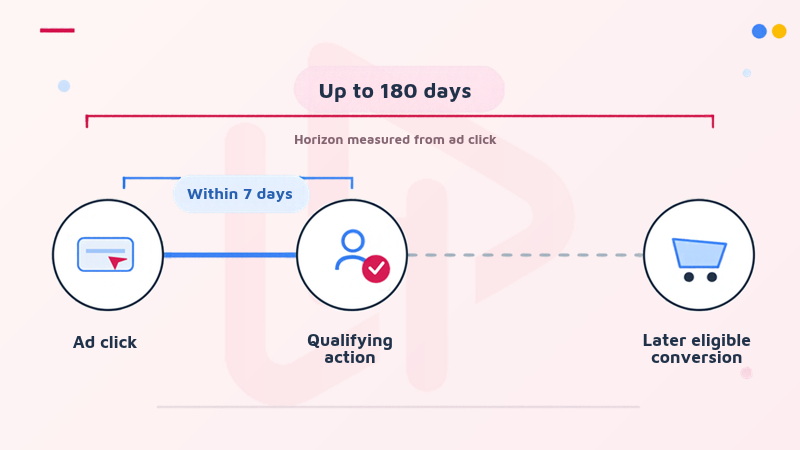
- QFCs require a qualifying signal within seven days, and can consider later conversions up to 180 days; the September recap called the feature a closed pilot.
- Projection and Scenario plans are estimates and do not directly change campaign budgets.
- Meridian and GA4 budgeting product surfaces have different availability and requirements.
1. Why reporting tools disagree
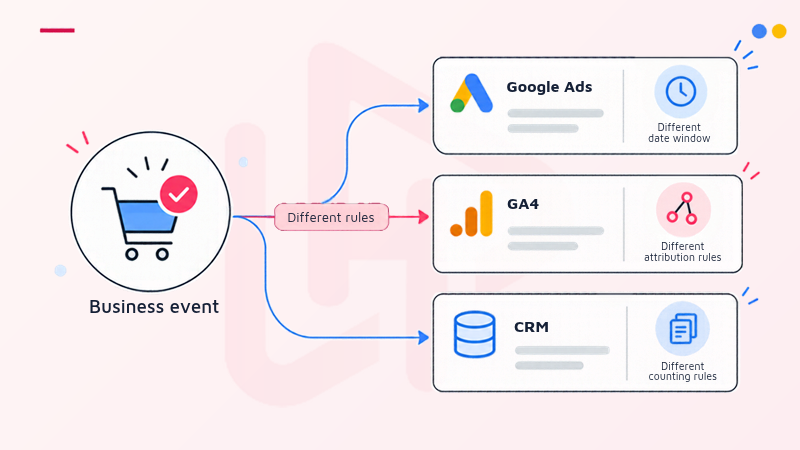
Disagreement between Google Ads, Google Analytics and an internal sales system does not necessarily mean that tracking is broken. The episode’s central point was broader: each measurement method observes a different slice of performance, at a different cadence and level of aggregation. An advertiser first needs to compare like with like before interpreting a gap as wasted spend.
1.1. Different definitions create different numbers
For conversion reporting specifically, Google Ads can assign a reported conversion to the ad interaction date, while certain Analytics reports use conversion time. Google also distinguishes Analytics key events, which describe behavior, from advertising conversions, which support campaign measurement and bidding. Attribution credit, lookback windows, counting settings, time zones and reporting scope can all alter a comparison.
That means a mismatch is not, by itself, evidence that Google Ads always reports a higher number than GA4. Teams should identify the conversion action, column, date basis and attribution configuration behind each figure before drawing a conclusion. A procedural troubleshooting guide belongs in a separate, focused evergreen article – not in this news recap.
Read more:
Google Analytics Help — Conversions vs. key events
Google Ads Help — Create conversions from Analytics events
1.2. Google’s answer is triangulation, not one dashboard
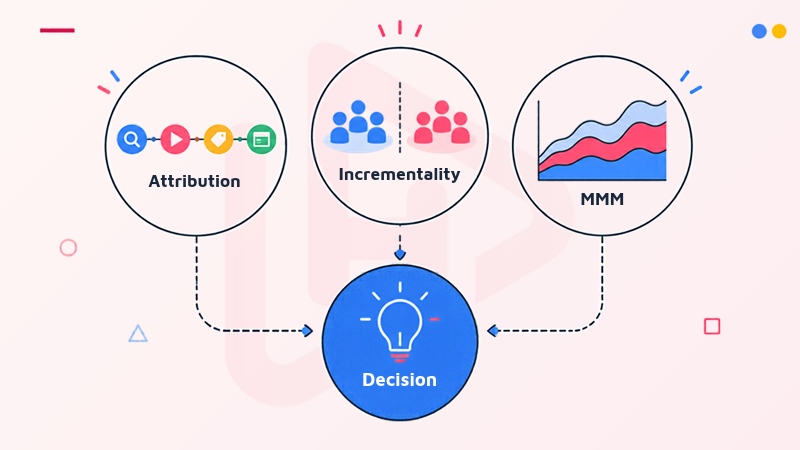
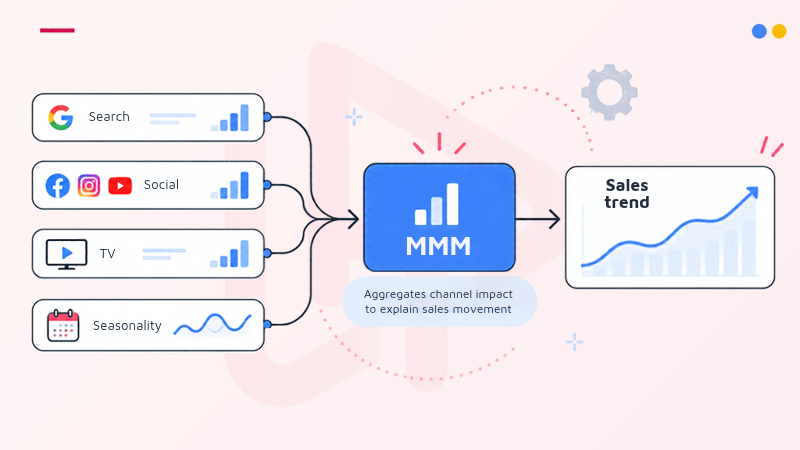
John Chen argued against treating a single model as the ‘North Star’. Attribution offers continuous, fast feedback, while an incrementality holdout estimates what changed because advertising ran. Media mix modeling (MMM) analyzes the relationship between spend and outcomes at an aggregate level. These are complementary instruments, not three copies of the same metric.
A test measured in spring may not explain holiday trading conditions, and an MMM will not usually diagnose a particular keyword or creative. Conversely, near-real-time attributed conversions cannot prove how many sales would have occurred without the ad. The episode’s recommendation was to interpret each signal in context.
Read more:
Google Ads — Ads Decoded: Attribution, incrementality & MMM
2. Attribution, incrementality and MMM serve different decisions
The practical value of the Ads Decoded discussion is its division of measurement responsibilities. Instead of reconciling all reports into a single total, advertisers can select the method most suited to the decision, acknowledge its blind spots and use another method as a cross-check.
2.1. Attribution supports timely campaign decisions
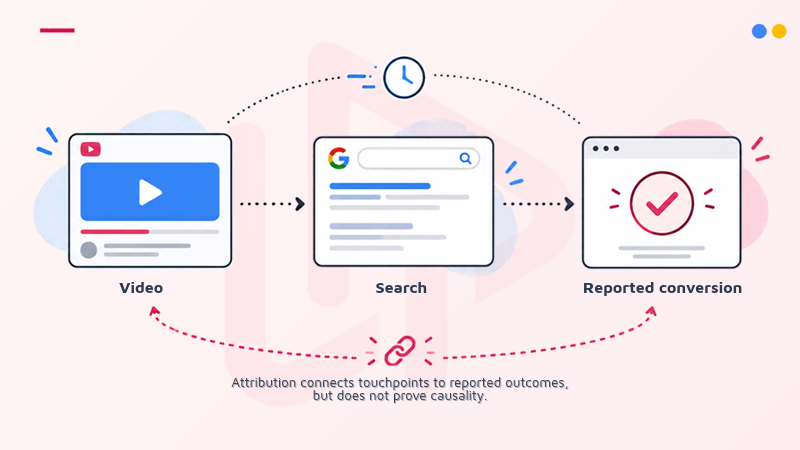
Attribution connects eligible advertising interactions with reported outcomes, giving campaign teams frequent directional feedback. The conversation encouraged advertisers to move beyond last-click views of the journey, particularly where video, connected TV and other discovery formats may influence a customer before the final click. Cross-publisher view data can be difficult to collect consistently; a data-driven model alone cannot compensate for absent inputs.
2.2. Incrementality tests causal lift for a defined period
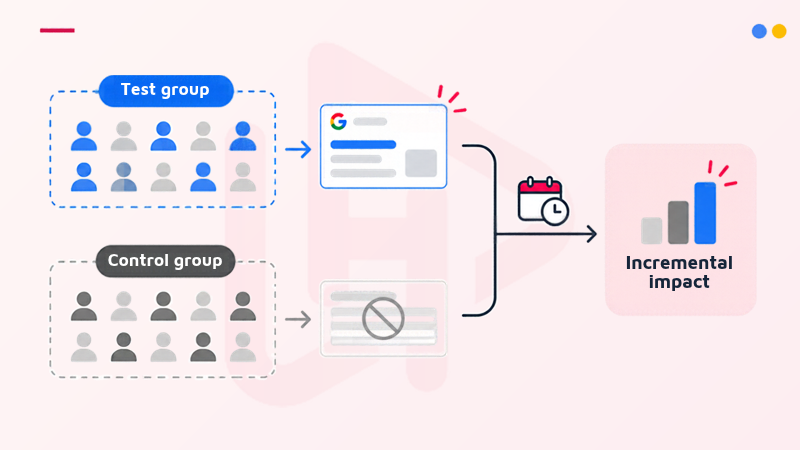
A well-designed holdout or geographic experiment compares exposed and control conditions to estimate incremental outcomes. That makes it useful for challenging whether an attributed conversion would have happened anyway. However, the test is bounded by its design, timing, sample, and potential contamination. The speaker mentioned periodic studies as an illustrative cadence—not a requirement for every brand to run GeoX once each quarter.
2.3. MMM adds a strategic, aggregated view
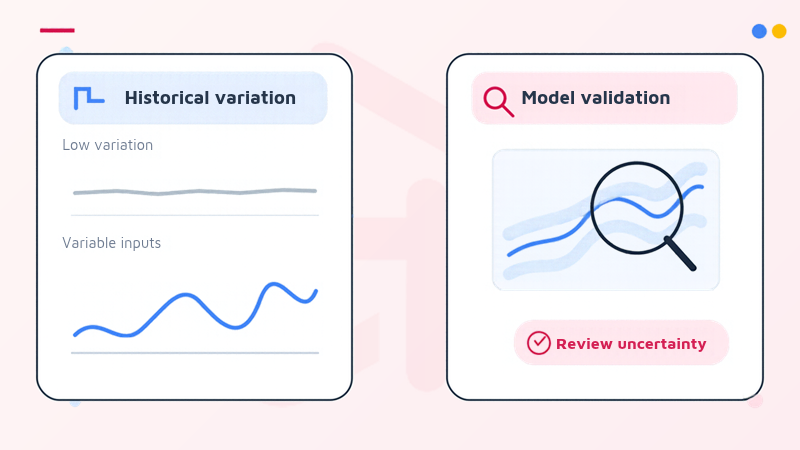
An MMM models outcomes using historical marketing inputs and other explanatory factors. It is suited to allocation questions across channels and longer horizons, rather than minute-by-minute bid management. Google highlighted Meridian as an open-source route into MMM, while caution is still needed: adequate data quality, variation, assumptions and model validation all affect usefulness. Aggregate modeling reduces dependence on person-level tracking but does not independently guarantee legal compliance.
| Method | Best-fit decision | Main limitation |
|---|---|---|
| Attribution | Daily campaign and bidding signals | Does not establish counterfactual lift |
| Incrementality | Causal impact of a specific test | Limited by experiment period and design |
| MMM / Meridian | Strategic cross-channel allocation | Aggregate findings depend on inputs and assumptions |
3. Qualified Future Conversions: a longer measurement horizon
One of the new measurement concepts discussed in the episode was Qualified Future Conversions (QFCs). Its purpose is to recognize valuable customer journeys that extend beyond a standard short attribution window, especially in demand-creation media. The mechanism and its availability must be described separately.
3.1. Seven-day signal and up to 180-day conversion horizon
Chen described an early qualifying action within seven days after an ad click, such as an attributed branded search, a website visit or an add-to-cart. When such a signal is present, the approach can account for later conversions across windows including 30, 90 and up to 180 days. The seven-day qualification period is not the same as the longer period for subsequent conversion outcomes.
Google positions QFCs as an additional view of longer-term effects, not as proof that an ad caused every eventual sale. The interview did not provide a universal accuracy guarantee or a demonstrated uplift applicable to all campaigns.
3.2. Availability is not a universal launch
The Google Ads LinkedIn recap of this September discussion described QFCs as being in a closed pilot. Consequently, the correct takeaway for advertisers is to monitor availability and document current conversion-window definitions—not to assume a QFC switch can already be activated inside every Demand Gen or YouTube account. Any later expansion would require separate release verification.

Read more:
Google Ads — Resolving the data tug-of-war
Accelerate with Google — Qualified future conversions
4. Cross-channel budgeting in Google Analytics
The conversation also connected measurement data with budget planning. Google Analytics cross-channel budgeting introduces projections for campaigns already running and scenarios for future allocation. These planning features address a different question from raw conversion reconciliation and should not be mistaken for automatically changing an ad account’s spend.
4.1. Projection plans versus scenario plans
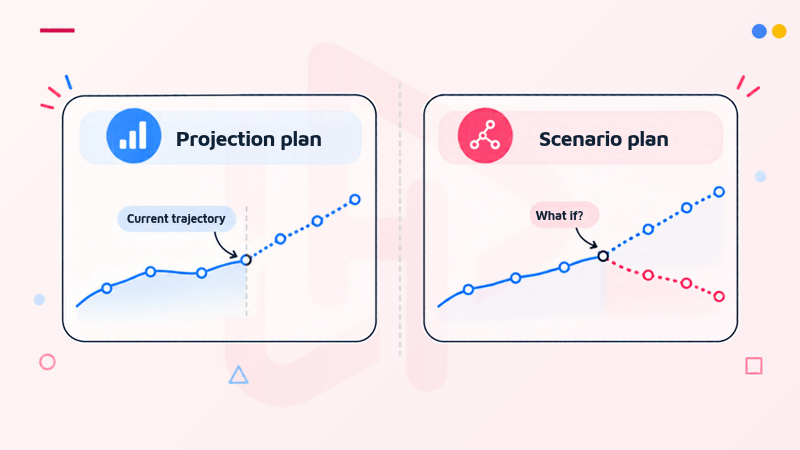
Projection plans estimate whether current investments are tracking toward a spend, conversion or revenue goal; scenario plans explore modeled outcomes under alternative future budget distributions. Google describes both as planning and analysis tools, not account-side automation. Predicted returns depend on historical data and model confidence and must not be presented as guaranteed ROAS.
4.2. Eligibility and data limits matter
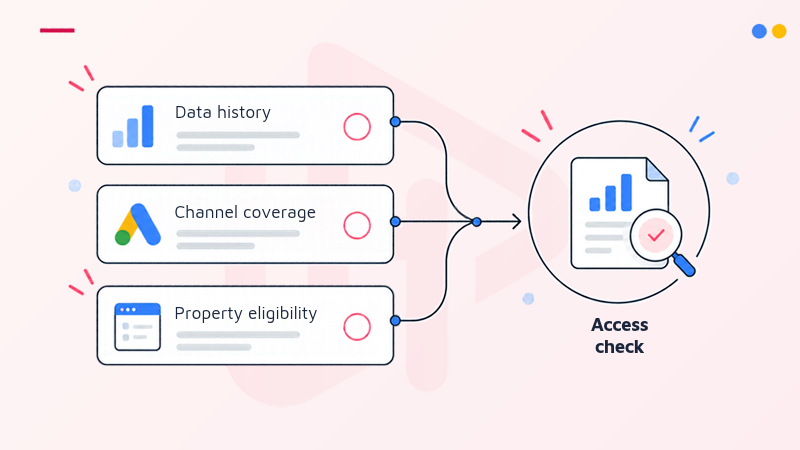
Google’s documentation describes eligibility checks based on sufficient conversion and paid-channel campaign history; its stated baseline includes roughly a year of qualifying data and activity from at least two channels, spanning Google and non-Google media. Access is not universal to every Google Analytics property. The model may exclude channels with insufficient usable data; account teams should verify their own property status before promising a planning workflow.
Read more:
Google Analytics Help — About cross-channel budgeting
5. Meridian makes MMM more accessible, but not automatic
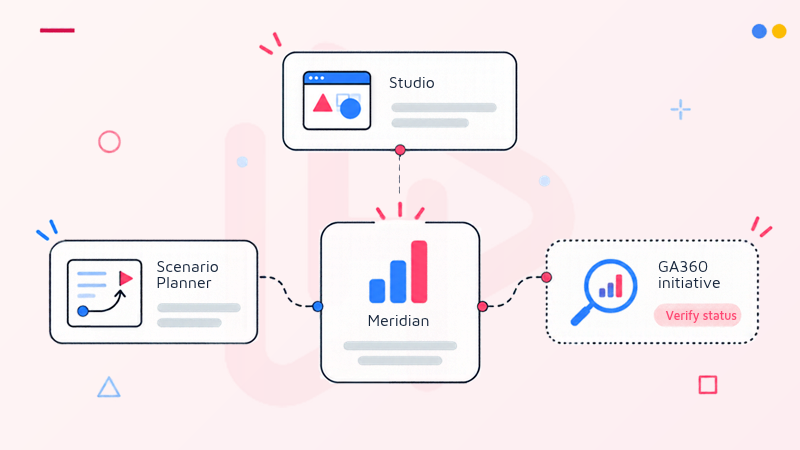
Meridian was discussed as an open-source MMM option designed to reduce historical implementation barriers. The episode distinguished the core modeling technology from additional product surfaces such as Meridian Studio, the Meridian Scenario Planner and the Google Analytics 360 initiative. These should not be collapsed into one universally available integration.
5.1. Distinguish product surfaces and availability
In the interview, Google identified Meridian Studio as a cloud-based path to using the model with existing data, and described work to bring a Meridian-based experience into Google Analytics 360. Google’s budgeting documentation also differentiates DDA-based budgeting options from Meridian-based models, with eligibility depending on product tier and rollout stage. Teams should check what is actually enabled rather than assuming every GA4 property has a native Meridian workspace.
5.2. Data variation and validation remain essential
Google’s accompanying agency discussion noted that variation in spend and outcomes matters for identifying effects. This is a useful design consideration, not permission to engineer artificial spend shocks or a guarantee that a smaller data set will yield precise estimates. Before acting on modeled budget shifts, marketers need reliable historical inputs, meaningful variability, uncertainty review and business judgment.
Read more:
Google Ads & Commerce Blog — Marketing metrics you can trust
Google Analytics Help — Cross-channel budgeting powered by Meridian
6. What advertisers should take away from Ads Decoded
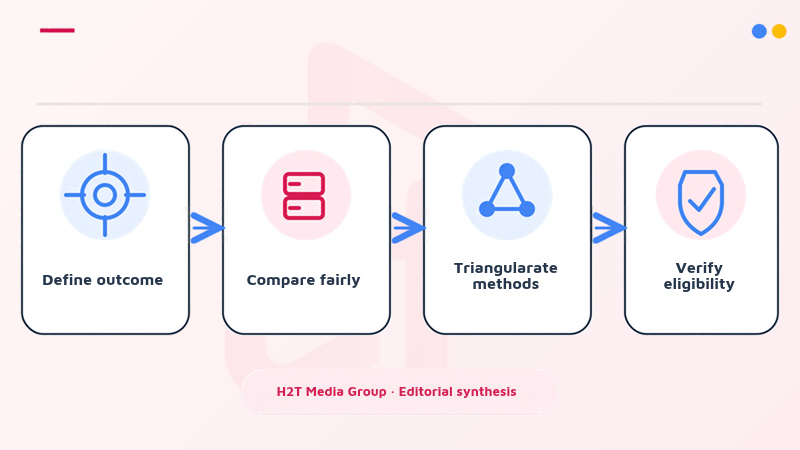
H2T Media Group’s interpretation of the conversation is straightforward: match measurement tools to the decision, then explain discrepancies as differences in scope and methodology before labeling them tracking defects. This is editorial guidance drawn from the discussion, not a mandated configuration issued by Google.
- Define which business outcome each report measures and compare the same time basis, action and attribution scope.
- Use attribution for timely campaign signals; use well-designed experiments and aggregate modeling to challenge the causal story.
- Document the source and eligibility of emerging metrics such as QFCs before using them in executive forecasts.
- Treat cross-channel budget projections as estimates, with scenario assumptions and limits clearly stated.
For teams following wider digital marketing updates, this episode is a useful example of why feature availability and measurement purpose matter as much as dashboards. The Google Ads category covers related platform announcements without turning this news article into a full measurement implementation manual.
7. Frequently asked questions
These answers summarize the September Ads Decoded discussion and the relevant Google documentation; they do not replace an account-specific analytics audit.
No. Differences may come from event definitions, attribution scope, reporting time, counting settings or missing data. Compare equivalent conversions and time windows before diagnosing a fault.
Google’s speakers did not endorse one universal measurement model. Attribution, incrementality and MMM answer different operational, causal and strategic questions.
No such general availability was established in the September discussion. Google’s contemporary recap described QFCs as a closed pilot; verify availability in your own account.
No. They are modeling and planning tools. Implementing any recommended allocation requires separate decisions and changes in the appropriate buying platforms.
Ads Decoded reporting discrepancies illustrate a larger lesson: faster data is not always causal evidence, and long-horizon models do not replace real-time optimization. H2T Media Group recommends keeping attribution, experiments, and MMM in dialogue while checking product eligibility before implementation. Follow our Google Ads category and connect with H2T Media Group on Facebook and H2T Media Group on LinkedIn for further discussions.

bichthao
H2T Media Group decodes every meaningful platform update for advertisers and affiliate partners across APAC, EU and North America — always with a practical "H2T take" you can act on.
More about H2T →