

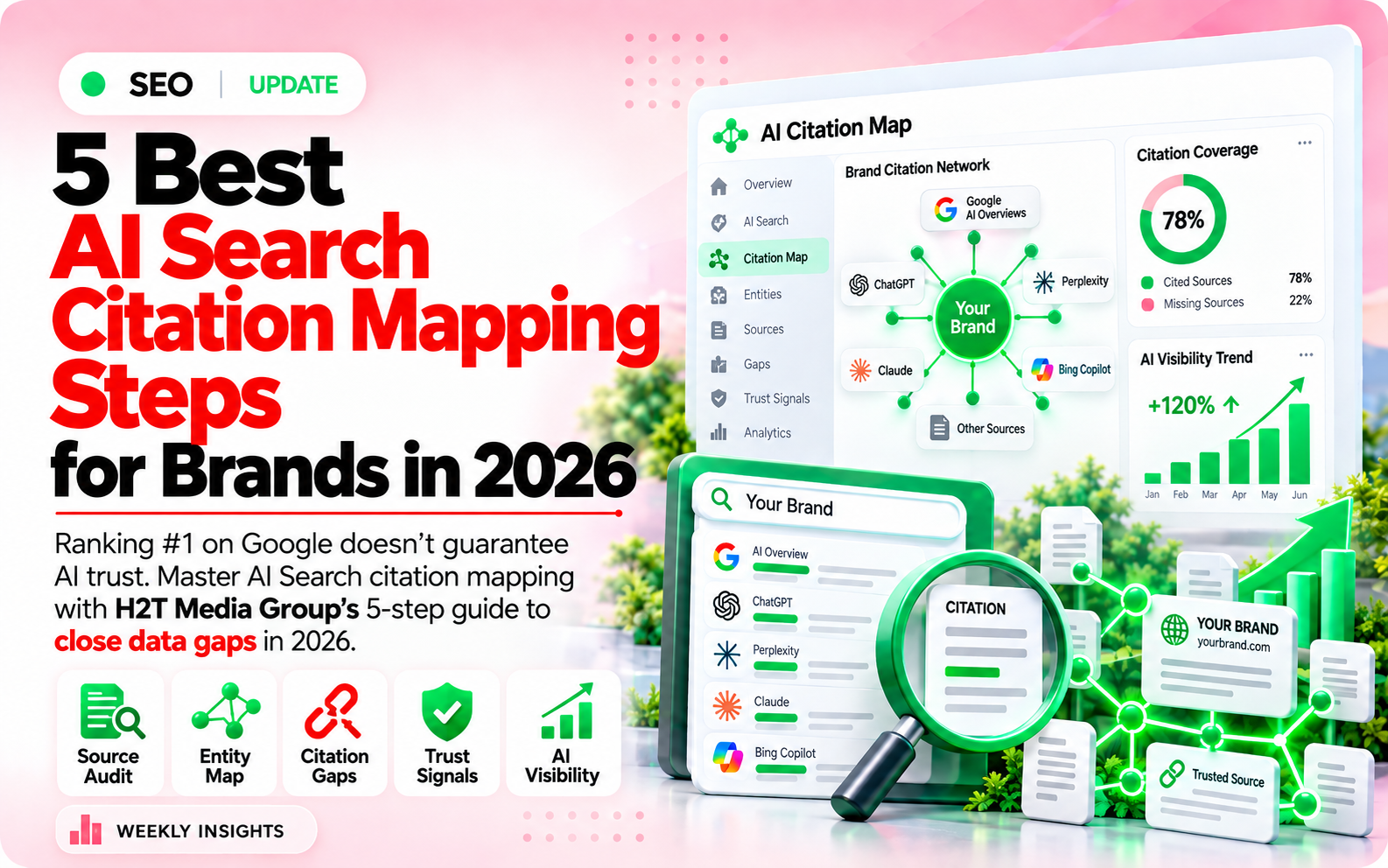
Welcome to the digital performance and search insights hub by H2T Media Group. Executing an AI Search citation mapping strategy requires brands to systematically audit competitor visibility within LLM outputs, isolate vertical-specific dataset preferences, and optimize high-trust surfaces beyond legacy SERP rankings. Relying solely on top Google search rankings no longer guarantees visibility in generative search engines like ChatGPT, Perplexity, or Google Gemini. Below is H2T’s technical analysis and the 5-step operational framework needed to command AI Search and establish your brand as an authoritative citation node with H2T Media Group.
 Key Takeaways
AI Search citation mapping is the diagnostic framework used to identify, categorize, and capture the exact digital sources LLMs cite in user answers.
Essential Strategic Directives
- Vertical-Specific Datasets: Language models prioritize distinct verification sources depending on specific industry verticals.
- Industry Data Requirements: E-commerce mandates tabular specifications; B2B tech requires third-party peer reviews (G2, Trustpilot).
- Exposing Competitor Footprints: Building a Citation Map exposes the exact data sources driving competitor AI recommendations.
- Targeted Entity Optimization: Replace keyword stuffing with targeted digital PR, on-site data structuring, and community engagement.
- Share of Model (SoM): Evaluate organic authority via Share of Model (SoM) rather than traditional search position tracking.
1. The Divergence Between Legacy SERP Rankings and AI Grounding Datasets
For over a decade, digital performance success was defined strictly by winning the #1 organic ranking position across high-volume keyword strings.
1.1. Indexing mechanisms vs. LLM grounding memory
Legacy search algorithms rank web documents based on external backlink profiles and on-page keyword density metrics. Conversely, generative language models operate utilizing semantic reasoning and entity resolution. When a prospect submits a complex commercial prompt, the AI does not simply summarize the top-ranking link. It cross-references multiple independent data repositories across the web graph to establish factual consensus.
If a website commands the #1 position solely through aggressive backlink acquisition but lacks original empirical data or third-party validation, the language model will systematically bypass that URL to cite an authoritative, data-dense analysis situated on page two of search results.
1.2. The threat of generative invisibility
Modern consumers increasingly consume synthesized answers delivered directly within AI Overviews, ChatGPT Search, and Perplexity, bypassing traditional website links entirely.
If your corporate domain is optimized exclusively for legacy SERPs but remains absent from the foundational grounding datasets queried by AI models, your business becomes completely invisible to the highest-converting buyer cohorts.
2. How AI Engines Segment Data Authority Across Industry Verticals
A critical strategic error across enterprise SEO is deploying uniform content templates across disparate commercial sectors. AI models exhibit highly specific data preferences per vertical:
2.1. E-Commerce and Consumer Retail
When consumers interrogate AI regarding physical merchandise, the model seeks structural verification:
- Granular manufacturer specification tables.
- Real-time pricing parameters and stock availability authenticated via Schema markup.
- Unbiased side-by-side feature comparison matrices.
2.2. B2B Enterprise Software and IT Services
Modern B2B decision-makers consistently prioritize empirical performance metrics and verified peer consensus over proprietary marketing claims, prompting generative AI models to systematically bypass promotional copy in favor of objective, third-party validation.
When synthesizing enterprise recommendations, the AI prioritizes:
- Unbiased customer sentiment and verified ratings aggregated across platforms like G2, Trustpilot, and Capterra.
- Granular architectural documentation, API manuals, and quantitative case studies demonstrating measurable ROI.
- Independent editorial analyses published by recognized industry authorities.
2.3. Digital Agencies, Consulting, and Professional Services
For qualitative and consultative services, language models prioritize decentralized consensus:
- Authentic, unmanipulated peer discussions across professional forums like Reddit, Quora, and specialized industry boards.
- Verified client portfolio case studies and recognized industry awards.
3. Defining the AI Search Citation Mapping Architecture
Rather than speculating on algorithmic preferences, performance agencies deploy AI Search citation mapping to reverse-engineer competitor data footprints.
3.1. Identifying proprietary information gaps
Citation mapping is an empirical audit methodology designed to quantify:
- Which specific URLs language models retrieve to substantiate competitor recommendations.
- Whether cited sources originate from owned domains, third-party review directories, or editorial publications.
- Where competing entities maintain authoritative footprint while your brand remains entirely absent.
The gap separating the sources AI cites for your competitors from your current digital footprint represents the exact “Information Gap” your team must systematically bridge.
3.2. Transitioning from keyword stuffing to entity corroboration
Once an information gap is identified, marketing teams systematically stop wasting resources on generic, low-quality blog filler. Instead, they reallocate capital directly toward high-impact data optimization that actively feeds LLM retrieval systems.
Capital is allocated toward high-impact data optimization:
- If the AI consistently cites comparison threads on Reddit: Deploy authorized technical specialists to contribute authentic, high-value problem-solving answers.
- If the AI retrieves data from an industry trade publication: Execute targeted digital PR to insert proprietary benchmark research into that specific publication.
- If the AI fails to parse your on-site data: Re-engineer content using semantic HTML tables and Schema markup.
According to developer documentation from Google Search Central, establishing factual accuracy and verified entity consensus across reputable sources represents the foundational requirement for visibility in generative search.
4. Technical Matrix: Primary AI Trust Sources by Commercial Vertical
The technical matrix below outlines the primary data surfaces language models prioritize when synthesizing commercial answers across key verticals:
| Target Commercial Vertical | Prioritized Data Taxonomy | Primary Cited Digital Surfaces | Mandatory Technical Execution |
|---|---|---|---|
| Retail & E-Commerce | Tabular specifications, pricing, comparisons. | Product landing pages, YouTube unboxings, GMC Feeds. | Deploy Product Schema, build raw HTML <table> specs. |
| B2B SaaS & Enterprise Tech | Verified feature utility, security, stability. | G2, Trustpilot, API documentation, Whitepapers. | Harvest verified reviews, publish technical whitepapers. |
| Agencies & Consultancies | Demonstrated execution, authentic peer proof. | Reddit subcultures, Case studies, Trade journals. | Publish data-backed case studies, engage in forums. |
| Healthcare & Medical | Clinical efficacy, verified doctor credentials. | Medical journals, Physician profiles, Health registries. | Declare MedicalEntity Schema, cite clinical literature. |
| Local Professional Services | Verified proximity, customer feedback, hours. | Google Maps, Local directories, Regional press. | Enforce 100% NAP parity, build multi-platform reviews. |
5. The 5-Step Operational Blueprint for AI Search Citation Mapping
To execute AI Search citation mapping and systematically capture LLM citation share, H2T Media Group mandates the following 5-step framework:
5.1. Step 1: Isolate 10 to 20 Critical Pre-Purchase Inquiries
Collaborate directly with sales and customer support teams to identify the 10 to 20 definitive questions prospects evaluate immediately prior to procurement:
- “What is the top enterprise CRM for a 50-person financial services firm?”
- “What are the verified pros and cons of Solution A versus Solution B?”
- “What is the total cost of ownership for deploying Solution X?”
5.2. Step 2: Execute Multi-Engine Query Testing
Submit these exact prompt strings across all four primary AI search engines: Google AI Overviews, ChatGPT Search, Perplexity AI, and Claude.
Log the complete synthesized narrative generated across each query session. Then, systematically extract and catalog every cited reference link for analysis.
5.3. Step 3: Categorize and Map All Cited Sources
Inspect every cited URL and classify it across four architectural tiers:
- Owned corporate domains (Owned Media).
- Decentralized community discussion boards (Community).
- Independent third-party review directories (Review Platforms).
- Verified industry trade press and news journals (Earned Media).
5.4. Step 4: Audit Competitor Footprint vs. Brand Absence
Construct a comparative matrix: Across the 20 core prompt evaluations, calculate how frequently competitors are cited versus your brand. Isolate the specific third-party URLs feeding the AI’s positive competitor sentiment where your domain maintains zero presence.
5.5. Step 5: Allocate Tactical Resources to Close Information Gaps
Deploy dedicated operational teams to address the identified data deficits:
- On-Site Technical Teams: Restructure landing pages to feature direct HTML comparison tables and concise FAQ blocks resolving the specific criteria the AI evaluates.
- Digital PR Teams: Secure brand inclusion and proprietary data citations within the specific trade publications the AI utilizes as grounding sources.
- Community Strategists: Provide authentic, high-utility technical contributions within the specific forum threads language models parse during real-time retrieval.
6. Frequently Asked Questions
Organizations should execute a complete Citation Map audit quarterly. Language models continuously update their training datasets and recalibrate real-time retrieval weights.
Language models cite sources based on Information Gain, structural clarity, and multi-source consensus, not raw backlink volume. Content that merely rephrases existing web copy is filtered out during synthesis.
While platforms exist to track aggregate Share of Model (SoM), forensically evaluating why an AI engine prioritizes a specific source requires manual query testing paired with qualitative data mapping.
Yes. While aggregate click volume is lower than traditional blue-link search pages, traffic originating from AI citation links represents highly educated, high-intent prospects that demonstrate significantly higher conversion rates.
In the generative AI era, discovery has inverted: consumers seek direct synthesized answers, not blue links. Continuing legacy ranking tactics without AI Search citation mapping guarantees digital invisibility. Stop guessing algorithmic preferences base your organic strategy on empirical citation data today to ensure your enterprise becomes the default recommendation across AI search ecosystems.
To access proprietary entity audit frameworks and advanced generative search optimization playbooks, explore our full technical repository on the Insights hub at H2T Media Group. Make sure to consistently follow our dedicated SEO to master the strategies dictating brand authority across global digital search ecosystems.

bichthao
H2T Media Group decodes every meaningful platform update for advertisers and affiliate partners across APAC, EU and North America — always with a practical "H2T take" you can act on.
More about H2T →