

Welcome to the technical performance marketing insights hub by H2T Media Group. In the contemporary advertising landscape, enterprise Media Buyers and Chief Marketing Officers (CMOs) perpetually encounter an internal data tug-of-war: Google Ads reports 500 conversions, Google Analytics 4 (GA4) registers only 320, while the internal CRM dashboard reflects a completely disparate number.
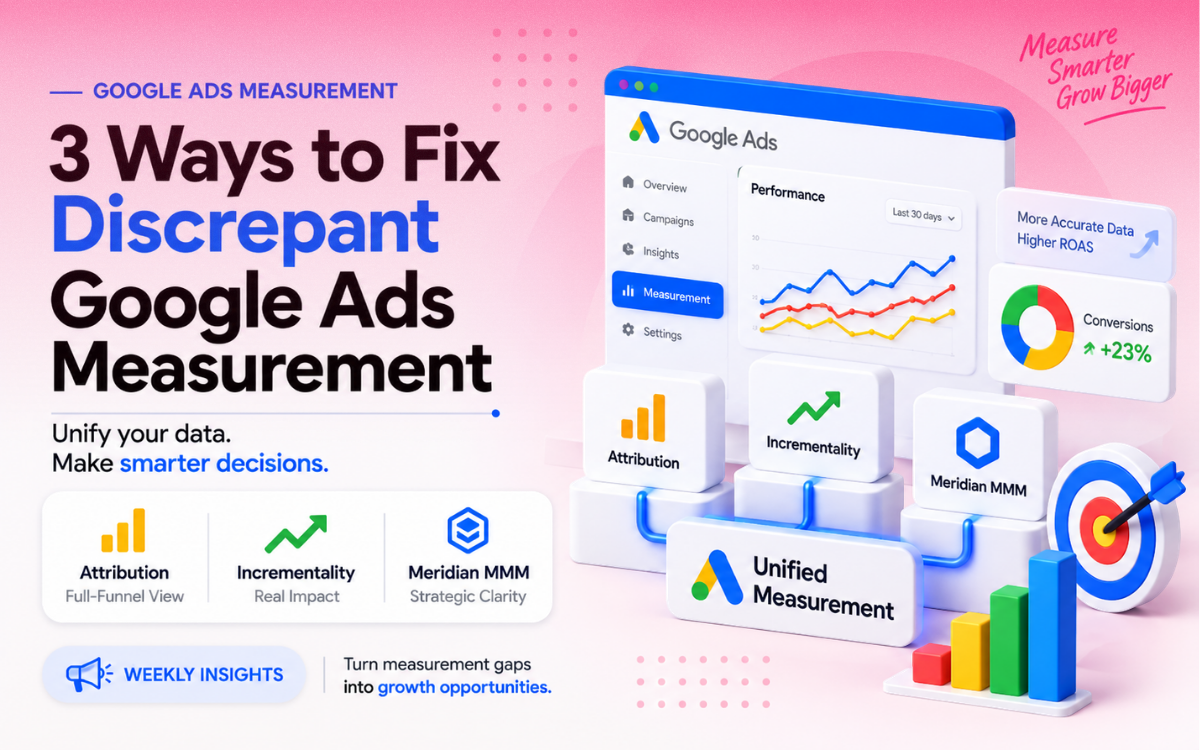
With an unprecedented array of reporting platforms available, evaluating campaign effectiveness has paradoxically become more complex, not simpler. This discrepancy does not indicate a system failure; rather, it stems from foundational differences in analytical methodologies. Establishing an authoritative Google Ads measurement framework requires adopting a triangulation approach – harmonizing real-time Attribution, causal Incrementality experiments, and macro-level Media Mix Modeling (MMM). This comprehensive article dissects the root causes of metric conflict and provides an enterprise-grade execution blueprint.
 Key Takeaways
Google Ads measurement requires a synchronized, multi-layered framework rather than searching for an elusive single source of truth.
Essential Facts About Measurement Stack
- Google Ads and GA4 diverge fundamentally due to differing conversion timestamps and attribution rules.
- Attribution manages tactical bidding; Incrementality isolates true causal business lift.
- Open-source Meridian MMM guides strategic budget allocation without reliance on browser cookies.
- Qualified Future Conversions (QFCs) quantify long-term pipeline revenue from upper-funnel media.
- High-growth brands must abandon short-term ROAS chasing to establish sustainable measurement architectures.
1. Deconstructing Why Reporting Platforms Disagree
Metric discrepancies between Google Ads, GA4, and backend CRM platforms represent the primary operational bottleneck paralyzing capital allocation decisions.
1.1. The conversion timestamp divergence
The initial technical driver of reporting variance centers on timestamp assignment:
- Google Ads assigns conversions retroactively to the exact time of the ad interaction (Click-time attribution). If a prospect clicks a Search ad on Monday but executes the purchase on Friday, Google Ads attributes that conversion value to Monday’s performance log.
- Conversely, GA4 and enterprise CRM databases record transactions at the exact time of conversion completion (Conversion-time attribution), which is Friday. This temporal asymmetry creates artificial daily performance variances across reporting dashboards.
1.2. Cross-channel attribution logic vs. channel-specific reporting
Google Ads operates primarily within a channel-specific silo. If an ad interaction occurred within the conversion lookback window, Google Ads claims full or fractional credit based on Data-Driven Attribution models.
In contrast, GA4 operates as a holistic cross-channel analytics suite. If a user interacts with a Google ad, but subsequently clicks an email link or an organic search listing prior to purchasing, GA4 redistributes fractional credit across those non-Google touchpoints. Consequently, Google Ads conversions reported within GA4 will mathematically track lower than figures native to the Google Ads dashboard.
2. Triangulating Performance: The 3 Core Measurement Pillars
As highlighted by Google Ads leadership in recent Ads Decoded discussions, sophisticated enterprises reject the concept of a singular “truth engine.” Instead, they triangulate performance using three interconnected methodologies:
2.1. Touchpoint attribution
Attribution provides micro-level, user-journey granularity.
It evaluates which specific creative assets, landing pages, or keyword themes stimulate user progression. Attribution serves as the vital, low-latency feedback mechanism required to steer algorithmic bidding engines like Smart Bidding (Target CPA and Target ROAS).
2.2. Causal incrementality
Where attribution demonstrates correlation, incrementality establishes causality.
Conducted via controlled geographic experiments (Geo-testing) or audience holdout groups, incrementality answers the decisive question: “How many conversions would have occurred organically if ad spend were reduced to zero?” This isolates true incremental lift from baseline organic brand equity.
2.3. Media Mix Modeling (MMM)
Media Mix Modeling delivers a top-down macro perspective.
Utilizing advanced econometric regression techniques, MMM calculates the statistical relationship between holistic marketing expenditures across all channels (Paid Search, Social, TV, Retail Media) and macro revenue outcomes over time. MMM operates completely independent of third-party cookies or user-level identifiers, ensuring absolute privacy compliance.
3. Comparing the 3 Google Ads Measurement Methodologies
The matrix below illustrates the precise technical role of each pillar within a unified Google Ads measurement stack:
| Technical Dimension | Touchpoint Attribution | Causal Incrementality | Media Mix Modeling (Meridian) |
|---|---|---|---|
| Data Granularity | User-level and click-level parameters. | Cohort and geographic experiment data. | Aggregated, privacy-safe macro data. |
| Operational Cadence | Continuous, real-time algorithmic bidding. | Periodic (Quarterly or post-scaling phases). | Strategic planning (Quarterly / Annual). |
| Primary Utility | Steering daily Smart Bidding execution. | Validating true incremental business lift. | Allocating macro capital across channels. |
| Cookie Reliance | High (Requires CAPI and Enhanced Conversions). | Completely independent of user cookies. | Zero cookie or device tracking required. |
| Strategic Governance | Short-term tactical campaign optimization. | Calibrating attribution validity thresholds. | Executive-level financial resource allocation. |
4. Capturing Long-Term Impact via Qualified Future Conversions (QFCs)
A primary structural flaw in legacy Google Ads measurement involves the obsessive pursuit of immediate, short-term ROAS. This short-sightedness systematically depresses capital allocation toward upper-funnel demand creation campaigns.
4.1. Understanding Qualified Future Conversions (QFCs)
Powered by Gemini models, Qualified Future Conversions (QFCs) connect current marketing spend with verified future purchasing outcomes.
Rather than truncating measurement at standard 30-day lookback windows, QFCs analyze Leading User Actions (LUAs). When a consumer engages with a YouTube video ad, does not transact immediately, but executes subsequent branded searches or deep product explorations, AI projects the mathematical probability of that user converting over a 3 to 6-month temporal window.
4.2. Shifting to long-term pipeline creation
Deploying QFCs empowers marketing leadership to mathematically prove to executive boards that upper-funnel awareness investments are not speculative expenses, but predictive drivers of long-term commercial pipeline. Transitioning from short-term transaction capture to continuous demand generation secures sustained enterprise growth.
5. Macro Budget Allocation Utilizing Google Meridian MMM
To democratize econometric modeling historically restricted to massive enterprise budgets, Google open-sourced Meridian – an advanced, modern Media Mix Modeling platform.
5.1. Meridian integration with Google Analytics 360
Meridian natively connects within Google Analytics 360, allowing organizations to synthesize advertising signals from Google, Meta, and TikTok alongside proprietary first-party transaction data within a unified environment.
The embedded Scenario Planner allows leadership to execute predictive financial simulations: “What is the projected revenue variance if we shift 15% of Search budget into YouTube Shorts and Demand Gen?”.
5.2. Data variance outweighs budget scale
A critical technical takeaway from enterprise Meridian deployments is that modeling precision is not governed by budget magnitude, but by Data Variance.
If an advertiser maintains static, unvarying daily ad spends across quarters, statistical algorithms cannot isolate baseline organic demand from paid media contribution. Introducing calculated, strategic spend variance across distinct geographic test markets (Meridian GeoX) provides the mathematical contrast required to train the model accurately.
6. The Enterprise Technical Action Blueprint by H2T Media Group
To establish an authoritative, multi-layered Google Ads measurement infrastructure, H2T Media Group mandates the execution of this 3-step operational framework:
Step 1: Structurally isolate reporting functions
Utilize Google Ads conversion data strictly to steer automated Smart Bidding algorithms. Leverage GA4 to optimize multi-touch site engagement and CRO paths. Anchor financial accounting metrics exclusively to first-party CRM revenue.
Step 2: Deploy routine incrementality experiments
Implement geographic testing via Meridian GeoX at least once per quarter across primary spend campaigns. Feed empirical incremental lift results directly into your MMM architecture as Bayesian priors to continuously refine forecasting models.
Step 3: Integrate forward-looking predictive metrics (QFCs)
Activate Qualified Future Conversions within Demand Gen and YouTube portfolios. Gauge creative effectiveness by its capacity to drive incremental branded search velocity and long-term customer acquisition, bypassing restrictive 7-day conversion windows.
7. Frequently Asked Questions
Google Ads records conversions based on the timestamp of the ad click and claims full credit for touchpoints, whereas GA4 records conversions at the time of final purchase and distributes attribution across non-Google channels.
Yes. Because Meridian is open-source and depends on data variance rather than total spend volume, mid-market businesses executing structured geo-testing can deploy highly accurate models.
No. QFCs function purely as an analytical forecasting metric within reporting interfaces and do not alter Google Ads cost-per-click (CPC) or cost-per-view (CPV) billing mechanics.
No single tool holds absolute authority. Deploy Google Ads for micro bidding optimization, GA4 for cross-channel behavior, and verified first-party CRM data for net profit reconciliation.
Reporting variances across analytical platforms represent an inevitable characteristic of modern digital architecture, not an operational failure. Dominance in contemporary Google Ads measurement belongs to organizations that successfully triangulate tactical Attribution, causal Incrementality, and macro-level Econometric Modeling to guide capital allocation. Transitioning from reactionary short-term optimization to an integrated measurement stack represents the definitive methodology for protecting enterprise margins and driving sustainable scale.
To access advanced attribution frameworks and empirical media buying blueprints, explore our comprehensive technical repository on the Insights hub at H2T Media Group. Make sure to consistently follow our dedicated Google Ads category to master the measurement strategies actively defining the global digital landscape.

bichthao
H2T Media Group decodes every meaningful platform update for advertisers and affiliate partners across APAC, EU and North America — always with a practical "H2T take" you can act on.
More about H2T →