

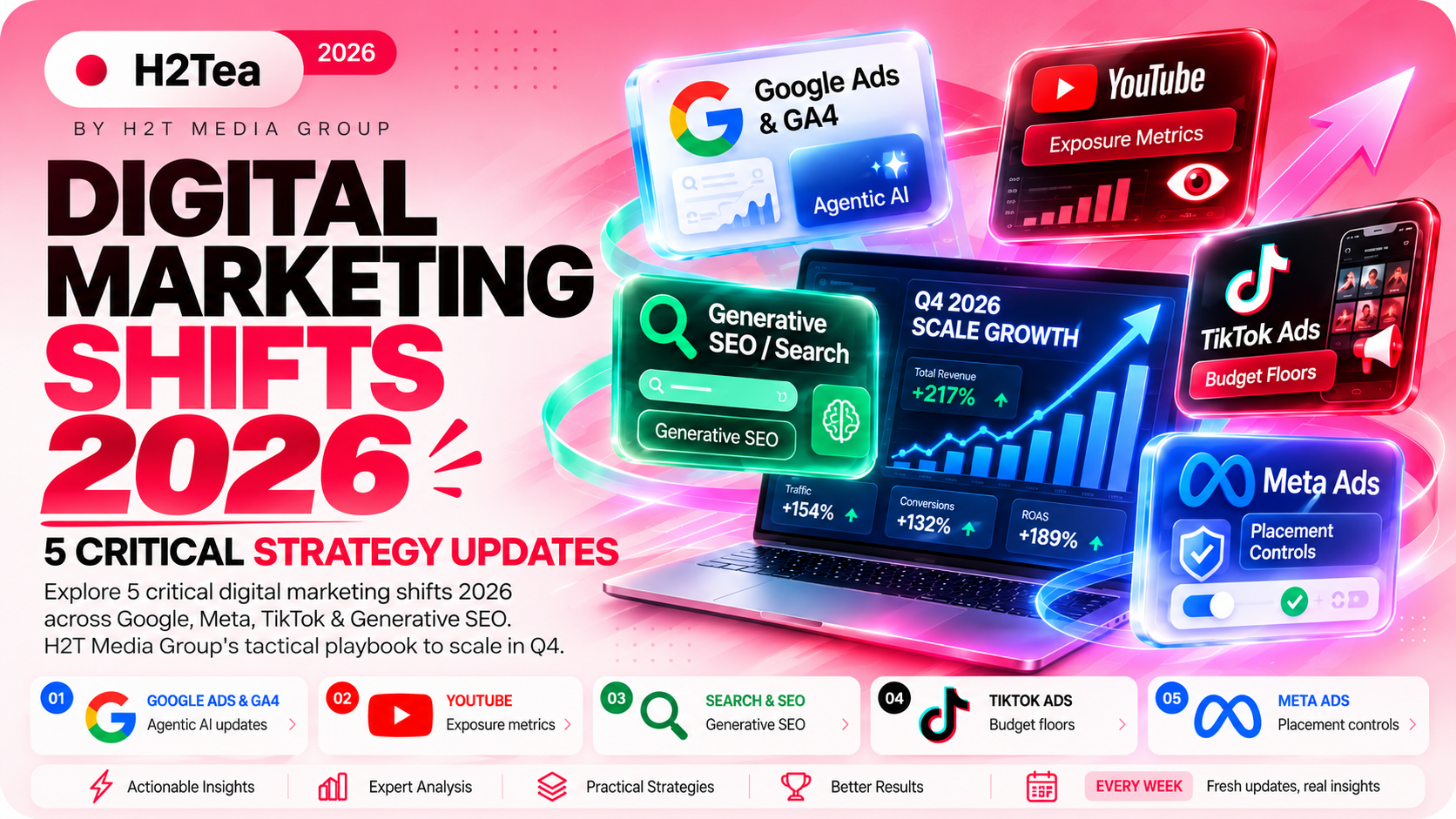
Navigating the digital marketing shifts 2026, H2T Media Group’s weekly executive summary dissects the fundamental restructuring of omnichannel advertising: “The Convergence of Gross Profit Bidding and Closed-Loop Generative Creative Operating Systems.” Driven by core AI ad auction automation, media buying has evolved from speculative guesswork into data supply chain engineering.
From Google deploying “The Commerce Four” architecture to bid on real gross profit, YouTube validating a +40% conversion lift, and Generative SEO redefining authority via AI Citation Mapping, to TikTok industrializing creative production with Symphony OS, and deconstructing Meta One Max’s true ROI ($499/mo). This H2Tea digest delivers an enterprise execution playbook to dominate fourth-quarter retail performance in 2026.
 Key Takeaways
The H2Tea Digital Marketing Digest EP.10 synthesizes 5 critical adtech infrastructure transformations spanning retail media, generative video, and generative search.
Essential Facts About This Week’s 5 Shifts
- Google Ads: The Commerce Four deploys Conversions with Cart Data to shift Smart Bidding to gross profit.
- YouTube: The Performance Four unlocks +40% conversions through multi-format creative parity.
- Generative SEO: Top 1 SERP rankings do not guarantee AI citations; build a Citation Map across vertical hubs.
- TikTok Ads: Symphony Creative Studio recuts winning video hooks via API using real-time drop-off telemetry.
- Meta Ads: Meta One Max ($499/mo) provides zero ad perks; breaks even only on 10+ seats or heavy link posting.
1. Google Ads: “The Commerce Four” and Profit-Based Bidding via Cart Data
The opening technical shift this week centers on Google Ads unveiling “The Commerce Four” framework at Rethink 2026, engineered to systematically restructure e-commerce media allocation during the peak holiday corridor.
1.1. The fatal flaw of bidding on top-line GMV
For years, digital retailers optimized Smart Bidding campaigns based on gross reported revenue. When deploying Target ROAS bidding against top-line GMV, machine learning systems prioritize user cohorts purchasing high-ticket items characterized by razor-thin profit margins or heavy seasonal discounts.
The operational consequence is severe margin compression: ad dashboards display record-breaking revenue figures, yet after subtracting Cost of Goods Sold (COGS), fulfillment expenses, and media spend, the enterprise operates at a net loss during peak shopping weeks.
1.2. Implementing Conversions with Cart Data (CwCD)
Google mandates a complete transition toward Profit-Based Smart Bidding:
- Google Tag Gateway & Cart Data: Activate Conversions with Cart Data via server-side Tag Gateway infrastructure. At checkout completion, the system streams item-level parameters: SKU identifiers, quantities purchased, sales price, and unit-level COGS.
- Optimizing for Gross Profit: Smart Bidding algorithms are trained to autonomously allocate aggressive liquidity toward acquiring customer cohorts predisposed to purchasing high-margin inventory, directly maximizing Actual Gross Margin Yield.
- Direct Demand Gen Checkout Links: Embed 1-click checkout links within YouTube Shorts and In-Feed ad units, routing consumers directly to pre-populated checkout sessions, completely eliminating product detail page (PDP) bounce drop-offs.
2. YouTube: The Performance Four Framework Driving a +40% Conversion Lift
Global retail benchmark data published via YouTube for Business’s Brands & Beyond newsletter confirms extraordinary performance metrics for accounts deploying the YouTube Performance Four framework: generating an average lift of over 40% in conversions and 30% higher conversion value.
2.1. Eliminating single-format creative silos
Numerous enterprise accounts continue to deploy isolated 16:9 horizontal video assets across campaigns. This single-format approach restricts campaigns from accessing more than 60% of available auction liquidity across YouTube Shorts and mobile surfaces.
The Performance Four mandates absolute multi-screen format parity:
- 9:16 vertical video capturing 100% of mobile screen real estate on Shorts.
- 16:9 4K horizontal master cuts dominating living room Connected TV (CTV) screens.
- 1:1 square assets engaging high-intent users across Discover and Gmail.
2.2. The 4-pillar growth loop
The operational framework unites four synchronized disciplines:
- Data: Establish resilient first-party tracking via Enhanced Conversions and Consent Mode v2.
- Volume: Maintain a minimum conversion velocity of 30 to 50 weekly events to prevent machine learning stalls.
- Targeting: Deploy Value-Based Bidding (tROAS) combined with Custom Intent segments harvested from seasonal search queries.
- Creative: Deliver full aspect ratio coverage and link dynamic Google Merchant Center (GMC) product feeds displaying live promotional pricing beneath active video units.
3. Generative SEO: Top 1 SERP ≠ AI Citation and the Citation Mapping Protocol
Within generative AI search interfaces, winning the #1 position on traditional Google SERPs is no longer enough. It no longer guarantees brand inclusion within synthesized LLM answers.
3.1. The retrieval mechanics of RAG models
Language models powering ChatGPT Search, Perplexity AI, and Google Gemini do not inspect keyword rank-tracking tables. They operate utilizing Retrieval-Augmented Generation (RAG) and entity resolution models:
- AI engines retrieve data based on verified consensus across independent external repositories.
- Information requirements diverge sharply per commercial vertical: E-commerce demands tabular specifications; B2B tech services require verified third-party reviews (G2, Trustpilot); consulting agencies depend on unmanipulated community debates on Reddit.
3.2. Building an enterprise Citation Map
Rather than stuffing keywords to chase standard blue links, marketing teams must execute AI Search Citation Mapping:
- Isolate the 10 to 20 critical decision queries prospects evaluate immediately before purchase.
- Execute multi-engine prompt testing across leading AI platforms to catalog the exact source domains language models retrieve to substantiate recommendations.
- Identify information gaps: URLs where competitors maintain authoritative footprint while your domain remains absent must be systematically closed via digital PR, community engagement, or structured on-site data tables.
4. TikTok Ads: Symphony Creative Studio Closed-Loop Operating System
An in-depth engineering case study published by TikTok Engineering details the foundational architecture of Symphony Creative Studio—the industry’s first closed-loop generative creative operating system.
4.1. Defeating the 7-to-14 day creative decay cycle
On TikTok, creative fatigue represents the single greatest driver of rising Customer Acquisition Costs (CAC), with high-performing assets experiencing severe engagement decay within two weeks.
The Symphony architecture resolves this vulnerability by connecting generative AI directly to live auction delivery telemetry:
- The system continuously ingests second-by-second viewer retention curves and isolates exact drop-off coordinates.
- When an active asset’s retention degrades at the 2-second mark, the engine autonomously calls native APIs to render five fresh opening hook permutations within minutes, eliminating campaign downtime.
4.2. Zero-latency platform-native asset compilation
Symphony guarantees that 100% of rendered assets adhere strictly to platform specifications: programmatic Safe Zone compliance, synchronization with pre-cleared commercial audio stems, and photorealistic Digital Avatars, ensuring GMV Max and Spark Ads campaigns maintain “Excellent” Ad Strength ratings continuously.
5. Meta Ads: Deconstructing the Unit Economics of Meta One Max ($499/Month)
The commercial rollout of Meta One for business—headlined by the 499/month(5,988/year) Max plan—has generated widespread speculation suggesting that subscribers receive preferential ad auction treatment.
5.1. Zero integration with Ads Manager bidding
The technical reality is absolute: Meta One shares zero operational infrastructure with Ads Manager.
- The subscription provides zero ad credits, zero CPM reductions, and zero priority within live ad auctions.
- It functions strictly as an organic software bundle providing verification badges, link post expansions, and customer support automation via the Meta Business Agent.
5.2. The mathematical break-even model
The 350monthlypricedeltaseparatingMax(499) from Expert ($149) only achieves financial break-even under two distinct operational conditions:
- Condition 1 (Managing 10+ Team Seats): Max provides 30 credentialed seats compared to 8 on Expert. Individualized delegation eliminates approximately $1,213/month in administrative labor overhead while completely preventing account lockouts caused by shared credentials.
- Condition 2 (High-Volume Outbound Link Publishing): Expert caps outbound link posts at 20 on Facebook and 8 on Instagram monthly. Max lifts this restriction entirely, unlocking uncapped traffic distribution for publishing networks and high-velocity affiliate models.
According to documentation within the Meta Business Help Center, organizations managing fewer than 10 team operators should retain lower-tier plans and reallocate capital directly into creative asset production.
6. Technical Specifications Matrix: Synthesizing the 5 Weekly Platform Shifts
The technical matrix below outlines the core updates, algorithmic mechanisms, and mandatory operational directives across all five platforms:
| Advertising Platform | Core Technical Upgrade | Algorithmic Mechanism Shift | Mandatory Enterprise Action Protocol |
|---|---|---|---|
| Google Ads | “The Commerce Four” Framework. | Smart Bidding optimizes for Gross Profit via Cart Data. | Deploy Tag Gateway; pass SKU-level COGS; link Checkout CTAs. |
| YouTube | Performance Four (+40% Lift). | Format parity across CTV, In-Stream, and Shorts. | Deploy 9:16 vertical video; connect shoppable GMC feeds. |
| Generative SEO | Enterprise AI Citation Mapping. | LLMs parse vertical-specific third-party consensus. | Audit 10–20 buying prompts; close competitor data gaps. |
| TikTok Ads | Symphony Closed-Loop Creative OS. | Real-time drop-off telemetry triggers automated recuts. | Connect Symphony API to automate hook iteration pipelines. |
| Meta Ads | Meta One Max $499 ROI Math. | Zero Ads Manager perks; SaaS operational bundle. | Restrict upgrade to teams managing 10+ seats or heavy links. |
7. The Enterprise Q4 Execution Blueprint for Growth Leaders
To translate this week’s technical updates into scalable Q4 commercial revenue, H2T Media Group mandates the following 3-pillar operational roadmap:
Pillar 1: Deploy Gross Profit Bidding Infrastructure Activate Conversions with Cart Data on Google Ads prior to November 1st. Ingest item-level COGS parameters through server-side Tag Gateway infrastructure to train Smart Bidding algorithms to hunt for high-margin shopping carts rather than unprofitable discounted volume.
Pillar 2: Industrialize Closed-Loop Creative Production Eliminate slow manual video editing cycles. Deploy automated generative systems—including TikTok Symphony and Google Asset Studio—to iterate high-impact vertical 9:16 assets dynamically, ensuring asset groups sustain peak Ad Strength throughout competitive Black Friday surges.
Pillar 3: Dominate AI Citation Ecosystems Audit your enterprise’s core commercial queries across ChatGPT Search, Perplexity, and Google Gemini. Identify the specific third-party review repositories and community hubs language models retrieve to substantiate category recommendations, systematically closing information gaps.
8. Frequently Asked Questions
No. Major digital storefront platforms—including Shopify, WooCommerce, and Magento—support cart data integration natively via Google Tag Manager or direct server-to-server plugins.
The ad set must deploy complete format coverage (horizontal 16:9, vertical 9:16, square 1:1), maintain an integrated Google Merchant Center product feed, and sustain a minimum of 30 to 50 weekly conversion events.
RAG models seek unmanipulated, third-party consensus. Commercial websites publish biased promotional copy, whereas high-engagement community threads and independent review hubs provide the verified ground truth AI engines require to formulate answers.
No. Meta One provides brand impersonation monitoring and dedicated business support, but confers zero immunity against Ads Manager advertising policy violations or automated integrity enforcement.
The digital marketing shifts 2026 synthesized in this H2Tea digest establish an undeniable performance marketing reality: sustainable competitive advantage belongs to enterprises mastering data supply chain engineering and closed-loop creative systems. As ad platforms consolidate algorithmic control, managing media investments through disciplined inputs—from item-level cart margins and multi-screen video assets to verified entity citation mapping—represents the definitive formula for defending net contribution margins throughout the peak fourth-quarter commercial corridor.
To access proprietary performance playbooks and advanced conversion measurement frameworks, explore our full repository on the Insights hub at H2T Media Group. Make sure to consistently follow our dedicated H2Tea to master the executive briefings dictating success across global digital advertising ecosystems.

bichthao
H2T Media Group decodes every meaningful platform update for advertisers and affiliate partners across APAC, EU and North America — always with a practical "H2T take" you can act on.
More about H2T →