

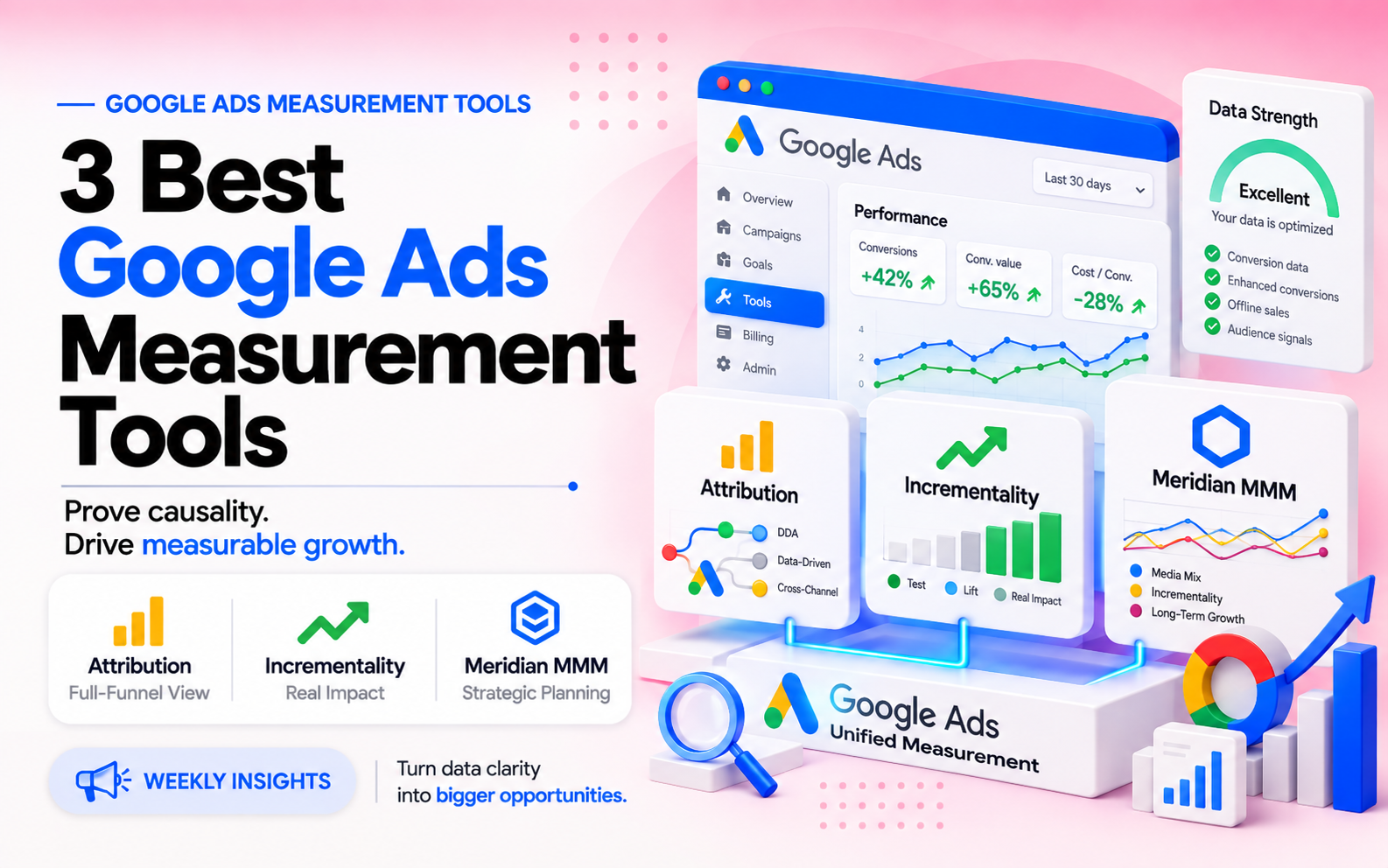
Welcome to the Google Ads performance insights hub by H2T Media Group. Mastering modern Google Ads measurement tools specifically Google Data Manager, Google Tag Gateway, and Google Meridian is essential to protect tracking signals and sustain profit margins in 2026. Without first-party data integration and server-side infrastructure, strict privacy controls and ad blockers can degrade conversion signals by up to 30%. Below is H2T’s technical analysis and the operational blueprint required to maximize your Smart Bidding ROI.
 Key Takeaways
Modern Google Ads measurement tools unite first-party data management, server-side Tag Gateway infrastructure, and open-source Meridian MMM.
Essential Facts About This Release
- Google Data Manager standardizes direct API pipelines for CRM, POS, and Customer Match data.
- Google Tag Gateway delivers server-side tag resilience, bypassing client-side ad blockers.
- Conversions with Cart Data (CWCD) trains Smart Bidding algorithms on true gross profit margins.
- Meridian MMM powers cookieless, privacy-safe cross-channel budget scenario planning.
- Meridian GeoX validates causal incrementality to eliminate wasted ad expenditures.
1. The Profitable Growth Equation: Data + Causality = Sustainable Margins
Contemporary performance marketing has permanently evolved beyond superficial click tracking. Google has codified the operational benchmark for capital allocation: Data + Causality + Better Decisions = Profitable Growth.
1.1. The attribution crisis in a privacy-first ecosystem
As consumers navigate fluid multi-device paths and desktop browsers enforce aggressive tracking prevention protocols (such as Apple ITP and network ad blockers), standard client-side pixel architectures experience tracking signal degradation exceeding 20% to 30%.
Depriving machine learning systems of conversion signals causes Smart Bidding algorithms to miscalculate audience intent, resulting in capital allocation toward low-intent user cohorts.
1.2. Synthesizing First-Party signals with econometric modeling
To resolve this structural vulnerability, Google has architected an interconnected, multi-layered measurement stack:
- Tactical Layer: Consented, cryptographically hashed First-Party Data streamed directly via server-to-server APIs.
- Strategic Layer: Cookieless Media Mix Modeling (MMM) that evaluates macro revenue impact without requiring user-level tracking.
As documented in official technical releases on the Google Ads Product & Commerce Blog, establishing a pristine first-party data foundation represents the sole mechanism for sustaining Return on Ad Spend (ROAS) during aggressive scaling phases.
2. Unifying First-Party Signals via Data Manager and Google Tag Gateway
The initial phase of this infrastructure upgrade standardizes how first-party customer signals are ingested and protected across ad accounts.
2.1. Standardizing CRM data ingestion via Google Data Manager
Google Data Manager operates as a centralized data integration gateway:
Enterprises can deploy direct, point-and-click connections linking internal CRMs (Salesforce, HubSpot, Zoho), enterprise data warehouses (BigQuery, AWS), and offline Point-of-Sale (POS) systems directly into Google Ads without requiring complex custom software engineering.
The interface automates Customer Match audience synchronization and streams Offline Conversion Tracking (OCT) signals, ensuring machine learning models receive verified purchase outcomes in near real time.
2.2. Google Tag Gateway: Server-side tracking resilience
Google Tag Gateway represents a fundamental evolution from fragile client-side tags to resilient server-side infrastructure:
- Tracking scripts execute within the enterprise’s own first-party domain context, preventing browser-level script suppression.
- Form interactions and transaction payloads are cryptographically hashed and routed securely via cloud containers, elevating Enhanced Conversions Match Rates consistently above the 90% benchmark.
3. Quantifying Customer Lifetime Value (LTV) and Cart Data Signals
This release equips performance media buyers with advanced tools to steer automated bidding algorithms directly toward gross profit margins rather than top-line revenue.
3.1. Conversions with Cart Data (CWCD) for margin optimization
Standard conversion tracking reports aggregate transaction totals without contextual margin visibility.
Deploying Conversions with Cart Data (CWCD) provides item-level transaction transparency:
- The data stream decomposes each transaction: Item SKU, quantity, sales price, and Cost of Goods Sold (COGS).
- Smart Bidding algorithms autonomously recalibrate Target ROAS parameters, allocating aggressive liquidity toward acquiring customer cohorts predisposed to purchasing high-margin inventory, directly maximizing Actual Gross Profit.
3.2. Qualified Future Conversions (QFCs) validate upper-funnel investments
Powered by Gemini AI, Qualified Future Conversions (QFCs) quantify the downstream pipeline value generated by non-transactional top-of-funnel interactions:
The model evaluates early Leading User Actions (such as initial brand search velocity or engaged video completions) to calculate the statistical probability of that cohort converting over an extended 3 to 6-month temporal window.
Google’s empirical testing confirms that brands deploying QFCs achieve an average 20% revenue lift across Demand Gen campaigns by preventing the premature termination of high-performing upper-funnel assets.
4. Proving Business Impact Utilizing Google Meridian MMM and GeoX
To provide executive leadership with cross-channel visibility independent of cookie tracking, Google has significantly upgraded its open-source Meridian Media Mix Modeling platform.
4.1. Scenario planning inside Google Analytics 360
Meridian integrates natively with Google Analytics 360, empowering Chief Financial Officers and CMOs to execute predictive financial simulations:
- Accurately forecast revenue variance if 15% of Search budget is reallocated to YouTube Shorts or Meta Ads.
- Evaluate the reciprocal commercial impact between digital performance channels and traditional broadcast media (Linear TV, OOH).
4.2. Meridian GeoX: Grounding measurement in causal incrementality
The foundational breakthrough within Meridian is the integration of Meridian GeoX an advanced geographic experimentation suite: Rather than relying on speculative multi-touch attribution models, enterprises execute structured holdout tests across randomized geographic territories. By comparing revenue performance between active advertising markets and isolated control regions, Meridian GeoX isolates true Causal Incrementality, empowering leadership to permanently eliminate ad spend allocated to baseline organic conversions.
5. Technical Specifications Matrix: Google’s Advanced Measurement Stack
The matrix below illustrates the operational parameters and performance marketing utility of Google’s modernized measurement suite:
| Measurement Tool | Technical Mechanism | Integrated Data Source | Primary Media Buying Utility |
|---|---|---|---|
| Google Data Manager | Centralized point-and-click API connector hub. | Enterprise CRM (Salesforce, HubSpot), POS, Cloud DB. | Automates Customer Match and Offline Conversion Tracking (OCT). |
| Google Tag Gateway | First-party server-side tagging infrastructure. | Domain-level website scripts and cloud containers. | Neutralizes signal loss, elevating Enhanced Conversions Match Rates >90%. |
| Cart Data (CWCD) | Item-level SKU and gross margin parsing. | Checkout transaction payload and product feeds. | Trains Smart Bidding algorithms to optimize for net profit yield. |
| Meridian MMM | Open-source cookieless econometric modeling. | Aggregated cross-channel ad spend and revenue logs. | Macro budget scenario planning and cross-platform capital allocation. |
| Meridian GeoX | Randomized geographic holdout testing framework. | Territory-level sales data and media delivery logs. | Quantifies true causal incrementality, eliminating ad waste. |
6. The Enterprise Measurement Implementation Blueprint by H2T Media Group
To transform these measurement capabilities into a definitive financial advantage, H2T Media Group mandates the execution of this 3-phase technical roadmap:
Phase 1: Modernize Data Ingestion Architecture (Months 1–2)
- Deploy Google Tag Gateway across all digital web properties to eliminate client-side tracking signal drop-offs.
- Establish automated API connections linking internal CRMs to Google Data Manager to stream qualified lead milestones (qualified_lead).
Phase 2: Activate Margin-Based Bidding and LTV Signals (Months 3–4)
- Implement Conversions with Cart Data (CWCD), declaring Cost of Goods Sold parameters to enable profit-optimized Smart Bidding.
- Deploy New Customer Acquisition (NCA) bidding goals to prioritize media spend toward acquiring net-new customer profiles over repeat purchasers.
Phase 3: Calibrate Cross-Channel Allocation via Meridian MMM (Quarterly Execution)
- Ingest multi-channel marketing data into Google Meridian hosted on internal BigQuery instances.
- Execute periodic geographic holdout tests utilizing Meridian GeoX to establish empirical Bayesian priors, ensuring cross-channel media planning is anchored in verified causal incrementality.
7. Frequently Asked Questions
No. Google Data Manager provides native, point-and-click connectors for major enterprise CRMs (including Salesforce, HubSpot, and Google Sheets), allowing marketing operations teams to deploy integrations without custom script development.
Yes. Meridian is completely open-source and free to deploy. Modeling accuracy is governed by historical spend variance across markets (Data Variance) rather than absolute budget scale.
No. COGS and margin parameters transmitted via CWCD are cryptographically secured and utilized strictly as internal optimization weights for Google Ads Smart Bidding algorithms.
If your Enhanced Conversions Match Rate registers below 80% or if your analytics team observes significant data variances between backend order logs and Google Ads reported conversions, migrating to Tag Gateway is an immediate operational mandate.
Google’s comprehensive 2026 data and measurement release confirms an immutable performance marketing reality: Sustainable enterprise growth is engineered through first-party data integrity and the rigorous validation of causal incrementality. Migrating away from fragile client-side tracking toward resilient Google Tag Gateway infrastructure and open-source Meridian econometric modeling equips organizations with the analytical precision required to eliminate ad waste and maximize customer lifetime value.
To access proprietary server-side tracking blueprints and advanced incrementality testing frameworks, explore our technical repository on the Insights hub at H2T Media Group. Make sure to consistently follow our dedicated Google Ads category to master the tactical marketing strategies dictating success across global advertising ecosystems.

bichthao
H2T Media Group decodes every meaningful platform update for advertisers and affiliate partners across APAC, EU and North America — always with a practical "H2T take" you can act on.
More about H2T →