
Google Gemini Drops August 2026 brings together several Google announcements about Connected Apps, Gemini 3.7 Flash, and the Gemini Omni 1.1 Flash video toolset. These releases expand what people and developers can do with Gemini, but they do not constitute a single Google Ads launch or a universal new conversion funnel.
For marketing teams, the useful questions are which capabilities Google actually announced, who can access them, and what evidence would be needed before changing a campaign workflow. H2T Media Group reviews the dated releases and their practical boundaries below.
 Key Takeaways
The August 2026 releases span Connected Apps, Gemini 3.7 Flash, and Omni 1.1 Flash. Each has a separate product scope and availability.
Essential facts about Google Gemini Drops August 2026
- Connected Apps were announced on August 12 with a staged rollout and service-specific eligibility.
- Gemini 3.7 Flash was introduced on August 13 as a model for coding and agents, not a native PPC operator.
- Omni 1.1 Flash was detailed on August 27 for generative-video controls across named product surfaces.
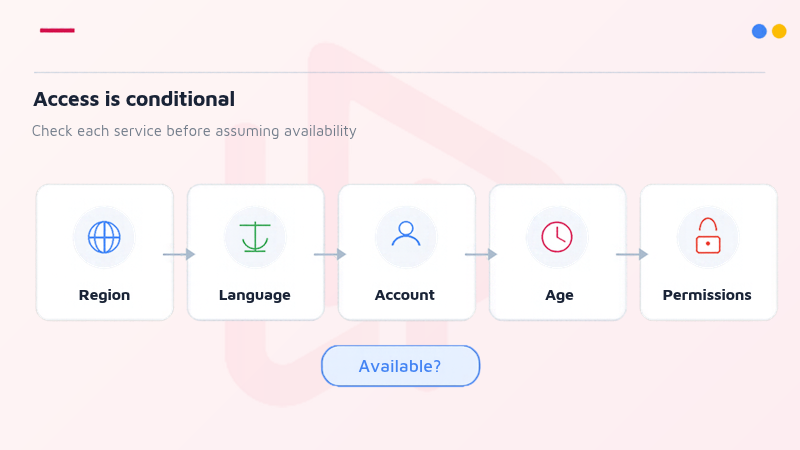
- OpenTable availability depends on geography, personal account, age, language, and activity settings.
- Google Ads conversion solutions remain use-case-dependent, not universally mandatory for Gemini actions.
1. What Google announced in August 2026
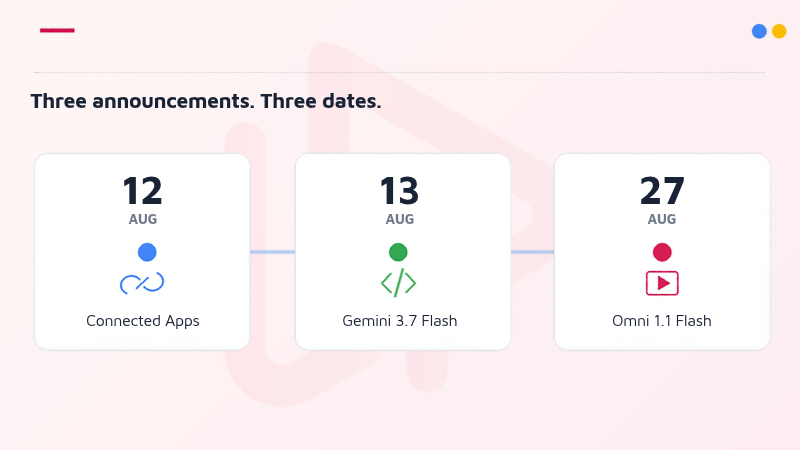
The phrase “Gemini Drops August 2026” is useful as a monthly editorial label, not proof that every feature launched together on August 24. The confirmed primary-source timeline spans separate products and release dates:
- August 12: Google announced another wave of Connected Apps, with a rollout described as taking place over the following weeks.
- August 13: Google introduced Gemini 3.7 Flash, emphasizing coding, agent development, and complex workflow performance.
- August 27: Google unveiled Omni 1.1 Flash controls for video scene extension, interpolation and upscaling.
Google later included these innovations in its September 1 recap of August AI announcements. The releases share a wider AI-product direction, yet each has its own availability, interface, and technical responsibilities.
Read more:
Google — New connected apps are coming to Gemini (August 12, 2026)
Google — Introducing Gemini 3.7 Flash (August 13, 2026)
Google — Gemini Omni 1.1 Flash lets you build with more control (August 27, 2026)
Google — The latest AI news we announced in August 2026 (September 1, 2026)
2. Connected Apps: actions are possible, but availability matters
Connected Apps can reduce context switching for certain tasks. The commercial significance is not that every company can suddenly close a sale inside Gemini; it is that a supported service may become an action endpoint when the user, provider, and account meet the applicable requirements.
2.1. Which app categories were included
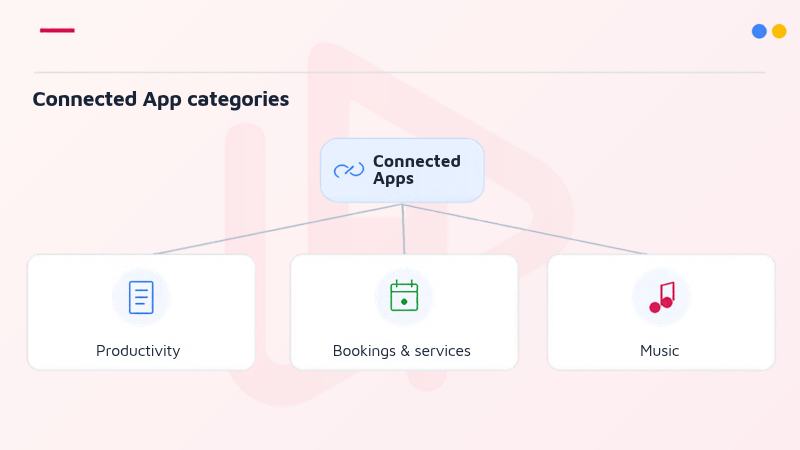
Google’s August 12 announcement named productivity and creative tools such as Granola, Otter.ai and Wix; booking or local-service providers including Fever, GetYourGuide, OpenTable (UK), Ticketmaster, Angi, Thumbtack and Zocdoc; and music partners. These were described as incoming connections, rather than a guarantee of immediate global access.
For example, restaurant booking through a supported OpenTable connection is an identifiable task flow. It should not be generalized into direct checkout, payment, or CRM conversion reporting for every other partner app.
Read more:
Google — New connected apps are coming to Gemini (August 12, 2026)
2.2. Why market, account and permission checks come first
Gemini’s help documentation states that Connected Apps access varies by location, language, account type, device, and experience. At the time of this review, its OpenTable help page lists adults using eligible personal Google Accounts in the UK or US, in English, with Keep Activity enabled; work or school accounts are not supported for that connection.
Before projecting a lower-friction customer journey, a marketer should test the exact service, region, and account path. Availability in a product announcement is not the same as a measurable advertising conversion, and a connected app does not automatically expose third-party transaction data to Google Ads.
Zoho also requires careful dating: it appears in Google’s September 23 Connected Apps wave, so it should not be treated as part of the same August 12 slate.
Read more:
Gemini Apps Help — Connected Apps availability and requirements
Gemini Apps Help — Find, book and manage OpenTable reservations
Google — A new wave of Connected Apps is rolling out (September 23, 2026)
3. Gemini 3.7 Flash: an agent model, not a built-in PPC operator
Gemini 3.7 Flash was presented as a more capable model for coding and agent workflows. That creates development options for marketing operations, but the announcement did not establish an out-of-the-box Google Ads feature that audits Merchant Center, pauses campaigns, or reallocates budgets autonomously.
3.1. The capability Google actually documented
Google highlighted improvements in software engineering, web development, instruction-following and multi-step planning. Developers can use those capabilities as building blocks for tools that summarize reports, interpret documentation, or assist with debugging when suitable data and interfaces are supplied.
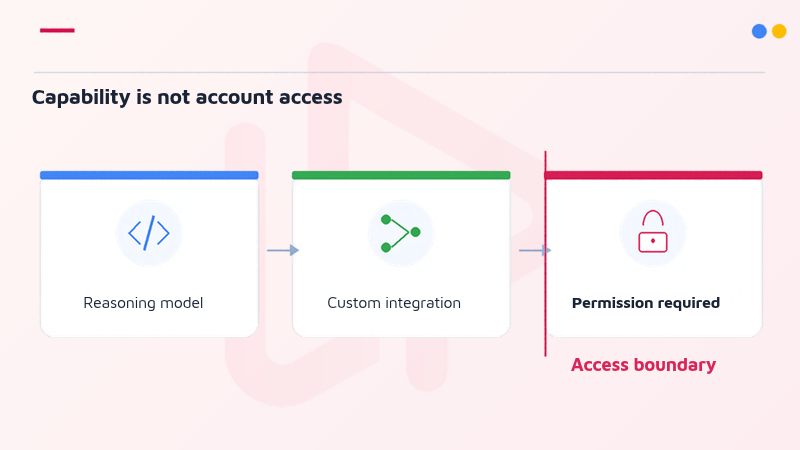
The distinction is essential: a model may reason about an exported campaign report without having permission to read a live account, and it cannot execute an account change merely because a demonstration shows capable reasoning.
Read more:
Google — Introducing Gemini 3.7 Flash (August 13, 2026)
3.2. Guardrails for any advertising-side implementation
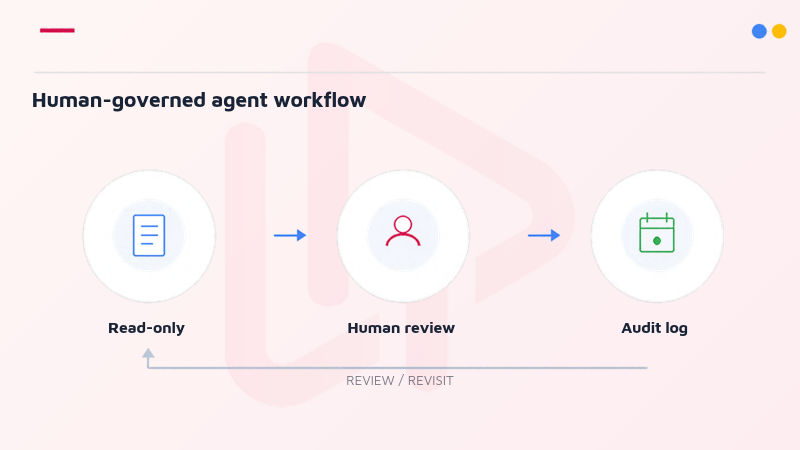
An agency exploring an AI assistant should separate read-only analysis from write access. Define permitted data, authentication, human approval thresholds, audit logging, and rollback procedures before connecting any automated workflow to production ad accounts.
- Start with exported, permissioned datasets and a documented evaluation rubric.
- Require human review for budget, targeting, policy, and conversion-goal changes.
- Evaluate errors, reproducibility, and data freshness before scaling an assistant.
Those controls are H2T Media Group’s operational recommendations, not Google’s announced Gemini 3.7 Flash product guarantees.
4. Gemini Omni 1.1 Flash: video tools need a separate ad-production review
Google’s August 27 announcement concerned generation and editing controls for Gemini Omni 1.1 Flash, with access through identified Gemini and developer products. Creative teams can investigate these controls, but they should not confuse a generative-video tool with a native Performance Max or Demand Gen asset-extension rollout.
4.1. Scene extension, interpolation and output resolution
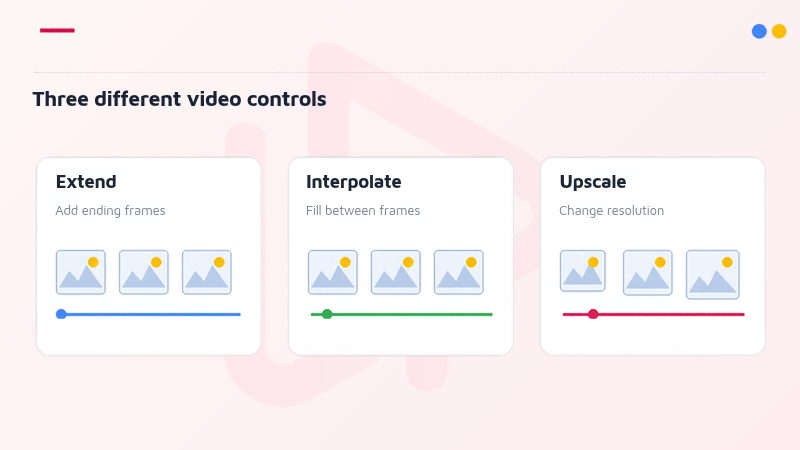
Google described scene extension that uses previous video context to generate a continuation, first-and-last-frame interpolation, and higher-resolution output options. Its developer announcement discusses extending scenes in increments of 10 seconds up to a cumulative 40 seconds, alongside previews and upscaling options.
These are production controls with surface-specific conditions. They are not evidence that any five-second ad hook becomes a ready-to-serve 30-second video without editing or loss of brand fidelity.
Read more:
Google — Gemini Omni 1.1 Flash lets you build with more control (August 27, 2026)
4.2. Where performance creative teams can test responsibly
A reasonable experiment is to generate an alternative scene ending, inspect product geometry and on-screen claims, then compare it with the original through a controlled creative review. Final suitability still depends on permissions, brand standards, platform ad policies, and the actual campaign asset requirements.
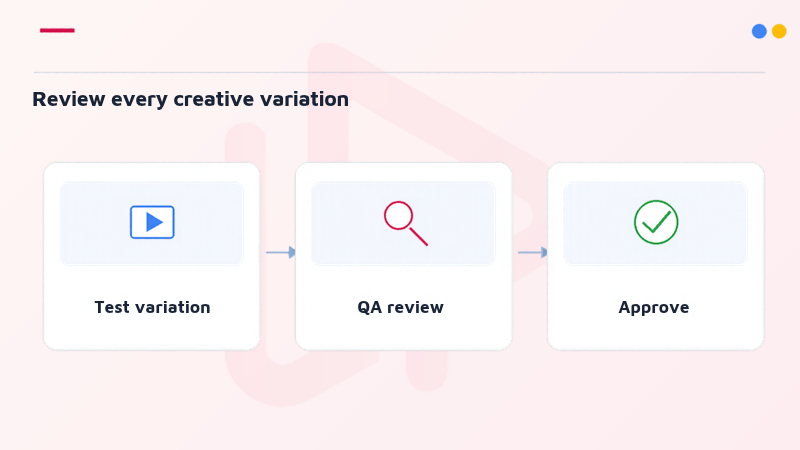
- Generate a clearly labeled test variation from owned or licensed footage.
- Review continuity, logos, product details, audio, disclosures, and aspect ratio.
- Have a human approve the final asset before any campaign upload.
5. Release scope versus marketing implications
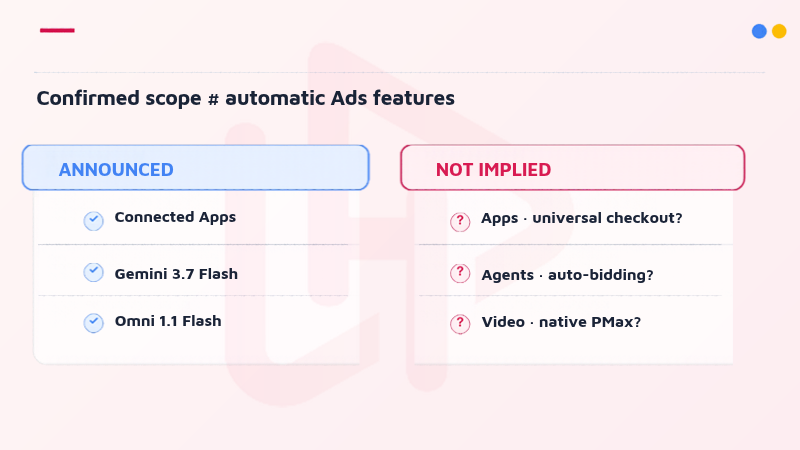
The releases address different layers of the customer and production experience. This comparison distinguishes Google’s documented features from interpretations that require independent testing, preventing an AI product announcement from being mistaken for a Google Ads measurement or bidding change.
| Release | Verified capability | Not established by the release | Practical review |
|---|---|---|---|
| Connected Apps | Supported service actions, subject to rollout and eligibility | Universal checkout or Google Ads conversion reporting | Test actual account and geography |
| Gemini 3.7 Flash | Model capability for coding and agents | Default autonomous changes to ad accounts | Control access and human approvals |
| Omni 1.1 Flash | Video generation and editing controls | Native PMax video extension or fidelity guarantee | Review the asset before serving |
For advertisers, the direct implication is a due-diligence workflow – not an automatic migration to a new campaign architecture. Existing campaign goals and measurement settings should be changed only after a supported use case is demonstrated, and its data path is understood.
6. A verification checklist for marketing teams
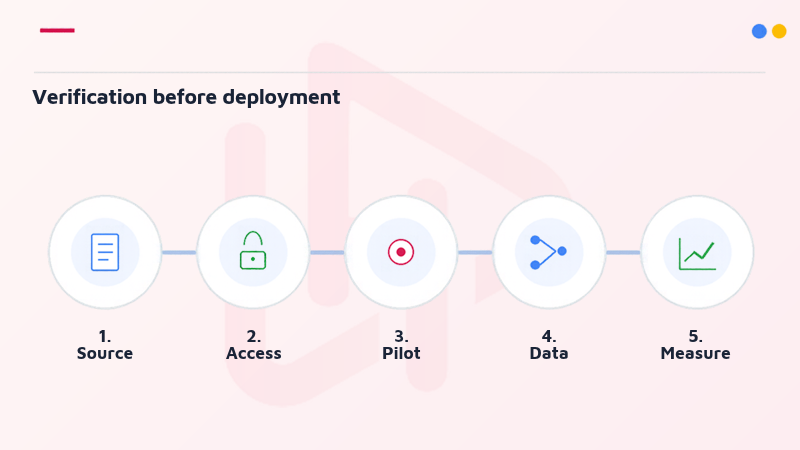
A cautious rollout plan protects both campaign performance and editorial accuracy. The following sequence is a proposed operating checklist, not a Google-mandated procedure:
- Confirm the original announcement date and the specific product surface; separate August announcements from September additions.
- Check market, language, subscription, account type, age, and consent/permissions for the intended integration.
- Run a bounded pilot with documented inputs, expected outcomes, and human oversight.
- For any externally completed commercial action, determine whether the merchant or partner actually provides usable event data; never assume automatic Google Ads attribution.
- If a business needs to measure offline outcomes from ad-generated leads, evaluate Google Ads Data Manager, enhanced conversions for leads, and offline imports according to that specific conversion path and privacy requirements.
These Google Ads measurement methods address eligible advertising journeys; they are not a blanket rule that every Gemini Connected App requires a universal “Google CAPI” implementation. For broader advertising context, review the Google Ads insights on H2T Media Group’s website.
Read more:
Google Ads Help — Guidelines for importing offline conversions
7. Frequently asked questions
Availability, integration, and advertising impact are separate questions. The answers below focus on the boundaries supported by Google’s product and help documentation, rather than promising outcomes that depend on an untested account setup.
No single August 24 launch is established by the primary sources reviewed here. The documented announcements for Connected Apps, 3.7 Flash and Omni 1.1 Flash are dated August 12, 13 and 27, respectively.
No. Eligibility depends on the particular app and the user’s region, language, device, account and permissions. The OpenTable example has explicit restrictions; check the latest help page for each connection.
No native bidding-control feature follows from the model announcement alone. Any custom agent operating on an advertising account needs appropriate APIs, approved access, monitoring and explicit safeguards.
The August source documents Omni creative controls and specified developer/consumer surfaces, not an automatic Performance Max asset feature. Exported creative must still be checked against the placement and policy requirements of the ad product used.
No such blanket requirement appears in the sources reviewed. Use measurement methods appropriate to the real advertising and conversion journey; confirm what data a service shares before choosing any import or enhanced-conversion solution.
Conclusion
Google Gemini Drops August 2026 is best understood as a collection of product and developer updates, not a wholesale replacement of landing pages, Google Ads bidding, or conversion measurement. Connected Apps, Gemini 3.7 Flash and Omni 1.1 Flash each deserve targeted testing within their documented limits.
At H2T Media Group, we help marketers turn complex platform updates into practical, evidence-based decisions. Explore more technical insights in our Google Ads category and Insights hub. For ongoing industry updates and hands-on discussions, connect with H2T Media Group on Facebook and follow H2T Media Group on LinkedIn for deeper perspectives on digital performance and emerging technologies.

bichthao
H2T Media Group decodes every meaningful platform update for advertisers and affiliate partners across APAC, EU and North America — always with a practical "H2T take" you can act on.
More about H2T →