


The Google Ads August 17 bidding rollout is complete: Google began updating eligible target-based bid strategies on August 17, 2026, and finished the global rollout on August 27. The change concerns campaigns that are limited by budget, not every Google Ads auction or every Smart Bidding strategy.
This post-rollout audit explains the affected scope, how to interpret target gaps, and which account actions deserve testing. Follow H2T Media Group’s evidence-led review before changing your bid settings.

Key Takeaways
The Google Ads August 17 bidding rollout started on August 17, 2026, and finished globally on August 27. It affects eligible budget-limited campaigns using target-based bidding.
Essential facts about this rollout
- Eligible targets include Target CPA, Target ROAS, and Target CPC for Demand Gen only.
- Scope includes relevant Search, Shopping, Performance Max, Demand Gen, and Travel campaigns.
- Performance may move closer to the target; a specific CPA, ROAS, or channel shift is not guaranteed.
- Use the Bid Target Adjustment Tool where available and allow one to two conversion cycles to evaluate changes.
- Audience signals in Performance Max are suggestions, not hard placement or targeting restrictions.
1. Rollout status and eligibility
The key distinction is between an announced change and an implemented one. The August update is now live, but eligibility depends on campaign status and bidding strategy. Advertisers should establish whether an account was exposed to the change before attributing subsequent performance movements to the rollout.
1.1. Timeline and confirmed scope
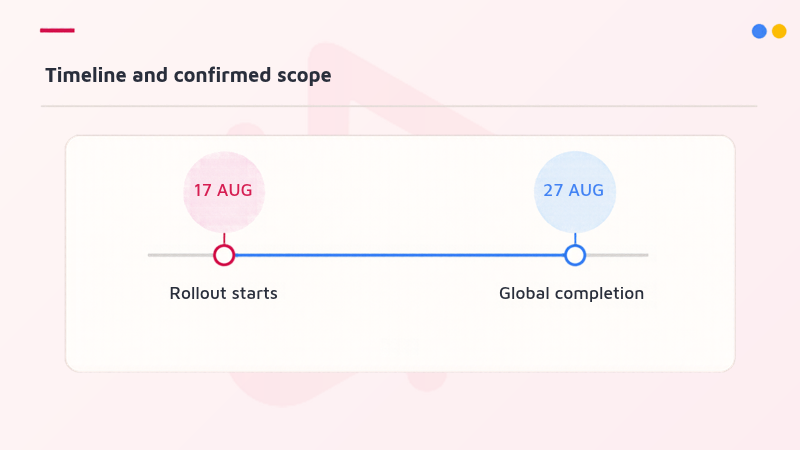
Google says the rollout began on August 17, 2026, and was completed globally on August 27, 2026. Affected setups use Target CPA or Target ROAS, with Target CPC also included for eligible Demand Gen campaigns. The stated scope covers Search, Shopping, Performance Max, Demand Gen, and Travel campaigns in the supported management environments, including specified Search Ads 360 and Display & Video 360 setups.
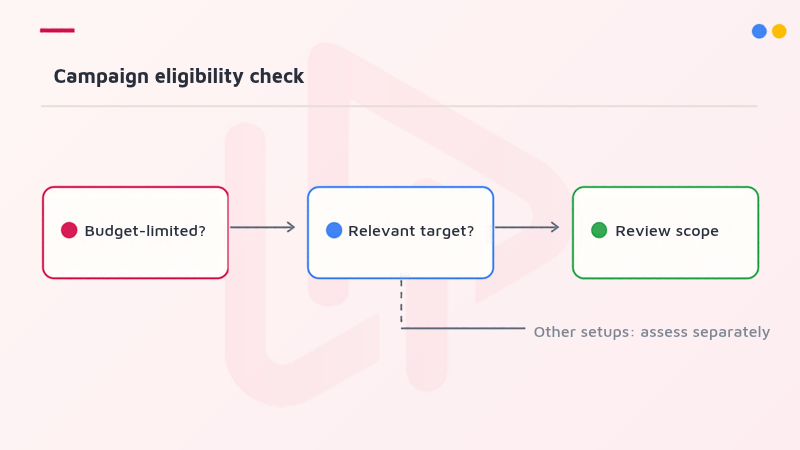
The useful test is not whether an account contains Smart Bidding. It is whether a budget limits an eligible campaign using a relevant target-based strategy. Google does not automatically change advertisers’ targets or daily budgets.
1.2. Campaigns that should not be grouped into the rollout
Google states that unconstrained Target CPA and Target ROAS campaigns do not change bidding behavior because of this update. Manual CPC and Target Impression Share are outside this change. App campaigns and Video reach/view campaigns continue with their previous bidding behavior; Hotel and Display campaigns already had the updated behavior before this rollout.
- Review eligibility at the campaign or relevant portfolio/shared-budget level instead of tagging an entire account as affected.
- Check historical “Limited by budget” status; a campaign that is unconstrained today may still warrant a period-specific review.
2. What changed in target-based bidding
Google’s stated objective is more consistent optimization toward the advertiser’s selected target when a campaign has a constrained budget. This addresses cases in which actual CPA or ROAS historically exceeded the efficiency implied by the configured target. It is not a promise that each campaign will deliver an exact metric on every day.
2.1. Read the target gap without inventing a deterministic outcome
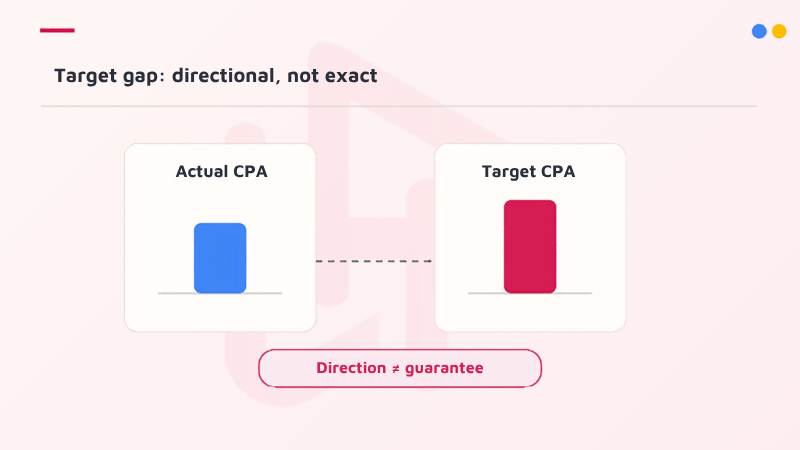
Consider Google’s own illustrative example: a budget-constrained campaign has a $10 Target CPA but recently delivered a $5 actual CPA. Under the updated behavior, the campaign may move closer to the configured $10 target if the advertiser makes no target adjustment. An advertiser seeking to preserve the $5 efficiency can consider setting a more demanding target, subject to business goals and available volume.
This example explains directional alignment, not a guaranteed doubling of acquisition cost. Target CPA is an optimization objective assessed over time; individual conversions and reporting periods can be above or below the stated target. The equivalent Target ROAS discussion also requires careful attention to conversion values, attribution, and reporting lag.
2.2. What the rollout does not authorize us to claim
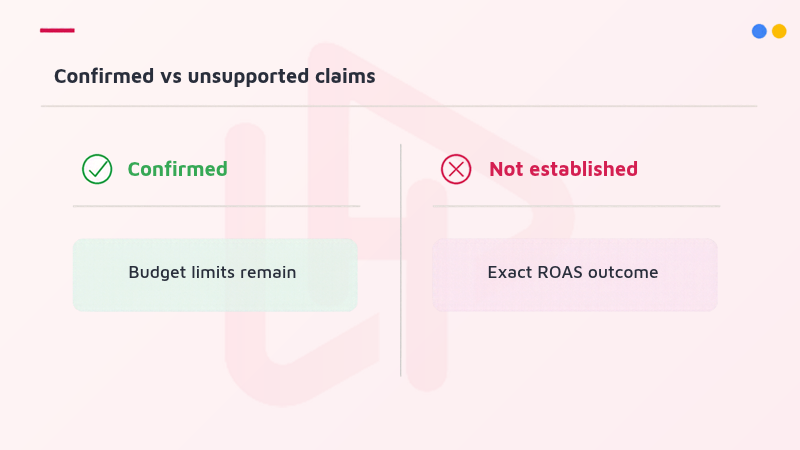
Google explicitly says the auction mechanism does not change and normal daily and monthly budget limits remain respected. The rollout does not mandate uncapped spending, compel exact target attainment, or prove that CPC will rise by a fixed multiple. It is therefore inaccurate to describe this as Google deliberately forcing every ROAS line down to an exact number.
- Do not infer a causal algorithmic effect from a one-day CPA spike or a single campaign screenshot.
- Do not treat a stated tCPA or tROAS as a direct measure of net profit margin; financial viability depends on unit economics and conversion-value quality.
3. Multi-channel implications for Performance Max and Demand Gen
The same target-alignment principle can apply to eligible multi-channel campaigns, but observable delivery may involve several inventory surfaces. Google notes that the relative channel allocation can change. That possibility is important to monitor, yet it does not support assuming that every affected campaign will divert spend from Search to Display.
3.1. Audit distribution instead of predicting “budget bleeding”
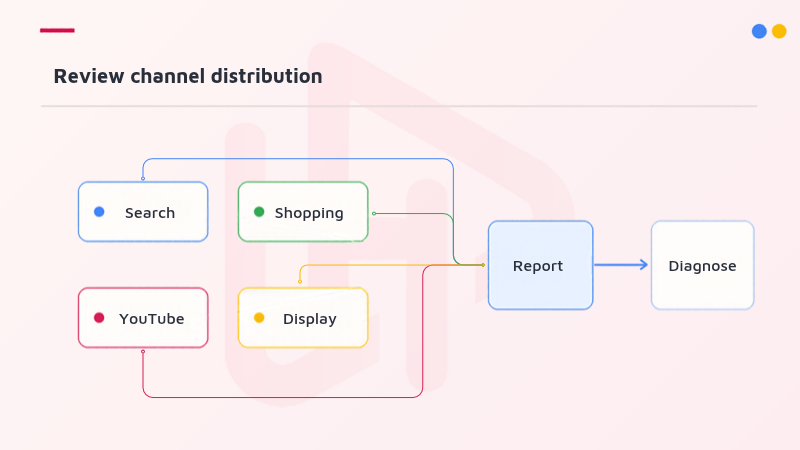
Performance Max can serve across Google Search, Display, YouTube, Discover, Maps, and Gmail. For affected accounts, compare campaign-level goals with channel performance reports, conversion metrics, change history, and any diagnostics. A channel-level increase in clicks is a prompt for investigation, not by itself evidence of low-quality traffic or wasted budget.
For lead-generation advertisers, evaluate qualified leads and later-stage CRM outcomes alongside reported conversions. For commerce advertisers, verify conversion value, returns, and other financial inputs before concluding that stronger top-line ROAS means stronger profit. Channel averages can be misleading because Performance Max optimizes across channels, not for an isolated channel’s average CPA.
3.2. Audience signals are not channel controls
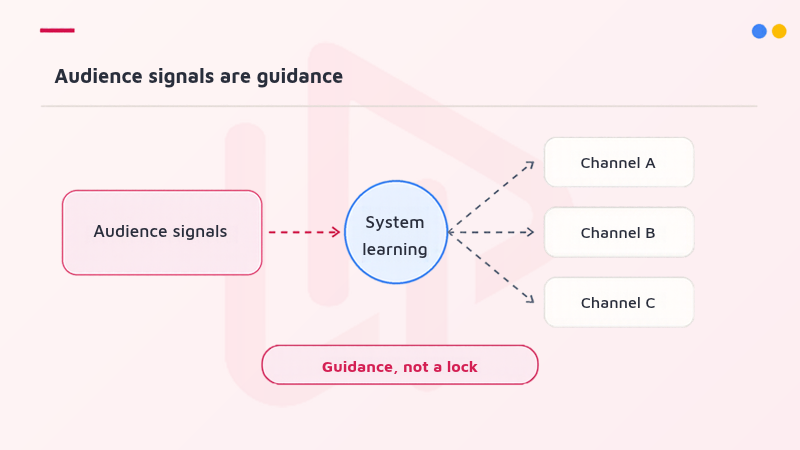
Google describes Performance Max audience signals as suggestions that help its AI learn; they are not hard targeting criteria. First-party audience data and custom segments may improve the relevance of information supplied to the campaign, but they cannot force delivery exclusively into Search or Shopping. Use supported settings and channel reporting for oversight, rather than promising strict inventory control through audience signals alone.
4. A practical post-rollout account audit
The audit should separate exposure to the feature change from coincident business conditions. Seasonality, conversion delay, tracking changes, creative edits, auction competition, and budget decisions can all affect outcomes. The following workflow is an operational method proposed by H2T Media Group, not a Google-prescribed universal 28-day rule.
4.1. Establish a fair baseline
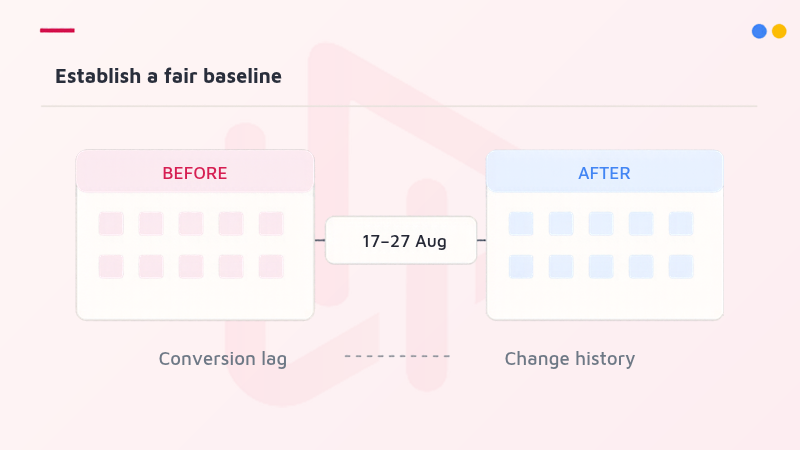
A reliable post-rollout assessment starts with a fair comparison baseline. Before evaluating changes in CPA, ROAS, or conversion volume, advertisers should identify which campaigns were eligible for the rollout and account for concurrent setting changes, conversion delays, and differences in reporting periods. The following four checks help separate meaningful performance signals from misleading before-and-after comparisons.
- Filter campaigns by eligible strategy, current and historical budget limitations, and the dates when material account changes occurred.
- Compare the pre-rollout and post-rollout periods with enough reported conversions to make the comparison meaningful; document gaps in sample size.
- Use the Days to conversion segment or bid strategy reporting to account for lag; do not mechanically discard seven days for every advertiser.
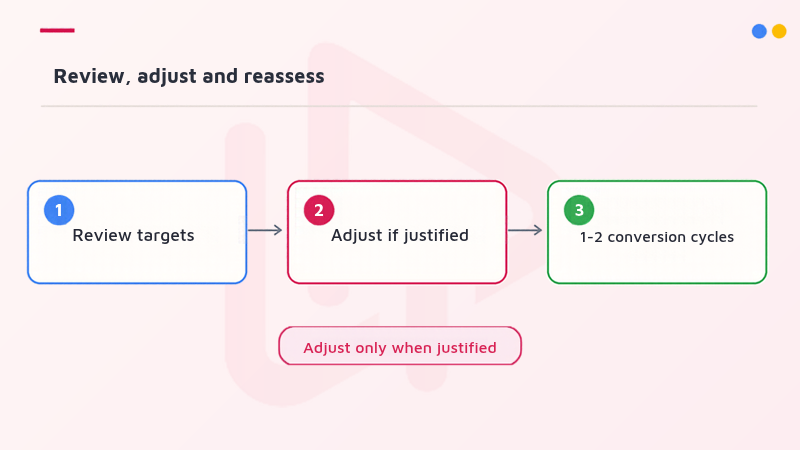
- After a material target or budget change, allow roughly one to two conversion cycles before drawing conclusions, as Google recommends.
4.2. Diagnose target gaps and lead quality
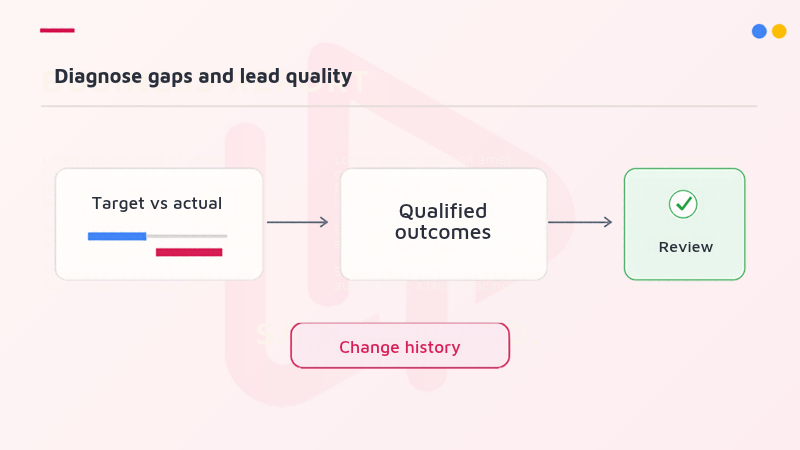
Record target CPA versus actual CPA, or target ROAS versus realized ROAS, together with spend, conversion volume, conversion value, and marginal economics where available. Compare those measures with campaign change history. A larger gap from target may support a target review, but it does not tell you which target is commercially correct.
- For B2B: reconcile imported qualified-lead or opportunity stages with campaign-reported conversions where tracking permits.
- For e-commerce: separate attributed sales value from margin, refunds, and inventory constraints.
- For PMax or Demand Gen: review channel distribution and diagnostics before proposing an inventory explanation.
5. Choose the next action based on business objectives
The correct response is a decision, not a mandatory three-step migration. Google permits advertisers to keep, change, or customize a target, change certain bidding strategies, or raise budget where demand and business economics justify it. The comparison below is a planning aid; actual outcomes remain subject to auction conditions and conversion quality.
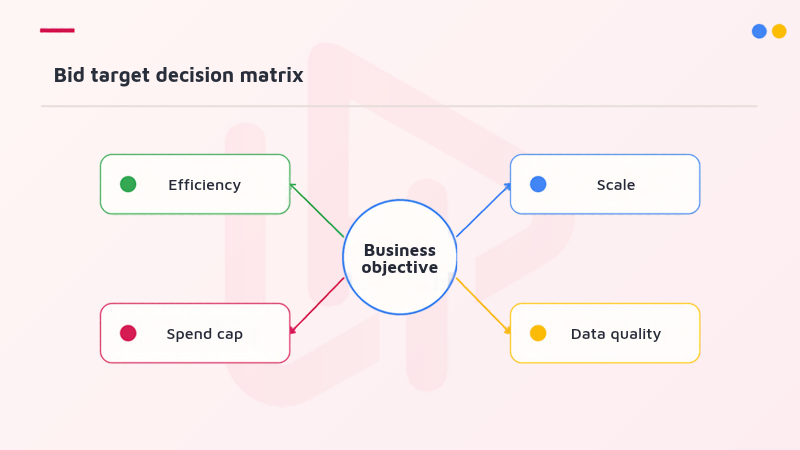
5.1. Bid target decision matrix
Choosing the right bidding adjustment requires balancing campaign performance against business objectives, rather than reacting to the rollout with a universal rule. Advertisers should assess the gap between actual and target performance, available budget, conversion data quality, and their tolerance for efficiency changes. The decision matrix below outlines four common scenarios, the actions worth considering, and their potential trade-offs.
| Observed condition | Business objective | Possible action and trade-off |
|---|---|---|
| Actual CPA materially below configured tCPA; volume adequate | Preserve recent acquisition efficiency | Review lowering tCPA toward a defensible level; tighter targets can reduce scale. |
| Current target reflects acceptable economics | Maintain target while assessing additional reach | Keep target; test budget increases if profitable demand exists. More budget does not guarantee full delivery. |
| Set spending ceiling cannot change | Prioritize conversions or value within that ceiling | Consider Maximize Conversions or Maximize Conversion Value without a target; CPA/ROAS can fluctuate. |
| Sparse conversions or noisy tracking | Avoid false precision | Improve measurement and review manually; the tool may not recommend targets below 7 conversions. |
5.2. Apply changes with the available Google Ads tools
Google says its Bid Target Adjustment Tool is available from the account notification (“Review your campaign targets”) or from Campaigns → the campaign Settings → Bidding → Review campaigns, where eligible. In Search Ads 360, the workflow is different. Recommendations are suggestions, not compulsory settings; an absent recommendation does not prove a campaign was unaffected.
For portfolio strategies and constrained shared budgets, review and apply target decisions at the relevant strategy or shared-budget level. Avoid applying data exclusions or new bid limits solely in reaction to the rollout. Record the reason for each change and the measurement date before reassessing results.
6. Frequently asked questions
These answers distinguish Google’s confirmed bidding behavior from predictions about account-specific results. They are intended as review prompts, not performance guarantees.
No. Google describes more consistent optimization toward the specified target for eligible budget-limited campaigns. It does not guarantee an exact CPA or ROAS in each reporting period.
No. Google states that it does not automatically change your target or budget and that normal spending limits remain in place.
Not necessarily. Channel mix may shift, but direction and magnitude must be established from channel-level reports and business outcomes. Audience signals do not impose exclusive channel targeting.
Google recommends waiting roughly one to two conversion cycles. Use your account’s actual reporting delay and conversion volume to choose a sensible comparison period.
Conclusion
The Google Ads August 17 bidding rollout is now complete, and the useful question is whether each affected campaign’s configured target matches the business outcome it should optimize for. H2T Media Group recommends verifying eligibility, conversion quality, and target gaps before changing budgets or bid strategies. For the original pre-rollout announcement, see our August 03 update; for further technical analysis, explore the Google Ads category of our Insights hub. Follow H2T Media Group on LinkedIn and H2T Media Group on Facebook for future analysis.

bichthao
H2T Media Group decodes every meaningful platform update for advertisers and affiliate partners across APAC, EU and North America — always with a practical "H2T take" you can act on.
More about H2T →