

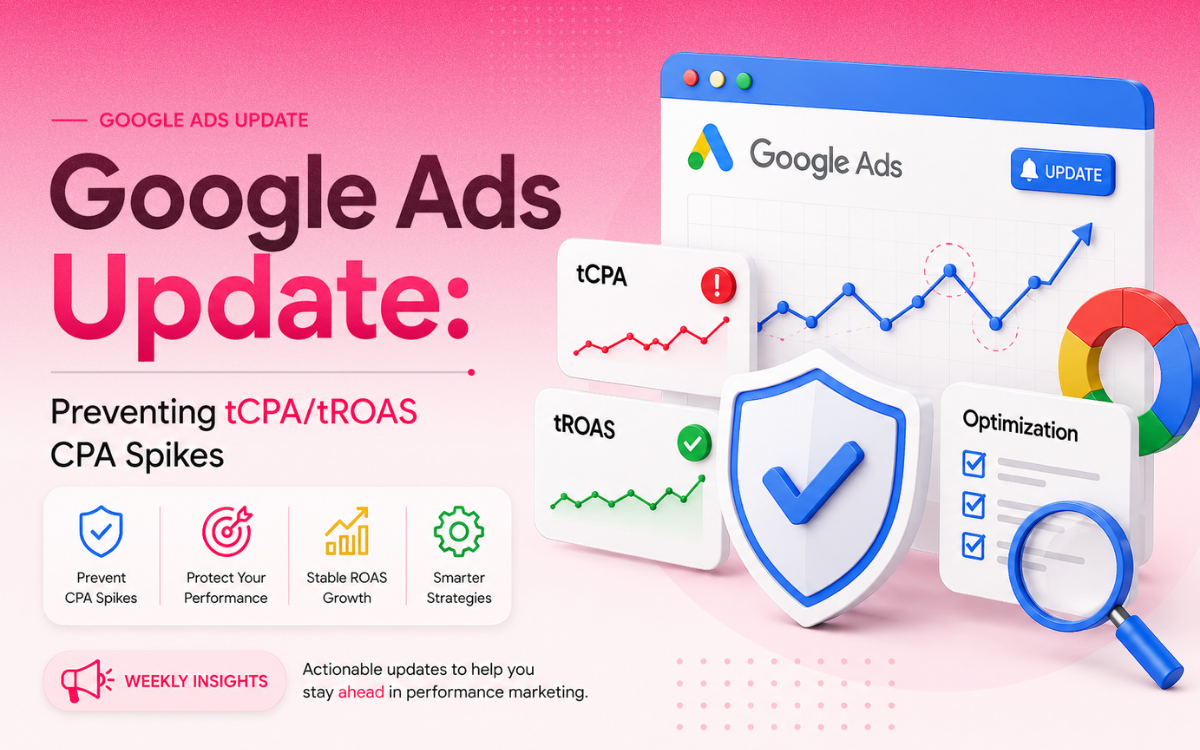
Welcome to the Google performance insights hub by H2T Media Group. On August 17, 2026, Google will deploy a major Core Update that completely overhauls the Target CPA (tCPA) and Target ROAS (tROAS) smart bidding algorithms. If Media Buyers fail to grasp the technical nuances of this Google Ads Update August 17 2026, the system will automatically recalibrate your auctions, leading to an immediate, unjustified spike in your Cost Per Acquisition (CPA). Let’s dive deep into the mechanics of this shift and outline the exact strategies to protect your margins.
 Key Takeaways
Google Ads Core Update (August 17, 2026) fundamentally overhauls Smart Bidding by shifting from a “Baseline” model to “Forced Target Alignment,” compelling actual performance to strictly match set tCPA/tROAS targets.
Essential Facts About This Update
- The update eliminates artificial bid manipulation (setting low tCPA to “trick” AI), forcing actual CPA to rise to match higher target inputs.
- B2B Lead Generation campaigns (PMax) risk severe quality degradation as budget shifts to cheap Display/Video inventory, creating a “junk pipeline.”
- E-Commerce brands benefit significantly as the “Scaling Penalty” is removed, enabling stable ROAS during aggressive budget scaling.
- H2T Media Group recommends three immediate scenarios: lower targets to lock in efficiency, scale with uncapped budgets for E-com, or remove targets and use Maximize Conversions for strict spending caps.
1. Google Ads Update August 17: Shifting from “Baseline” to “Absolute Target”
The key change is how Google’s AI interprets the number you enter in the Target field.
1.1. The Old System: Target as a Minimum Baseline
Historically, the system treated your tCPA or tROAS as a “minimum desired threshold.” The algorithm consistently tried to over-deliver and beat that target (cheaper CPA, higher ROAS) when campaigns were budget-constrained. Media Buyers often used this loophole, setting artificially low tCPAs as a manual lever to trick the AI into generating cheap leads.
1.2. The New System: The “Forced Target Alignment” Risk
Effective Aug 17, the new algorithm forces actual performance to match your input EXACTLY.
For example: Your inputted tCPA is $10, but through hyper-optimization, your actual CPA is $7. If you do nothing, the AI will recognize that you are willing to pay $10. It will loosen its bidding criteria and enter more expensive auctions until your actual CPA is forced up from $7 to match the $10 input. You will literally pay more for the same results.
Strategic Perspective from H2T Media Group:
Google’s macro-objective is aggressively clear: Force advertisers to uncap their budgets and surrender total control to the AI. The era of human bid-manipulation is dead. From now on, your input must reflect your 100% true Business Margin, rather than a fabricated number used to bait the system.
2. Risk & Reward Analysis (Before vs. After): Who is Impacted?
This algorithmic shift creates a dual impact, polarizing strategies across different industries.
2.1. B2B Lead Generation: The PMax “Junk Pipeline” Disaster
Multi-channel campaigns like Performance Max (PMax) for B2B enterprises will take the hardest hit. Because the AI is forced to hit a potentially loose tCPA, it will trigger Sudden Channel Shifts:
- Pulling budget away from the Search network (expensive CPC, high purchase intent).
- Dumping budget into Display/Video networks (cheap CPM, prone to low-quality leads).
- The Consequence: The dashboard reports a perfect average CPA, but the Sales team receives a pipeline stuffed with unconvertible “spam leads”.
2.2. E-Commerce (Retail): The End of the “Scaling Penalty”
Conversely, E-commerce brands win big. Google has permanently fixed the volatility associated with budget expansion.
| Metric | The Old Era (Pre-Update) | The New Era (Post Aug 17, 2026) |
|---|---|---|
| Scaling Behavior | Hit by the “Scaling Penalty”. Uncapping a budget from $200 to $1000 crashed actual ROAS from 10x back to 5x. | Predictable Scaling. Uncapping budgets stabilizes performance; actual ROAS remains constant at your exact 10x target. |
| Recommended Action | Micro-adjusting daily budgets by 10-20% to avoid shocking the AI. | Deploying “demand-led budgets” (Uncapped) to capture all profitable conversions. |
3. The 3-Step Action Plan from H2T Media Group
Hesitation is no longer an option. Media Buying teams must execute these 3 account recalibration scenarios immediately:
- Maintain Current Efficiency (Protect Margins): If your actual CPA is $5 (but your target is set to $10), lower your Target to $5 immediately. This locks in your current efficiency and stops the AI from artificially inflating your bids.
- Scale for Volume (E-com Focus): Adjust your target to a realistic business goal (e.g., $7) and uncap the budget completely. Let the AI freely hunt for scale without ROAS volatility.
- Fixed Budget Strategy: If your daily budgets are strictly fixed and cannot be increased, remove the tCPA/tROAS targets entirely. Switch to ‘Maximize Conversions’ or ‘Maximize Conversion Value’. Daily performance will fluctuate, but it will maximize total returns within your strict spending limit.
4. Frequently Asked Questions
Previously, Google’s algorithm treated your target CPA/ROAS as a baseline, attempting to over-deliver cheaper conversions when budget was limited. The August 17 update introduces Forced Target Alignment, which strictly adjusts auction entry to ensure actual performance matches your exact inputted target.
If your target CPA was set higher than your actual historical CPA (e.g., target set to $10 while actual CPA was $7), the new system interprets this gap as a willingness to pay more. To align actual performance with your $10 input, the AI enters higher-cost auctions, artificially inflating your CPA.
To hit a loose target CPA under the new system, PMax algorithms may shift budget away from high-intent Search traffic toward cheaper Display and Video inventory. While this maintains the target CPA on paper, it often increases low-quality or spam lead volume (“junk pipeline”).
If daily budgets cannot be uncapped or increased, remove the tCPA/tROAS targets entirely and switch to Maximize Conversions or Maximize Conversion Value. This allows the AI to capture maximum volume within your capped spend limit without forcing artificial target adjustments.
The Google Ads Update August 17, 2026 is a pivotal moment, forcing every enterprise to fully embrace data-driven automation. Tricking the algorithm is no longer a viable strategy. Audit your entire portfolio today to master Google’s new rules of engagement. Keep following the Insight about Google Ads category at H2T Media Group for razor-sharp technical analyses that protect your ROI and elevate your global media buying strategies.

bichthao
H2T Media Group decodes every meaningful platform update for advertisers and affiliate partners across APAC, EU and North America — always with a practical "H2T take" you can act on.
More about H2T →