

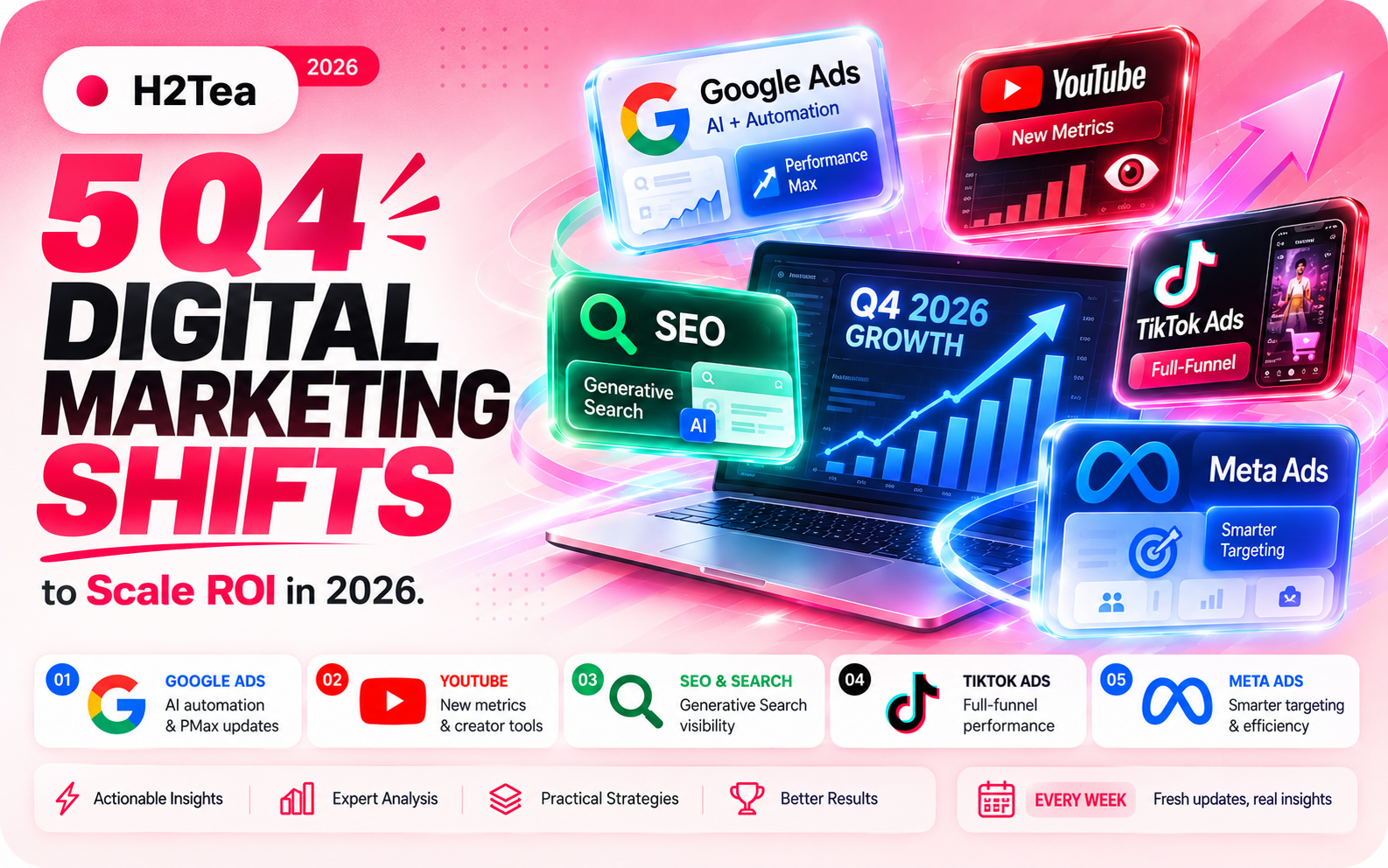
Welcome to H2Tea – the weekly executive digest engineered by H2T Media Group, where we unpack the critical Q4 digital marketing shifts driven by tech conglomerates replacing legacy manual operations with deep neural networks and real-time server-side infrastructure. By synthesizing these five fundamental algorithmic updates across Google Ads, YouTube, AI Search, TikTok, and Meta, this edition delivers a technical execution playbook to defend your net contribution margins throughout 2026.
 Key Takeaways
The H2Tea Digital Marketing Digest synthesizes 5 critical adtech infrastructure transformations spanning Google Ads, YouTube, SEO, TikTok, and Meta Ads.
Essential Facts About This Week’s 5 Shifts
- Google Ads: Data Manager, Tag Gateway, and Meridian MMM unify data strength and causal incrementality.
- YouTube: 65% of holiday shoppers rely on YouTube; cutting $1 of brand spend requires $1.92 to recover.
- Technical SEO: UPenn and Northeastern study proves AI Search suppresses external website clicks by 45%.
- TikTok Ads: Upgrades Smart Plus (Smart+), integrating generative Symphony AI to defeat creative fatigue.
- Meta Ads: The Andromeda, GEM, and Lattice neural serving stack permanently retires the legacy eCPM auction.
1. Google Ads: Multi-Layered Measurement and Meridian Econometric Modeling
The opening technical shift this week centers on Google Ads upgrading its Data Strength suite, officially standardizing the enterprise growth equation: Data + Causality + Better Decisions = Profitable Growth.
1.1. Server-side Tag Gateway and Data Manager infrastructure
To counteract client-side browser tracking prevention that strips away 20% to 30% of conversion signals, Google has unified its data ingestion layer:
- Google Data Manager: A centralized API connector hub that standardizes direct data synchronization linking enterprise CRMs (Salesforce, HubSpot) and offline Point-of-Sale (POS) systems directly into Google Ads.
- Google Tag Gateway: Server-side proxy tagging executed within the enterprise’s own first-party domain context, elevating Enhanced Conversions match rates consistently above 90%.
1.2. Cart margin optimization and open-source Meridian MMM
Google delivers two critical financial levers:
- Conversions with Cart Data (CWCD): Decomposes transactions into item-level SKUs, quantities, and Cost of Goods Sold (COGS), training Smart Bidding algorithms to optimize directly for Actual Gross Profit rather than top-line revenue volume.
- Google Meridian MMM & GeoX: Cookieless, open-source Media Mix Modeling. Meridian GeoX deploys randomized geographic holdout testing to isolate true Causal Incrementality, empowering leadership to permanently eliminate ad spend allocated to baseline organic conversions.
2. YouTube: Q4 Strategies for Super-Empowered Shoppers and the $1.92 BCG Rule
During Rethink Week 2026, a comprehensive Ipsos study surveyed 8,237 consumers. The findings revealed that 65% of shoppers consider Google or YouTube absolutely essential to complete their holiday shopping.
2.1. The rise of AI-guided Super-Empowered Shoppers
Empowered by conversational tools like Google Gemini, consumers interact with 2.8x more digital touchpoints prior to purchasing. Rather than browsing passively, shoppers consult trusted creators on YouTube for validation—scrutinizing unboxings, gift guides, and durability tests immediately before completing checkouts.
2.2. The cost penalty of brand marketing cuts (BCG Study)
Research from the Boston Consulting Group (BCG) establishes a critical financial benchmark:
- For every $1 of near-term brand spend cut, enterprises must reinvest $1.92 in subsequent cycles simply to regain lost market share.
- Treating brand awareness and direct-response performance as opposing silos is an operational failure. Growth teams must implement a balanced 40/60 distribution: building demand across YouTube Shorts and Connected TV, while capturing checkouts via shoppable Demand Gen campaigns linked to dynamic product feeds.
3. Technical SEO: Empirical 1,100-User Research and the 45% AI Search Traffic Contraction
Directly contradicting public platform messaging, an independent empirical study published in August 2026 by researchers at the University of Pennsylvania (UPenn) and Northeastern University evaluating 1,100 verified users exposed the actual mechanical impact of generative search.
3.1. The enclosed walled-garden retention barrier
The academic data proves that when AI Overviews or AI Mode render on the SERP:
- External website click-through rates contract by an average of 45%.
- Google AI functions as an enclosed “Walled Garden” engineered to retain user dwell time within the native search ecosystem to maximize internal ad impressions, converting informational queries into zero-click dead ends.
3.2. Transitioning to direct branded search demand
Continuing to produce generic, definitional blog posts hoping for superficial AI citations represents an inefficient deployment of capital.
- Terminate production of generic informational content that is 100% absorbed by AI summaries.
- Pivot toward engineering Direct Branded Search Demand: publish proprietary empirical datasets, primary market research, and specialized technical case studies. Transform owned domains into essential knowledge destinations that buyers navigate to directly, bypassing intermediary AI summaries.
4. TikTok Ads: Full-Funnel Automation via TikTok Smart Plus and Symphony
TikTok for Business upgraded its automated performance suite, TikTok Smart Plus (Smart+), integrating generative AI creative production via Symphony Creative Studio.
4.1. Unifying four commercial objectives
Smart+ eliminates tactical manual adjustments by autonomously managing audience targeting, bid calibration, and real-time capital allocation:
- Smart+ Web: Deploys Value-Based Bidding (VBB) to optimize e-commerce transaction value.
- Smart+ App: Focuses on deep in-app event milestones (AEO) and post-install lifetime value (LTV).
- Smart+ Lead Gen: Captures high-intent prospects via friction-free native Instant Forms.
- Smart+ Catalog: Programmatically distributes dynamic product feeds tailored to live browsing intent.
4.2. Defeating creative fatigue via Symphony AI
Smart+ natively integrates the closed-loop Symphony creative engine:
- When telemetry detects engagement drop-offs at the 2-second mark, the engine autonomously calls APIs to render five fresh opening hook variations in minutes.
- Automatically enforces 9:16 vertical Safe Zone compliance and synchronizes pre-cleared commercial audio, sustaining an “Excellent” Ad Strength rating across GMV Max and Spark Ads campaigns continuously.
5. Meta Ads: The Andromeda, GEM, and Lattice Neural Serving Stack
Meta Ads has permanently retired the legacy static eCPM formula, transferring all delivery and pricing authority to a unified neural computing architecture: Andromeda, GEM, and Lattice.
5.1. Operational mechanics of the three AI engines
- Andromeda: High-speed candidate retrieval engine scanning global ad pools to filter millions of competing ads down to hundreds of relevant candidates in milliseconds.
- GEM (Generative Engagement Model): Deploys computer vision and deep natural language processing to decode video keyframes, audio transcripts, and text copy, positioning creative assets as the primary targeting mechanism.
- Lattice: Multi-task deep neural network concurrently predicting click probability (pCTR), conversion propensity (pCVR), and customer lifetime value (pLTV) to determine winning auction bids.
5.2. Governance directives for media buyers
Because GEM autonomously classifies audience intent through video content, micro-interest targeting is obsolete. Performance teams must consolidate ad accounts into broad Advantage+ Shopping Campaigns (ASC+), deploy multi-ratio creative packages (PAC 9:16 and 4:5), and maintain Server-Side CAPI Event Match Quality (EMQ) scores ≥ 8.5/10 to supply Lattice with clean optimization signals.
As documented in official technical guidelines within the Meta Business Help Center, standardizing server data connections is mandatory for machine learning precision.
6. Technical Specifications Matrix: Synthesizing the 5 Weekly Platform Shifts
The technical matrix below outlines the core updates, algorithmic mechanisms, and mandatory operational directives across all five platforms:
| Advertising Platform | Core Technical Upgrade | Algorithmic Mechanism Shift | Mandatory Enterprise Action Protocol |
|---|---|---|---|
| Google Ads | Data Strength & Meridian MMM. | Smart Bidding optimizes for Cart Margin (CwCD) & GeoX. | Deploy Tag Gateway; pass SKU-level COGS; track QFCs. |
| YouTube | Q4 Rethink 2026 Strategy. | AI shoppers touch 2.8x points; BCG $1.92 reinvestment rule. | Maintain 40/60 brand-performance balance; deploy CTV & Demand Gen. |
| Technical SEO | UPenn Empirical Research. | AI Search retains users on-platform, reducing click-outs 45%. | Build direct Branded Demand; diversify into owned channels. |
| TikTok Ads | Upgraded TikTok Smart Plus. | Full-funnel automated delivery paired with Symphony AI. | Implement Events API; render multi-variant 9:16 video assets. |
| Meta Ads | Andromeda, GEM, & Lattice Stack. | Video content functions as targeting; multi-task valuation. | Consolidate ASC+ campaigns; maintain CAPI EMQ ≥ 8.5. |
7. The Enterprise Q4 Execution Blueprint for Growth Leaders
To translate this week’s technical updates into scalable Q4 commercial revenue, H2T Media Group mandates the following 3-pillar operational roadmap:
Pillar 1: Fortify Cross-Platform First-Party Data Pipelines Audit server-side tracking infrastructure across Google Tag Gateway, Meta Server-Side CAPI, and TikTok Events API. Stream verified offline transaction milestones and item-level cart margins directly from enterprise CRMs to train automated bidding algorithms on actual gross profit rather than superficial top-line revenue.
Pillar 2: Industrialize Multi-Ratio Native Creative Engineering Enforce the principle that “Content Functions as Targeting.” Utilize generative video tools (TikTok Symphony, Google Asset Studio) to iterate native vertical 9:16 assets dynamically, ensuring asset groups sustain peak Ad Strength throughout competitive holiday shopping surges.
Pillar 3: Unify Full-Funnel Distribution and Liquid Budgets Maintain top-of-funnel brand momentum across YouTube to capture AI-guided shoppers, adhering strictly to BCG’s brand preservation guidelines. Deploy flexible Demand-Led Budgets anchored by Value-Based Bidding (Target ROAS) to capture 100% of high-intent commercial demand across all consumer touchpoints.
8. Frequently Asked Questions (FAQ)
Siphoning capital entirely away from upper-funnel demand creation restricts campaigns to consumers who have already finalized their purchase criteria. This narrow audience pool saturates rapidly, driving auction bids to unsustainable levels.
Most enterprise digital storefront platforms (Shopify, WooCommerce, Magento) support cart data integration natively via Google Tag Manager Server-Side or specialized data plugins without custom code.
Audit informational content libraries, gate proprietary benchmark research behind email registration portals, and diversify audience acquisition across owned email newsletters, direct communities, and precision paid search.
Yes. Brands can deploy Smart+ alongside standard custom ad sets. However, operators must segregate product SKUs across campaigns to eliminate internal auction overlap.
To access proprietary performance playbooks and advanced conversion measurement frameworks, explore our full repository on the Insights hub at H2T Media Group. Make sure to consistently follow our dedicated H2Tea to master the executive briefings dictating success across global digital advertising ecosystems.

bichthao
H2T Media Group decodes every meaningful platform update for advertisers and affiliate partners across APAC, EU and North America — always with a practical "H2T take" you can act on.
More about H2T →