

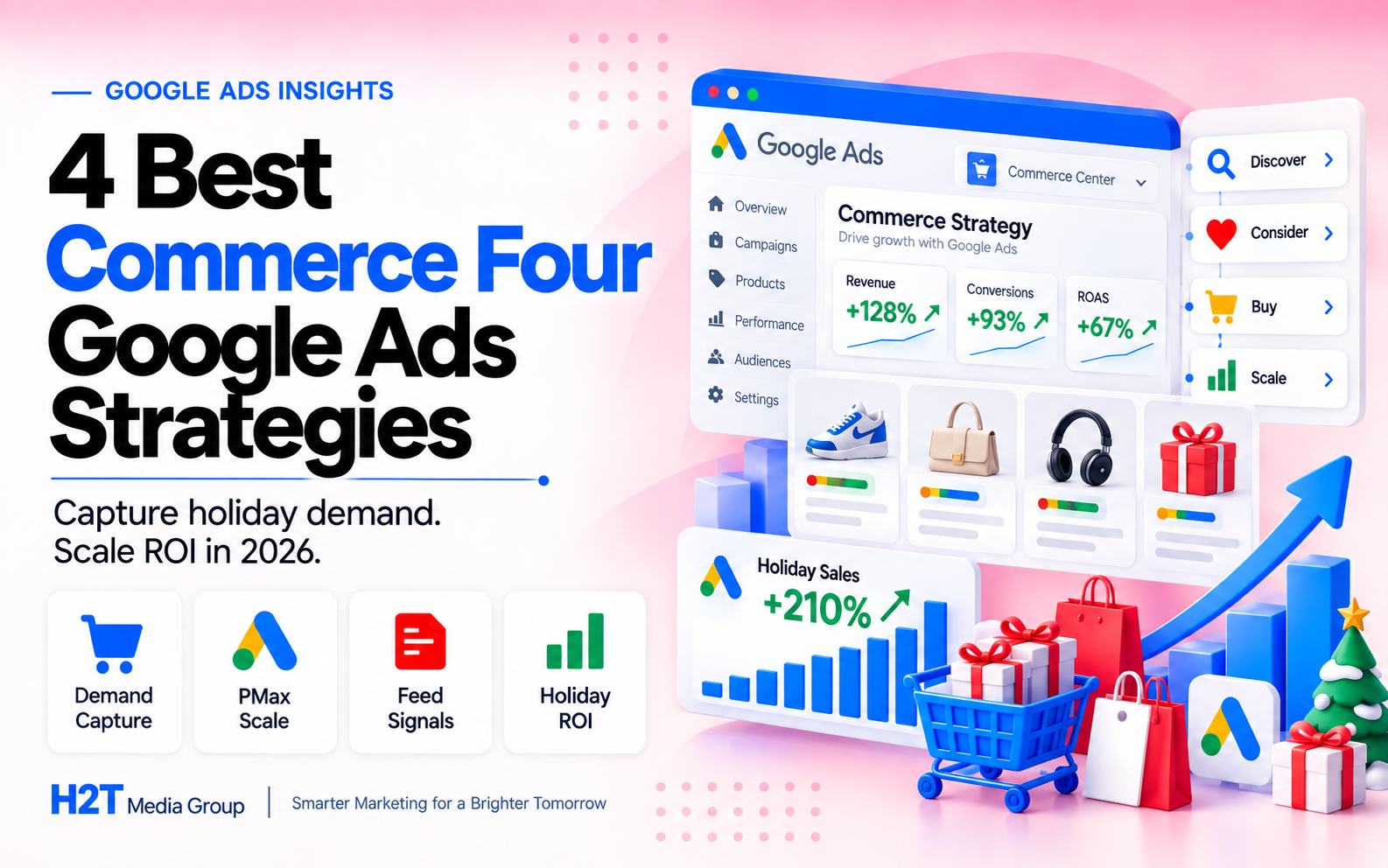
Welcome to the commercial performance marketing insights hub by H2T Media Group. Mastering the Commerce Four Google Ads framework unveiled by Google at Rethink Retail 2026 is essential for digital retailers to capture peak holiday demand, prevent margin compression, and scale performance across AI-driven surfaces. If your enterprise relies on outdated catalog feeds and standard top-line bidding without item-level cart margin signals, your Q4 campaigns risk catastrophic spend inefficiency and lost market share.
Below is H2T Media Group’s technical analysis breaking down the 4 core framework pillars, data infrastructure setup, and an enterprise execution roadmap to future-proof your digital storefront.
 Key Takeaways
Commerce Four Google Ads is Google’s comprehensive retail framework engineered to optimize product feeds, measure item-level cart margins, and scale AI-driven commerce.
Essential Framework Pillars
- Enrich product feeds with conversational attributes and establish verified Brand Profiles in GMC.
- Connect first-party signals via Data Manager and implement Conversions with Cart Data (CWCD).
- Pair Performance Max with AI Max for Search while deploying shoppable Demand Gen creator assets.
- Implement flexible Demand-Led Budgets and optimize for New Customer Acquisition (NCA) value.
- Prepare for the Universal Commerce Protocol (UCP) and integrate frictionless Google Pay checkout.
1. The Structural Evolution of E-Commerce in the 2026 AI Era
The 2026 holiday shopping season marks a decisive behavioral inflection point: consumers no longer navigate static digital storefronts; they converse directly with generative AI models to discover, compare, and validate gift procurement.
Consumer discovery has migrated from fragmented keyword queries to complex conversational requests. A shopper prompts an AI agent: “Recommend three premium oversized merino wool sweaters in beige with guaranteed delivery before December 24th in Chicago”.
If a retailer maintains basic, un-enriched catalog metadata, language models will systematically bypass their storefront. The Google Commerce Four framework unveiled at Rethink 2026 was engineered precisely to help enterprise brands structure their operational data, ensuring their catalog is algorithmically prioritized across all AI discovery surfaces.
2. Deconstructing the 4 Pillars of the Commerce Four Google Ads Framework
The Commerce Four methodology unites four synchronized technical disciplines into a closed-loop retail conversion ecosystem:
2.1. Pillar 1: Product Feeds (Conversational Metadata & Brand Agents)
Your Google Merchant Center (GMC) feed serves as the native training dataset powering Google AI’s commercial comprehension.
- Enriching Conversational Attributes: Populate granular, contextual attributes beyond standard sizes and colors: specific materials (material), intended use cases (occasion), aesthetic design styles (style), and seasonal alignment (seasonality).
- Claiming Brand Profiles & Business Agents: Establish an official Brand Profile and authenticate your verified “Business Agent” inside Merchant Center. This signals verifiable brand ownership to Google’s systems, giving your products prioritized placement in conversational AI shopping sessions on Google Gemini and AI Overviews.
2.2. Pillar 2: Data Strength (Deep Measurement & Cart Margin Signals)
Machine learning bidding models cannot protect profit margins when they rely on fragmented transaction data.
- First-Party Data Unification via Data Manager: Ingest offline CRM, POS, and ERP data into Google Data Manager to build comprehensive customer lifetime value (LTV) models.
- Deploying Google Tag Gateway: Migrate website tracking to server-side Google Tag Gateway infrastructure, eliminating tracking signal loss caused by browser-level ad blockers and network latency.
- Implementing Conversions with Cart Data (CWCD): Transmit item-level transaction details: Product IDs, quantities purchased, Cost of Goods Sold (COGS), and gross margins. This data trains Smart Bidding algorithms to optimize directly for Net Profit Yield rather than superficial top-line revenue volume.
2.3. Pillar 3: AI Campaigns (Full-Funnel Algorithmic Distribution)
Deploy synchronized AI campaign architectures to dominate consumer touchpoints across search, video, and social feeds.
- Pairing Performance Max & AI Max: Deploy Performance Max alongside AI Max for Search & Shopping to command simultaneous real estate across Search, Shopping, YouTube Shorts, Discover, and Maps.
- Scaling Demand Gen with Shoppable Creator Feeds: Utilize Demand Gen campaigns embedding authentic creator video reviews paired with Direct Checkout Links, routing consumers seamlessly from mobile video streams to pre-populated checkout carts.
- Activating New Customer Acquisition (NCA) Bidding: Assign custom bid multipliers for net-new customer profiles, preventing automated bidding engines from wasting media capital retargeting existing brand loyalists.
2.4. Pillar 4: Agentic Infrastructure (Autonomous Commerce Readiness)
Construct the technical rails required for autonomous AI shopping agents to execute commercial transactions on behalf of consumers.
- Evaluating the Universal Commerce Protocol (UCP): Standardize internal product and inventory APIs to allow external AI shopping agents to query live stock levels and execute automated checkouts.
- Integrating 1-Click Google Pay: Eliminate mobile checkout friction. Allowing consumers to authenticate transactions via biometric verification in seconds maximizes checkout completion rates.
3. Advanced Data Infrastructure: Google Tag Gateway and Cart Data Analytics
The primary failure point for online retailers during peak Q4 scaling is the severe data discrepancy separating ad dashboard reporting from actual backend profitability.
3.1. Neutralizing signal loss via Google Tag Gateway
During high-traffic events like Black Friday and Cyber Monday, client-side JavaScript tags frequently experience rendering delays or are blocked by browser privacy protocols (iOS 14.5+).
Google Tag Gateway operates as an authenticated server-side data conduit, ensuring 100% of product impressions, cart additions, and finalized transactions are cryptographically hashed and streamed directly into Google Ads in real time.
3.2. Driving profit optimization with Conversions with Cart Data
Standard conversion tracking informs the bidding engine: “Customer A completed a $200 purchase”.
The algorithm cannot determine whether that $200 transaction generated $100 in net profit or resulted in a $10 loss.
With Conversions with Cart Data implemented:
- The system parses: The customer purchased Product X (50% profit margin) and Product Y (5% margin).
- Smart Bidding recalibrates its Target ROAS bidding models, allocating aggressive liquidity toward acquiring customer cohorts predisposed to purchasing high-margin Product X inventory.
- The enterprise maximizes Actual Gross Profit rather than pursuing inflated, low-margin top-line revenue.
4. Preparing for the Agentic Commerce Infrastructure Era
Digital retail is transitioning rapidly from “Consumer Search & Select” to “Autonomous Agent Execution.” In this new paradigm, shoppers rely on intelligent AI assistants to discover, compare, and complete transactions automatically. Brands must adapt their digital infrastructure to ensure these autonomous agents can seamlessly access accurate product data and execute purchases without friction.
4.1. The Universal Commerce Protocol (UCP)
In the near future, consumers will instruct their personal AI assistants: “Reorder my standard laundry detergent and automatically select the retailer offering the lowest price with guaranteed delivery by Friday”.
The Universal Commerce Protocol (UCP) establishes the open communication standard connecting Google AI to enterprise inventory databases. Retailers possessing UCP-compliant architectures will be autonomously selected by AI shopping agents to fulfill consumer transactions without manual web browsing.
4.2. Frictionless transactions via Google Pay
Every manual form field required during mobile checkout reduces conversion probability by an estimated 10%. Integrating native Google Pay allows consumers to bypass address entry and payment inputs, compressing the entire checkout journey into a single biometric touchpoint.
5. Technical Specifications Matrix: The Commerce Four Framework
The matrix below outlines the technical actions, integrated technologies, and performance consequences governing each pillar:
| Commerce Four Pillar | Mandatory Technical Execution | Integrated Google Technology | Operational Risk of Non-Compliance |
|---|---|---|---|
| 1. Product Feeds | Populate conversational attributes; verify Business Agent. | Google Merchant Center, Brand Profile. | Product catalog bypassed by AI in conversational shopping. |
| 2. Data Strength | Upgrade to Tag Gateway; implement Cart Data (CWCD). | Google Data Manager, Server-Side Tagging. | Blind bidding optimization; algorithm optimizes for low-margin revenue. |
| 3. AI Campaigns | Deploy PMax + AI Max; integrate Demand Gen & NCA goals. | Smart Bidding, Asset Studio, Value Rules. | Loss of high-intent impression share across YouTube Shorts and Search. |
| 4. Agentic Infra | Standardize UCP architecture; enable 1-click Google Pay. | Universal Commerce Protocol, Google Pay API. | Exclusion from autonomous AI-assisted purchasing ecosystems. |
6. The 3-Phase Enterprise Execution Roadmap by H2T Media Group
To transform Google’s strategic framework into scalable Q4 profitability, H2T Media Group mandates the following 3-phase technical implementation:
Phase 1: Feed Enrichment and Tag Gateway Deployment (September – October)
- Enrich all GMC product feeds with verified GTINs, precise material attributes, sizing vectors, and holiday gift metadata.
- Deploy Google Tag Gateway via server-side containers and activate the Conversions with Cart Data streaming pipeline.
- Authenticate corporate Brand Profiles and claim Business Agent verification in Merchant Center.
Phase 2: AI Campaign Structuring and Value Calibration (October – November)
- Restructure Performance Max asset groups utilizing custom labels segmented strictly by product profit margins.
- Activate AI Max on core Search campaigns and launch Demand Gen campaigns utilizing verified creator video assets.
- Implement New Customer Acquisition (NCA) bidding rules to prioritize new buyer acquisition during pre-holiday research weeks.
Phase 3: Uncapping Demand-Led Liquidity (November – December)
- Activate Demand-Led Budgets, removing artificial daily caps to permit automated scaling during peak promotional surges (BFCM, Cyber Week, Christmas).
- Enable 1-click Google Pay checkout links across all visual touchpoints to maximize down-funnel transaction velocity.
7. Frequently Asked Questions
Search Four is optimized for lead generation and consultative service pipelines, whereas Commerce Four is engineered specifically for multi-SKU e-commerce retailers managing complex shopping carts.
Audit your Merchant Center diagnostics to confirm that rich optional attributes (material, pattern, lifestyle_image_link, product_highlight) are populated across at least 90% of active SKUs.
No. Major digital storefront platforms—including Shopify, WooCommerce, and Magento—support cart data integration natively via Google Tag Manager or direct server-to-server plugins.
Activate flexible budget pacing approximately 3 to 5 business days prior to peak shopping surges to allow machine learning models to expand auction liquidity without operational instability.
The Commerce Four Google Ads framework unveiled at Rethink Retail 2026 establishes the definitive architectural standard for scaling e-commerce revenue during the fourth quarter. The era of managing media spend based on speculative guesswork has ended, replaced by the dominance of first-party data governance, algorithmic campaign synthesis, and autonomous checkout infrastructure. Organizations that proactively enrich their product feeds and establish item-level cart measurement will unlock unprecedented scaling velocity while defending sustainable profit margins throughout the 2026 holiday season.
To access proprietary cart data integration blueprints and advanced performance marketing frameworks, explore our technical repository on the Insights hub at H2T Media Group. Make sure to consistently follow our dedicated category Google Ads to master the tactical marketing strategies dictating success across global advertising ecosystems.

bichthao
H2T Media Group decodes every meaningful platform update for advertisers and affiliate partners across APAC, EU and North America — always with a practical "H2T take" you can act on.
More about H2T →