
Welcome to the performance marketing insights hub by H2T Media Group. On August 24, 2026, Google officially launched its latest feature release: Google Gemini Drops. While general users focus on interactive study notebooks or in-car voice tools, media buyers must examine the underlying technology.
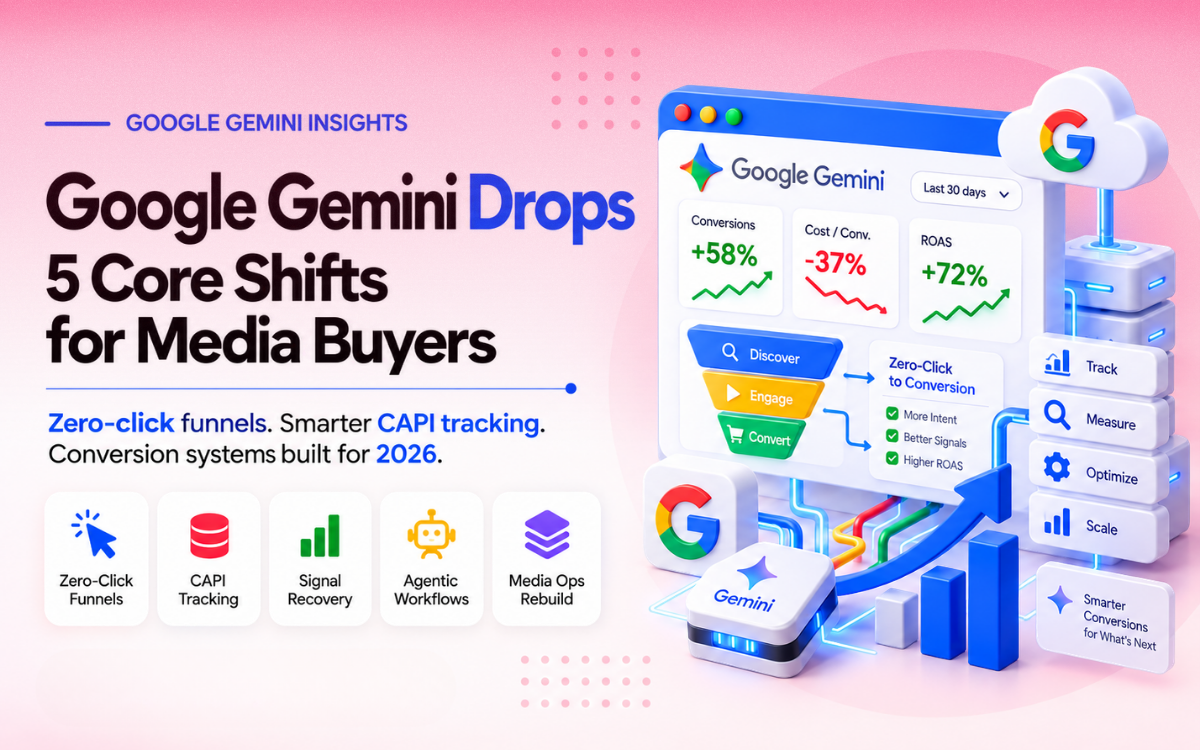
This update establishes direct conversational commerce and introduces zero-click conversion funnels. The combination of the Gemini 3.7 Flash reasoning engine, native partner app actions, and video scene extensions fundamentally alters how digital campaigns convert. This article outlines the key technical shifts and provides practical solutions to protect your advertising performance.
 Key Takeaways
Google Gemini Drops is Google’s major feature update focusing on Gemini 3.7 Flash reasoning, third-party app actions, and automated video scene extensions.
Essential Facts About Google Gemini Drops
- Partner app integrations (Zoho, OpenTable) enable direct zero-click conversion flows inside chat.
- Gemini 3.7 Flash powers multi-step automated campaign audits and error troubleshooting.
- Video scene extension scales Performance Max creative assets without studio reshoots.
- Standard browser pixels cannot track commercial actions completed inside conversational AI interfaces.
- Deploying Server-Side CAPI and CRM synchronization is mandatory to maintain data attribution.
1. Understanding the Reality Behind Google Gemini Drops
The Google Gemini Drops release is presented as a consumer productivity update. However, technically, it represents a major move to transition user interactions from search results pages to conversational interfaces.
Traditionally, the search funnel followed a linear path: User searches a query → Google displays links and ads → User clicks an ad → Lands on an external Landing Page → Reads content and fills out a form.
With Google Gemini Drops, this process changes. By connecting directly with third-party applications, Google allows AI to process transactions natively. Users can book appointments, reserve tables, or request business quotes inside the conversation without visiting the business website.
2. Partner App Integrations and the Zero-Click Funnel
The most critical component of Google Gemini Drops is the direct integration of partner applications, including: Zoho, Wix, OpenTable, Thumbtack, Angi, Zocdoc, and Ticketmaster.
2.1. Direct in-dialogue actions
Gemini can now call APIs to execute actions in real time:
- Users can book restaurant tables through OpenTable, schedule home contractors via Thumbtack, or reserve medical appointments using Zocdoc directly inside the chat.
- For B2B companies, integrations with Zoho and Wix let prospects submit inquiries or request quotes without navigating to an external portal.
2.2. Impact on the role of landing pages
For years, landing pages served as the foundation for lead generation campaigns. Companies invested heavily in conversion rate optimization, faster loading speeds, and concise form designs.
As Google Gemini Drops normalizes completing tasks within chat, the step of visiting a landing page is bypassed. This creates the zero-click funnel: The customer discovers a solution and finishes the transaction on a single screen. Businesses without direct API connections will face higher friction in capturing leads.
3. Gemini 3.7 Flash and Programmatic PPC Automation
The Google Gemini Drops suite integrates the Gemini 3.7 Flash model, featuring advanced multi-step reasoning. This capability improves how large-scale advertising accounts are managed and audited.
3.1. Automated multi-step account audits
Gemini 3.7 Flash can process multi-tiered logical operations in seconds:
- It can cross-reference disapproved items in Google Merchant Center (GMC) against live website product data, identifying price mismatches or inventory errors automatically.
- It can also evaluate performance data across dozens of ad groups simultaneously, distinguishing between normal conversion reporting delays and actual performance drops to avoid false alarms.
3.2. Reducing technical incident delays
Due to fast processing speeds, automated scripts built with the Gemini API can pause ad groups with broken landing page URLs or adjust budgets between Search and Performance Max campaigns automatically without waiting for manual reviews.
4. Automated Video Scene Extensions for PMax and Demand Gen
The video scene extension feature in Google Gemini Drops uses AI to analyze the final frames of an existing video and generate smooth, continuous action.
4.1. Solving creative asset shortages
In Performance Max (PMax) and Demand Gen campaigns, creative fatigue occurs quickly. Algorithms constantly require new video assets to keep ad strength ratings high. However, producing new videos in studios requires significant time and budget.
4.2. Expanding 5-second hooks into 30-second assets
Scene extension technology simplifies production:
- Teams only need to film an engaging 5-second opening hook addressing a clear customer problem.
- The AI then extends this footage into 15-second versions for YouTube Shorts and 30-second versions for standard video placements without distorting product details or brand colors.
- This allows media buyers to produce multiple testing variations quickly at low cost.
5. Comparing Traditional Funnels vs. Google Gemini Drops
Below is a direct comparison between the traditional search journey and the new conversational flow:
| Comparison Metric | Traditional Search Funnel | Google Gemini Drops Funnel |
|---|---|---|
| Discovery Point | Search Engine Results Page (SERP) with text links. | Conversational AI interfaces (Gemini App, Waymo voice). |
| Customer Action | Click link → Wait for landing page → Fill out form. | Ask question → Receive recommendation → Confirm action. |
| Drop-off Risks | Slow page speed, long forms, poor mobile layouts. | Broken app integrations, lack of direct CRM API hooks. |
| Measurement Method | Browser pixels, website cookies, thank-you pages. | Mandatory API Tracking: Google CAPI and Offline Tracking (OCT). |
| Optimization Focus | Landing page design, keyword density, ad copy CTR. | Entity authority, structured schema, and API integrations. |
6. Measurement Solutions: Server-Side CAPI and CRM Tracking
The most significant risk of users transacting directly within Google Gemini Drops is data loss when relying solely on traditional tracking tools.
6.1. Limitations of browser pixels
When a user schedules an appointment through an integrated app in Gemini chat:
- The user never visits the company’s website.
- No browser-side tracking scripts are triggered.
- No website thank-you page is loaded to count the conversion.
Relying on standard website pixels will cause ad accounts to register zero conversions. Without conversion signals, automated bidding models assume campaigns are underperforming and reduce delivery, driving up customer acquisition costs.
6.2. Building first-party server data pipelines
To maintain accurate measurement, companies must connect backend data:
- Transactions completed via partner apps must be recorded in the internal CRM with customer identifiers.
- Deploy Conversions API (CAPI) to send transaction data from the CRM back to Google Ads in real time.
- This ensures bidding algorithms receive accurate revenue signals to find higher-value customer profiles.
Technical guidelines from Google AI Developers emphasize that structured data and direct API integrations are critical for AI systems to accurately process business entities.
7. 3-Step Action Blueprint by H2T Media Group
To adapt effectively to the changes introduced by Google Gemini Drops, businesses should execute three practical steps:
Step 1: Upgrade to API-first tracking
Review your ad accounts and reduce reliance on browser-only pixels. Enable Enhanced Conversions and establish offline conversion imports from your CRM to Google Ads.
Step 2: Restructure video creative workflows
Focus creative production on high-impact 5-second human opening hooks. Use video scene extension tools to generate multiple aspect ratios and durations for Performance Max campaigns.
Step 3: Standardize business entity profiles
Ensure business name, address, and phone numbers are identical across Google Business Profile. Maintain up-to-date service profiles on partner networks like OpenTable and Thumbtack to capture voice-driven search queries.
8. Frequently Asked Questions (FAQ)
Not immediately, but their role will decline for simple bookings and lead forms. Detailed landing pages remain necessary for complex products requiring extensive research.
Businesses must implement Server-Side CAPI and Offline Conversion Tracking (OCT) to pass completed sales from their CRM back to the ad platform.
The model builds upon the original visual frames, maintaining product proportions and brand color consistency significantly better than standard text-to-video generators.
The first priority is verifying business information across Google Business Profile and enabling Enhanced Conversions to prevent data loss.
The release of Google Gemini Drops highlights a clear direction: Consumers are moving from keyword searches to direct conversational actions. Campaigns focused solely on sending traffic to standard landing pages will experience declining efficiency. Long-term success belongs to businesses that structure their data for AI extraction and secure their measurement with direct server-side integrations.
To explore our latest technical analyses and execution frameworks, visit the Insights hub at H2T Media Group. Be sure to follow our dedicated Google Ads category for continuous updates on global advertising strategies.

bichthao
H2T Media Group decodes every meaningful platform update for advertisers and affiliate partners across APAC, EU and North America — always with a practical "H2T take" you can act on.
More about H2T →