

The YouTube Build and Boost playbook explains how advertisers can turn creator partnerships into a coordinated system for choosing partners, developing useful content, amplifying approved videos, and evaluating results. This article breaks down the four steps, the safeguards around Brand Partner Access, and the evidence behind YouTube’s performance examples. H2T Media Group translates the framework into a practical audit for marketing and media teams.
 Key Takeaways
YouTube Build & Boost is a four-step creator marketing framework connecting authentic creator content with paid amplification and measurable business goals.
Essential facts about YouTube Build & Boost
- BUILD: Select relevant creators and brief authentic, buyer-focused content.
- BOOST: Amplify approved creator videos based on campaign objectives.
- Rule of 4: Use at least two brand and two creator assets across vertical and horizontal formats.
- Viewer behavior: 13× higher branded search and 5× higher purchase likelihood in observational analysis.
- Wayfair case study: 8× ROAS for Affiliate Boost versus business as usual (BAU).
1. What YouTube Build and Boost actually changes
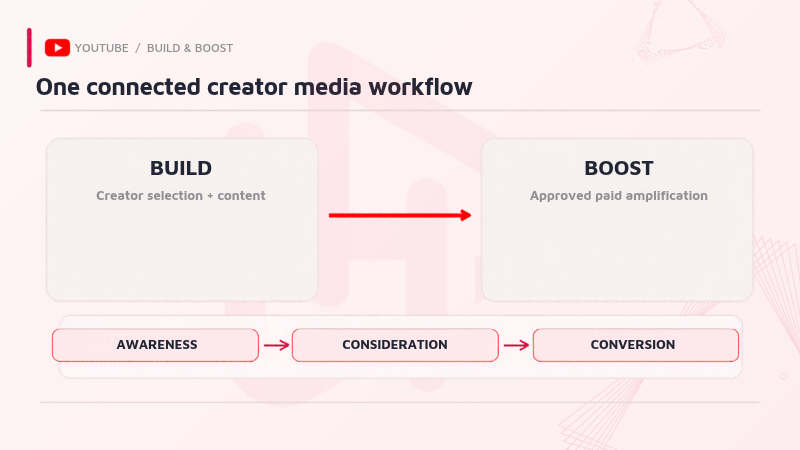
Google’s October 2026 creator-marketing guide treats Build and Boost as parts of one workflow rather than two disconnected budgets. Build establishes a portfolio of relevant creators and content worth finding. Boost puts suitable, authorized creator assets into paid campaigns with explicit objectives. This is not a new promise that every creator collaboration will drive sales; it is a way to coordinate creative, media, and measurement.
The workflow addresses three distinct outcomes: awareness, consideration, and conversion. An authentic tutorial may explain product fit, while paid distribution can reach people who were not part of that creator’s organic audience. Success still depends on the buyer question answered, permission to use the asset, and the campaign KPI selected before launch.
Read more:
YouTube Creator Marketing: Build & Boost — official introduction (October 2026)
2. Build: creator selection and content that earns attention
The Build stage is a planning discipline, not merely a talent shortlist. Teams first decide what the audience needs to learn or do, then identify who can credibly explain it. The next two steps preserve creator voice while giving the advertiser an accountable content plan.
2.1. Select creators by role and brand fit
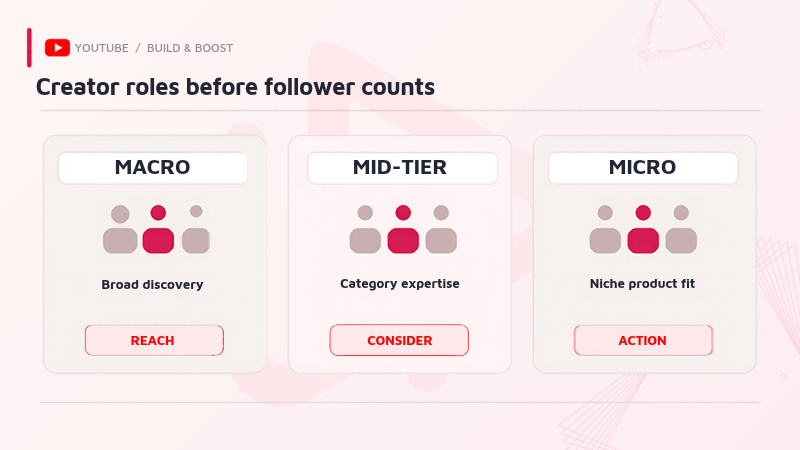
The playbook distinguishes broad-reach creators, category specialists, and smaller communities. Its sample roster is useful for discussing coverage, but the suggested numbers are illustrative, not a required mix for every brand. Audience relevance, recent activity, and product-category competence matter more than a single subscriber threshold.
| Creator tier | Illustrative scale and mix | Primary planning role |
|---|---|---|
| Macro | 100K+ subscribers; 1+ creator | Broad discovery and brand reach |
| Mid-tier | 10K–100K subscribers; 2–3+ creators | Category expertise and consideration |
| Micro | 1K–10K subscribers; 3–6+ creators | Niche trust and product-specific action |
A workable brief should record each creator’s audience overlap, fit with the product, and role in the purchase journey. For example, a broad lifestyle channel may introduce an unfamiliar category, while a technical reviewer answers comparison questions closer to a decision. Treat these as planning hypotheses to test, not guaranteed performance by tier.
2.2. Brief for discovery while protecting authenticity
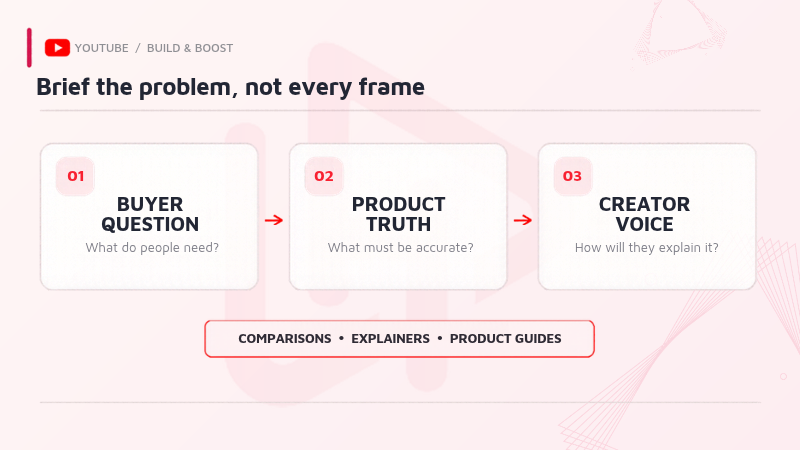
YouTube recommends grounding briefs in category insights and questions real consumers ask. Instead of dictating every shot, provide the product truth, non-negotiable claims, value proposition, and a clear call to action. Let the creator choose the hook, language, pacing, and shooting style that already work with their viewers.
- Prioritize durable answers such as product guides, comparisons, myth-busting explanations, or demonstrations, rather than only launch-day promotion.
- Specify what must be accurate and disclosed, while allowing creators to develop their own narrative.
- Plan vertical and horizontal execution from the outset; a short-form cut should serve its viewing context instead of copying a long video unchanged.
A successful output from Build is not simply “three creator videos.” It is a mapped library: which buyer question each asset answers, who owns approvals, and which asset may later move into paid distribution.
3. Boost: rights, campaign objectives and creative variety
The Boost stage begins only after the advertiser has defined its media goal and verified the right to use the creator’s material. The playbook connects authorization, Google Ads/DV360 execution, asset diversification, and downstream measurement; the details should be checked against actual account and market eligibility.
3.1. Confirm Brand Partner Access and usage rights
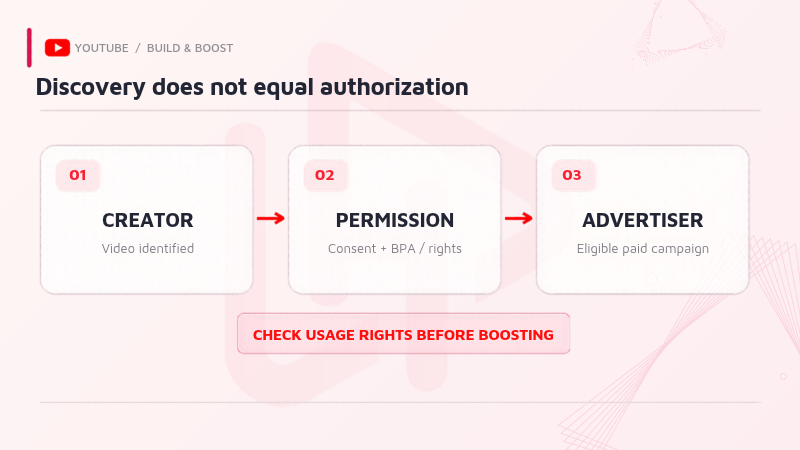
Brand Partner Access (BPA) lets a creator share access that enables an eligible brand to boost an approved video and inspect relevant organic and paid performance. Google’s support documentation separately advises the parties to agree on video usage rights. A video surfaced as sponsored or affiliate-related is therefore not automatically an asset the advertiser is authorized to run as an ad.
- Identify the exact video and creator; record consent, account permissions, allowed usage, and any contract restrictions.
- Check who can request or approve access and whether the campaign format is available in the relevant market.
- Revalidate rights before reusing a cut, extending its period, changing markets, or placing it in another campaign.
Read more:
YouTube Help — Sharing brand partner access to your video
Google Ads Help — Creator partnerships boost
3.2. Match the paid objective to a measurable KPI
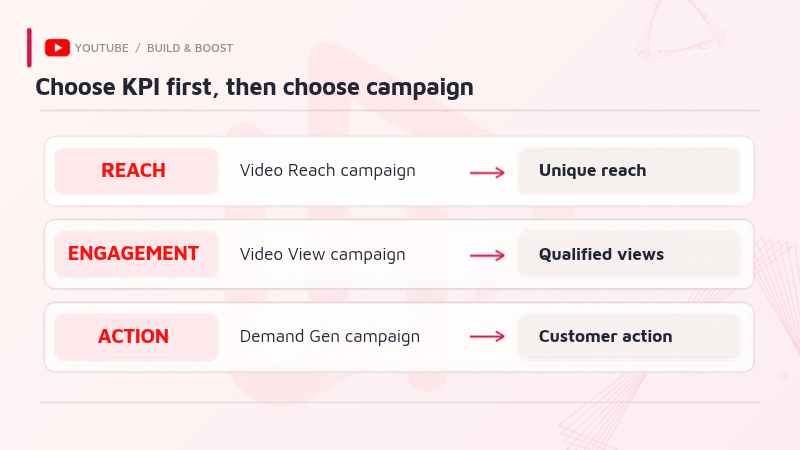
YouTube’s examples distinguish reach, video engagement, and customer action. They should not be collapsed into a single “creator performance” score. Assign the KPI first, then select the eligible campaign type and evaluate whether the chosen audience approach supports that objective.
| Business objective | Playbook campaign example | Decision KPI |
|---|---|---|
| Reach new people | Video Reach Campaign | Unique reach and efficient exposure |
| Increase video engagement | Video View Campaign | Qualified video views or engagement |
| Prompt customer action | Demand Gen Campaign | New or returning customer actions, conversion value when available |
The guide gives Target Frequency, Lookalike Audiences, and Optimized Targeting with first-party lists as examples for different cases. It does not establish that all options are available for every account. Document campaign eligibility, tracking readiness, and the evaluation period before activation.
3.3. Apply the Rule of 4 across formats
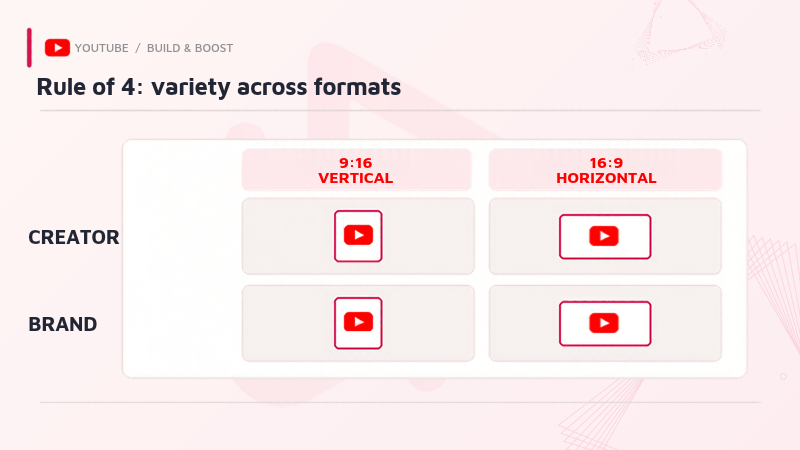
The Rule of 4 asks teams to supply at least two brand assets and two creator assets, including both horizontal 16:9 and vertical 9:16 formats. A simple working matrix includes a creator vertical, creator horizontal, brand vertical, and brand horizontal cut. The point is creative variety across surfaces – not a rule that four assets guarantee more sales.
Before exporting, check readable branding, supported placements, safe captions, and whether the creative answers the same buyer need across different viewing contexts. Use the mix as an asset-supply checklist, then let actual campaign performance identify which combinations deserve more budget.
4. What the numbers mean – and what they do not prove
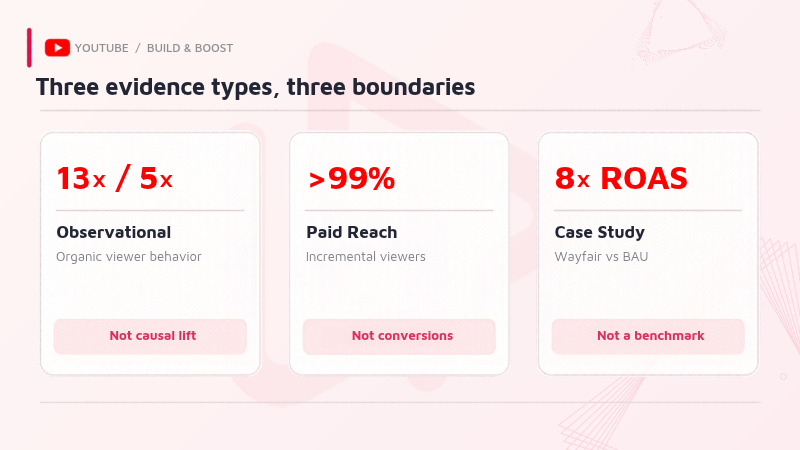
The playbook contains three different kinds of evidence: an observational comparison among organic video viewers, internal paid-reach overlap analysis, and a named brand case study. None should be presented as a universal causal conversion uplift from Creator Partnerships Boost.
| Reported result | Defined scope | What it does not prove |
|---|---|---|
| 13× branded search; 5× purchase likelihood | Observed among users who viewed an organic brand video; global, approximately 60 brands, Dec 2025 | That boosting caused 13× more searches or 5× more sales |
| More than 99% incremental viewers | Average viewers reached by paid boosting relative to the same video’s organic reach; Google internal analysis, Jun–Sep 2026 | That 99% of conversions or total brand reach is incremental |
| Wayfair 8× ROAS | Affiliate Boost versus Wayfair business-as-usual baseline, as reported in the case study | An achievable ROAS benchmark for other advertisers |
| Wayfair 34% higher engagement rate | Versus benchmarks described in the case study; complete comparator details not published in the PDF | A universal engagement lift or a causal effect across all campaigns |
Wayfair is valuable because its example connects creator roles and briefing with Open Call, YouTube Shopping affiliate content, Affiliate Partnerships Boost, and Demand Gen. The playbook reports 8× ROAS versus BAU and an engagement rate 34% above benchmarks, but does not publish complete attribution and benchmark methodology. Treat these figures as the retailer’s reported outcome, not a planning forecast.
A more rigorous measurement plan separates organic engagement, incremental paid audience reach, attributed customer action and – when feasible – lift or marketing-mix analysis. The playbook lists several such methods, but their suitability depends on data quality, scale and test design.
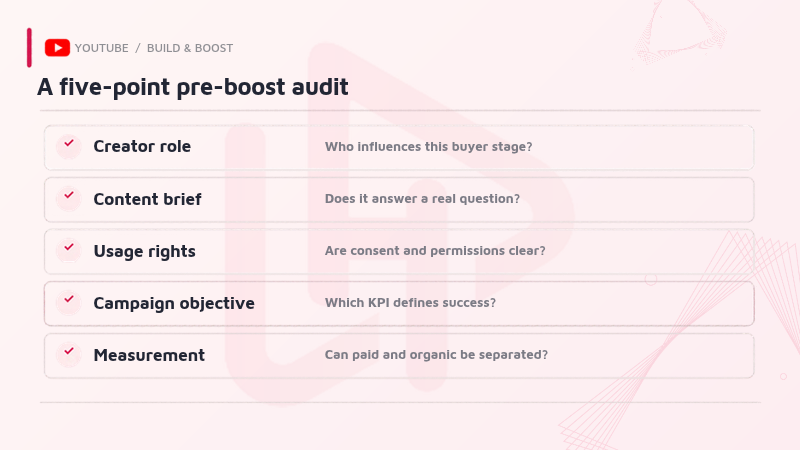
5. A practical five-point audit before boosting
H2T Media Group recommends using a short sign-off sheet before moving any creator asset from production to media buying. This is an editorial operating recommendation, derived from the playbook rather than an official YouTube eligibility checklist.
- Role: What buyer stage and audience problem is this creator expected to influence?
- Brief: Does the asset answer a real question and state the product value accurately without sacrificing the creator’s voice?
- Rights: Is creator consent documented, with applicable BPA, licensing scope, and market eligibility checked?
- Campaign: Is the campaign type aligned with a primary KPI such as reach, engagement, or customer action?
- Evidence: Are brand and creator assets available in suitable formats, and can the team distinguish organic, paid, and downstream results?
Review the checklist jointly with creator operations, paid media, and analytics. The goal is to prevent scaling a well-produced video without a clear usage path or a testable definition of success.
6. Frequently asked questions
It is YouTube’s four-step framework for selecting creators, briefing useful content, amplifying approved videos through suitable paid campaigns, and supplying varied creative assets. It is guidance, not a fixed performance guarantee.
No. BPA enables specific platform access for eligible boosting and measurement, while creators and advertisers should separately agree contractual usage rights and check account eligibility.
The 25-page playbook describes it as a creative-supply recommendation: at least two brand and two creator assets across horizontal and vertical formats. It does not demonstrate an automatic conversion uplift.
No. They describe observed behaviors among viewers who watched organic videos about brands, not a controlled measure of the causal effect of paid boosting.
No. It is a single retailer’s reported comparison with business as usual. Results elsewhere depend on margin, creative, permissions, media configuration, demand and measurement method.
Conclusion
The YouTube Build & Boost playbook works best as an operating model: select creator roles, protect authentic answers, secure usage permissions, match paid distribution to the intended KPI, and measure beyond views. Before investing more budget, document who owns each handoff and which result would validate it. Explore H2T Media Group’s YouTube Performance Four analysis for a separate Demand Gen framework, or browse Insights. For ongoing perspectives, follow H2T Media Group on Facebook and H2T Media Group on LinkedIn.

bichthao
H2T Media Group decodes every meaningful platform update for advertisers and affiliate partners across APAC, EU and North America — always with a practical "H2T take" you can act on.
More about H2T →