

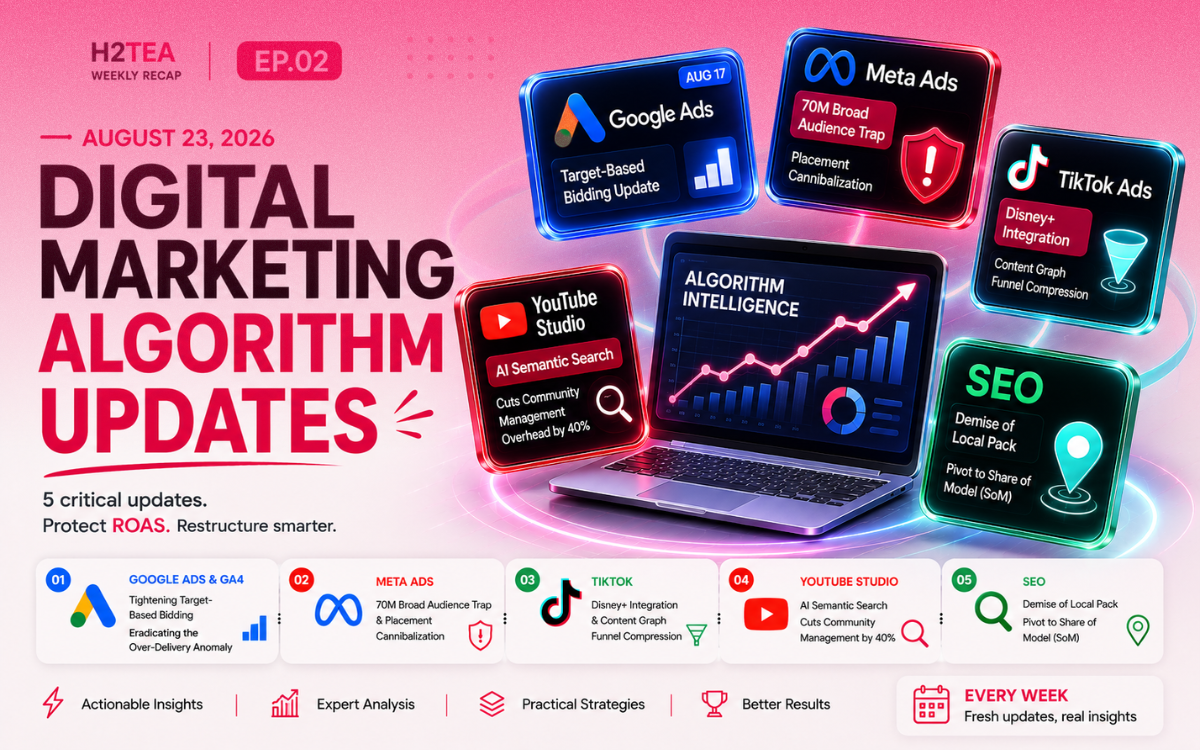
[Intro] Welcome to H2Tea – the advanced weekly executive summary engineered by H2T Media Group. The digital advertising ecosystem over the past week was fundamentally restructured by a synchronized wave of Digital Marketing algorithm updates deployed by core Big Tech conglomerates. The overarching theme defining this period is “Machine Learning Infrastructure Maturation.” From Google neutralizing bid manipulation loopholes and Meta enforcing stricter inventory allocation, to the collapse of the traditional Local Pack under the weight of Generative AI Search. For Chief Marketing Officers (CMOs) and elite Media Buyers, automated systems are becoming increasingly unforgiving. The following comprehensive report dissects the 5 pivotal technical events that shaped the market this week and provides the mandatory operational Action Plan required to sustain enterprise profitability.
1. Google Ads (Aug 17): Tightening Target-Based Bidding and Eradicating the Over-Delivery Anomaly
The most financially impactful event among this week’s Digital Marketing algorithm updates was Google’s architectural shift regarding how it processes tCPA and tROAS bidding strategies.
1.1. The Mechanics of the Throttling Loophole
For years, performance agencies exploited a systemic vulnerability: Establishing exceptionally high Target ROAS metrics (e.g., 5x) while simultaneously suffocating the daily budget limit ($200). Depriving the algorithm of liquidity forced the system into a “survival state,” compelling it to exclusively acquire clicks possessing the absolute highest conversion probability. Consequently, campaigns consistently over-delivered, generating illusionary 10x ROAS returns.
1.2. The “Regression to Target” Mechanism
As of August 17, Google permanently closed this loophole. When a media buyer removes the budget cap and scales spend to $1,000, the system will no longer maintain the anomalous 10x efficiency. The updated algorithm perceives the 5x input as an absolute mathematical baseline. It will proactively inject capital into broader, higher-cost auctions, forcing the actual ROAS to linearly regress downward until it precisely matches the 5x target.
- H2T Action Plan: Audit your 28-day historical data immediately. If your campaign is currently over-performing its set target due to budget constraints, proactively lower the inputted tCPA/tROAS to match your actual historical efficiency before injecting additional scale. This protocol locks the algorithm, preventing the AI from intentionally wasting budget to satisfy the median target equation.
2. Meta Ads: The 70M Broad Audience Trap and Placement Cannibalization
The unchecked reliance on automated distribution without data guardrails is actively compressing profit margins for global E-commerce operators.
2.1. Diagnosing Algorithmic Budget Leakage
Deploying a Sales objective campaign targeting a Broad 70M+ audience paired with Advantage+ Placements (fully automated delivery) constitutes a highly flawed strategy. H2T’s internal audits reveal that Meta’s algorithm has a propensity to leak up to 42% of scaling budgets into “Junk Inventory”—specifically the Audience Network—to fulfill delivery quotas at the lowest possible CPM. This inventory generates massive volumes of “fat-finger” (accidental) clicks, precipitating Landing Page Bounce Rates exceeding 85%.
2.2. Engineering Guardrails via CAPI and Sandboxing
To counteract this specific Digital Marketing algorithm update, operations teams must intervene at both the server data and creative architecture levels.
- H2T Action Plan: First, manually blacklist the Audience Network from strict conversion campaigns. Second, standardize Server-Side CAPI implementation. Ensure your Event Match Quality (EMQ) score sits at a minimum of 8.5/10 so Meta can deterministically track purchasers utilizing 1st-party data (Hashed emails, IP addresses, fbc). Third, utilize Creative Angles as dynamic audience filters. Test assets in isolated sandboxes (3:2:1 methodology) before graduating them into Advantage+ Shopping Campaigns (ASC+) heavily restricted by a strict Existing Customer Budget Cap.
3. TikTok: The Disney+ Integration and Content Graph Funnel Compression
The Walt Disney Company has officially integrated TikTok’s vertical video interface (designated as “Verts”) natively into the Disney+ streaming application, signaling enterprise-level validation of the vertical operating system.
3.1. The Dominance of the Content Graph
With over 6.5 million entertainment-related posts generated daily, Disney recognized that TikTok’s Content Graph algorithm distributes material based on intense community intent far more effectively than traditional internal recommendation engines.
3.2. Total Funnel Compression
The most paradigm-shifting statistic released alongside this partnership is the 50% Discovery-to-Stream Conversion Rate. Users discover cinematic content via a 15-second TikTok video and immediately transition to streaming the full-length feature. The traditional marketing funnel—separating Top-of-Funnel awareness from Bottom-of-Funnel action—has compressed into a singular digital touchpoint.
- H2T Action Plan: Cease treating TikTok purely as an awareness vehicle. Scale proven User-Generated Content (UGC) via Spark Ads. However, strict Intellectual Property (IP) auditing is mandatory. TikTok’s advanced Machine Vision AI will issue immediate account suspensions if your brand utilizes unauthorized IP without explicit backend data authentication derived from the Creator Marketplace.
4. YouTube Studio: AI Semantic Search Cuts Community Management Overhead by 40%
Managing global video assets underwent a systemic upgrade as YouTube natively integrated AI-powered semantic search directly into its Studio moderation backend.
4.1. The Obsolescence of Static Keyword Filtering
The archaic system of filtering community comments via “Exact-match strings” has been permanently deprecated. YouTube now permits channel administrators to utilize natural language queries (up to 100 characters) to execute Semantic Search.
4.2. Intent-Clustering Execution
The “Find Similar Comments” tool autonomously analyzes and clusters hundreds of comments sharing identical contextual intent (e.g., specific hardware complaints or shipping inquiries) requiring a mere three clicks to process in bulk.
- H2T Action Plan: This integration allows Global Agencies to slash CM operational hours by up to 40%. Nevertheless, instituting a “Human-in-the-Loop” mechanism is strictly non-negotiable. The AI functions purely as a diagnostic and clustering tool; human specialists must dictate the responses to preserve organic Brand Trust signals. Under no circumstances should this tool be utilized to auto-suppress legitimate consumer friction points.
5. SEO: The Demise of the Traditional Local Pack and the Pivot to Share of Model (SoM)
The final critical component of this week’s Digital Marketing algorithm updates involves the complete reconstruction of the Zero-Click Search ecosystem.
5.1. The Era of the Single Definitive Recommendation
Multi-location B2B and retail enterprises are incinerating budgets attempting to rank in the traditional Google Maps Top 3 Local Pack. High-value consumers have pivoted; they are directly querying Large Language Models (LLMs) such as ChatGPT, Gemini, and Google SGE.
Instead of providing 10 blue links, an LLM synthesizes data and explicitly cites one or two unique Entities as the definitive default answer. Legacy Keyword Density possesses zero value in this environment; Entity Authority is the sole determining factor.
5.2. Transitioning Measurement: From SERP Traffic to SoM
- H2T Action Plan: Technical SEO divisions must cease tracking standard Click-Through Rates (CTR) as their primary KPI. The measurement model must pivot to Share of Model (SoM)—quantifying the frequency at which your brand is cited within synthesized AI outputs.
Achieving dominance requires restructuring landing page source code utilizing strict JSON-LD Schema (specifically Organization and LocalBusiness). Furthermore, NAP data (Name, Address, Phone) must maintain 100% uniformity across all cross-platform directories, granting the AI the necessary Confidence Score to extract your enterprise data (Information Gain) without hallucination risks.
[Outro]
The five Digital Marketing algorithm updates deployed this week by Google, Meta, TikTok, and YouTube delineate a definitive operational reality: The era of “Lazy Automation” is permanently over. Platforms are utilizing AI to rigidly control distribution while heavily penalizing campaigns lacking proper data guardrails. The singular survival methodology for enterprise-scale operations requires feeding these machine learning systems with absolute data precision (First-party CAPI, Semantic Schema Markup) to effectively guide algorithmic behavior. Ensure your execution teams download our visual Cheat Sheet and align their workflows accordingly. Continue monitoring the weekly H2Tea reports at H2T Media Group to master the Performance Marketing frameworks actively defining the global digital economy.

bichthao
H2T Media Group decodes every meaningful platform update for advertisers and affiliate partners across APAC, EU and North America — always with a practical "H2T take" you can act on.
More about H2T →