

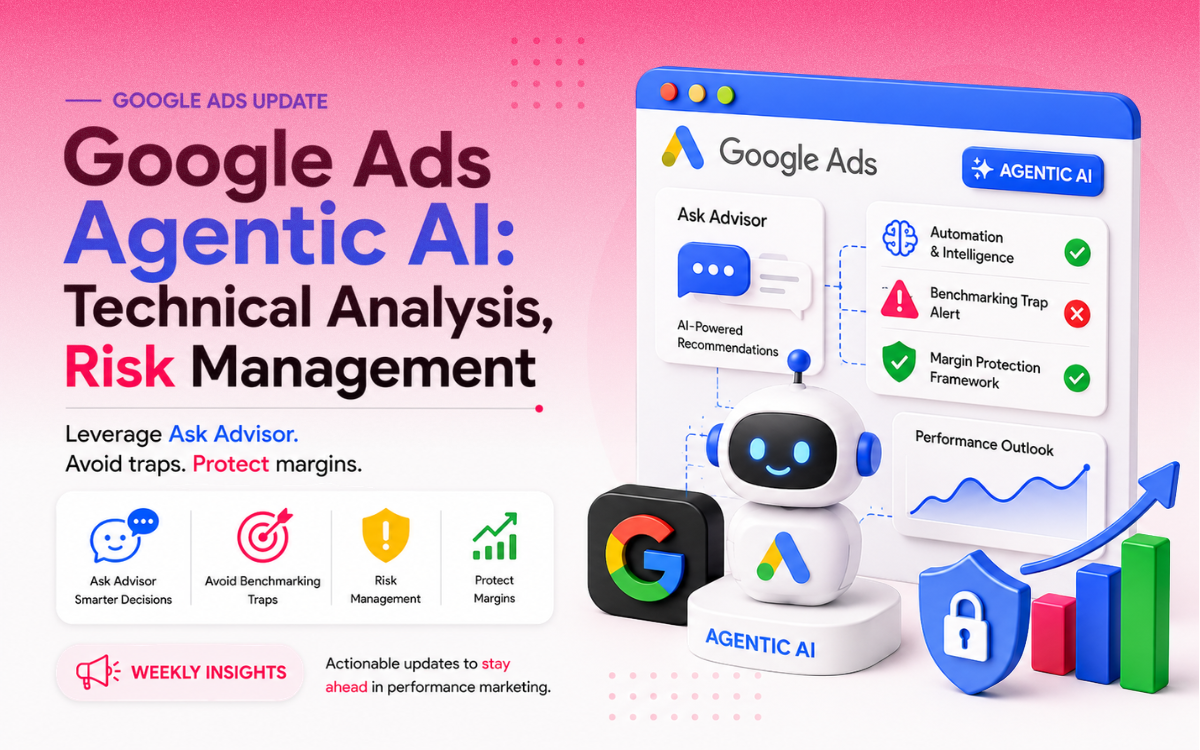
Welcome to the advanced performance marketing insights hub by H2T Media Group. Google Ads Agentic AI is transforming ad management from static dashboards into conversational interfaces, but placing blind trust in automated recommendations introduces severe conversion attribution risks that can destroy profit margins.
To prevent budget waste caused by conversion lag, misaligned CAPI data, and misleading peer benchmarks, media buyers must strictly separate reporting automation from bidding execution. Below is H2T Media Group’s technical analysis and the battle-tested Risk Management Framework required to safeguard your enterprise ad accounts – read on to discover how to master this AI transformation without compromising your ROI.
 Key Takeaways
Google Ads Agentic AI shifts ad management from static dashboards to conversational UIs, but relying blindly on automated execution creates severe attribution traps that erode profit margins.
Essential Facts About This Update
- Conversion Lag & CAPI Traps: 8–24h latency in server-side data uploads causes AI tools to misinterpret temporary delays as campaign failures, triggering destructive budget cuts.
- Flawed AI Peer Benchmarking: Industry median metrics ignore individual gross margins and business unit economics, risking auction expansion into low-intent traffic.
- Garbage In, Hallucination Out: Faulty Enhanced Conversions or broken GCLID tracking lead conversational assistants to generate false diagnostic conclusions.
- Strict Execution Boundaries: Use natural language prompts to automate reporting and visualization, but never delegate bidding or tCPA/tROAS adjustments to autonomous tools.
- Mandatory Account Hardening: Disable “Auto-apply recommendations” immediately to prevent unapproved structural changes driven by incomplete real-time data.
1. The Transition from Static Dashboards to Conversational Interfaces
To master the capabilities of Google Ads Agentic AI, Chief Marketing Officers (CMOs) and Media Buying teams must dissect the underlying technological principles driving these features. This is not standard Generative AI engineered purely for text synthesis; this is Agentic AI – a highly autonomous, action-oriented intelligence infrastructure.
1.1. The Technical Nature of Agentic AI
Unlike passive analytical tools, Agentic AI is granted deep, programmatic access to the platform’s core data layers. It possesses the capability to comprehend the specific structural context of an ad account, autonomously analyze millions of historical data points, and synthesize them into highly actionable executive reports. The primary differentiating factor is its “Proactive” nature. The system does not wait idly for a user to navigate through intricate campaign menus to extract metrics; it continuously scans the data architecture 24/7, pushing surface-level alerts immediately upon administrator login.
1.2. The “Ask Advisor” Feature and Prompt-to-Visual Reporting
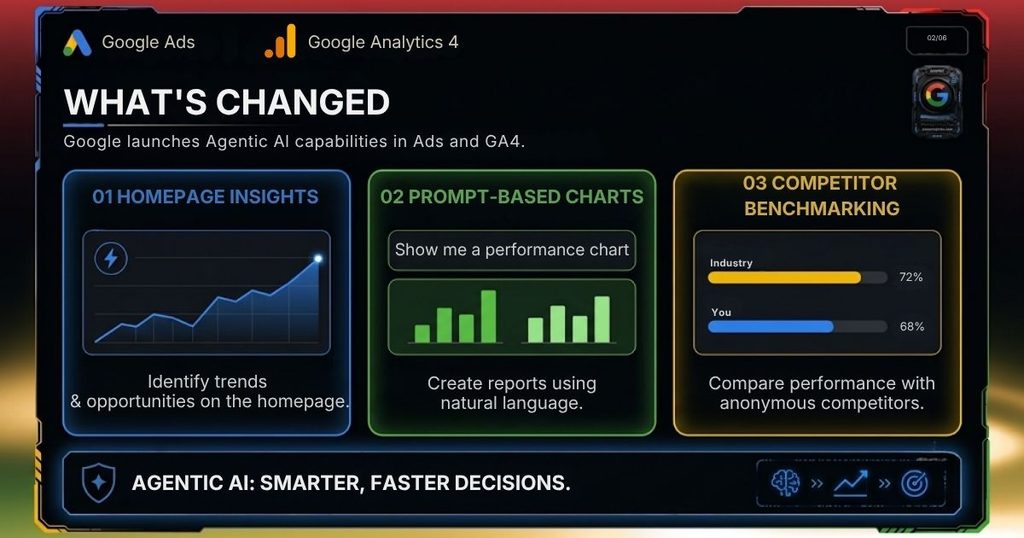
The most transformative feature regarding operational efficiency within the Google Ads Agentic AI suite is the “Ask Advisor” assistant. Instead of executing 15 manual clicks, exporting raw CSV data files, and migrating them into Looker Studio to construct pivot charts, Media Buyers can now simply input a natural language prompt.
- Practical Application: An operator can input the prompt: “Generate a visual chart comparing the audience overlap between Performance Max Campaign A and Search Campaign B over the preceding 30 days, isolating the mobile device cohort.”
- The Output: The system instantaneously renders a dynamic, highly accurate visual chart. For ad-hoc stakeholder reporting and spontaneous client inquiries, this tool entirely eradicates the latency inherent in traditional data extraction pipelines.
2. Technical Analysis: Execution Velocity vs. Attribution Traps
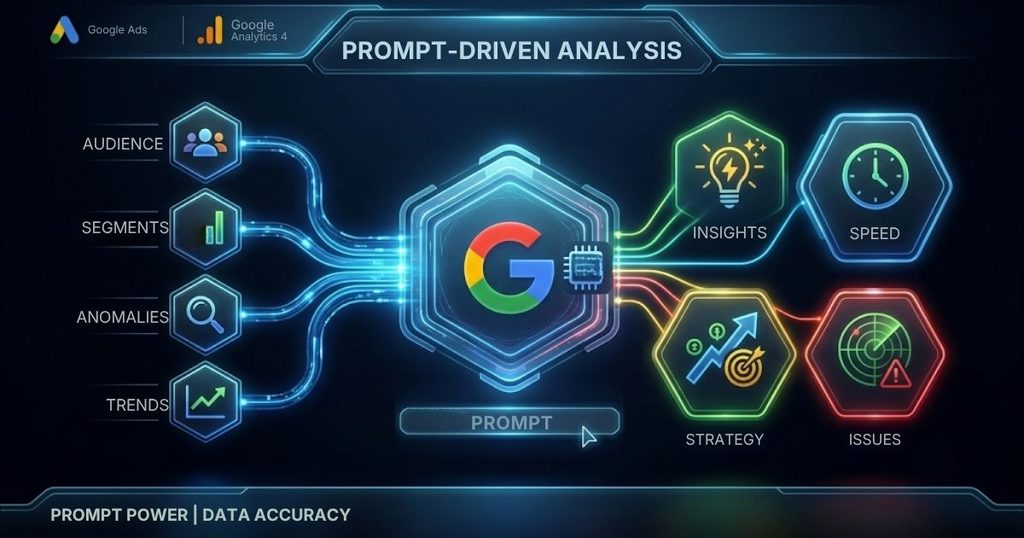
Despite delivering revolutionary operational speed, Google Ads Agentic AI conceals severe technical risks directly related to how the machine learning model “reads” and interprets conversion data.
2.1. Proactive Anomaly Detection
The algorithmic identification of performance anomalies acts as a double-edged sword. The AI system is structurally programmed to flag abrupt performance volatility, such as a sudden degradation in Conversion Rate (CVR) or an inexplicable spike in Cost-Per-Click (CPC). Evaluated purely as an early-warning mechanism, this is highly beneficial.
However, the intrinsic danger lies in the AI’s generalized evaluative criteria. Automated alerts frequently fail to distinguish between pre-planned seasonal volatility or strategic scaling phases and genuine technical campaign failures. If an inexperienced Media Buyer panics upon receiving a red algorithmic alert and abruptly pauses a scaling campaign, they critically disrupt the Smart Bidding algorithm’s machine learning phase.
2.2. Interpolation Errors Derived from Conversion Lag and CAPI
The most devastating technical vulnerability within this conversational assistant relates to server-side data infrastructure.
Within high-tier B2B or complex E-commerce advertising architectures, Agencies like H2T extensively utilize Offline Conversion Tracking (OCT) via Server-Side Conversions API (CAPI) pipelines. Verified transaction data originating from backend CRM systems (e.g., Salesforce, HubSpot) is typically uploaded in batch processes every 24 hours.
The Consequence: During this data upload latency window (an 8 to 24-hour delay), the conversion metrics displayed natively within the Google Ads UI register as artificially low. If an operator utilizes Google Ads Agentic AI to query “Today’s Performance,” the AI will confidently hallucinate a disastrous conclusion: “Campaign performance is critically degrading, CVR has dropped by 100%, recommend immediate budget reduction.” Executing optimization strategies based on this fractured, delayed data stream constitutes a fatal trap for enterprise ad accounts.
3. The Highest Risk Factor: The AI Peer Benchmarking Trap
One of the most aggressively promoted features in this global rollout is the AI Peer Benchmarking utility. However, through the lens of a performance-driven Agency, this specific feature represents the most destructive threat to financial measurement systems.
3.1. The Limitations of Anonymized Peer Medians
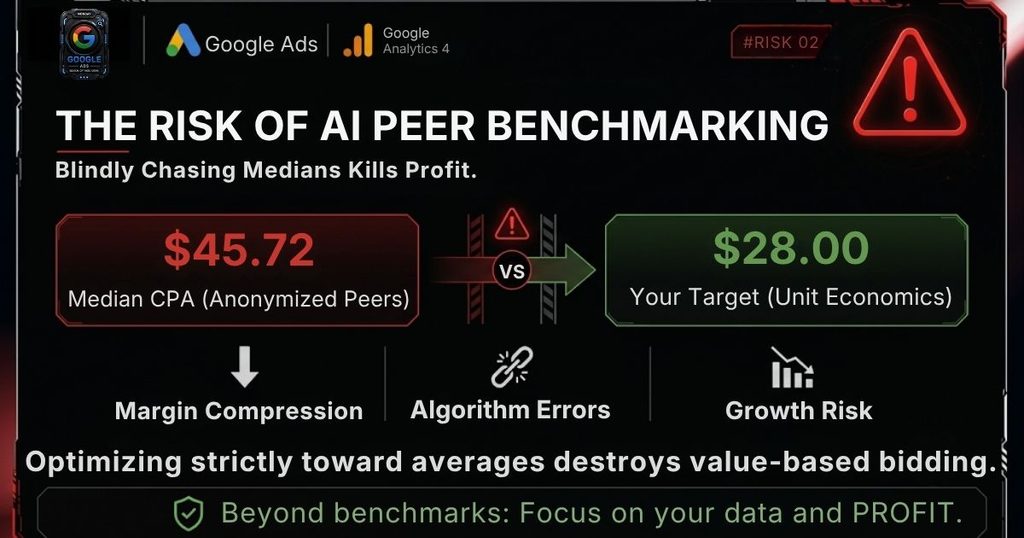
This tool permits administrators to prompt the AI to compare account-level Engagement Rates and Conversion Durations against an anonymized cluster of “Industry Peers”.
The fundamental flaw: The AI clusters competitors based on broad industry categorization and aggregate spend tiers, rendering it entirely blind to the unique Unit Economics of individual enterprises.
Competitor Analysis: Unit Economics & Strategy Impact
| Competitor Type | Unit Economics & Strategy | Bidding Focus | Impact of AI Benchmarking |
|---|---|---|---|
| Competitor A | High Gross Margin (~60%) | Profit-Focused (Selective Auctions) | Tolerates higher CPC for high-intent leads. |
| Competitor B | VC-Backed / Cash-Burn Model | Acquisition-Focused (Market Share) | Bids aggressively regardless of short-term losses. |
3.2. The Destruction of Value-Based Bidding (VBB) Algorithms
The primary objective of large-scale E-commerce accounts is not to acquire cheap, superficial engagement; the objective is to target consumer cohorts delivering the highest Lifetime Value (LTV). Campaigns executing tROAS (Value-Based Bidding) strategies frequently tolerate lower Click-Through Rates (CTR) and higher baseline CPCs as a necessary filter to acquire high-intent purchasers.
If a Media Buyer blindly follows the prescriptive advice generated by Google Ads Agentic AI to force a campaign to achieve the “Industry Average CTR,” they will inadvertently expand the bidding auction to include low-intent, junk queries. This action permanently destroys the meticulously calibrated Value-Based Bidding architecture.
4. The Data Foundation: “Garbage In, Hallucination Out”
Agentic AI technology does not possess the capability to spontaneously generate factual truth; it merely synthesizes the data it is granted access to. The engineering adage “Garbage In, Garbage Out” has evolved into “Garbage In, Hallucination Out.”
4.1. The Vital Role of Server-Side Tracking and GCLID
For the conversational outputs generated by the “Ask Advisor” tool to hold any practical utility, the enterprise’s technical data infrastructure must be flawless. If Enhanced Conversions protocols are misconfigured, or if the GCLID (Google Click Identifier) parameter is stripped during the user’s website navigation journey, the AI will process a severely distorted map of the customer journey. Consequently, the user will receive Root-Cause Summaries from the system that are entirely fabricated (Hallucinations).
4.2. Securing First-Party Data Sovereignty
Global brands must enforce a strict operational protocol: The Single Source of Truth for evaluating advertising performance must remain the internal corporate database (CRM, Shopify backend), never the synthesized summaries generated by a Google chatbot. Tracking pipelines must be highly transparent, structurally isolating high-intent leads generated by paid search networks from baseline organic acquisition sources.
5. The H2T Practical Operating Framework for Agentic AI Systems
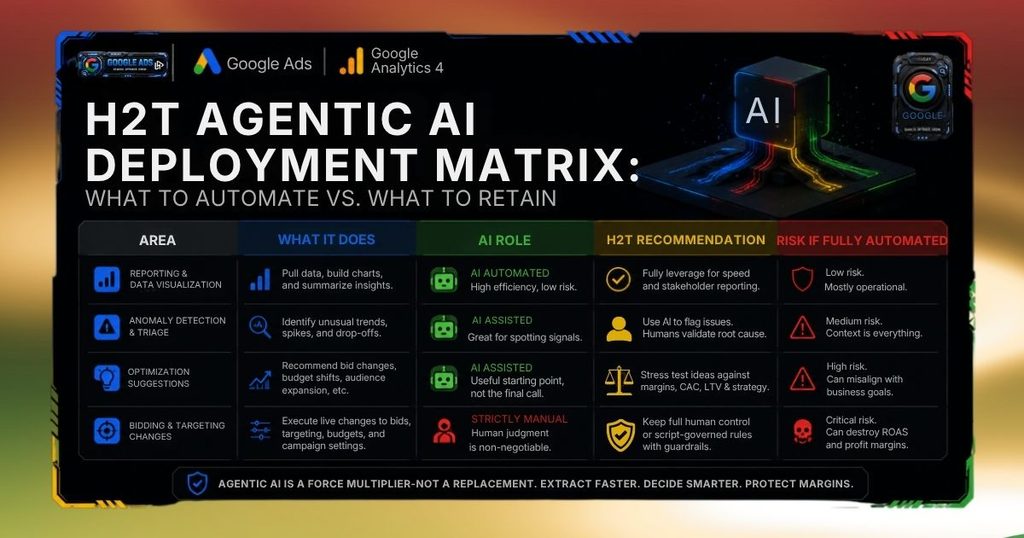
To weaponize the processing speed of this technology without falling victim to blind, destructive automation, Media Buyers and CMOs must immediately deploy the following 3-step operational framework developed by H2T Media Group.
H2T Risk Management Matrix for Agentic AI
| Framework Pillar | Permitted Action (AI Role) | Restricted Action (Human Control) |
|---|---|---|
| 5.1 Execution Limits | Data extraction, custom visualization, and reporting. | Bidding changes (tCPA/tROAS), budget tweaks, and negative keywords. |
| 5.2 Benchmarking Rule | Monitoring internal baseline trends over time. | Never optimize to match broad industry average CTR/CPC medians. |
| 5.3 Account Hardening | Generating system alerts and optimization suggestions. | Toggle OFF “Auto-apply recommendations” to block automated changes. |
5.1. Prompt for Data Extraction, Never Delegate Execution
The immutable rule of deployment: Leverage the natural language processing capabilities of Google Ads Agentic AI strictly to eradicate reporting friction. Instruct the AI to render complex multi-channel charts, filter intricate audience segments, and highlight macro-trends. However, ABSOLUTELY DO NOT utilize conversational AI to execute critical bidding decisions. All actions altering tCPA/tROAS targets, injecting negative keyword lists, or modifying budget thresholds must be evaluated manually by human specialists or governed by secure Custom Scripts possessing strict financial guardrails.
5.2. Anchor Benchmarks to Internal Unit Economics
Completely disregard the AI Peer Benchmarking features. Never initiate a structural campaign reconstruction simply because the AI issues an alert stating, “Your CTR is 15% lower than your peers.” Adjustments must only be executed when a specific metric directly and negatively impacts the Real Offline Revenue data uploaded via the OCT pipeline. Operations teams must optimize campaigns to maximize net Margins, not to satisfy superficial vanity metrics dictated by an algorithm.
5.3. Disable the Auto-Apply Recommendations Feature
Navigate to the Google Ads account settings interface and definitively ensure that the “Auto-apply recommendations” toggle is switched to the OFF position. If permitted to run autonomously, Agentic AI may utilize conclusions drawn from incomplete data (as analyzed in the Conversion Lag section) to autonomously alter your campaign structure in the middle of the night, precipitating financial disasters that burn thousands of dollars in wasted ad spend.
6. Frequently Asked Questions
Google Ads Agentic AI is an action-oriented intelligence infrastructure designed for proactive account management. Unlike traditional Generative AI focused solely on text creation, Agentic AI connects directly to account data layers, scanning performance 24/7 to deliver conversational analysis and actionable alerts.
Due to conversion lag from Server-Side Conversions API (CAPI) or offline backend tracking (which often takes 8 to 24 hours to sync), the AI may mistake a temporary data delay for a failing campaign and push inaccurate alerts advocating for destructive budget cuts.
AI Peer Benchmarking evaluates metrics against broad industry medians without factoring in your company’s unique profit margins or Unit Economics. Attempting to match aggregate industry averages can force your account into low-intent auctions and ruin Value-Based Bidding strategies.
Advertisers should use natural language prompts exclusively for data extraction, visualization, and reporting tasks. Bidding decisions, tCPA/tROAS targets, and structural changes should remain under human control, and the “Auto-apply recommendations” setting should be immediately turned off.
The expansion of Google Ads Agentic AI accelerates ad operations, but strategic human oversight remains vital to protect profit margins. To avoid automated attribution traps and maintain campaign profitability, media buyers must utilize AI for rapid data extraction while keeping strict human control over bidding, budgets, and account structures. Protect your advertising ROI by auditing your tracking pipelines today, and explore more insights in the Google Ads category under the Insights hub on the official H2T Media Group website.

bichthao
H2T Media Group decodes every meaningful platform update for advertisers and affiliate partners across APAC, EU and North America — always with a practical "H2T take" you can act on.
More about H2T →