

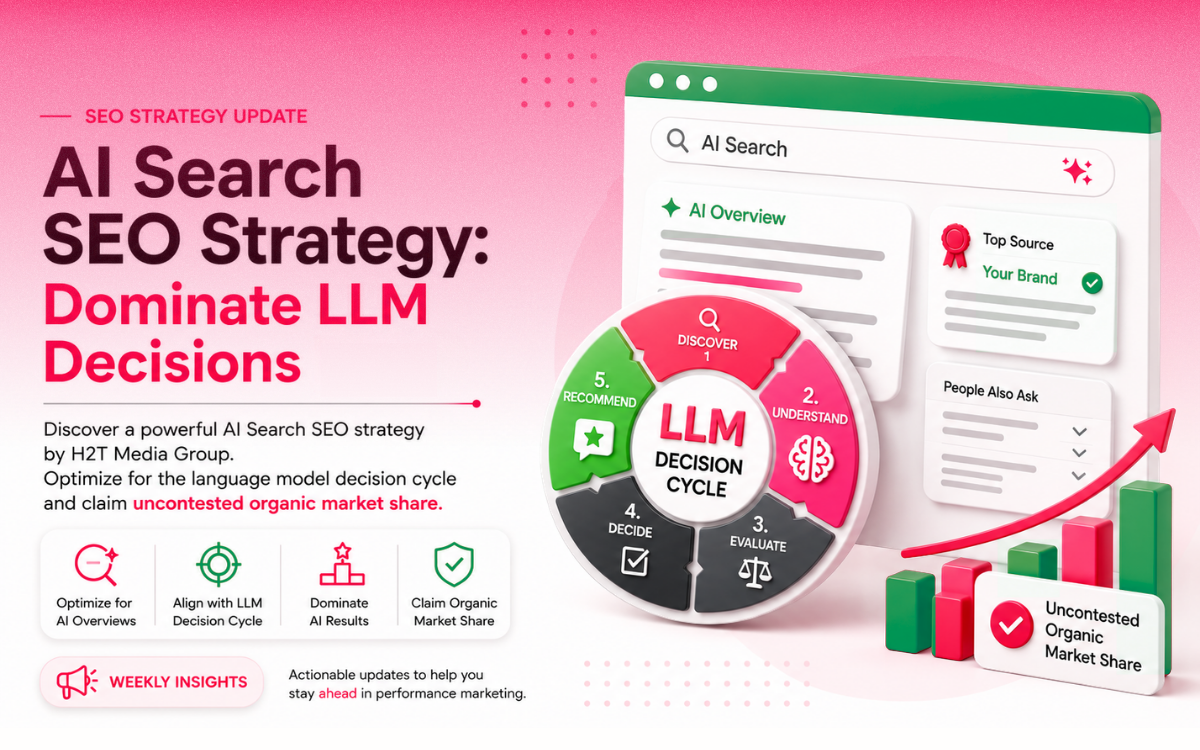
Welcome to the SEO performance insights hub by H2T Media Group. An effective AI Search SEO Strategy requires enterprises to capture default brand recommendations within Large Language Models (LLMs) rather than merely competing for traditional SERP rankings or citation footnotes. With 89.3% of AI search queries currently lacking a dominant brand leader, businesses have a critical window to claim early Topical Authority at the lowest technical cost. This article breaks down the 5-step AI decision cycle, analyzes the citation flaw, and outlines the Share of Model (SoM) framework required to scale your revenue – read on for the complete technical analysis by H2T Media Group.
 Key Takeaways
AI Search SEO Strategy in 2026 shifts focus from traditional SERP rankings and citation links to capturing default brand recommendations within Large Language Models (LLMs).
Essential Facts About This Strategy
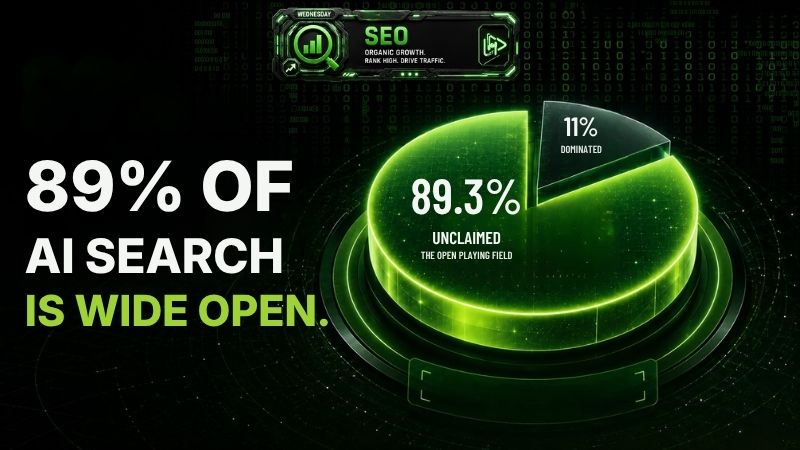
- 89.3% Market Window: Most AI query categories have no default brand leader, providing early adopters a critical cost advantage to establish authority.
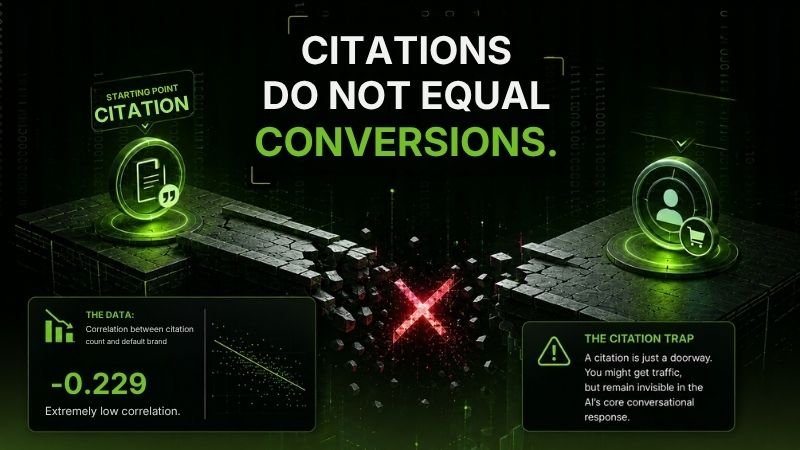
- The Citation Illusion: Footnote citations show a -0.229 correlation with conversion; true value lies in securing direct “Default Recommendations” in conversational text.
- 5-Step AI Decision Cycle: Content architecture must align with LLM processing nodes: Concept Definition, Internal Comparisons, Alternative Suggestions, Practical Use-cases, and Purchase Recommendations.
- Share of Model (SoM): Traditional keyword rank tracking is obsolete; performance should be measured by API-prompted recommendation frequency against competitors.
- LLM Ingestion Formatting: Strict technical structure—semantic HTML, data tables, and JSON-LD Schema Markup—is required for AI models to accurately process entity relationships.
1. Market Data Analysis: 89.3% of AI Search Demand Lacks a Dominant Brand Leader
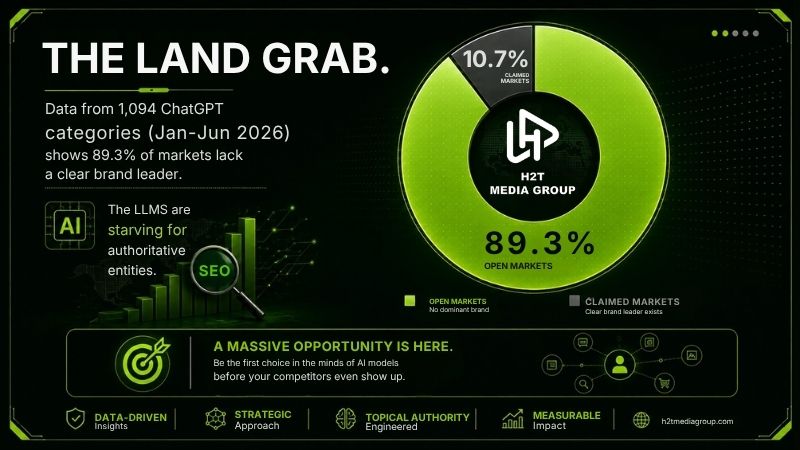
In the first half of 2026, in-depth data reports analyzing 1,094 query categories on the ChatGPT platform revealed a highly actionable metric for Chief Marketing Officers (CMOs) and media buying teams.
1.1. The Fragmentation of LLM Data
According to the report, only 10.7% of query categories have established a “default” brand—meaning that when a user inputs a prompt, the AI immediately and directly recommends a specific enterprise within its Core Conversational Output.
Conversely, 89.3% of current queries possess no dominant brand leader. When users ask for solutions within these categories, the AI generates generalized responses, listing multiple alternatives without showing a definitive bias. This indicates that the parameter weights of the LLMs regarding most commercial sectors are currently unassigned and neutral.
1.2. The Opportunity Cost of Establishing Topical Authority
This 89.3% market availability creates a significant cost advantage for early adopters. In the AI environment, the resource expenditure required to train the system (via publishing high-quality, structured content) to claim the “default entity” position is currently at its lowest.
However, once LLMs update and lock their priority parameter weights onto a competitor, the technical resources and financial costs required to displace that competitor within the AI’s architecture will be exponentially higher than traditional keyword competition.
2. Technical Flaw Analysis: The Citation Illusion
One of the most prevalent operational errors made by SEO teams transitioning to AI Search is applying legacy “Link-building” mentalities to Generative AI environments. They set their Key Performance Indicators (KPIs) on ensuring the enterprise’s URL appears as a footnote citation at the bottom of the AI’s response.
2.1. The Negative Statistical Correlation (-0.229) Between Citations and Conversions
System testing data indicates that the correlation ratio between the volume of citations a brand receives and the frequency of that brand being directly recommended for purchase stands at a mere -0.229. This is an exceptionally low, negative correlation.
Technical Explanation:
- A Citation is merely data verification: The LLM crawls your website to extract a definition or statistical figure, subsequently placing your URL in the footnotes to maintain transparency. End-users rarely click these footnotes.
- A Default Recommendation is a conversion event: This occurs when the AI explicitly states in the conversational text: “Based on your requirements, the optimal solution is [Your Brand Name] due to features A, B, and C.”
2.2. The Consequence of Misaligned Optimization
If an enterprise exclusively focuses on writing short, traditional SEO content just to be “cited,” they may acquire initial organic traffic but will remain entirely invisible in the AI’s core advisory process. A citation is a secondary doorway; it does not guarantee final conversion metrics.
3. The Operational Framework: Optimizing for the 5-Step AI Decision Cycle
To secure a sustainable advantage in AI Search, SEO teams must cease tracking backlinks and citations. Instead, the Content Architecture must be designed to natively align with the internal logic of the neural network. H2T Media Group standardizes this process into the 5-Step AI Decision Cycle.
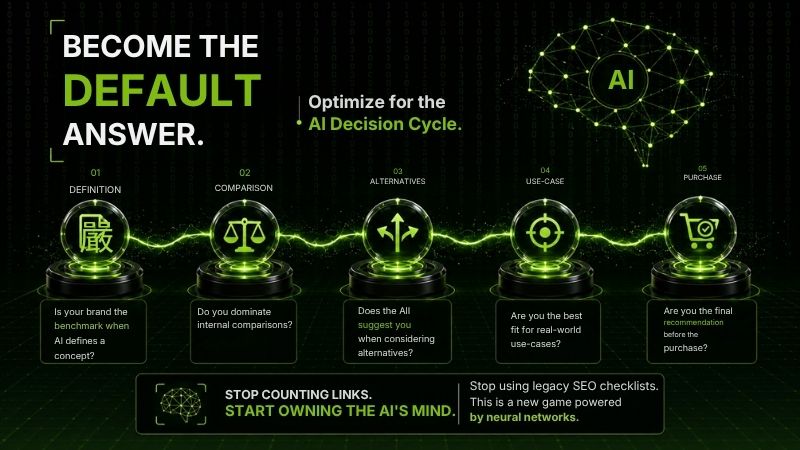
Enterprises must deploy targeted Content Clusters to accurately satisfy these 5 processing nodes within the LLM’s logic path.
| LLM Processing Node | User Query Intent | Required Content Strategy & Data Structure |
|---|---|---|
| 1. Concept Definition | Seeking foundational knowledge or defining an industry concept. | Develop comprehensive Glossaries and definitive Whitepapers. Objective: Become the baseline reference standard when the AI defines concepts. |
| 2. Internal Comparisons | Requesting the AI to evaluate differences between technologies or products. | Publish objective “Vs.” analysis pages (e.g., Product A vs. Product B) utilizing strictly quantitative data (clear feature tables and technical specifications). |
| 3. Alternative Suggestions | The user is currently using a competitor and asks the AI for better alternatives. | Establish “Top Alternatives to [Competitor Name]” assets. Feed the LLM exact Unique Selling Propositions (USPs) for automated extraction. |
| 4. Practical Use-cases | Asking the AI for real-world applications within a specific sector. | Build a robust Case Study database. Structure the narrative strictly as Problem – Solution – Measured Results (providing specific numerical data for the AI to learn). |
| 5. Purchase Recommendation | The user finalizes their intent and requests a definitive vendor choice. | Optimize Product/Service Pages. Ensure pricing data, warranty policies, and positive user reviews are structured flawlessly using Schema Markup. |
4. Transitioning KPI Measurement Models: From Keyword Ranking to “Share of Model” (SoM)
A structural shift in content strategy mandates an evolution in measurement methodology. Traditional Keyword Rank Trackers are obsolete in reflecting true performance within Generative Engine Optimization (GEO).
4.1. Understanding Share of Model (SoM)
At H2T Media Group, the efficacy of AI SEO campaigns is evaluated through the Share of Model (SoM) metric. SoM quantifies the exact percentage of instances your brand is explicitly recommended by the LLM as a primary solution across a broad volume of simulated user queries.
4.2. Technical Execution of Measurement
Our technical teams do not query keywords on Google. The evaluation protocol is executed via API integrations:
- Configure hundreds of automated prompt clusters simulating potential B2B buyers.
- Run these multi-turn prompts through the APIs of GPT-4, Gemini, and Claude.
- Parse the generated text outputs to calculate the frequency of your brand being recommended versus competitors.
- Safety Margin standard: To ensure the sustainability of your Topical Authority, your brand must maintain a recommendation frequency margin of at least 3% above your closest competitor within these analytical clusters.
5. Data Structuring for LLM Ingestion
AI models do not “read” websites like human users. They process text based on Entity Relationships. Therefore, publishing plain-text content is operationally insufficient.
To guarantee that the enterprise’s content is accurately ingested by the AI across all 5 steps of the Decision Cycle, SEO specialists must rigorously apply the following formatting protocols:
- Semantic HTML: Ensure H1, H2, and H3 tags maintain absolute logical hierarchy.
- Data Tables: LLMs prioritize data extraction from comparison tables. All pricing, features, and technical specifications must be systematized using the <table> tag.
- Schema Markup: Deploy JSON-LD architecture to explicitly declare entities: Organization, Product, FAQ, and Review. This allows the AI to categorize data and assign parameter weights to the brand without expending computational inference resources.
6. Frequently Asked Questions
Traditional SEO focuses on optimizing content to rank on Search Engine Result Pages (SERPs) and generate click-through traffic via hyperlinks. In contrast, an AI Search SEO Strategy aims to position your enterprise as the default, direct recommendation within the Large Language Model’s (LLM) conversational text, capturing user intent before they even look at search links or footnote citations.
Data indicates a negative correlation (-0.229) between footnote citation volume and direct product recommendations. Footnote citations are merely used by LLMs for data verification or source attribution, which users rarely click. True conversions occur when the AI explicitly names your brand as the primary recommended solution inside its core generated answer.
Share of Model (SoM) measures the percentage of times your brand is recommended by LLMs across automated, multi-turn prompt simulations using APIs (such as GPT-4, Gemini, and Claude). Because AI search results are personalized and generative rather than static lists, keyword rank tracking is no longer accurate, making SoM the definitive metric for Generative Engine Optimization (GEO).
To ensure LLMs accurately parse entity relationships, content must strictly utilize semantic heading hierarchies (H1-H3), structured data comparison tables for specs and pricing, and detailed JSON-LD Schema Markup (declaring Organization, Product, FAQ, and Review entities).
With 89.3% of the market still uncontested, mastering an effective AI Search SEO Strategy requires enterprises to build Topical Authority across the 5-step decision cycle and track Share of Model (SoM). Aligning content with LLM logic paths secures early default recommendations before competitors lock in parameter weights. To explore more technical frameworks and growth strategies, visit the SEO category within the Insights hub on the official website of H2T Media Group.

bichthao
H2T Media Group decodes every meaningful platform update for advertisers and affiliate partners across APAC, EU and North America — always with a practical "H2T take" you can act on.
More about H2T →