

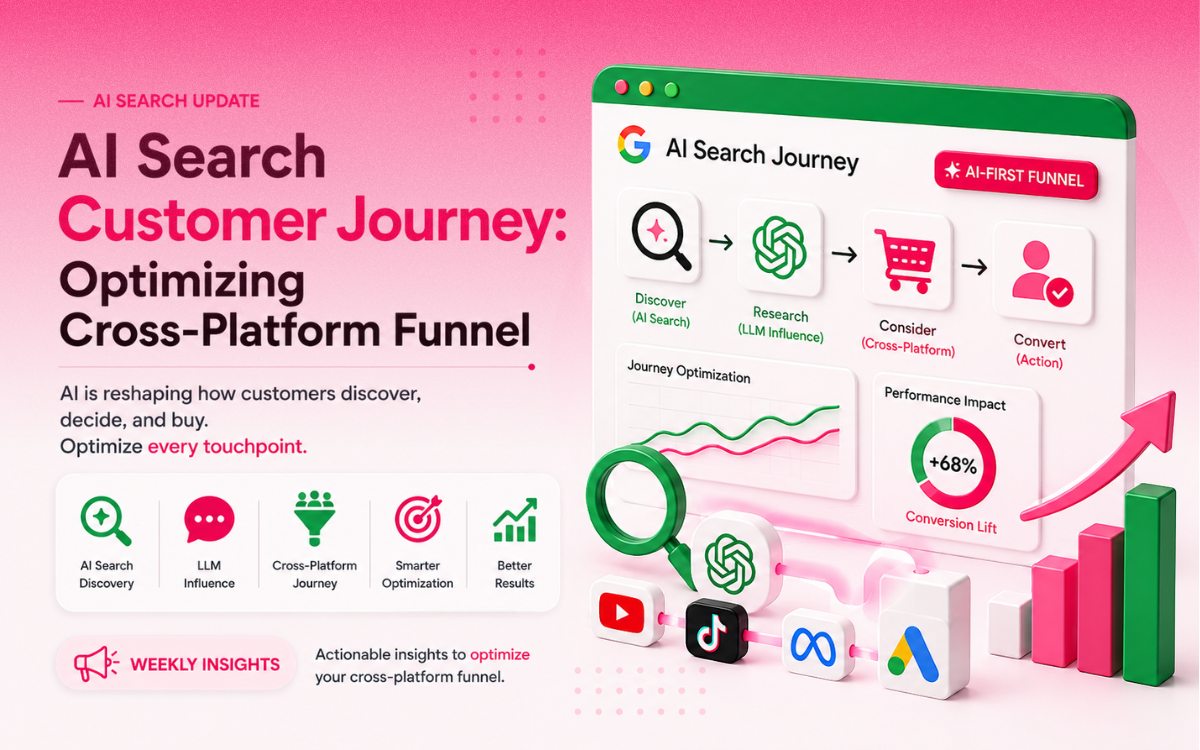
Welcome to the advanced SEO and Search Marketing data analysis hub by H2T Media Group. The AI Search customer journey is not a zero-sum battle between Google Ads and Large Language Models (LLMs), but rather a highly unified, cross-platform ecosystem where Google serves as an upstream traffic driver into AI interfaces.
Based on the latest iPullRank dataset analyzing over 13 billion searches, this article dissects how ChatGPT captures paid clicks from Google Search, decodes consumer discovery vs. synthesis behavior, and provides a 3-step action blueprint to restructure your attribution models and paid search allocations. Below is H2T Media Group’s technical analysis and strategic framework required to master your cross-platform acquisition funnel.
 Key Takeaways
The AI Search Customer Journey is a highly synergistic ecosystem where Google functions as an upstream discovery funnel, routing high-intent traffic directly into AI interfaces for complex data synthesis.
Essential Facts About This Analysis
- Symbiotic Ecosystem: ChatGPT ranks #6 for paid clicks originating from Google Search, proving that AI platforms actively utilize Google Ads for user acquisition.
- Behavioral Shift: 86% of Google clicks are discovery-driven, while users actively transition to conversational interfaces like ChatGPT or Gemini for deep-dive product synthesis.
- Hybrid Attribution: Standard GA4 loses tracking during platform transitions. Deep-link tracking parameters in Schema Markup and post-purchase surveys are now mandatory.
- LLM-Optimized Architecture: Websites must prioritize AI data extraction by deploying native HTML tables for technical specs and strict FAQPage Schema for direct answers.
- Entity Authority (NAP): 100% uniformity in Name, Address, and Phone data across all directories is critical; conflicting data causes AI to eliminate your brand from recommendation pools.
1. iPullRank Data Analysis: The Truth Behind 13 Billion Searches
To escape a defensive posture regarding AI, Chief Marketing Officers (CMOs) and Media Buying teams must analyze definitive quantitative data.
1.1. ChatGPT Ranks #6 for Paid Clicks Originating from Google
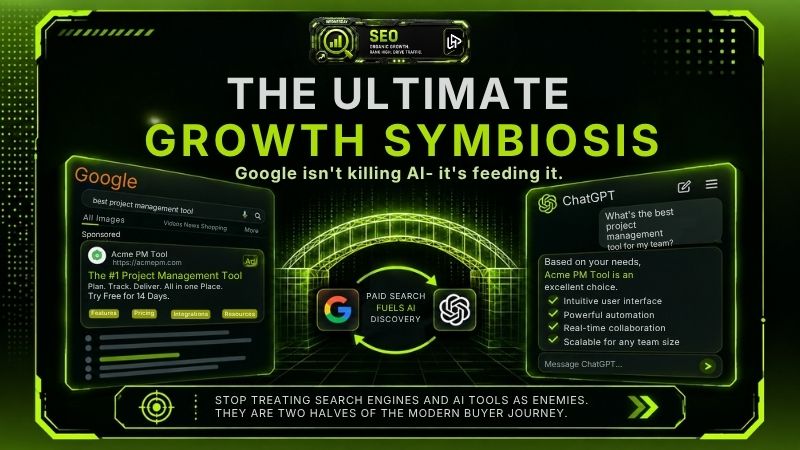
The iPullRank report reveals a staggering statistic: ChatGPT currently ranks #6 among the top digital destinations receiving paid click share from Google Search. This metric provides empirical proof that OpenAI (the parent entity of ChatGPT) and other AI platform operators are aggressively utilizing Google Ads as a primary user acquisition channel.
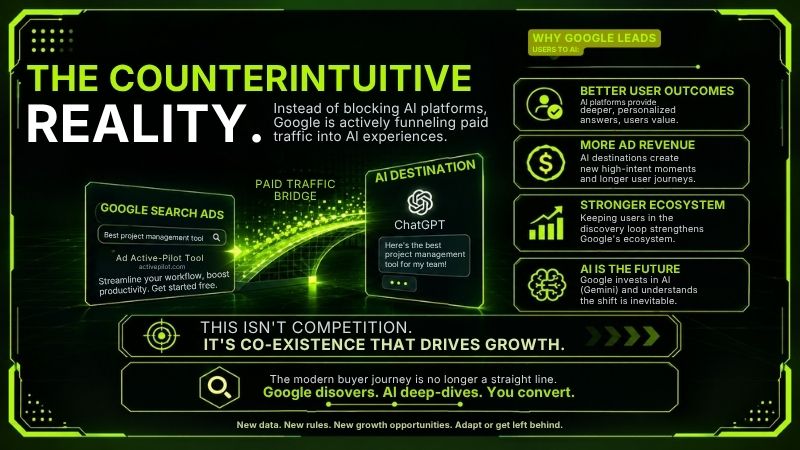
Rather than suffocating competitors, Google continues to generate massive revenue by facilitating clicks that navigate users away from its own ecosystem and into AI platforms. The relationship here is not eradication; it is financial symbiosis. Both platforms capitalize on the fluid transitions defining the modern AI Search customer journey.
1.2. Decoding the 86% Discovery and 11% Zero-Click Metrics
The dataset further clarifies consumer behavior upon the Search Engine Results Page (SERP).
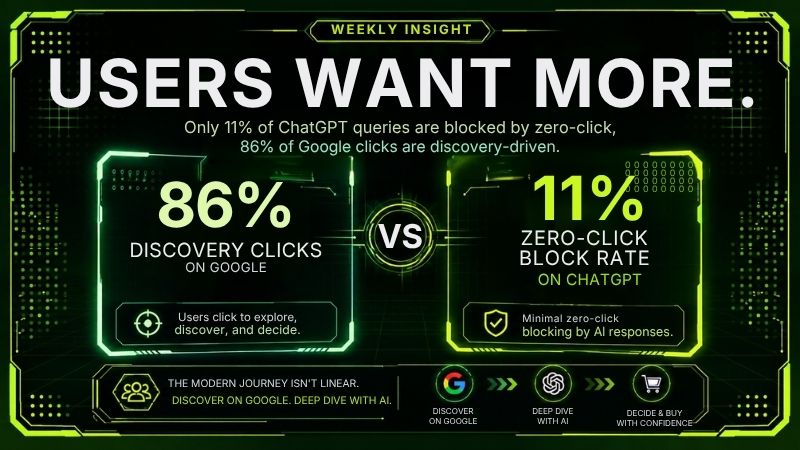
- 86% of Google clicks are Discovery-driven. Consumers utilize Google to compile initial solution lists, establish surface-level brand recognition, and validate product existence.
- Only 11% of ChatGPT-related queries are blocked by Google’s Zero-click features (Featured Snippets or AI Overviews). This invalidates the “death of traffic” narrative. Consumers are not satisfied with static, brief answers provided natively on Google; they actively desire to transition into deeper, conversational interfaces on ChatGPT or Gemini to execute complex data synthesis requests.
2. Anatomizing the Cross-Platform Customer Journey
The functional polarization between Google and LLMs has engineered an entirely novel consumer behavioral model.
2.1. Google as the Bridge, LLMs as the Synthesizer
During previous eras, the purchasing journey was linear: Consumer searches on Google -> Clicks an advertisement -> Navigates to a Landing Page -> Consumes information and executes a conversion.
Currently, the AI Search customer journey is highly non-linear and fragmented:
- Touchpoint 1 (Discovery): A consumer queries a generalized solution (e.g., “SME CRM software platforms”) on Google. They click top-of-page Google Ads to aggregate a list of 3-4 prominent brands.
- Touchpoint 2 (Synthesis): The consumer does not consume the entirety of the Landing Page content. They exit, launch the ChatGPT interface, and input a complex prompt: “Compare the features, integration capabilities, and pricing models of HubSpot, Salesforce, and Zoho for a 50-person enterprise.”
- Touchpoint 3 (Conversion): After the LLM provides an in-depth analysis and recommends the optimal solution, the consumer returns to Google (frequently utilizing a direct branded search) to execute the final transaction (Bottom-of-funnel).
2.2. The Flaw of Siloed Budgeting
The most severe strategic error committed by Global Agencies today is segregating budgets into “Traditional Search Engine Optimization” (SEO/SEM) and “Generative Engine Optimization” (GEO/LLMO) silos. In reality, if an enterprise slashes Top-of-Funnel Google Ads budgets, the brand entirely loses its visibility during the consumer’s initial awareness phase. If a prospect remains unaware of your brand name via Google Ads discovery, they will inherently fail to include your entity within their comparative prompts on ChatGPT.
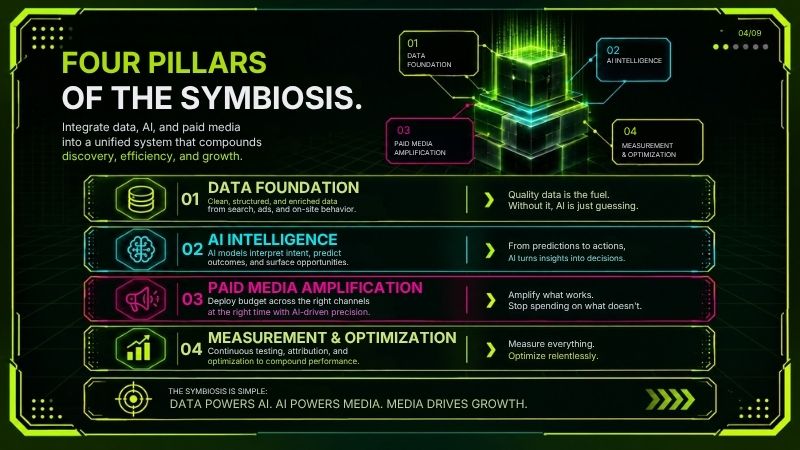
3. Transitioning Attribution Measurement Models
Because consumers continuously pivot between search platforms and AI interfaces, standardized attribution tools like Google Analytics 4 (GA4) experience severe “journey fragmentation.”
3.1. The Invisibility of Transit Traffic
When a user transitions from clicking a Google advertisement to engaging in a conversation with ChatGPT, standard tracking parameters (UTM, GCLID) are stripped away. The analytics system cannot accurately attribute the origin of the consumer when they eventually return via direct branded traffic.
3.2. Restructuring Measurement Methodologies (Proxy & Post-Purchase)
To accurately quantify the value of the AI Search customer journey, enterprises must deploy a hybrid multi-touch attribution framework:
- Deep-link Tracking Parameters: Embed unique URL parameters directly into the structural code that only AI crawlers parse (e.g., links deeply encrypted within JSON-LD Schema Markup). When an LLM extracts your data to present to a user, it frequently provides these source links. Clicks originating from these specific links can be definitively attributed to “AI Citations.”
- Automated Post-Purchase Qualitative Surveys: Integrate a mandatory survey question directly into the checkout sequence: “Which platform primarily influenced your discovery of our brand?”. Distinctly separate options such as “Standard Google Search,” “Recommendation from ChatGPT/Gemini,” and “Social Media Ads” to mathematically cross-reference against quantitative Analytics data.
4. The H2T Technical Action Blueprint
Rather than exhausting resources attempting to defend traditional organic keywords facing diminishing returns, enterprises must reallocate budgets to dominate “Transit Lanes.” Below is a 3-step strategic execution framework developed by H2T Media Group:
4.1. Reallocating Paid Search Budgets
Do not restrict bidding architecture exclusively to high-intent transactional keywords. Expand Google Ads budget allocations into campaigns specifically targeting Discovery Intent. Utilize Ad Copy that focuses on educational value, comparative resource provision, or problem resolution (e.g., “Download the Comprehensive 2026 CRM Comparison Matrix”). The tactical objective is to inject the brand entity into the consumer’s short-term memory immediately prior to their transition to an AI platform.
4.2. Optimizing Destination Architecture for LLM Extraction
A Landing Page must not merely possess high aesthetic value for human scrolling; its source code must be rigidly structured for effortless AI data extraction.
- Deploy native HTML Tables to present technical specifications and pricing matrices. Neural networks inherently prioritize the extraction of structured tabular data.
- Construct comprehensive Frequently Asked Questions (FAQ) blocks strictly validated with standard FAQPage Schema. Provide direct, concise answers to common industry queries, maximizing the probability that LLMs will prioritize your data as primary input material during consumer conversations.
4.3. Executing an Entity Authority Audit
Within the AI Search customer journey, the LLM operates as the ultimate arbiter. To ensure the AI consistently recommends your brand within its final synthesis, your entity must demonstrate absolute cross-platform consistency. Ensure corporate identification data (NAP: Name, Address, Phone) is 100% uniform across all business directories, review aggregator platforms, and official social media profiles. If the AI detects fragmented or conflicting data, it will autonomously eliminate your brand from the recommendation pool to mitigate hallucination risks.
5. Frequently Asked Questions
The AI Search customer journey is a hybrid acquisition path where consumers begin with initial solution discovery on Google Search (via ads or organic results) and then pivot to LLM platforms like ChatGPT or Gemini for deep comparative analysis before converting.
No, they operate in a symbiotic relationship where Google Ads acts as an upstream traffic driver, feeding discovery-driven users directly into AI interfaces for complex evaluation and data synthesis.
Standard GA4 attribution models lose referral data when users transition from search engine results into private conversational AI prompts, creating tracking blind spots that require hybrid measurement solutions like deep-link parameters and qualitative surveys.
Websites should structure key data into native tabular formats, implement strict FAQPage Schema markup, and maintain 100% uniformity in Name, Address, and Phone (NAP) details across all web directories to ensure accurate AI citation.
The AI Search customer journey is not a zero-sum competition, but a unified, multi-platform acquisition funnel where Google Ads drives initial discovery and LLMs execute decisive data synthesis. By analyzing 13 billion search data points from iPullRank, this technical framework demonstrates why modern marketing teams must bridge Search and Generative AI budgets, deploy native HTML tables and FAQPage Schema for direct LLM extraction, and implement hybrid post-purchase attribution to eliminate multi-platform tracking dead zones. To explore more in-depth data analyses, cross-platform frameworks, and performance scaling blueprints, continue reading our latest technical articles in the SEO Category under the Insights hub on the official website of H2T Media Group.

bichthao
H2T Media Group decodes every meaningful platform update for advertisers and affiliate partners across APAC, EU and North America — always with a practical "H2T take" you can act on.
More about H2T →