

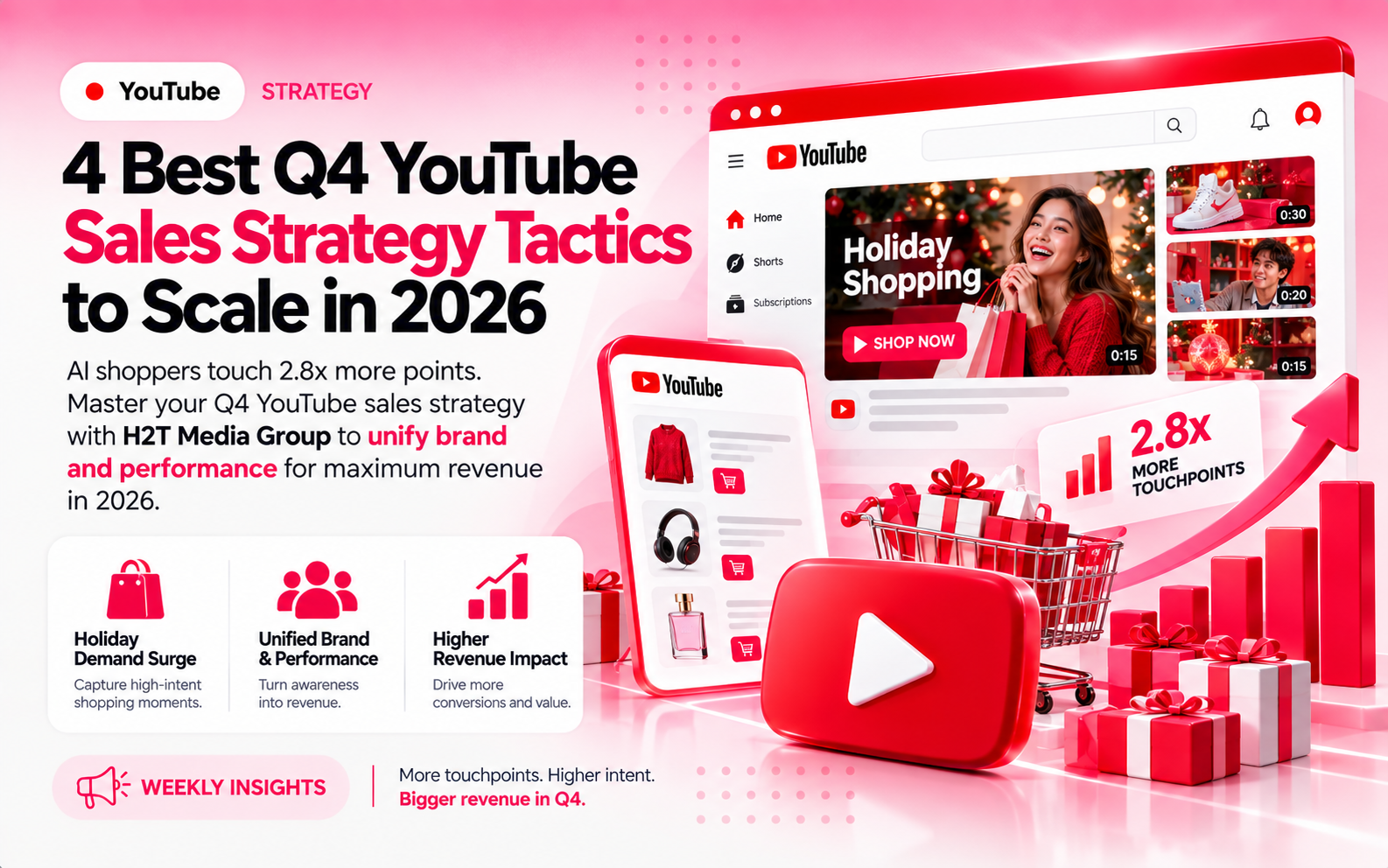
Welcome to the video commercial performance insights hub by H2T Media Group. A winning Q4 YouTube sales strategy in 2026 relies on connecting upstream video demand creation directly to downstream checkout velocity to capture AI-empowered consumer intent. By unifying brand discovery on YouTube with high-converting search capture and first-party data integration, e-commerce brands can maximize holiday revenue and eliminate market share loss. Below is H2T’s technical analysis and the 4-pillar execution blueprint required to dominate fourth-quarter sales.
 Key Takeaways
A winning Q4 YouTube sales strategy bridges upstream brand discovery and downstream direct checkout to capture AI-empowered consumer intent.
Essential Facts for Q4 Retail
- 2.8x More Touchpoints: AI-guided shoppers interact with significantly more digital touchpoints prior to completing a purchase.
- Purchase Confidence Lift: 75% of consumers affirm that Google AI capabilities directly increase their buying confidence.
- The Brand Cut Penalty: Siphoning upper-funnel budgets starves downstream performance bidding algorithms of essential conversion signals.
- First-Party Data Ingestion: Syncing CRM data via Data Manager is mandatory to steer automated Smart Bidding models accurately.
- Full-Funnel Convergence: Connecting YouTube demand creation with Google Search capture maximizes gross profit margins.
1. The Rise of the AI-Guided “Super-Empowered Shopper”
The 2026 holiday shopping corridor marks the first retail season where artificial intelligence acts as the primary shopping copilot for everyday consumers. By serving as an active decision-making assistant, AI permanently transforms how shoppers discover, evaluate, and purchase products during peak sales periods.
1.1. Consumers interact with 2.8x more touchpoints
Empirical data released during Rethink Week 2026 confirms the ascendance of a new behavioral profile known as the “Super-Empowered Shopper.” Driven by artificial intelligence, this modern consumer leverages high-intent digital tools to research, evaluate, and execute purchases with unprecedented speed and conviction.
Historically, consumer purchasing journeys were defined by a structural compromise between Speed and Confidence. Executing a rapid purchase risked buying suboptimal merchandise; securing high confidence demanded exhaustive manual research spanning days.
Generative AI has permanently dissolved this operational friction:
- Leveraging tools like Google Gemini and AI Overviews, shoppers synthesize reviews, compare technical specifications, and cross-reference pricing in seconds.
- AI-guided consumers interact with 2.8x more digital touchpoints on average compared to traditional shoppers before executing a transaction.
- An impressive 75% of active consumers (3 in 4 shoppers) explicitly state that Google AI tools empower them to make faster, substantially more confident purchasing decisions.
1.2. The convergence of discovery speed and buying conviction
Consumers no longer react to an isolated advertisement with an immediate, blind checkout. They discover a product via YouTube Shorts, prompt Gemini to verify ingredient safety or hardware durability, evaluate an unboxing review on a living room Connected TV, and subsequently execute a branded search query to finalize the transaction.
An enterprise-grade Q4 YouTube sales strategy must span this interconnected touchpoint matrix. By establishing continuous presence across all formats, brands ensure they serve as the definitive answer throughout every stage of the AI-guided consumer journey.
2. The Cost Penalty of Brand Budget Cuts: The $1.92 BCG Economic Rule
During high-stakes Q4 budget planning meetings, executive leadership often faces the temptation to mandate: “Eliminate brand awareness expenditures and reallocate 100% of capital into bottom-funnel performance ads to maximize short-term revenue.”
2.1. The operational failure of siloed performance marketing
Rigorous empirical research conducted by the Boston Consulting Group (BCG) provides an undeniable financial counterpoint. For every $1 of near-term brand marketing spend cut, enterprises are forced to reinvest $1.92 in subsequent cycles simply to regain lost market share. Siphoning capital entirely away from upper-funnel demand creation is mathematically equivalent to exhausting a well without replenishing the water table. Bidding exclusively on bottom-funnel intent reaches only consumers who have already finalized their product criteria. Within two to three weeks, this narrow audience pool saturates, driving Customer Acquisition Costs (CAC) to unsustainable levels during peak auction weeks.
2.2. The cost of invisibility in conversational AI search
In modern AI-mediated search environments, language models prioritize citing and recommending brand entities with high established authority to shape a winning Q4 YouTube sales strategy. By building a rich cultural footprint across video formats, enterprise brands secure top-of-funnel presence and drive AI recommendation algorithms toward their products.
If an enterprise deactivates its top-of-funnel video presence, its entity strength decays within the Knowledge Graph. When consumers prompt Gemini: “What is the best ergonomic office setup for remote work?”, the AI model will exclusively recommend competitor brands that maintained continuous video awareness.
3. First-Party Data Ingestion: The Engine Powering AI Bidding Algorithms
Google’s automated Smart Bidding systems (Target ROAS and Maximize Conversion Value) operate utilizing advanced machine learning models. Machine learning requires continuous, high-fidelity data streams to accurately identify high-value buyer cohorts.
3.1. Preventing bidding algorithms from flying blind
Relying exclusively on fragile client-side browser pixels results in severe conversion signal loss due to browser privacy restrictions and ad blockers. Deprived of verified conversion signals, Smart Bidding algorithms miscalculate audience intent, resulting in erratic bid pacing during high-volume promotional surges.
3.2. Synchronizing CRM and Offline Sales via Data Manager
To dominate Q4 retail auctions, enterprises must fortify their first-party data architecture:
- Ingest verified customer records from enterprise CRMs and physical Point-of-Sale (POS) systems directly into Google Data Manager.
- Implement Server-Side Offline Conversion Tracking (OCT) to stream actual closed-loop transaction values back to Google Ads.
- When the AI engine receives deterministic signals identifying high Lifetime Value (LTV) purchasers, it autonomously calibrates live bids to capture matching high-AOV profiles across YouTube’s vast video inventory.
As documented in official industry intelligence on YouTube for Business Rethink 2026, connecting upstream video demand creation with closed-loop revenue data is the definitive formula for scaling profitable growth.
4. Comparative Matrix: Siloed Funnel vs. Unified Full-Funnel YouTube Strategy
The technical matrix below outlines the operational divergence separating fragmented legacy marketing from a modernized full-funnel YouTube strategy:
| Evaluation Dimension | Fragmented Legacy Funnel Strategy | Unified Full-Funnel Q4 YouTube Strategy |
|---|---|---|
| Capital Allocation | Strips brand budgets; allocates 100% to lower-funnel ads. | Balanced 40/60 distribution: Builds demand while capturing checkout. |
| Market Share Defense (BCG) | Loses market share; incurs $1.92 penalty per $1 cut. | Defends profit margins; continuously acquires net-new customer cohorts. |
| Consumer Journey Capture | Reacts passively after the user executes a search query. | Proactively seeds intent across YouTube Shorts, capturing 2.8x touchpoints. |
| Measurement Infrastructure | Relies on client-side pixels and single-touch attribution. | Server-Side CAPI, Data Manager, cross-screen Connected TV tracking. |
| Creative Architecture | Broadcasts rigid corporate TVCs and generic promo banners. | Authentic creator reviews paired with shoppable Demand Gen feeds. |
5. The 3-Phase Enterprise Q4 Execution Blueprint by H2T Media Group
To successfully deploy an enterprise Q4 YouTube sales strategy that converts AI-empowered shoppers, H2T Media Group mandates the following 3-phase technical roadmap:
5.1. Phase 1: Audience Seeding and Entity Authority Building (October)
- Strategic Objective: Establish initial brand consideration and seed product interest across prospective households.
- Technical Execution: Partner with verified category creators to publish unboxing assets, seasonal gift guides, and problem-solving tutorials. Distribute high-definition 4K video assets onto living room Connected TV screens and vertical cuts onto YouTube Shorts. Accumulate comprehensive Video Viewer Custom Audiences.
5.2. Phase 2: Black Friday & Cyber Monday Liquidity Maximization (November)
- Strategic Objective: Capture maximum conversion velocity and monetize accumulated audience pools during peak promotional weeks.
- Technical Execution: Deploy high-frequency Demand Gen campaigns retargeting the audience cohorts built in Phase 1. Enable dynamic Google Merchant Center Product Feeds displaying live holiday discounts beneath video ad units. Implement Value-Based Bidding (Target ROAS) and activate Demand-Led Budgets to prevent premature daily budget caps.
5.3. Phase 3: Last-Minute Holiday Fulfillment and Urgency Capture (December)
- Strategic Objective: Capture late-season gift buyers, promote digital fulfillment solutions, and clear seasonal inventory.
- Technical Execution: Pivot creative messaging to emphasize guaranteed shipping deadlines before Christmas Eve, digital gift cards, and Buy-Online-Pickup-In-Store (BOPIS) fulfillment. Deploy Local Campaigns and Local Inventory Ads to route nearby mobile shoppers directly to physical retail locations.
6. Frequently Asked Questions
Because AI tools make deep information retrieval frictionless. Instead of manually spending hours researching, consumers use AI to evaluate dozens of creator reviews, spec tables, and pricing comparisons in minutes, creating a denser multi-touch journey.
Track the native Attributed Branded Searches metric within Google Ads and deploy Data-Driven Attribution (DDA) modeling to accurately credit upper-funnel video impressions for initiating downstream search and checkout actions.
No. The December 1st to 15th window represents the peak purchasing period for high-ticket holiday gifts. Maintaining continuous media liquidity ensures your bidding models capture late-season high-margin demand without algorithmic interruption.
Lean operators should allocate approximately 30% of media spend to native, mobile-shot YouTube Shorts for awareness, while dedicating 70% to direct-response Demand Gen campaigns linked directly to shoppable product feeds.
The 2026 holiday retail corridor brings unprecedented revenue for brands capturing AI-driven, multi-touch customer journeys. Executing an integrated Q4 YouTube sales strategy by combining first-party server data, authentic creator partnerships, and shoppable Demand Gen formats empowers enterprises to maximize conversions and dominate holiday sales.
To access proprietary full-funnel video frameworks and advanced conversion measurement playbooks, explore our technical repository on the Insights hub at H2T Media Group. Make sure to consistently follow our dedicated YouTube to master the tactical marketing strategies dictating success across global video advertising ecosystems.

bichthao
H2T Media Group decodes every meaningful platform update for advertisers and affiliate partners across APAC, EU and North America — always with a practical "H2T take" you can act on.
More about H2T →