

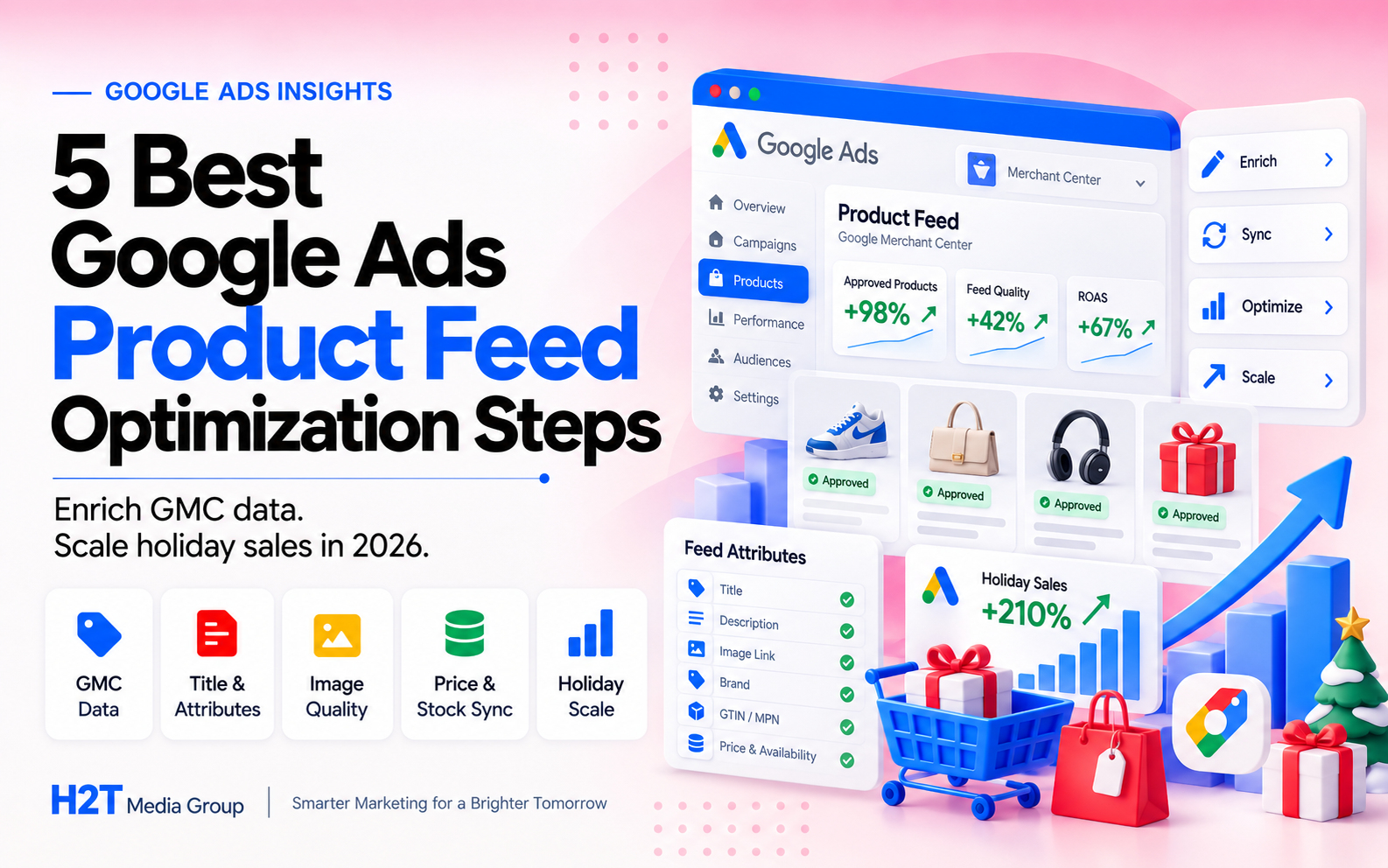
Welcome to the commercial performance marketing insights hub by H2T Media Group. Executing Google Ads product feed optimization by refining titles, enriching metadata, upgrading visuals, synchronizing promotions, and segmenting via custom labels is the critical core solution to boosting feed quality scores, maximizing impression share, and scaling Q4 2026 revenue. If an enterprise focuses solely on increasing ad spend while neglecting Google Merchant Center data hygiene, Google’s AI algorithms will fail to connect products with high-intent shoppers.
Below, H2T Media Group provides a 5-step technical framework, comparative matrix, and execution blueprint for Performance Max campaigns – explore the full guide to dominate retail performance.
 Key Takeaways
Google Ads product feed optimization provides the foundational data structure required for AI bidding engines to match products with high-intent holiday demand.
Essential Facts About Product Feeds
- Holiday shoppers in 2026 utilize AI agents for conversational product research and gift discovery.
- Front-load critical keywords, brand names, and key attributes into the first 70 characters of titles.
- Populating optional attributes (color, size, material) allows AI to capture long-tail search intent.
- Synchronize real-time promotional badges and inventory availability to prevent wasted clicks.
- Deploy custom labels to segment bidding strategies based on true product gross profit margins.
1. The Rise of Agentic Commerce in the 2026 Holiday Shopping Season
Consumer discovery behavior during the fourth-quarter retail corridor has fundamentally evolved beyond single-keyword queries. Modern holiday shoppers now rely heavily on conversational, multi-layered prompts to drive product research and decision-making.
1.1. Shoppers leverage AI for product discovery and validation
Modern consumers increasingly deploy conversational, research-oriented prompts: “Recommend the top waterproof winter jackets under $200 for skiing”, “Unique tech gifts for remote workers”. Generative architectures like Google Gemini and AI Overviews do not simply match exact title strings; they parse structured backend datasets to evaluate which commercial offerings definitively satisfy multi-layered user parameters. If your product metadata lacks descriptive depth, language models will systematically exclude your inventory, recommending competitor products equipped with comprehensive specifications.
1.2. The failure of single-minded last-click optimization
Numerous retail operators continue to over-index on optimizing bottom-of-funnel checkout steps while ignoring top-of-funnel data readiness. In an AI-mediated shopping landscape, the decision-making process occurs early during initial comparative research.
In an AI-mediated shopping landscape, the decision-making process occurs early during initial comparative research. Executing thorough Google Ads product feed optimization ensures your catalog surfaces during the foundational consideration phase, steering prospective buyers toward your checkout pipeline.
2. The Critical Function of Product Feeds in Machine Learning Algorithms
Within the Google advertising ecosystem, structured product feeds hosted inside Google Merchant Center serve as the primary knowledge base for automated bidding engines. These structured data payloads supply the necessary context and attributes required by machine learning algorithms to match commercial inventory with high-intent search queries.
2.1. Product feeds as the native language of Google AI
Automated campaign types like Performance Max and Smart Shopping do not utilize traditional keyword lists. Distribution algorithms rely exclusively on parsing the structured attributes declared within your feed: Title (title), Description (description), Product Category (google_product_category), and granular product specifications (attributes).
The more descriptive and uniform your data payload, the higher your Feed Quality Score, allowing your campaigns to win competitive auctions at lower baseline CPMs.
2.2. Powering omnichannel multi-surface visibility
Enriching your product feed expands visibility far beyond the standard Google Shopping tab. By supplying detailed attributes and media assets, your inventory gains the contextual depth required to surface across high-intent discovery surfaces like YouTube Shorts, Google Discover, and AI Overviews.
Google’s machine learning systems automatically extract imagery, live pricing, and promotional badges to render shoppable assets across:
- YouTube Shorts via interactive product stickers and carousels.
- Google Discover feeds tailored to individual user intent patterns.
- Synthesized citation boxes inside Search AI Overviews.
As documented in official industry playbooks on Google Ads Retail Strategy, feed enrichment represents the single most important prerequisite to maximizing brand discoverability in modern search.
3. 5 Tactical Steps for Google Ads Product Feed Optimization
To ensure complete operational readiness for Q4 scaling, H2T Media Group mandates the execution of five core technical optimization protocols. These structured steps encompass restructuring mobile titles, enriching metadata, upgrading visual assets, synchronizing real-time inventory, and implementing advanced custom label segmentation.
3.1. Step 1: Restructure product titles for mobile visibility
The product title represents the primary algorithmic signal dictating ad impression relevance.
- The 70-Character Rule: Mobile search interfaces and YouTube Shorts overlays truncate titles after roughly 70 characters. Position critical attributes at the front: [Brand] + [Product Type] + [Core Differentiator / Feature] + [Size / Color / Gender].
- Eliminate Keyword Stuffing: Maintain natural readability while highlighting technical intent (e.g., replace “Men’s Warm Sweater” with “H2T Men’s Merino Wool Turtleneck Sweater – Heavyweight Winter Knit – Charcoal Gray”).
3.2. Step 2: Maximize category attributes and rich metadata
Avoid restricting feed uploads to mandatory minimum fields; systematically populate optional attributes:
- Provide verified Global Trade Item Numbers: gtin, mpn, and brand. Products featuring verified GTIN codes receive over 40% higher impression priority across Google Shopping auctions compared to unverified entries.
- Declare specific long-tail attributes: color, size, gender, age_group, material, and pattern. These parameters empower AI engines to match exact conversational queries like “Women’s size M red velvet evening dress”.
3.3. Step 3: Upgrade visual asset quality and integrate video
High-fidelity visual assets directly govern Click-Through Rates (CTR):
- Primary Image (image_link): Must feature high-resolution product photography centered on a clean, solid white background without promotional text overlays or watermarks.
- Supplemental Imagery (additional_image_link): Upload a minimum of 3 to 5 lifestyle images showcasing the product in authentic, real-world usage environments.
- Video Integration: Utilize lifestyle_image_link attributes or link short product demonstration videos to enable automated motion ad rendering across YouTube.
3.4. Step 4: Synchronize real-time promotional feeds and inventory
Q4 retail is defined by rapid pricing fluctuations and flash sales.
- Deploy Promotions Feeds: Configure promotional badges (e.g., “20% Off Holiday Special”, “Buy One Get One”) directly within GMC to capture immediate user attention on crowded search result pages.
- Automate Inventory Updates: Enable Automated Item Updates via structured Schema markup on your website to ensure price changes and out-of-stock statuses synchronize instantly, preventing wasted ad spend on unavailable items.
3.5. Step 5: Segment bidding via custom labels
Deploy custom_label_0 through custom_label_4 to group inventory strategically, allowing precise budget control within Performance Max campaigns:
- Custom Label 0 (Margin Tier): Categorize products as High_Margin, Medium_Margin, or Low_Margin to align with differentiated Target ROAS thresholds.
- Custom Label 1 (Holiday Seasonality): Flag high-velocity items as Holiday_Bestseller, Gift_Ideas, or Clearance.
- Custom Label 2 (Price Competitiveness): Isolate products where your pricing beats competing market benchmarks to empower algorithms to bid aggressively.
4. Comparative Matrix: Basic Product Feeds vs. AI-Enriched Feeds
The technical matrix below outlines the operational divergence between standard feeds and fully optimized datasets:
| Product Data Field | Standard Unoptimized Feed | AI-Enriched Feed (2026 Standard) |
|---|---|---|
| Product Title (title) | Short, non-descriptive internal SKU names. | Front-loaded structure: Brand + Type + Key Feature + Spec. |
| GTIN & MPN Identifiers | Missing or declared as identifier_exists = false. | 100% verified: Authenticated via global GS1 databases. |
| Product Imagery | Single low-res catalog image with text overlays. | Multi-angle: 1 studio white-background + 4 lifestyle assets. |
| Detailed Attributes | Limited strictly to mandatory platform requirements. | Exhaustive: Material, pattern, size, gender, seasonal tags. |
| Campaign Governance | Single asset group containing entire product catalog. | Custom Labels: Segmented by margin tiers and holiday demand. |
| Performance Impact | High CPMs, low CTRs, frequent impression mismatches. | 25–40% expansion in qualified impression share. |
5. The Enterprise Q4 Execution Blueprint by H2T Media Group
To translate structured feed data into measurable revenue, H2T Media Group mandates the following 2-phase operational roadmap:
5.1. Merchant Center diagnostics and compliance audit (October)
- Audit the Diagnostics tab in Google Merchant Center to resolve all item disapprovals and policy flags before peak shopping weeks.
- Validate automated pricing synchronization between your digital storefront and your GMC feed to eliminate account suspension risks.
- Configure Holiday Shipping Settings, explicitly advertising guaranteed delivery cut-off dates before Christmas Eve to drive purchase urgency.
5.2. Deploying Promotion Mode and dynamic liquidity (November – December)
- As peak promotional dates commence, activate Promotion Mode within Google Ads to dynamically adjust Target ROAS tolerances and expand daily budgets during high-volume spikes (Black Friday, Cyber Monday).
- Leverage custom labels to allocate 70% of media liquidity into Holiday_Bestseller product clusters, guaranteeing dominant impression share on priority inventory.
6. Frequently Asked Questions
GMC typically requires between several hours and 24 hours to process and index revised feed attributes. Complete all core feed optimizations at least 3 to 5 business days prior to campaign scaling.
No. Implement controlled testing across your top 20% highest-performing SKUs first. Validate that impression volume and CTR demonstrate positive lift over a 7-day period before applying the title structure across your entire catalog.
A valid GTIN corresponds to the universal barcode number (UPC, EAN, ISBN) issued by GS1. Validate code integrity directly through the official GS1 global registry database.
Under-delivery often stems from overly aggressive Target ROAS floors or excessively narrow audience signals. Moderately lower your target ROAS threshold to provide the machine learning system with the liquidity required to enter competitive auctions.
In modern retail advertising, Google Ads product feed optimization is a strategic variable dictating Q4 enterprise profitability. A structured, enriched feed helps Google AI understand product value and connect your catalog with high-intent buyers. Proactively auditing and optimizing data foundations today builds an insurmountable advantage in acquisition efficiency for the 2026 holiday shopping season.
To access proprietary e-commerce scaling playbooks and advanced campaign management frameworks, explore our technical repository on the Insights hub at H2T Media Group. Make sure to consistently follow our dedicated catetory Google Ads to master the tactical marketing strategies dictating success across global advertising ecosystems.

bichthao
H2T Media Group decodes every meaningful platform update for advertisers and affiliate partners across APAC, EU and North America — always with a practical "H2T take" you can act on.
More about H2T →