

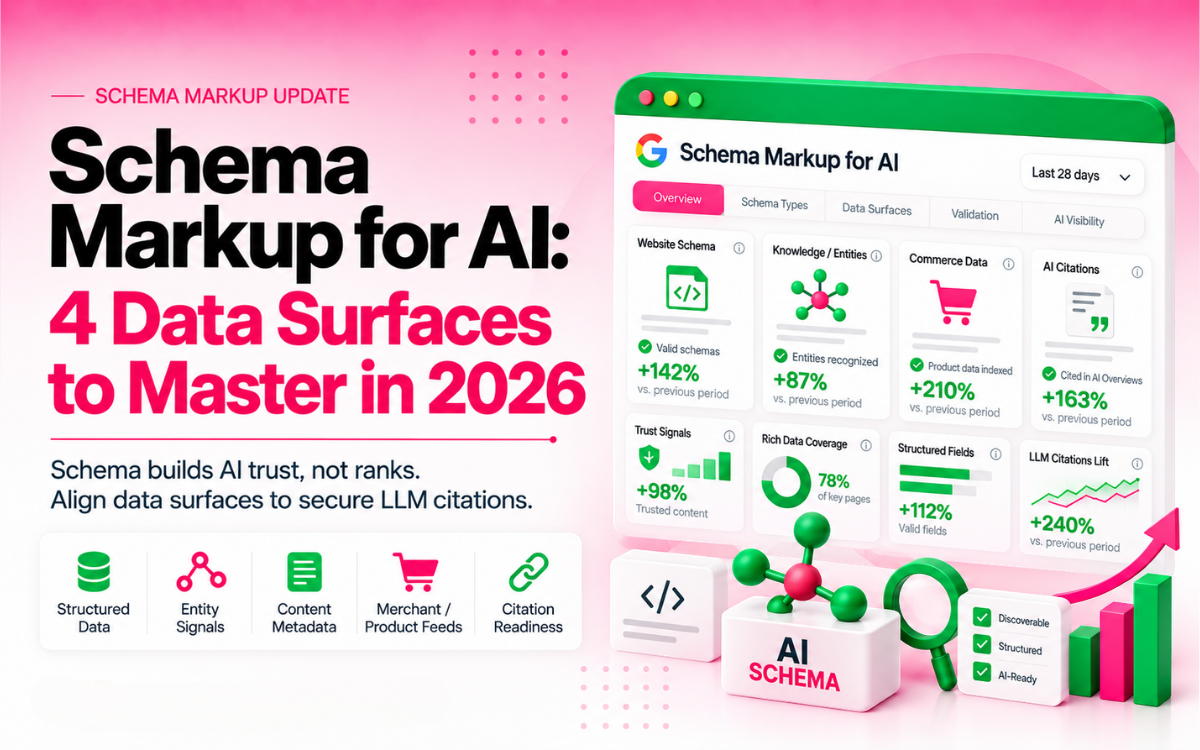
Welcome to the digital performance and search insights hub by H2T Media Group. Across the global SEO community, numerous marketing teams continue to treat structured data markup as a tactical shortcut to manipulate Search Engine Results Pages (SERPs) or secure decorative review stars. However, for Large Language Models (LLMs) and conversational search engines, implementing Schema Markup for AI is not a ranking cheat code; it functions as an enterprise data validation handshake.
Language models do not cite a commercial domain simply because it deploys pristine JSON-LD scripts; they cite an asset exclusively when they detect absolute, verifiable consensus across on-page content, machine-readable code, and real-world business footprints. When data discrepancies exist across these touchpoints, the AI immediately classifies the domain as unreliable. This technical analysis breaks down the multi-surface verification framework and delivers an operational blueprint for 2026.
 Key Takeaways
Schema Markup for AI operates as a data verification framework that enables machine learning models to confirm factual credibility before citing.
Essential Facts About Data Verification
- Structured markup does not artificially inflate rankings; it establishes factual confidence for AI models.
- Discrepancies between JSON-LD properties and visible text cause language models to downgrade entity trust.
- AI cross-references commercial entities against Google Business Profile and Merchant Center databases.
- Third-party customer reviews and external citations serve as empirical proof for declared Schema code.
- Standardize a single template with character-level accuracy before scaling markup site-wide.
1. The Functional Role of Schema in Generative AI Search
Many technical directors continue to mandate automated schema generation plugins under the assumption that these scripts directly elevate keyword positioning.
In legacy search environments, Googlebot parsed structured data primarily to understand basic topical taxonomy and render Rich Snippets on standard desktop screens.
However, advanced generative models – such as Gemini, ChatGPT Search, and Claude – process digital assets for an entirely different purpose: Entity Resolution and Hallucination Mitigation.
When an end-user submits a complex query, the AI engine is mathematically constrained to retrieve sources exhibiting the lowest risk of factual error. In this environment, Schema Markup for AI serves as an explicit, machine-readable declaration of corporate facts. If your JSON-LD script asserts that your enterprise provides specialized software from a specific location, but the on-page text lacks corroborating detail, the language model classifies the discrepancy as an algorithmic manipulation attempt, systematically excluding your domain from the citation carousel.
2. The 4 Data Surfaces Governing Generative AI Citations
Modern language models reject reliance on single-source declarations. To establish your enterprise as an authoritative, cited entity, machine learning architectures scan and cross-correlate four distinct data surfaces:
2.1. Surface 1: Human-readable on-page content
This is the visual, consumer-facing layer rendered within the browser DOM.
It contains body copy, descriptive paragraphs, numerical pricing tables, and product specifications. Language models process this surface using natural language understanding (NLU) to evaluate whether the text genuinely provides original information gain that resolves the searcher’s core operational problem.
2.2. Surface 2: Machine-readable Schema markup (JSON-LD)
This is the programmatic abstraction of the on-page content.
Constructed using standardized Schema.org vocabulary, this layer organizes unstructured text into explicit key-value pairs (e.g., @type, name, priceRange, geoCoordinates, author). This provides AI agents with an unambiguous semantic blueprint, allowing rapid data ingestion without requiring heavy inference compute.
2.3. Surface 3: Ecosystem platform registries
Search engines continuously cross-reference web pages against authenticated internal databases, predominantly Google Business Profile (GBP) and Google Merchant Center (GMC).
If your website claims an operating schedule or corporate address that contradicts your verified Google Maps listing, or if the inventory status on your product page diverges from your GMC data feed, the algorithmic confidence score assigned to your brand entity degrades immediately.
2.4. Surface 4: Third-party independent corroboration
This represents the ultimate pillar of Entity Authority.
It encompasses unvarnished customer sentiment across independent platforms like Trustpilot, G2, and Google Reviews, alongside editorial mentions across respected industry publications and structured entries in public repositories like Wikidata. Without third-party corroboration, on-page schema declarations are treated by AI as unverified marketing claims.
3. The Cost of Data Drift and the Failure of Premature Scaling
The most prevalent technical vulnerability observed across enterprise domains is the phenomenon of “Data Drift” – where independent data surfaces contradict one another.
3.1. Entity confidence degradation via data drift
Minor factual discrepancies trigger immediate risk mitigation responses within AI reasoning engines:
- A phone number in the website footer containing formatting differences compared to the LocalBusiness schema script.
- An e-commerce product page displaying “Out of Stock” to human users while the underlying JSON-LD script continues declaring InStock to preserve search impressions.
- An author entity declared in schema that cannot be verified against an authenticated external profile on LinkedIn or an official executive bio.
When language models detect these conflicting signals, their internal Confidence Score drops below the threshold required for citation. The model will systematically choose to cite a competitor possessing simpler code, provided that competitor demonstrates absolute factual consistency across all data layers.
3.2. The systemic risk of automated plugin scaling
Numerous organizations attempt to solve structured data requirements by deploying automated CMS plugins across tens of thousands of URLs simultaneously.
Executing bulk automation before validating the integrity of your foundational data merely scales errors across your entire digital footprint. The correct engineering protocol demands isolating a single representative template, auditing data accuracy down to the character level across all four surfaces, and only then programmatic rolling out the configuration.
4. Technical Comparison: The 4 Data Surfaces in Entity Verification
The matrix below illustrates how artificial intelligence systems parse, validate, and react to each individual data surface:
| Data Surface Layer | Target Audience | Data Format | Impact of Asymmetry | Technical Deployment Standard |
|---|---|---|---|---|
| 1. On-Page Web Text | Human Users & AI Crawlers | Semantic HTML, Raw Tables | High bounce rate, degraded user trust | Precise, quantitative, concise copy |
| 2. Schema Markup | Large Language Models (LLM) | JSON-LD Structured Scripts | Entity classification failure, citation loss | 100% character-level parity with text |
| 3. Platform Registries | Search Engine Knowledge Graph | API Feeds (GBP, GMC, Maps) | Feed disapprovals, entity confusion | Real-time automated data synchronization |
| 4. Third-Party Mentions | Cross-Validation Algorithms | Unstructured Reviews, Media | Demotion of overall domain authority | Reputation management, digital PR |
According to technical standards maintained by Schema.org Documentation, structured data declarations must always accurately reflect the primary content exposed to the human user within the browser canvas.
5. The Enterprise Technical Standardization Blueprint by H2T Media Group
To transform Schema Markup for AI into an impenetrable entity defense framework, H2T Media Group mandates the following 3-phase technical implementation:
Phase 1: Pilot Template Engineering
Isolate your most commercially critical product or service URL. Manually script custom JSON-LD blocks deploying precise types like Product, Organization, or ProfessionalService. Integrate the sameAs array to programmatically link your entity to verified Wikidata entries, Wikipedia pages, and official corporate social profiles.
Phase 2: Multi-Surface Cross-Audit
Execute a rigid audit comparing corporate Name, Address, Phone (NAP), operational hours, and pricing parameters across your landing page, your JSON-LD script, and your Google Business Profile. Eliminate any character-level or formatting variance to establish absolute data consensus.
Phase 3: External Proof Corroboration
Embed verified customer review objects into your schema code using legitimate review and aggregateRating properties. Simultaneously execute digital PR initiatives to secure entity mentions across authoritative industry trade publications, providing language models with the third-party verification required to crown your domain as the definitive citation source.
6. Frequently Asked Questions
No. Schema does not manipulate core algorithmic rankings. It functions strictly as a verification mechanism that enables AI models to understand, validate, and trust your factual assertions, thereby qualifying your domain for citation.
JSON-LD embedded within a dedicated <script> element is the universal standard mandated by Google and modern AI architectures. It completely decouples structured data from HTML presentation layers, accelerating crawler parsing speed.
If your on-page text lacks original Information Gain (proprietary data, unique case studies), or if your brand entity lacks corroboration across third-party review platforms, the AI will prioritize competing sources demonstrating higher real-world authority.
Generative tools can draft foundational JSON-LD syntax, but technical specialists must manually verify all schema properties against live web text to prevent data drift and avoid violating structured data guidelines.
Corporate authority within modern search ecosystems must be earned through operational reality, and Schema Markup for AI serves as the precise technical syntax used to communicate that reality to machine learning systems. Prioritizing clever coding syntax while neglecting multi-surface data consistency renders your technical investments completely ineffective. Organizations that abandon superficial shortcuts and commit to engineering unified, verifiable data across all consumer touchpoints will command sustainable visibility in the AI era.
To access proprietary structured data frameworks and advanced entity optimization playbooks, explore our technical repository on the Insights hub at H2T Media Group. Make sure to consistently follow our dedicated SEO category to master the technical strategies dictating authority across global search engine ecosystems.

bichthao
H2T Media Group decodes every meaningful platform update for advertisers and affiliate partners across APAC, EU and North America — always with a practical "H2T take" you can act on.
More about H2T →