

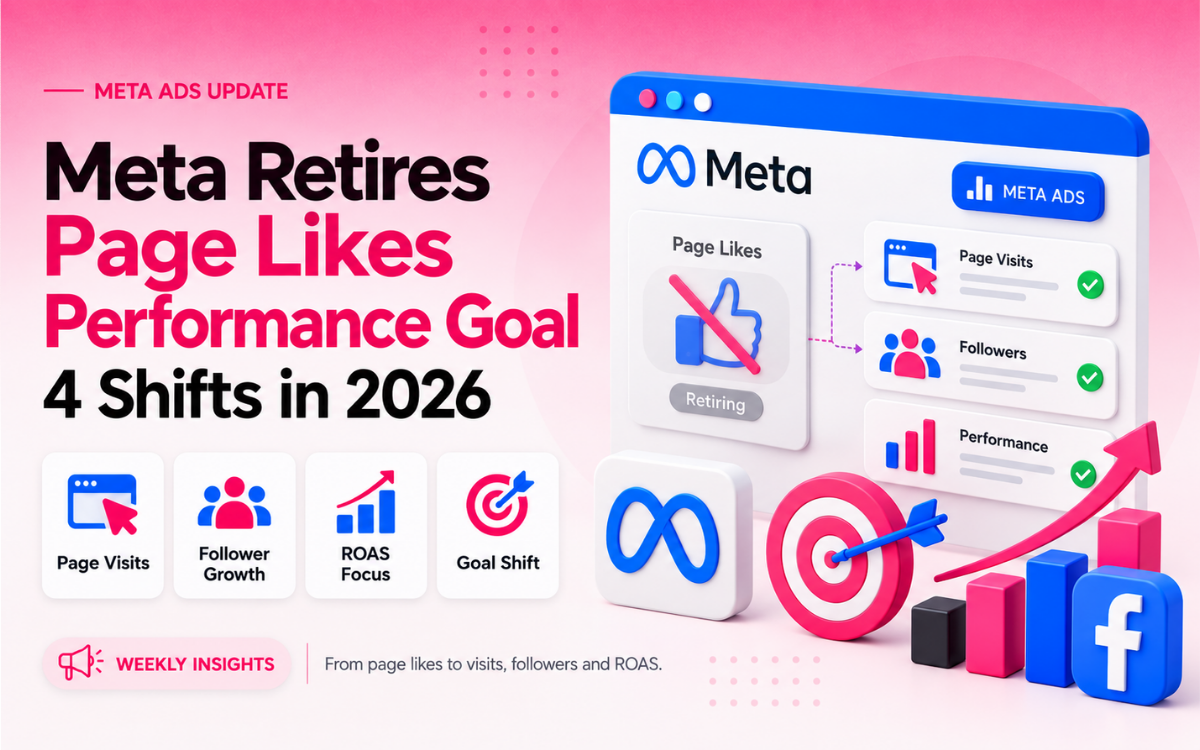
Welcome to the performance marketing insights hub by H2T Media Group. Meta has officially deployed a critical structural update within Ads Manager: The “Maximize number of Page likes” option has been permanently deprecated. In its place, the system now automatically defaults to the “Maximize number of Facebook Page visits” objective.
For seasoned performance advertisers, the Page Likes performance goal has long been classified as a vanity metric responsible for significant budgetary waste, particularly as organic page reach has plummeted below 1.5%. Meta’s decision to eliminate this legacy setting marks an inevitable operational transition toward deeper on-platform engagement and intentional profile exploration. This technical deep-dive analyzes the mechanics behind this update and delivers an actionable framework to restructure your paid social operations for 2026.
 Key Takeaways
The Page Likes performance goal has been officially retired by Meta and replaced by the Page visits optimization objective.
Key Facts About This Deprecation
- Meta permanently disabled the legacy Page Likes objective across all advertising accounts globally.
- Campaigns are now automatically routed to maximize Facebook Page and profile visits.
- Algorithms now target users exhibiting exploratory profile behavior rather than passive button clickers.
- Follower counts yield near-zero algorithmic distribution with organic reach remaining below 1.5%.
- Profiles must be optimized with clear pinned offers and direct messaging triggers to capture intent.
1. The Technical Rationale Behind Meta’s Deprecation Decision
Meta’s decision to revoke this legacy feature represents an ongoing effort to eliminate superficial data signals from its machine learning auction systems.
1.1. The obsolescence of page likes in an AI-driven ecosystem
Between 2012 and 2016, building a massive follower base guaranteed an enterprise a formidable organic distribution channel.
However, modern Meta algorithms operate strictly on an interest-based Content Graph. Content is distributed based on real-time engagement signals per post rather than account-level follower connections. Average organic reach for corporate pages currently tracks below 1.5%. Consequently, a page with 100,000 followers will frequently generate fewer than 1,500 organic impressions on standard status updates. Deploying ad spend toward the legacy Page Likes performance goal essentially meant paying to acquire a vanity number, only to be forced to pay again through sponsored distribution to reach those identical users.
1.2. The shift from passive clicking to intentional exploration
The legacy optimization model trained machine learning systems to locate users displaying high propensities for clicking the standalone “Like” button on feed ads. This cohort typically generated rapid, low-cost interactions but exhibited zero downstream engagement, reading retention, or commercial purchase intent.
Conversely, the “Maximize Page visits” objective forces the delivery engine to prioritize users whose behavioral history demonstrates an inclination to click handle identifiers and explore full business profiles. Actively visiting a profile signals substantially higher commercial curiosity than a passive thumb tap on a sponsored feed card.
2. Comparing Bidding Mechanics: Page Likes vs. Page Visits
The matrix below illustrates the structural shift between the deprecated objective and Meta’s new automated standard:
| Evaluation Dimension | Legacy Model (Page Likes) | Modern Model (Page Visits) |
|---|---|---|
| Algorithmic Target | Locates users with the highest statistical rate of clicking “Like Page” at the lowest cost. | Locates users who frequently click profile handles to inspect the complete page ecosystem. |
| Commercial Value | Delivers superficial social proof; yields zero direct revenue pipeline. | Funnels prospects into an organic content hub containing pinned offers and messaging triggers. |
| Audience Quality | High concentration of bot accounts and passive, accidental clickers. | Higher-intent user cohort accustomed to vetting vendor credibility prior to purchasing. |
| Retargeting Viability | Custom Audiences built from Page Likes are diluted and convert poorly. | Custom Audiences built from Page Visitors yield significantly higher conversion rates. |
| Capital Efficiency | Delivers cheap cost-per-like metrics that represent pure capital leakage. | Higher baseline CPMs balanced by tangible commercial touchpoints and downstream actions. |
According to official platform documentation within the Meta Business Help Center, aligning promotional campaigns around profile visits allows brands to bridge audience discovery across both Facebook and Instagram within a unified interface.
3. The New Vanity Metric Trap: Managing Zero-Intent Page Visits
While driving profile visits is vastly superior to acquiring passive page likes, growth leaders must avoid treating “Page Visits” as an ultimate conversion metric.
3.1. The accidental click phenomenon
A critical operational hazard associated with profile visit optimization is the generation of bounce traffic. Users may click through to a profile driven by curiosity or sensational creative hooks, only to exit immediately if the pinned content fails to establish clear value.
If an agency optimizes exclusively for raw visit volume devoid of downstream conversion guardrails, media budgets will continue to leak into unmonetized traffic. The auction system will naturally default to procuring the lowest-cost visitors rather than users exhibiting transactional viability.
3.2. Diluting Custom Engagement Audiences
In performance advertising, Page Engagement Custom Audiences represent a primary source for mid-funnel retargeting.
Injecting thousands of unvetted, superficial profile visitors into your account architecture severely corrupts these data pools. When scaling retargeting campaigns against these audiences, Customer Acquisition Costs (CAC) will inflate rapidly because the algorithm is forced to bid on prospects who engaged in a singular, accidental profile visit and possess zero commercial intent.
4. The Enterprise Technical Action Blueprint by H2T Media Group
To transition away from the deprecated Page Likes performance goal, H2T Media Group mandates the execution of this 3-step operational framework:
4.1. Transform the business profile into a high-converting landing page
Because traffic is routed directly to the native page environment rather than an external web page, the profile interface dictates conversion velocity:
- Visual Identity: The cover asset and profile avatar must clearly communicate the enterprise’s unique value proposition (UVP), eliminating abstract or decorative visuals.
- Pinned Strategy: The top pinned asset must function as a direct-response anchor: highlighting current commercial promotions, client testimonials, warranty parameters, and immediate purchase links.
- Action Buttons: Configure the primary profile CTA button to initiate high-intent actions – specifically “Send Message” or “View Shop” – bypassing generic informational options.
4.2. Deploy segmented, short-window retargeting pools
Rather than aggregating broad 365-day page engagement pools, segment custom audiences into aggressive, recency-based cohorts:
- The 7-Day and 14-Day Recency Windows: Prospects who visited the profile within the previous two weeks retain high brand recall. Deploy high-urgency conversion campaigns or dynamic product catalogs directly to this cohort to finalize transactions.
- Exclusion Governance: Systematically exclude validated past purchasers from profile visit retargeting pools to prevent capital waste.
4.3. Transition capital entirely to Sales and Lead objectives
For performance-driven organizations, the definitive strategic mandate from H2T is absolute: Eliminate standalone page promotion budgets entirely.
If your operational mandate is generating revenue, deploy the Sales objective. If your mandate is collecting qualified customer data, deploy the Leads objective. Allow Meta’s machine learning models to optimize directly for down-funnel financial events (Purchases, Leads) rather than funding intermediate, non-revenue-generating engagement steps.
5. Frequently Asked Questions
Active legacy campaigns will be automatically migrated by Meta to the “Maximize number of Facebook Page visits” performance goal. Advertisers must audit active ad sets to determine whether to sustain or terminate these campaigns.
Page likes carry negligible psychological social proof for first-time visitors, but they exert zero influence on algorithmic ad delivery, ad auction bidding priority, or organic post ranking.
For brands reliant on high-aesthetic visual storytelling (E-commerce, D2C, Fashion), directing traffic to an optimized Instagram Profile consistently delivers higher engagement and follow-through rates compared to desktop Facebook Pages.
The most capital-efficient organic acquisition engine is publishing high-value, native short-form video (Reels). Reels command the highest algorithmic discovery reach across Meta and generate qualified followers who possess genuine interest in your vertical.
Meta’s formal deprecation of the Page Likes performance goal delivers an unmistakable signal to the digital marketing industry: The era of deploying capital to acquire vanity metrics is officially over. Within an increasingly competitive, AI-governed advertising landscape, every media dollar must be directly tethered to concrete commercial pipeline and measurable return on ad spend. Transforming your native profiles into friction-free conversion hubs while reallocating capital toward bottom-funnel performance objectives represents the definitive path to protecting enterprise margins.
To access advanced full-funnel frameworks and empirical media buying blueprints, explore our technical repository on the Insights hub at H2T Media Group. Make sure to consistently follow our dedicated Meta category to master the platform updates actively defining global digital advertising performance.

bichthao
H2T Media Group decodes every meaningful platform update for advertisers and affiliate partners across APAC, EU and North America — always with a practical "H2T take" you can act on.
More about H2T →