

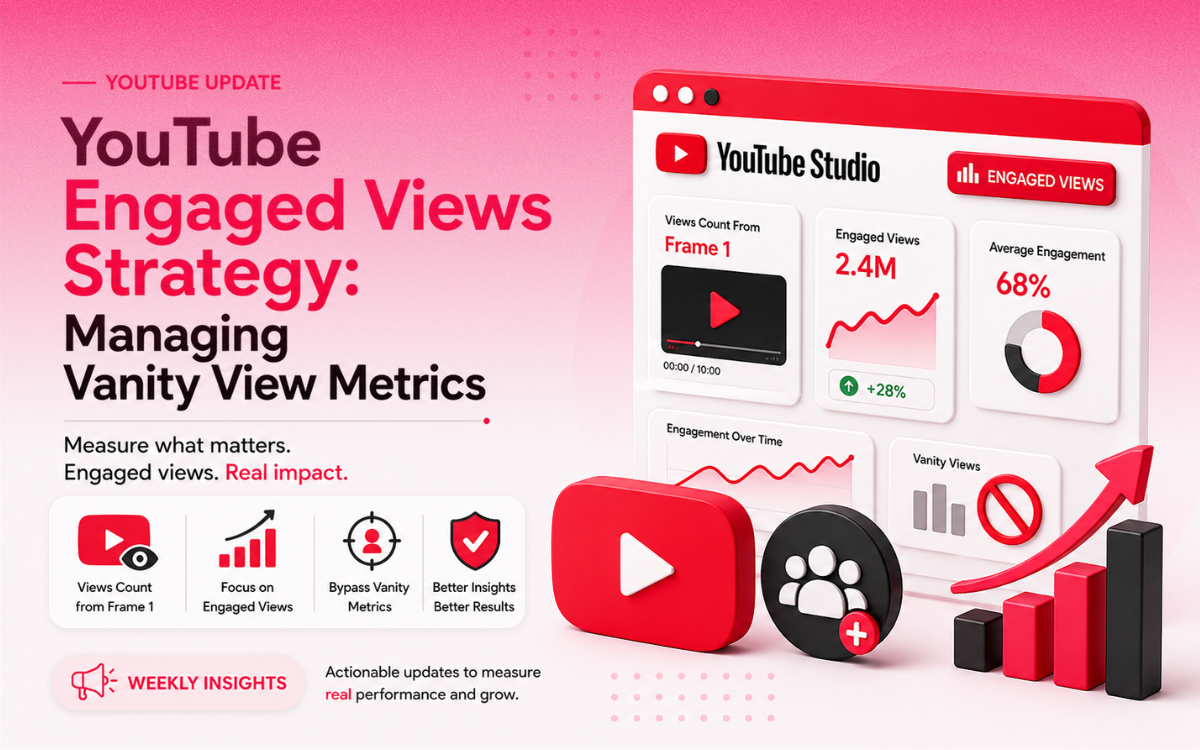
Welcome to the video performance insights hub by H2T Media Group. Strategizing around YouTube Engaged Views is now a mandatory requirement for Chief Marketing Officers (CMOs) and Media Buyers adjusting to YouTube’s latest algorithm updates. With public view counts transitioning to an exposure-based model registered at Frame 1, surface numbers are artificially inflating, creating major data noise for actual ROI evaluation.
Below, H2T Media Group breaks down the mechanics of Frame 1 view counting, the separation of public metrics from revenue mechanics, a framework for renegotiating creator SLA contracts, and visual/audio hook optimization tactics. Read the full analysis below with H2T Media Group to restructure your performance marketing pipeline and protect campaign profitability.
 Key Takeaways
Strategizing around YouTube Engaged Views is now a mandatory operational requirement for CMOs and Media Buyers adapting to YouTube’s Frame 1 exposure-based view calculation update.
Essential Facts About This Update
- Frame 1 Rule: Public views are now triggered at Frame 1 without minimum watch-time thresholds, creating superficial view inflation across long-form, Shorts, and Live formats.
- Financial Protection: Google Ads CPV billing and YPP watch-time criteria remain unchanged, ensuring ad budgets are protected from accidental autoplay views.
- YouTube Engaged Views: The new benchmark in YouTube Analytics filters out passive bounces to track real, intentional consumer engagement.
- First-3-Second Hooks: Instant bounces negatively signal the distribution algorithm; high-impact visual and audio engineering in the first 3 seconds is mandatory to convert impressions into engaged views.
- SLA Restructuring: Influencer and agency contracts must pivot from “Total Public Views” to “YouTube Engaged Views” with a minimum 35–50% Average View Duration (AVD) threshold.
1. Technical Anatomy: Synchronizing Cross-Platform Exposure Architectures
The modification in YouTube’s view calculation methodology does not signify a systemic error; rather, it represents a calculated strategic initiative designed to standardize impression metrics across the entire digital video ecosystem.
1.1. The Eradication of Minimum Watch-Time Thresholds
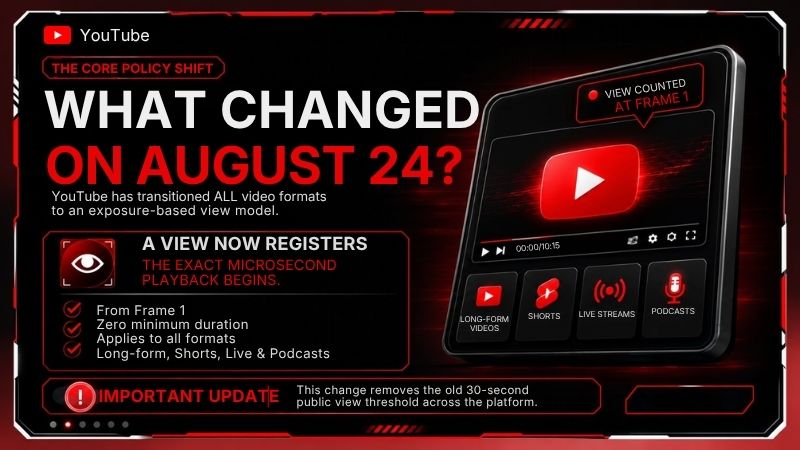
For years, YouTube maintained a strict internal technical barrier (frequently estimated by industry experts to be around the 30-second mark for long-form content) before the system officially validated a public view. This mechanism was engineered to combat view-botting algorithms and ensure high-quality engagement.
However, with this update, YouTube universally applies the “Frame 1” rule across all available formats: Long-form, Live Streams, Podcasts, and Shorts. Any video that initiates an Autoplay sequence on a mobile homepage, or triggers a Hover-to-Play action on a desktop interface, immediately increments the public view counter.
1.2. Algorithmic Parity with TikTok and Meta Reels
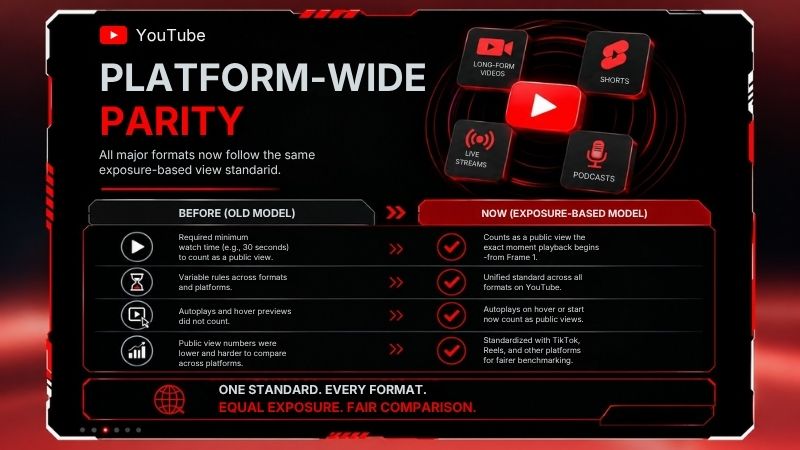
This operational pivot resolves a long-standing measurement discrepancy that plagued Media Planners. On TikTok and Meta Reels, an autoplay impression is instantaneously classified as a view. This structural disparity historically caused the reach reports of short-form content on TikTok to appear overwhelmingly superior to YouTube long-form content, despite YouTube audiences demonstrating significantly higher actual attention spans. By adopting the Frame 1 standard, YouTube establishes a unified “Top-of-funnel impression baseline,” empowering enterprise brands to mathematically compare cross-platform reach scaling with verifiable equity.
2. The Financial Ecosystem: The Segregation of Public Metrics and Actual Revenue
The primary apprehension among creators and Media Buying Organizations is that massive view inflation will unilaterally disrupt advertising cost structures. YouTube has proactively established stringent technical guardrails to prevent this financial instability.
2.1. Google Ads CPV Billing Mechanics Remain Unaltered
The public view counter and the Google Ads billing system operate on two entirely independent data pipelines.
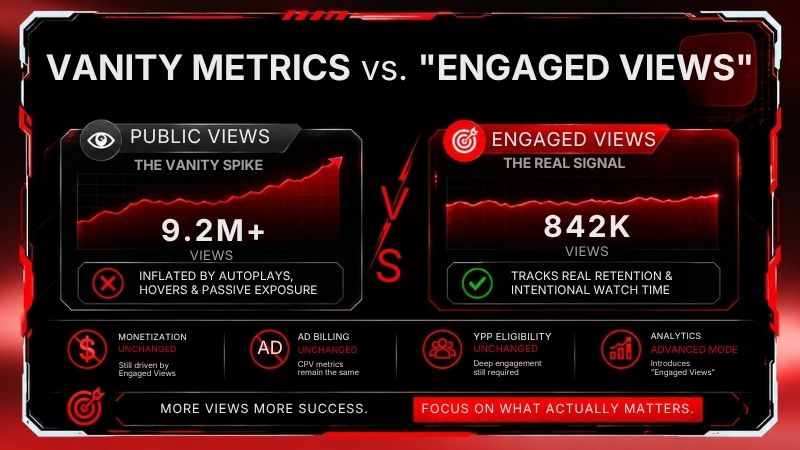
If your agency is deploying Skippable In-stream Video campaigns, the Cost-Per-View (CPV) billing mechanism strictly adheres to legacy protocols. Google Ads only executes a financial charge when a user consumes 30 seconds of the advertisement (or the entire duration if the asset is shorter than 30 seconds) or when they execute a direct click-through action. The phenomenon of an ad auto-playing for two seconds—triggering a public view under the new rules—will not result in a financial deduction from the advertiser’s budget.
2.2. YouTube Partner Program (YPP) Eligibility
Similar to paid advertising infrastructures, organic monetization criteria rigorously protect advertising integrity. Accumulating millions of superficial views via the Autoplay function will not automatically propel a channel past the 4,000 public watch hours threshold required to activate monetization. YouTube’s internal financial architecture still mandates genuine, verifiable user retention.
3. The New Paradigm: YouTube Engaged Views as the Core Metric
When public-facing view tallies devolve into a pure “Vanity Metric,” performance-driven agencies require a sophisticated instrument to measure the actual depth of consumer interaction.
3.1. The Introduction of the YouTube Engaged Views Metric
To resolve the impending data fragmentation, the platform has integrated a net-new data benchmark into YouTube Analytics Advanced Mode, designated as YouTube Engaged Views.
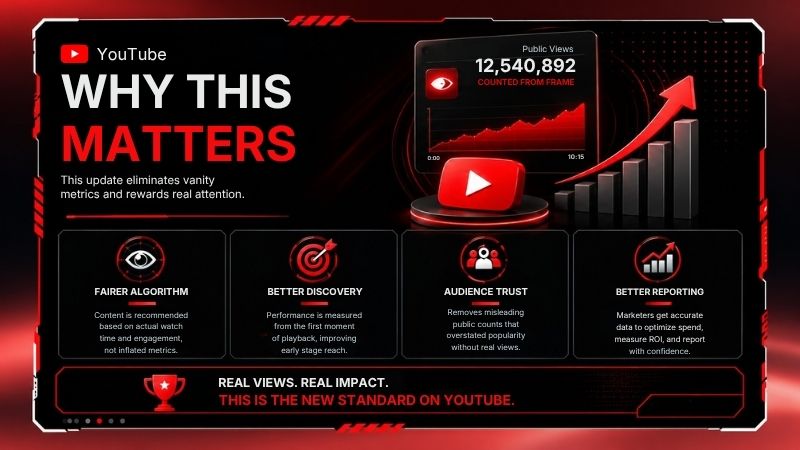
The YouTube Engaged Views metric functions as a highly precise technical filter. It automatically strips away all passive exposures, accidental scroll-bys, and instant bounces from the data pool. This metric exclusively registers viewing sessions where the user demonstrates a definitive, intentional desire to consume the content by sustaining their retention past a specific, algorithmic time threshold.
3.2. Restructuring Return on Investment (ROI) Reporting
The emergence of YouTube Engaged Views forces Marketing Managers to fundamentally reconstruct their performance dashboards. Presenting a report to the Executive Board stating, “Our video campaign achieved 5 million views,” no longer conveys quantitative performance value. Advanced analytical reports must now utilize YouTube Engaged Views as the denominator to accurately calculate true Click-Through Rates (CTR), Cost Per Quality View (CPQV), and Bottom-of-Funnel Conversion Rates (CVR).
4. Restructuring Production Pipelines: Weaponizing the First 3 Seconds
From a content operations perspective, the reality that a view is registered at Frame 1 dictates that the tolerance for production errors is now reduced to zero.
4.1. The Repercussions of Instant Bounce Rates
Historically, if a user viewed an asset for five seconds and exited, the system did not classify it as a view; consequently, it did not severely impact the video’s underlying quality score.
Currently, when a user encounters an autoplaying video, the system registers one view. If the user scrolls past immediately at the two-second mark, the system logs this as a view possessing catastrophic retention. Accumulating thousands of instant bounces transmits a severe negative signal to the distribution algorithm, rapidly degrading Channel Authority and suppressing the probability of securing organic recommendations.
4.2. Advanced Hook Optimization Strategy
Creative teams are now mandated to ruthlessly eliminate traditional cinematic intros, prolonged animated logos, or slow-paced establishing shots.
The initial three seconds of the video must operate as a razor-sharp “Hook.”
- Visual Engineering: Demands aggressive motion and dynamic camera angle shifts precisely within Frame 1.
- Audio Engineering: The initial spoken sentence must explicitly identify the consumer’s primary pain point or directly summarize the asset’s core value proposition.
The Technical Objective: Force a passive impression to transform into a validated YouTube Engaged View fractions of a second before the user finalizes their decision to scroll past the content.
5. The H2T Media Group Risk Management Framework
For global sponsorship campaigns and extensive Key Opinion Leader (KOL/Influencer) contracts, the artificial inflation of surface views requires immediate legal and evaluative recalibration. H2T provides a standardized 3-step operational framework:
| Operational Category | Vulnerability Stemming from Frame 1 Counting | H2T Technical Execution Solution |
|---|---|---|
| Sponsorship Contracts (SLA Agreements) | Creators report KPI completion based on inflated public views. Enterprises disburse premium payments but acquire zero down-funnel conversions. | Contract Revision: Transition acceptance KPIs from “Total Public Views” strictly to the YouTube Engaged Views metric, mandating that the Average View Duration (AVD) must secure a minimum threshold of 35-50%. |
| Third-Party API Auditing | External KOL evaluation tools (e.g., SocialBlade, NoxInfluencer) scrape public API data, displaying artificially inflated creator influence profiles. | Do not place 100% reliance on third-party scrapers. Demand that Creators provide Read-Only access to their YouTube Studio backend, or supply verifiable screenshots of their actual YouTube Engaged Views data prior to finalizing budget disbursement. |
| Media Buying Budget Allocation | Optimizing campaigns based on generalized CPA/CPV metrics leads to erroneous budget allocation toward ad formats generating high accidental click rates. | Systematically exclude display placements prone to generating passive, spontaneous views. Concentrate bidding architecture on the YouTube Search network to harvest high-intent, deterministic commercial queries. |
6. Frequently Asked Questions
YouTube Engaged Views is an analytics metric that filters out passive autoplay exposures and instant bounces, measuring only intentional viewing sessions where users actively engage with the video past a specific retention threshold.
No. Google Ads CPV billing operates on an independent data pipeline. Advertisers are only charged when a user watches 30 seconds of the ad (or the full duration if shorter) or interacts with it, so accidental autoplay views do not impact your budget.
Since a public view is logged instantly at Frame 1, a user scrolling away within 2 seconds creates an immediate bounce. Accumulating high volumes of instant bounces sends severe negative retention signals to YouTube’s recommendation algorithm, lowering organic reach.
Agencies should pivot KPI evaluation from “Total Public Views” to YouTube Engaged Views and mandate a minimum Average View Duration (AVD) threshold of 35–50% to ensure media spend delivers actual engagement.
Navigating YouTube’s shift to Frame 1 view counting requires a decisive pivot toward YouTube Engaged Views to eliminate vanity data and safeguard campaign profitability. By restructuring creator SLA contracts around genuine retention and optimizing the critical first 3 seconds of video content, enterprise marketing teams can effectively filter out passive noise and maximize real ROI. Explore more in-depth operational frameworks and performance marketing strategies in the YouTube category of the Insights hub on the official H2T Media Group website to stay ahead of platform updates and scale your brand’s video ecosystem.

bichthao
H2T Media Group decodes every meaningful platform update for advertisers and affiliate partners across APAC, EU and North America — always with a practical "H2T take" you can act on.
More about H2T →