

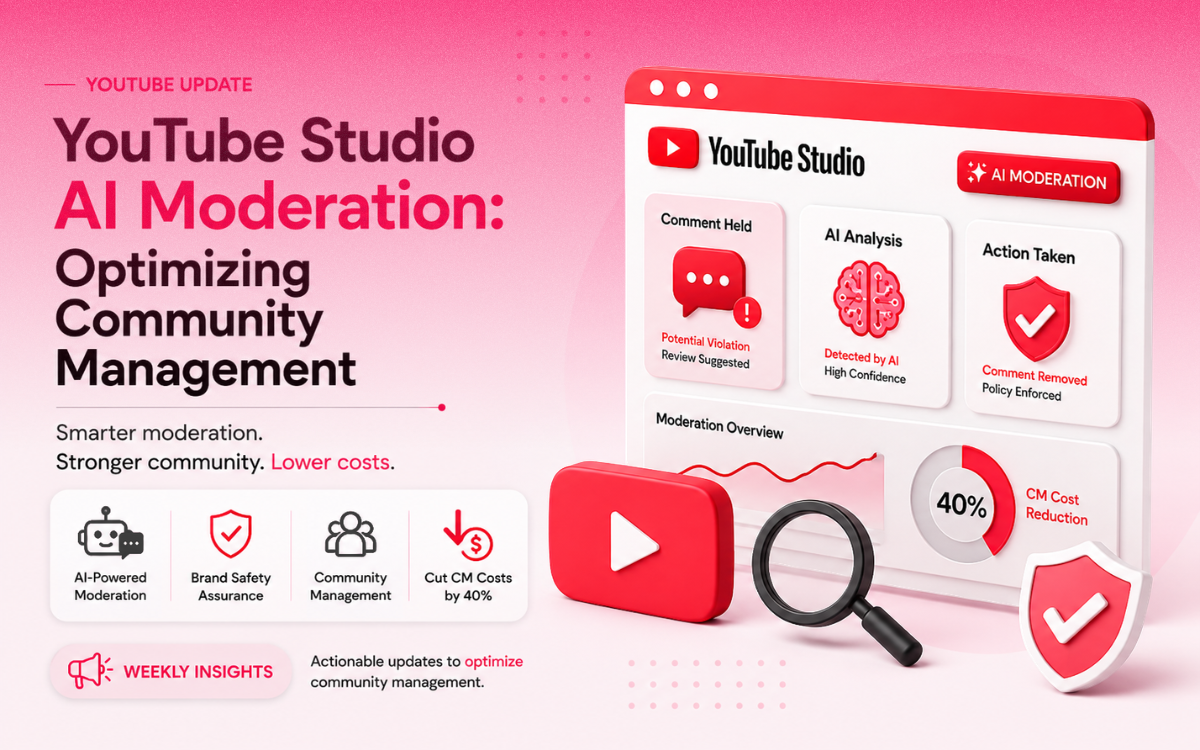
Welcome to the YouTube performance insights hub by H2T Media Group. The YouTube Studio AI moderation update introduces advanced semantic search capabilities to YouTube comment management, officially replacing rigid exact-match keyword filtering with natural language context processing. If your enterprise or Agency handles high-traffic video channels receiving thousands of daily interactions, relying on legacy string-matching filters inflates operational overhead and leaves your brand vulnerable to unmanaged engagement risks.
Below is H2T’s technical analysis of the structural shift, its financial impact on Community Management labor costs, and a practical Human-in-the-Loop framework to secure your brand safety – read on with H2T Media Group to optimize your community operations today.
 Key Takeaways
YouTube Studio AI Moderation replaces rigid exact-match keyword filters with advanced Semantic Search processing, completely reshaping enterprise Community Management workflows.
Essential Facts About This Update
- 100-Character Semantic Queries: Moderators can input natural language search queries to filter comments by conceptual meaning rather than exact word matches.
- Intent-Based Batching: The “Find Similar Comments” feature automatically clusters contextually identical interactions for rapid bulk actions.
- 40% Overhead Reduction: Automated intent sorting cuts labor hours on high-traffic channels by eliminating manual processing of low-value comments.
- Diagnostic Safeguards: YouTube’s AI tools sort and diagnose comments but do not autonomously auto-delete content, preventing accidental removal of constructive feedback.
- Human-in-the-Loop Imperative: AI handles large-scale intent triage and clustering, while human specialists establish initial search parameters, verify spam checks, and craft personalized conversion responses.
1. The Obsolescence of String-Matching Moderation Systems
Before examining the capabilities of the new YouTube Studio AI moderation tools, operations managers must understand the technical limitations of legacy systems that artificially inflated CM labor costs.

1.1. Technical Barriers in Processing Context and Nuance
Legacy systems operated entirely on String-matching mechanics. Administrators were required to manually input hundreds of specific words into exclusion lists. However, this architectural approach is mathematically incapable of processing complex natural language variations:
- Sarcasm Detection Failure: When a user comments, “Brilliant service, only took 3 weeks to arrive,” positive keyword filters (like “Brilliant”) incorrectly categorize the text as positive feedback, entirely missing the consumer’s actual frustration.
- Subtle Negativity: Comments containing unsolicited appearance critiques or subtle negative sentiment regarding a product frequently avoid explicit profanity or standard banned keywords, rendering old filtering systems useless.

1.2. The Hidden Operational Overhead of Keyword Databases
For global brands, maintaining expansive keyword exclusion lists across multiple markets and languages constitutes a significant financial drain. Whenever a new product line is launched or a synchronized spam wave occurs, the CM team must manually audit and update the keyword database. This manual maintenance generates severe latency in handling micro-PR crises on the platform.
2. Technical Analysis: The YouTube Studio AI Moderation Update
The new YouTube Studio AI moderation architecture neutralizes these barriers by integrating Natural Language Processing (NLP) and precise Intent Analysis. Below are the three core architectural upgrades.
2.1. 100-Character Natural Language Queries
The most significant operational shift is the transition from “Keywords” to “Semantic Search.” YouTube now permits administrators to input natural language queries up to 100 characters in length.
The system no longer searches for exact string matches; it scans for conceptual meaning. For example: Instead of managing a list containing “price,” “cost,” or “expensive,” a moderator simply inputs the query: “Questions relating to product pricing.” The AI scans thousands of comments and returns results based on semantic similarity, successfully capturing queries containing slang or misspellings.
2.2. Intent-Based Batching and Clustering
This feature serves as a high-velocity bulk processing tool. Accessible via the three-dot menu, the “Find Similar Comments” function utilizes AI to anchor a specific comment and automatically cluster all contextually identical comments into a singular batch. This allows the CM team to process hundreds of uniform responses (e.g., repetitive questions regarding technical specifications) with a mere three clicks, eliminating the necessity to read and respond to individual lines of text.

2.3. AI-Suggested Thematic Categorization
In addition to custom querying, the YouTube Studio AI moderation system provides pre-built filters based on sentiment classification. The AI autonomously segregates the comment section into broad behavioral buckets such as “Excitement and Enthusiasm” or “Negative Feedback.” This localized data grants Chief Marketing Officers (CMOs) an immediate, quantifiable overview of market sentiment following a major campaign asset release.
3. Operational Impact on Global E-Commerce and B2B Channels
Within Performance Marketing architectures, the YouTube comment section is not merely an engagement zone; it acts as a primary hub for customer service and Lead Nurturing.

3.1. Cutting 40% of Community Management Labor Costs
Empirical data testing indicates that deploying the YouTube Studio AI moderation workflow reduces average labor hour expenditures by 40% for high-traffic channels (exceeding 10,000 comments/day).
By eliminating the manual requirement to read zero-value comments (e.g., standalone emojis, meaningless greetings), operations teams can dedicate 100% of their bandwidth to addressing conversion-driven queries originating from highly qualified, high-intent buyers.
3.2. Managing Affiliate and Influencer Networks
When enterprises execute campaigns coordinating with dozens of Key Opinion Leaders (KOLs), the volume of community feedback spikes exponentially. Utilizing Manager Access combined with AI semantic grouping enables Agencies to synchronize moderation quality across multiple independent video assets, ensuring the brand’s positioning messaging remains uniform at a global scale.
4. The H2T Risk Management Framework: The “Human-In-The-Loop” Mechanism
While Artificial Intelligence delivers undeniable velocity, full automation in community management inherently risks destroying Brand Integrity. H2T Media Group mandates that organizations enforce a strict “Human-in-the-Loop” supervision mechanism when deploying this update.
4.1. The Diagnostic Nature of the Tools
The fundamental feature that renders the YouTube Studio AI moderation system safe for enterprise application is its operational parameter: The tools are strictly diagnostic and sorting-focused. They do not possess autonomous auto-delete capabilities.
This architectural safeguard protects the enterprise from “False Positives” – scenarios where the AI misclassifies a legitimate, constructive customer complaint as malicious negativity requiring suppression. Auto-deleting legitimate friction points severely damages consumer trust metrics.
4.2. Hybrid Supervision Workflow Matrix
| Operational Phase | Artificial Intelligence (AI) Execution | Human Specialist Execution |
|---|---|---|
| Triage Phase (Initial Sorting) | Utilizes semantic search queries to scan and cluster 10,000 comments into distinct intent buckets (Pricing inquiries, Complaints, Tech Support). | Establishes the specific natural language queries based on the precise business objectives of the active campaign. |
| Spam/Troll Management Phase | Aggregates all comments containing disruptive behavior, subtle appearance critiques, or malicious link spam. | Executes randomized spot-checks to ensure accuracy prior to executing bulk “Hide user from channel” commands. |
| Conversion Response Phase | Filters and highlights the cluster of comments containing direct purchase-intent questions (Shipping timelines, warranties). | Directly drafts highly personalized responses. Tactfully resolves customer friction points in the public forum to actively increase community trust. |
5. Frequently Asked Questions
It is YouTube’s upgraded comment moderation framework powered by Semantic Search, allowing administrators to filter and categorize comments based on conceptual intent rather than exact word matches.
No. The system functions purely as a diagnostic and sorting tool, grouping contextually similar comments so moderators can review and manage them manually.
While AI provides high-speed sorting across thousands of interactions, human operators are still essential for setting initial search queries, verifying spam filters, and engaging with high-intent leads to drive conversions.
Empirical testing shows that leveraging intent-based search workflows reduces Community Management labor hours by up to 40% on high-traffic channels.
YouTube’s semantic search upgrade proves AI is transforming community operations. Deploying YouTube Studio AI moderation removes rigid keyword boundaries, maximizing efficiency while protecting brand safety through a “Human-in-the-Loop” workflow. Discover more technical guides and performance strategies in the YouTube category within the main Insights page on the official H2T Media Group website.

bichthao
H2T Media Group decodes every meaningful platform update for advertisers and affiliate partners across APAC, EU and North America — always with a practical "H2T take" you can act on.
More about H2T →