

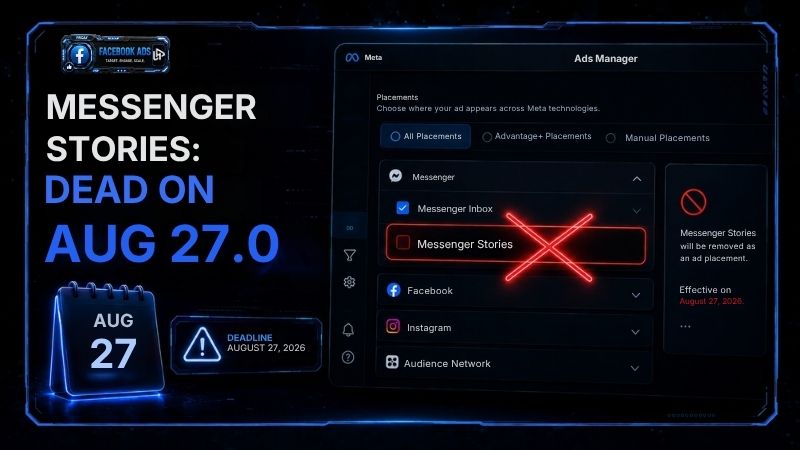
Welcome to the Meta/Facebook performance insights hub by H2T Media Group. Effective August 27, 2026, Meta removes Messenger Stories from its global roster of ad placements to eliminate low-intent “fat-finger” clicks, forcing automated bidding algorithms to reallocate budgets into high-conversion real estate like Reels and Instagram Stories.
If your enterprise relies on Advantage+ or manual placement campaigns, adjusting your ad architecture now is essential to prevent wasted spend and preserve backend ROAS. Below is H2T Media Group‘s technical analysis and operational framework to help you navigate this transition smoothly – read on to discover how to optimize your media buying strategy today.
 Key Takeaways
Meta Deprecates Messenger Stories ad placement globally to eliminate accidental, zero-intent clicks and focus ad liquidity on high-converting inventory.
Essential Facts About This Update
- Purging “Junk Inventory”: Messenger Stories drove bounce rates above 90%–95% and inflated CTR through “fat-finger” clicks without generating actual conversions.
- Advantage+ Algorithmic Impact: Severing cheap Messenger Stories impressions forces machine learning algorithms to invest in high-attention placements like Reels and IG Stories.
- Short-Term CPM Volatility: Expect a temporary contraction in available impression supply and mild CPM inflation across Reels/Feeds during the initial 2-to-3-week transition.
- Shift from Blended Metrics: Agencies must stop relying on superficial blended CTRs and evaluate placement efficiency purely on bottom-of-funnel Return on Ad Spend (ROAS).
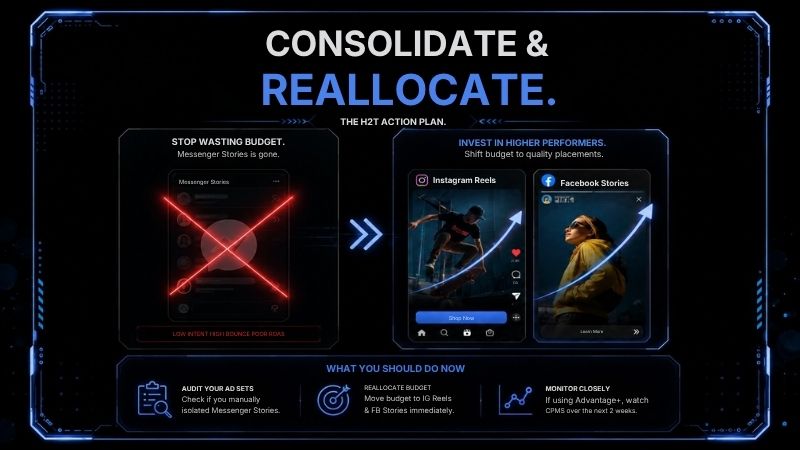
- Actionable Migration Checklist: Reallocate manual campaigns targeting Messenger Stories immediately to new ad sets; automated Advantage+ placements will optimize liquidity autonomously.
1. Why Meta Removes Messenger Stories: Technical Anatomy and Placement Flaws
To comprehend why the deprecation of Messenger Stories represents a positive operational shift, Media Buyers must analyze the severe discrepancy between the Top-of-Funnel interaction metrics and the Bottom-of-Funnel conversion data generated by this specific placement.
1.1. User Behavior and the “Fat-Finger” Anomaly
Messenger functions inherently as a private, closed-network communication utility. Users access this platform with a strict, task-oriented mindset: to read direct messages, respond to workplace communications, or converse with peers. They are not operating within a mindset conducive to content discovery or commercial purchasing.
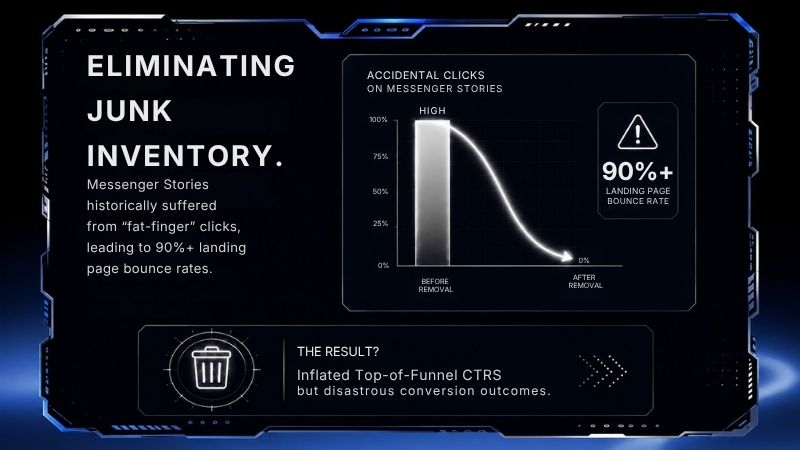
When a full-screen advertisement abruptly interrupts the sequence of peer-to-peer stories within Messenger, the immediate neurological reflex of the user is to swipe past or close the interface. The rapid navigational speed within a confined UI inevitably results in a phenomenon known as “Fat-finger clicks” (Accidental clicks). This generates a massive volume of registered clicks within the Meta Ads Manager, artificially inflating the Click-Through Rate (CTR). Crucially, these are “Zero-intent” interactions.
1.2. The Collapse of Landing Page Metrics (Bounce Rates)
The technical fallout of these accidental clicks becomes glaringly apparent upon analyzing destination measurement platforms, such as Google Analytics 4 (GA4).
When a user inadvertently triggers a Messenger Stories ad, the in-app browser initializes, prompting the user to immediately tap the “X” (close) button, often within a fraction of a second. This mechanical action generates massive influxes of ghost traffic.
- Landing Page Bounce Rates originating from Messenger Stories consistently exceed the 90% – 95% threshold.
- Time on Site / Session Duration registers at near-zero seconds.
- Cost Per Acquisition (CPA) metrics for this placement historically track at 5x to 10x higher than premium inventory such as the Facebook Feed or Instagram Reels.
Continuing to inject budget into this placement merely serves to dilute tracking Pixel data, polluting Retargeting Pools with highly unqualified, low-intent users.
2. Structural Impact on the Advantage+ Machine Learning Algorithms
This inventory deprecation exerts its most profound operational impact on campaigns utilizing automated distribution models, specifically Advantage+ Placements and Advantage+ Shopping Campaigns (ASC).
2.1. How Machine Learning Exploited Cheap Inventory
The foundational objective of Meta’s delivery algorithm is to secure the lowest-cost impressions capable of generating a designated outcome. Because the Messenger Stories placement suffered from a severe lack of advertiser demand (due to poor historical performance), the baseline CPM (Cost Per Mille) in this auction environment remained exceptionally low.
Historically, when an advertiser enabled Advantage+ Placements, the algorithm would occasionally inject a percentage of the budget into Messenger Stories to mathematically lower the blended average CPM of the entire campaign. The reporting interface presented the illusion of highly efficient spend, whereas, in reality, capital was being liquidated within an environment incapable of producing scalable ROI.
2.2. Algorithmic Forced Optimization
By autonomously severing the Messenger Stories placement from the network architecture, Meta has permanently eliminated a significant noise variable from its machine learning training models.
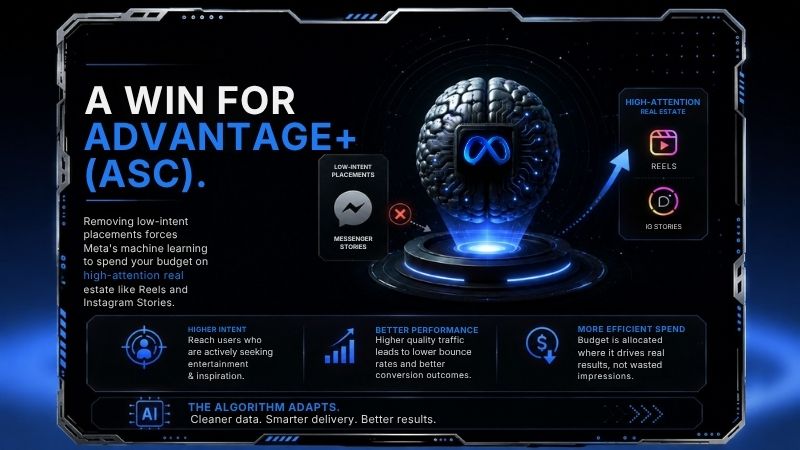
Post-August 27, 2026, the Advantage+ algorithm loses access to this “cheap spend” outlet. The system is therefore forced to reallocate that liquidity into high-attention, high-value digital real estate—predominantly Instagram Reels, Facebook Reels, and Instagram Stories. While this consolidation may induce a marginal increase in baseline CPMs, it guarantees that capital expenditure is strictly confined to environments where users exhibit genuine content consumption intent and conversion viability.
3. Financial Management: Recalibrating Reporting Metrics
Meta’s initiative to purge low-quality ad placements requires Chief Marketing Officers (CMOs) and operational leads to fundamentally recalibrate their performance evaluation frameworks.
3.1. The Obsolescence of Blended Click-Through Rates (CTR)
Numerous legacy campaign reports continue to rely on blended CTR as the primary metric for evaluating creative efficacy. However, when specific placements exhibit such extreme disparities in user intent, a blended CTR becomes a pure vanity metric. Achieving a 3% CTR driven by accidental Messenger Stories clicks possesses zero commercial value compared to a 1% CTR generated on IG Reels that converts into tangible revenue. This structural update forces agencies to abandon surface-level engagement metrics and evaluate placement efficacy strictly through the lens of Bottom-of-Funnel Return on Ad Spend (Backend ROAS).
3.2. Forecasting Short-Term Cost Volatility
When a display environment is deprecated, the aggregate supply of available impressions across the Meta network undergoes a fractional contraction. According to standard auction dynamics, if supply decreases while advertiser demand (budget) remains constant, the competition density within the remaining placements (Reels, Feeds) will intensify. Media Buying teams must prepare for mild CPM inflation during the initial 2-to-3-week transition period following the enforcement deadline, before the auction ecosystem naturally restabilizes.
4. The H2T Media Group Emergency Operations Checklist
To guarantee uninterrupted ad delivery and maximize capital efficiency prior to the August 27, 2026 deadline, media buyers must execute the following Technical Checklist across all active portfolios:
| Current Campaign Architecture | Systemic Impact of the Update | Mandatory Technical Action Plan |
|---|---|---|
| Manual Placement Campaigns explicitly targeting ONLY Messenger Stories | Ad delivery will suffer a hard stop. Spend will drop to zero on August 27. | Halt the campaign immediately. Construct a net-new ad set and reallocate the localized budget exclusively to Facebook/Instagram Stories and Reels formats. Do not edit the legacy campaign to prevent machine learning data fragmentation. |
| Manual Placement Campaigns targeting multiple networks (including Messenger Stories) | Delivery continues, but the budget percentage allocated to Messenger Stories will remain unspent. | Conduct a Placement Audit. Manually uncheck the Messenger Stories integration today. Monitor the campaign’s Cost Per Acquisition (CPA) variance over the subsequent 48-hour window. |
| Advantage+ Placements (Fully Automated Distribution) | The algorithm will autonomously recognize the deprecation and reroute liquidity accordingly. | No manual intervention is required. However, closely monitor aggregate CPM metrics over the next 14 days. The elimination of accidental clicks will cause the blended CTR to decrease, but the destination Landing Page Conversion Rate (CVR) will exhibit a marked improvement. |
5. Frequently Asked Questions
Effective August 27, 2026, Meta permanently removes the Messenger Stories placement from Ads Manager globally.
The placement generated a high rate of accidental “fat-finger” clicks and 90%+ landing page bounce rates, failing to deliver real conversion value for advertisers.
The algorithm will automatically stop allocating budget to Messenger Stories and redirect liquidity into higher-converting placements like Reels and Instagram Stories.
Audit all active campaigns immediately, turn off standalone Messenger Stories ad sets, and create new ad sets targeting Facebook/Instagram Reels and IG Stories to protect backend ROAS.
In conclusion, Meta Deprecates Messenger Stories to purge low-intent “junk inventory” and restructure its display ecosystem around high-converting video surfaces like Reels and Instagram Stories. By eliminating accidental clicks, this update empowers automated bidding systems to optimize liquidity, forcing enterprise brands to prioritize genuine bottom-of-funnel ROAS over inflated vanity metrics. To protect your media efficiency and smoothly execute this campaign migration, explore more expert guides and technical analyses in the Meta category under the Insights section on the official H2T Media Group website today.

bichthao
H2T Media Group decodes every meaningful platform update for advertisers and affiliate partners across APAC, EU and North America — always with a practical "H2T take" you can act on.
More about H2T →