

Google AI Mode SEO impact is a measurement question, not proof that organic search has collapsed. Alphabet reported 12% year-over-year growth in Google Search & other revenue in Q3 2026 while acknowledging that AI Mode’s lower monetization contributed to slower growth.
This H2T Media Group analysis separates confirmed earnings data from SEO implications and shows which visibility, traffic, and business metrics to review next.

Key Takeaways
Alphabet reported 12% year-over-year Google Search & other revenue growth in Q3 2026. AI Mode lower monetization was a contributing factor to deceleration, not evidence of a fall in total Search revenue.
Essential facts about Google AI Mode and SEO
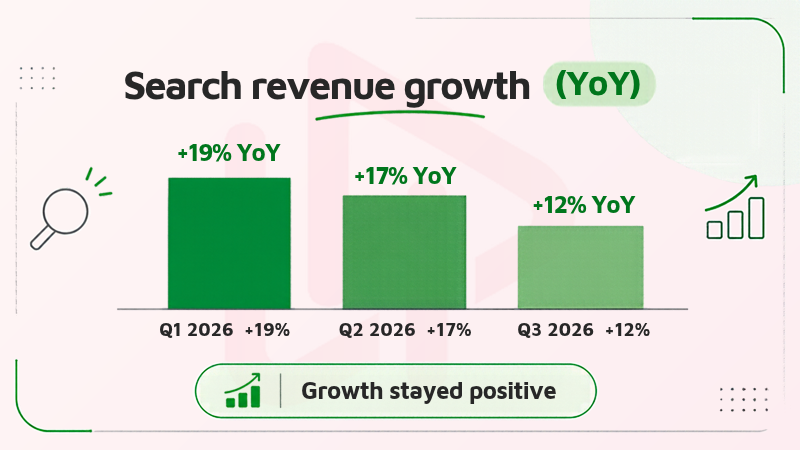
- Google Search & other revenue growth: 19% in Q1, 17% in Q2 and 12% in Q3 2026 (YoY).
- Alphabet identified foreign exchange as the largest Q2-to-Q3 deceleration factor.
- Google’s similar-CTR observation covers sponsored and organic product list items in AI Mode, not all organic links.
- Search Console has a dedicated generative AI visibility report; impressions are not conversion attribution.
1. What Alphabet actually disclosed
The Q3 disclosure concerns Google’s advertising economics rather than a direct measurement of publisher traffic. Reading it accurately requires separating growth rates from revenue levels, then distinguishing Alphabet’s list of contributors from a quantified causal estimate. Those distinctions determine whether an SEO takeaway is evidence-based or merely a plausible hypothesis.
1.1. Growth slowed from 19% to 12%, but remained positive
Google Search & other recorded year-over-year revenue growth of 19% in Q1, 17% in Q2 and 12% in Q3 2026. The sequence describes a slower growth rate, not three successive declines in revenue. Alphabet said Q3 Search revenue was approximately $63 billion, a positive 12% comparison with the same quarter a year earlier.
| Quarter | Search & other revenue growth | Comparison |
|---|---|---|
| Q1 2026 | +19% | Year over year |
| Q2 2026 | +17% | Year over year |
| Q3 2026 | +12% | Year over year |
Read more:
Alphabet Investor Relations — Q1 2026 earnings call
Alphabet Investor Relations — Q2 2026 earnings call
Alphabet Investor Relations — Q3 2026 earnings call
1.2. FX was the largest cited deceleration driver
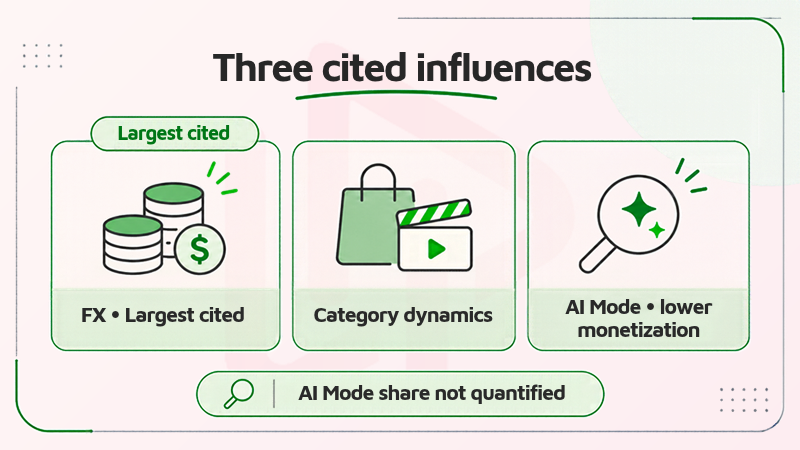
In its Q3 earnings discussion, Alphabet identified foreign exchange (FX) as the single largest driver of the slower growth rate versus Q2. It also cited changes in advertising spend across retail and media and entertainment. Philipp Schindler then noted that rapid AI Mode query growth affected Search growth because AI Mode was monetizing at a lower level.
Alphabet did not publish a standalone percentage-point estimate for the AI Mode effect. Subtracting 12% from 17% and labeling the full five-point difference “AI Mode losses” would incorrectly assign a multi-factor result to one cause.
Read more:
Alphabet Investor Relations — Q3 2026 earnings call
2. Why AI Mode monetization is not an organic traffic metric
Monetization captures how Google generates advertising revenue from Search activity. SEO performance concerns how frequently a site appears, whether people visit, and whether those visits create useful outcomes. These are linked parts of the search ecosystem, but they are measured with different denominators and cannot be exchanged for one another.
2.1. AI Mode changes the shape of search demand
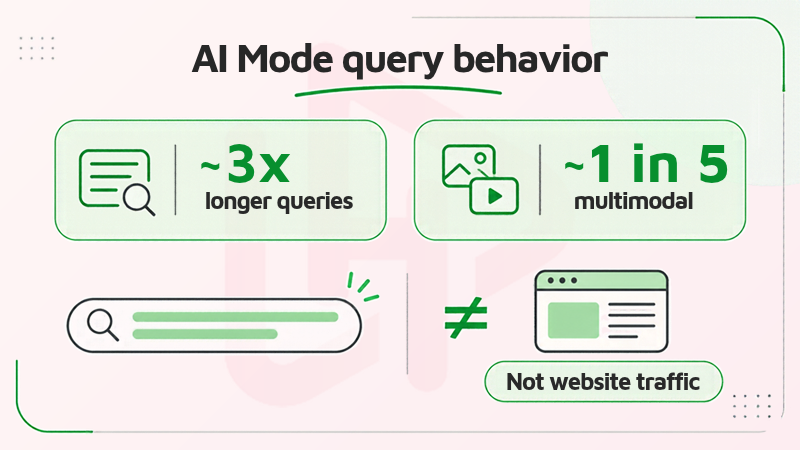
Alphabet reported that AI Mode queries are about three times as long as traditional searches on average, while roughly one in five global AI Mode queries uses voice, images or documents. It also described its fastest year-over-year Search query growth in five years. Longer, multimodal questions can create additional opportunities for users to explore topics and products within Google’s interface.
That is a change in query behavior, not a measured decline in third-party website visits. The public earnings statement does not provide a representative site-level organic click-through rate, publisher traffic loss figure or AI Mode-to-conversion attribution dataset.
Read more:
Alphabet Investor Relations — Q3 2026 earnings call
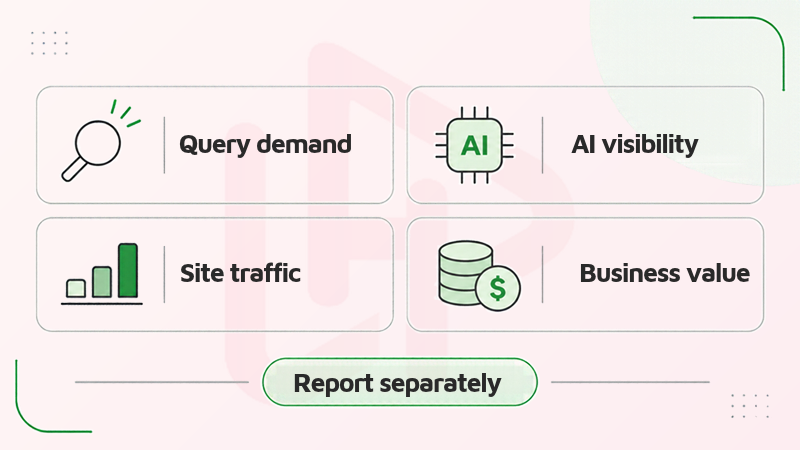
2.2. Four questions belong in four separate reports
A site owner should distinguish query demand, AI-result visibility, visits to the site, and business outcomes. A page may be mentioned in an AI result without receiving a click, while another page may attract fewer visits but produce more qualified leads. Neither scenario can be inferred from Alphabet’s revenue growth alone.
- Query demand: how search behavior and user questions are changing.
- AI visibility: which URLs appear in AI-enhanced results.
- Site traffic: sessions and engaged landing-page visits.
- Business value: qualified leads, pipeline, transactions, and revenue.
For adjacent technical background, review H2T Media Group’s AI-first SEO architecture analysis. That evergreen article addresses technical readiness; this Q3 update addresses what can actually be inferred from Alphabet’s financial disclosure.
3. What Google’s similar-CTR claim actually covers
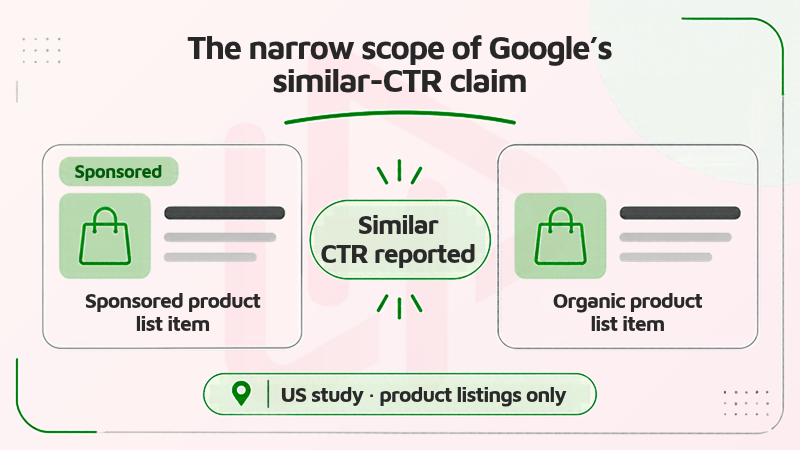
In its October 28 announcement, Google said click-through rates were already similar between sponsored and organic product list items within AI Mode. The footnote identifies internal Google data collected in the United States from August 20 through September 3, 2026. The statement is about a particular commerce presentation, not every organic citation, text link, or industry.
Google did not disclose absolute CTR values or establish identical performance. “Similar” must not be rewritten as “equal.” It also would be incorrect to claim that AI Mode’s sponsored and organic traffic across Search behaves identically, or that the result proves a universal increase or decline in SEO clicks.
For SEO managers, the appropriate response is to audit product-page visibility and commercial landing pages with their own first-party analytics. Treat the Google observation as a bounded platform statement – not a substitute for site-specific outcomes.
Read more:
Google Ads & Commerce — Ads in AI Mode expand to new markets
4. What Search Console can and cannot prove
Google introduced dedicated generative AI performance reports for Search Console in June 2026 and said rollout reached all websites worldwide by August 31. These reports add a visibility lens to normal Search data. They do not turn an impression into an identified user journey, and their dimensions should be interpreted in the context Google documents.
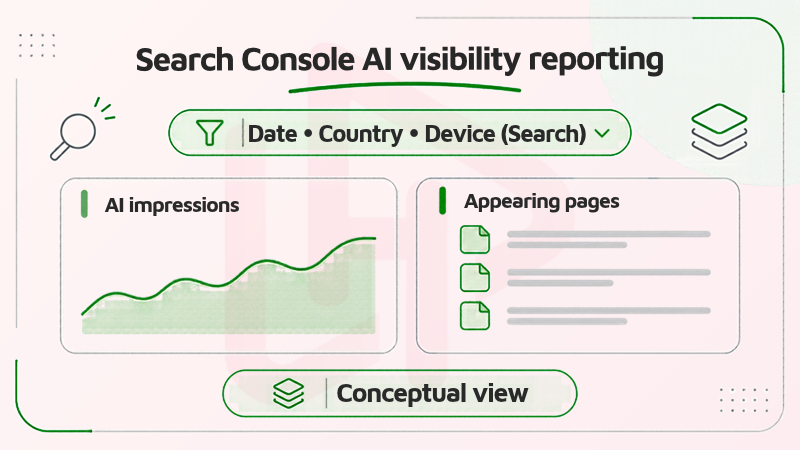
4.1. Track AI impressions and appearing pages
The dedicated views report impressions for generative AI features in Search, such as AI Overviews and AI Mode, and include reporting for generative features in Discover. Site owners can review pages and relevant dimensions, including country, date, and device, where supported. These views help identify which pages appear and whether visibility shifts over a comparable period.
AI-feature visibility should be monitored alongside the broader Performance report because the new view is not a separate traffic universe. For teams also diagnosing delayed indexing data, the H2T Media Group Search Console indexing audit explains why report freshness and actual URL status must remain separate observations.
Read more:
Google Search Central — Generative AI performance reports
Google Search Central — AI features and your website
4.2. Connect trends without inventing user-level attribution
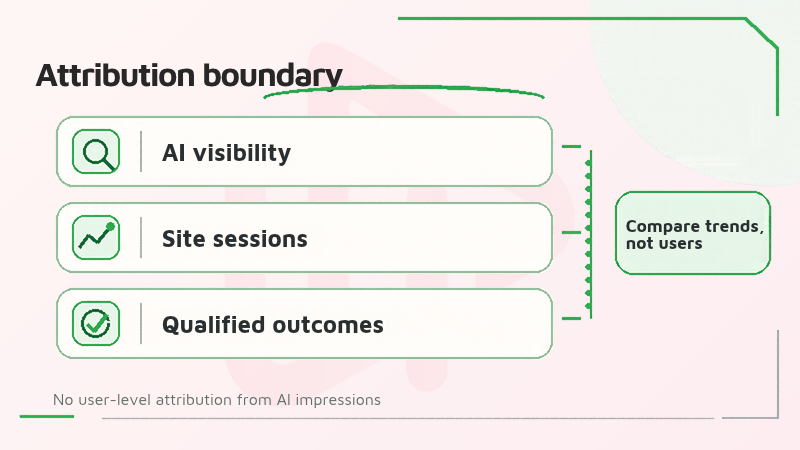
An AI impression is not an engaged session, lead, or transaction. Search Console and web analytics use different methods and scopes, so page-level changes should be compared by period and segment without claiming every AI impression can be connected to a specific conversion. When visibility rises, but business outcomes do not, that is a diagnostic prompt rather than proof of a causal loss.
Record site releases, seasonality, landing-page changes, and channel mix as possible confounders. Otherwise, an unrelated conversion dip may be incorrectly labeled an AI Mode effect. Analytics can help assess downstream traffic quality; CRM or ecommerce records are needed to evaluate qualified business outcomes.
5. An actionable SEO measurement framework
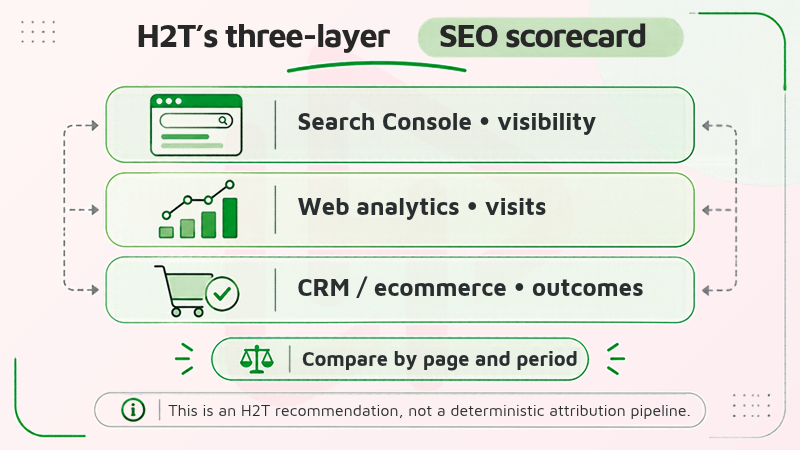
H2T Media Group recommends a three-layer operating model for organizations auditing Google AI Mode SEO impact. It aligns available platform visibility data with site behavior and commercial reporting, while explicitly avoiding the assumption that the tools provide direct person-level attribution. Use the model to prioritize investigations and decide what evidence would justify a content or technical change.
5.1. Build the three-layer scorecard
Review trends by page group, search intent, and consistent time windows. For news pages, compare periods with similar demand; for high-intent service or product pages, pair landing-page engagement with valid sales or lead-quality records. This scorecard is an H2T Media Group recommendation, not a Google-endorsed attribution system.
| Measurement layer | Primary signal | Interpretation boundary |
|---|---|---|
| Search Console | AI impressions; appearing pages | Exposure, not identifiable site visits |
| Web analytics | Landing-page sessions; engagement | Traffic quality, not causal AI attribution |
| CRM or ecommerce | Qualified leads; sales; revenue | Business outcomes with channel and data-quality limits |
5.2. Run a four-step audit before reallocating resources
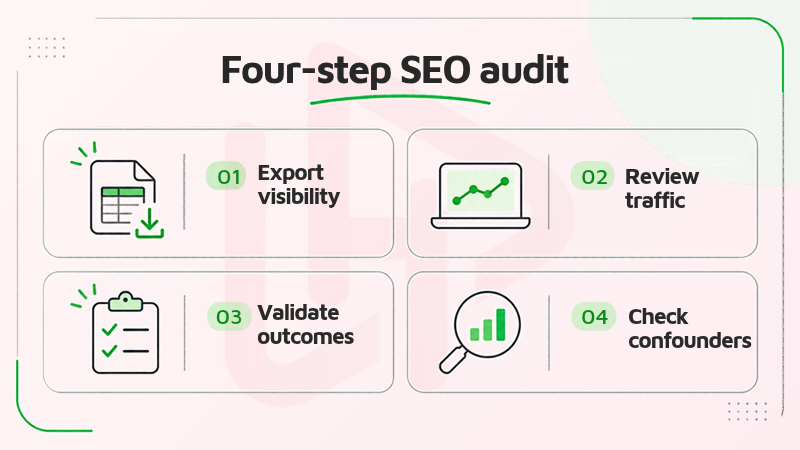
- Export AI visibility and appearing-page trends, marking the report date and supported dimensions.
- Compare priority landing-page traffic and engaged sessions across like-for-like periods.
- Validate which pages contribute qualified leads, sales, or pipeline using first-party records.
- Investigate content gaps, crawl/index issues, and major campaign or site changes before attributing a trend to AI Mode.
Document the confidence level of each finding: observed, inferred, or unresolved. A prioritized audit is more valuable than a single blended “AI SEO score,” because visibility, traffic, and business performance can move in different directions.
6. Keep SEO fundamentals stronger than AI shortcuts
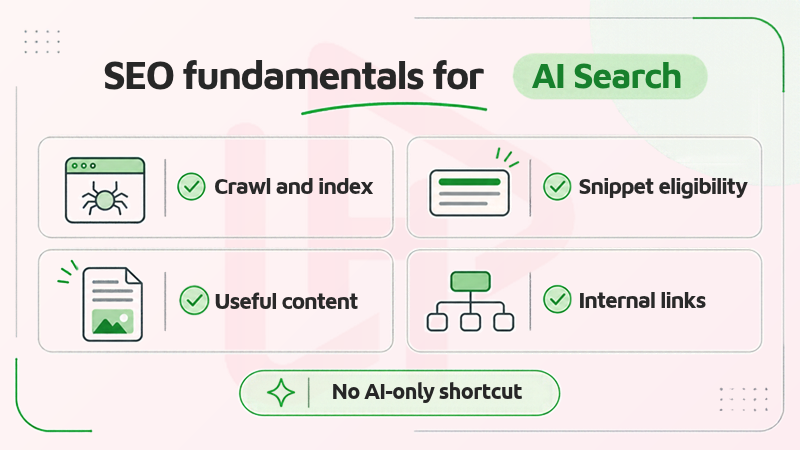
Google Search Central says the established SEO best practices remain relevant to AI Overviews and AI Mode. Content must be crawlable and eligible for Search snippets, useful to people and connected through sensible site navigation. Google does not require a special AI-only schema or hidden technical trick to make a page eligible for these experiences. Eligibility, however, does not guarantee inclusion.
- Confirm that important canonical pages are accessible, indexable, and technically sound.
- Publish distinctive, accurate content that resolves the user’s task and demonstrates real expertise.
- Use descriptive internal links and keep information consistent across text and supported structured data.
- Treat any claimed “AI citation guarantee” or invented visibility lift as unverified marketing, not an SEO requirement.
A well-structured site supports discovery and reader experience, but publishing more structured data alone cannot guarantee citations. For ongoing tactical context, explore the H2T Media Group Insights hub; validate every proposed optimization against the specific Search issue being solved.
Read more:
Google Search Central — AI features and your website
Google Search Central — Optimizing for generative AI features
7. Frequently asked questions
These short answers clarify the scope of Alphabet’s earnings comments, the product-listing CTR comparison and the limits of SEO measurement. They should not be read as performance forecasts for individual websites.
No. Alphabet reported positive 12% year-over-year Q3 Search & other revenue growth. Lower AI Mode monetization contributed to slower growth; it did not establish an absolute revenue fall.
No. Alphabet said foreign exchange was the largest cited factor and also noted category-level advertising changes. It did not quantify AI Mode’s standalone effect.
Google described similar CTRs for sponsored and organic product list items based on a limited U.S. internal study. It did not report equality, absolute CTR values or results for all organic citations.
Not at a user level from the public report. Compare AI visibility with landing-page analytics and first-party business records, and state attribution limits.
No special AI-only schema is required. Google recommends normal SEO foundations such as crawlability, useful content and Search eligibility.
Conclusion
Google AI Mode SEO impact should be assessed through evidence, not a headline about advertising monetization. The verified Q3 2026 story is that Search revenue kept growing year over year while its growth rate moderated, with multiple contributors and a still-developing AI Mode advertising model. For site owners, the responsible response is a page-level review of AI visibility, engaged visits, and qualified business outcomes – not an unsupported claim that organic traffic has already collapsed.
H2T Media Group recommends keeping the audit focused on the distinct intent of this Q3 update, then using the Insights library for related SEO analysis. For ongoing discussion, connect with H2T Media Group on Facebook and follow H2T Media Group on LinkedIn.

bichthao
H2T Media Group decodes every meaningful platform update for advertisers and affiliate partners across APAC, EU and North America — always with a practical "H2T take" you can act on.
More about H2T →