

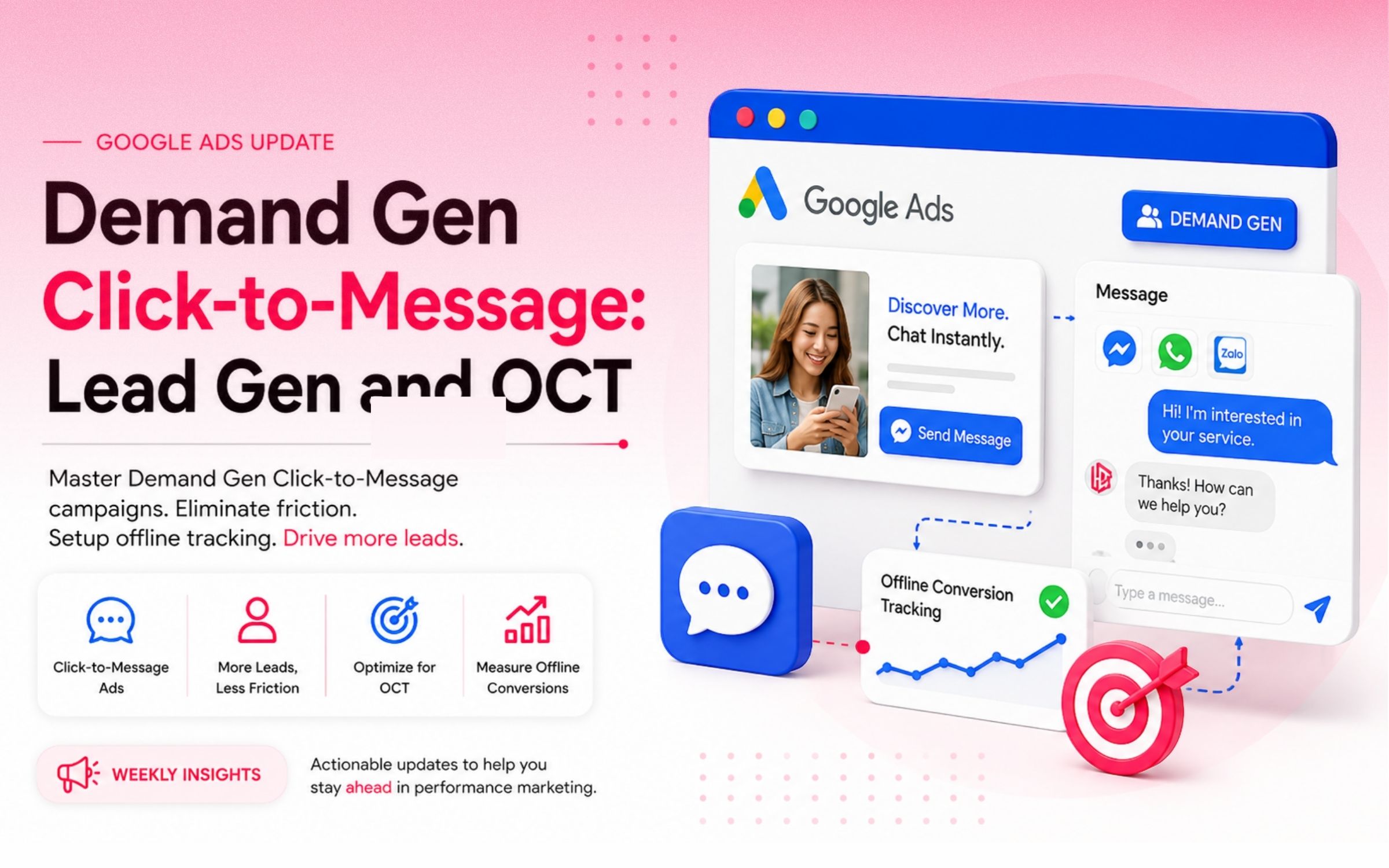
Welcome to the Google Ads performance insights hub by H2T Media Group. Demand Gen Click-to-Message campaigns optimize lead generation by removing landing page drop-offs and routing users directly into messaging apps like WhatsApp. If your business faces high bounce rates and inflated Cost Per Lead (CPL) due to static web forms, switching to Click-to-Message allows you to capture high-intent leads instantly.
Below, H2T Media Group provides a technical breakdown of its zero-friction architecture, Offline Conversion Tracking (OCT) setup, and localized messaging API roadmaps. Read on to discover how to future-proof your conversion strategy with H2T Media Group!
 Key Takeaways
Demand Gen Click-to-Message ad formats eliminate landing page load friction by connecting users directly from YouTube Shorts and In-feed ads into native messaging apps like WhatsApp.
Essential Facts About This Update
- Zero-Friction Funnel: Eliminates web forms entirely, initiating a 1:1 sales chat via pre-filled text templates in a single click.
- CRO Optimization: Bypasses mobile page latency drop-offs, significantly lowering Cost Per Lead (CPL) for high-intent consultative industries.
- Mandatory OCT Integration: Tracking app launches alone skews bid optimization; passing GCLID/WBRAID parameters back to CRM is essential for real conversion tracking.
- Smart Bidding Alignment: Postback of CRM-qualified leads recalibrates Target CPA/ROAS toward users genuinely intending to complete transactions.
- APAC Roadmap: Domestic markets will soon expand beyond WhatsApp to support direct ad routes into Zalo OA and Facebook Messenger.
1. Technical Mechanics: Resolving Conversion Rate Optimization (CRO) Bottlenecks
In traditional Performance Marketing campaigns, the Conversion Funnel is typically structured around a three-step protocol: Ad Click -> Landing Page Load -> Form Submission.
1.1. The Inefficiency of Traditional Lead Generation Models
Mobile user behavior data consistently indicates that conversion rates decline by an average of 20% for every additional second of page load time. For industries requiring extensive data collection (Real Estate, B2B SaaS, Higher Education), users exhibit high hesitation rates when requested to submit phone numbers and email addresses via static web forms. The friction between “Engaging with the video ad” and “Executing the form submission” is the primary factor inflating the Cost Per Lead (CPL).
1.2. The Zero-Friction Architecture of Demand Gen
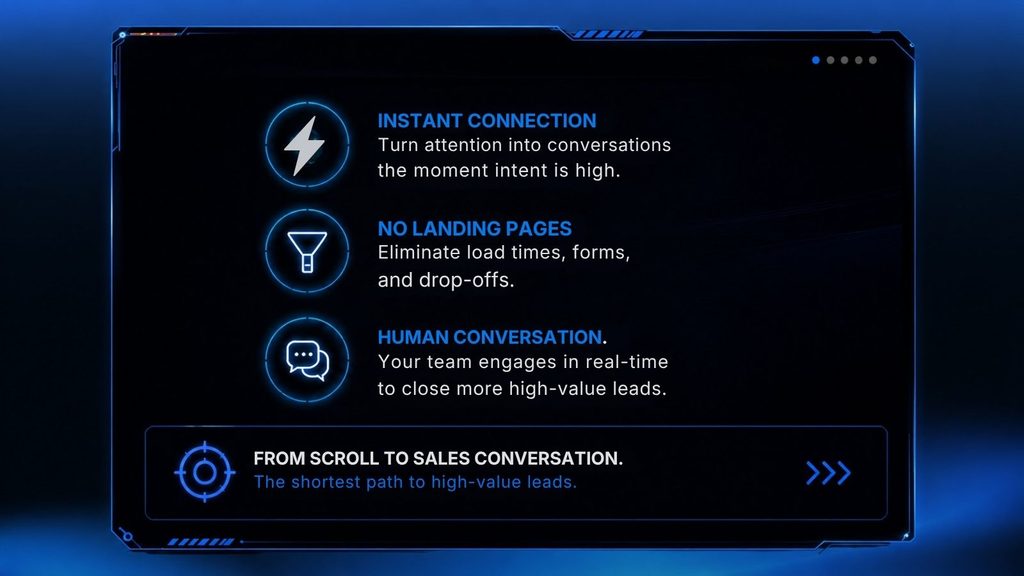
The Click-to-Message update on Demand Gen campaigns fundamentally restructures this conversion funnel. By embedding a “Contact Us” Call-to-Action (CTA) directly within YouTube Shorts or In-feed videos, Google enables advertisers to capitalize on the exact moment of peak user intent.
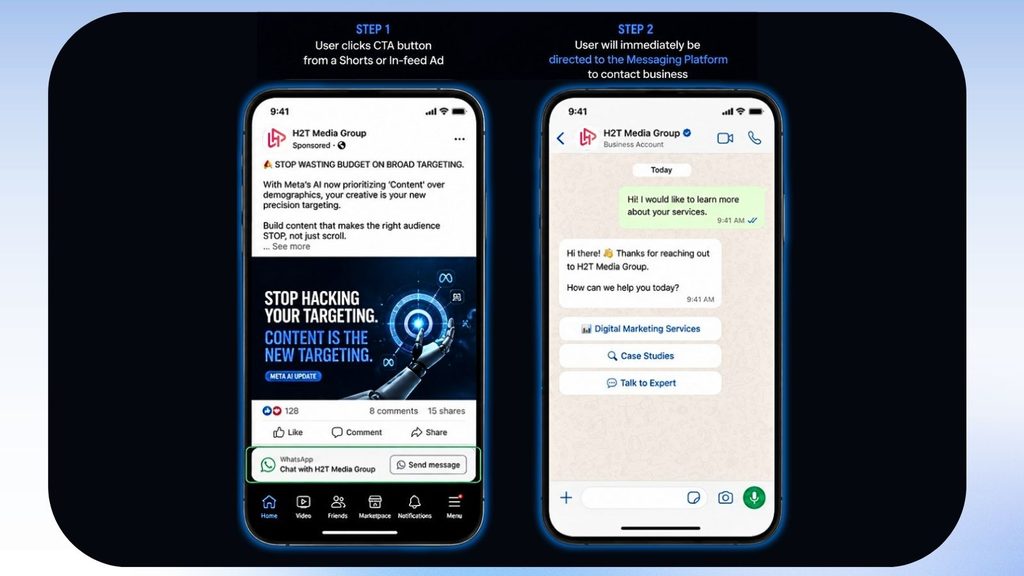
- Phase 1: The user consumes a vertical video (Shorts) on a mobile device.
- Phase 2: Upon clicking the CTA, the system bypasses the web browser entirely. It executes a deep link protocol that directly launches the pre-installed WhatsApp application on the device.
- Phase 3: The messaging interface opens with a pre-filled text template configured by the advertiser (e.g., “I would like to request a pricing proposal for Project A”).
- Phase 4: The user simply taps ‘Send,’ completing the lead acquisition process.
This operational workflow eradicates 100% of page load latency and eliminates manual data entry, placing the prospect into an immediate 1:1 conversational environment with the sales team.
2. Analyzing Industry-Specific Applications
The Click-to-Message format is not intended to universally replace Web Conversion campaigns; rather, it is a specialized acquisition tool designed for Consultative Sales models.
| Industry Vertical | Limitations of Traditional Landing Pages | Operational Advantages of Demand Gen Message Ads |
|---|---|---|
| Real Estate | Clients rarely execute high-value transactions purely from reading a webpage. Form submission rates with accurate data are low due to spam concerns. | Routes prospects directly to WhatsApp/Zalo. Enables Sales to immediately distribute catalogues, project progression videos, or location pins via chat, rapidly establishing trust. |
| B2B Software (SaaS) | B2B forms require multiple fields (Company size, Job Title, Industry), resulting in drop-off rates exceeding 80%. | Minimizes the initial entry barrier. The prospect only needs to send a pre-filled “Request a Demo” text. The Lead Qualification process is subsequently handled by the SDR team. |
| Education & Study Abroad | Complex curriculum structures require 1-on-1 consultations regarding pathways and tuition. Static forms cannot address highly personalized inquiries. | Establishes an instant interaction channel. Academic consultants can respond with Voice Notes or detailed PDF brochures directly within the messaging ecosystem. |
3. Measurement Architecture: The Offline Conversion Tracking (OCT) Requirement
The primary operational risk for Media Buyers deploying messaging campaigns is the fragmentation of attribution data. Relying solely on front-end metrics will result in severe inaccuracies regarding Return on Investment (ROI) calculations.
3.1. The Limitations of Front-End Tracking
During the execution of Click-to-Message campaigns, Google Ads defaults to recording a “Conversion” the moment a user clicks the CTA to launch the messaging application. However, “Opening the app” is not synonymous with “Sending the message.” Users may open WhatsApp and immediately exit without initiating contact. If the Smart Bidding algorithm optimizes based on this superficial click data, the budget will be misallocated.
3.2. Technical Solution: Importing Offline Conversion Tracking (OCT)
To generate accurate performance reports for Demand Gen campaigns, Agencies must establish a continuous feedback loop from the Customer Relationship Management (CRM) system back to Google Ads via the OCT protocol.
Standard API Configuration Procedure:
- Identifier Acquisition: When the user clicks the ad and transitions to WhatsApp, the system must be configured to append the GCLID (Google Click Identifier) or WBRAID (for iOS devices) parameter to the pre-filled message URL.
- CRM Storage: As the incoming message enters the enterprise’s management system (e.g., Salesforce, HubSpot, or Omnichannel platforms), the phone number and the corresponding GCLID parameter must be logged into the database.
- Lead Qualification: The sales team conducts the consultation. Once the prospect is validated as a “Qualified Lead” or “Closed Won,” the status is updated within the CRM.
- Data Postback: Utilizing the Google Ads API, the CRM transmits the GCLID alongside the exact Conversion Value back to the advertising platform.
- Algorithmic Optimization: Google Ads ingests the OCT data and recalibrates its bidding algorithms (e.g., Target CPA or Target ROAS) to prioritize user cohorts exhibiting behavioral patterns identical to those who actually sent messages and finalized purchases.
4. The APAC Localization Roadmap: Transitioning to Messenger and Zalo
While the current pilot phase of Click-to-Message on Demand Gen is natively synchronized with WhatsApp, this application structure is not universally applicable. In the Asia-Pacific (APAC) region, particularly in Vietnam, WhatsApp penetration among Business-to-Consumer (B2C) demographics is exceptionally low.
4.1. Domestic Social Network API Integration
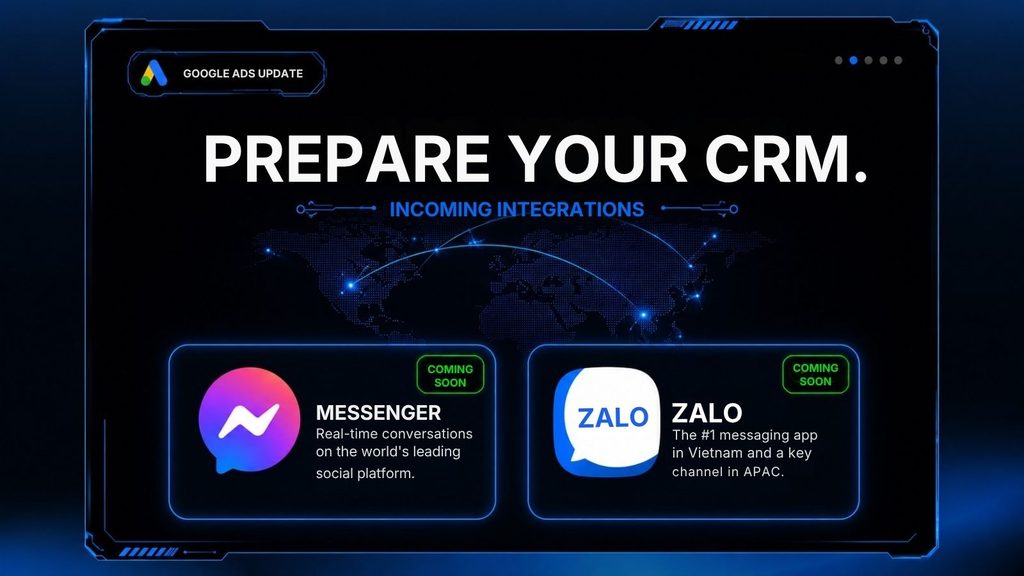
According to system update roadmaps, Google is actively developing the API infrastructure to natively integrate Facebook Messenger and Zalo Official Account (Zalo OA) as destination options for Demand Gen advertisements. This development will fundamentally redefine budget allocation strategies within domestic markets. Eradicating landing pages and routing consumers directly into Zalo OA will drastically reduce funnel drop-off rates in sectors such as Financial Services, Aesthetics, and Automotive Retail.
4.2. Preparing Enterprise Technical Infrastructure
To ensure operational readiness for the upcoming Messenger and Zalo integrations, technical operations teams must standardize their systems immediately:
- Consolidated Messaging Hubs: Enterprises cannot manage high-volume traffic spikes from YouTube using personal mobile devices. It is a mandatory requirement to utilize Zalo OA (Enterprise version) and link the Meta Business Suite to an API-supported Omnichannel Helpdesk software.
- Webhook Configuration: Ensure the enterprise’s current messaging software is capable of parsing and extracting UTM or GCLID parameters transferred from third-party platforms. If the Zalo OA system fails to capture the identifier from Google Ads, cross-platform attribution will fail entirely.
- Deploying Routing Chatbots: Demand Gen campaigns distributed on YouTube Shorts frequently generate traffic spikes. Deploying foundational Chatbot scripts (requesting basic information, categorizing user intent) is critical to retaining customer engagement during the latency period before a human consultant responds.
5. Frequently Asked Questions
It is a Google Ads format that connects users directly from YouTube video ads into messaging apps like WhatsApp without requiring a website landing page.
By eliminating landing page load latency and form-filling friction, it allows high-intent users to start a direct 1:1 conversation in a single tap.
Tracking just the initial ad click or app launch skews algorithm bidding, so sending post-click CRM lead status back to Google Ads via OCT is required to optimize for actual qualified sales.
Yes, Google’s integration roadmap for regional markets includes expanding direct ad routing to platforms such as Facebook Messenger and Zalo Official Account.
The introduction of Demand Gen Click-to-Message campaigns marks a crucial evolution in conversion strategy: shifting focus from broad website traffic to immediate, high-intent lead engagement. By eliminating landing page friction, implementing robust Offline Conversion Tracking (OCT), and preparing your technical stack for incoming Messenger and Zalo integrations, your business can significantly lower Cost Per Acquisition (CPA) while scaling ROI. To stay ahead of digital advertising trends, explore more expert guides in the Google Ads category under our official Insights hub on H2T Media Group!

bichthao
H2T Media Group decodes every meaningful platform update for advertisers and affiliate partners across APAC, EU and North America — always with a practical "H2T take" you can act on.
More about H2T →