

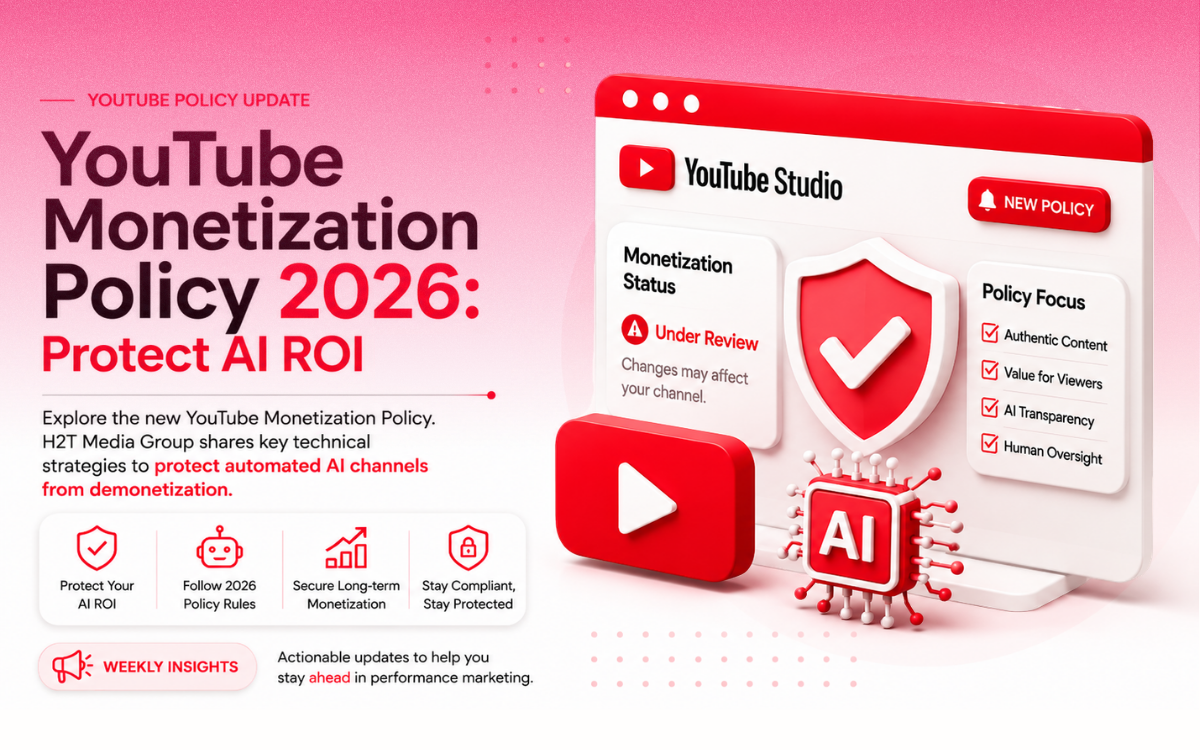
Welcome to the YouTube performance insights hub by H2T Media Group. The operational model of fully automated content creation is undergoing a mandatory transition. With the rollout of the YouTube monetization policy 2026, the platform is actively restructuring its ad ecosystem, enforcing demonetization protocols on mass-produced, templated AI channels. If your Agency relies on a fully automated pipeline without manual editorial control for AdSense or Affiliate revenue, your channel network faces a high risk of suspension. Below is H2T’s technical analysis and the operational framework required to maintain your ROI.
 Key Takeaways
YouTube Monetization Policy 2026 tightens the moderation of mass-produced AI channels, requiring direct human intervention to protect AdSense and Affiliate revenue.
Essential Facts About This Update
- 3 Violation Signals: Templated structures, raw content reuse, and low-information loops trigger automatic demonetization.
- Quality Over Volume: AI tools aren’t banned, but mass-produced, unedited videos will face heavily reduced organic reach.
- CPM/RPM Growth: Ad budgets are consolidating into compliant, high-quality channels, boosting their revenue potential.
- “Human-in-the-loop”: Use AI for raw data generation (ChatGPT, Midjourney), but rely on human editors to optimize pacing and context.
- YPP Requirement: Manual intervention and professional commentary are now mandatory to bypass automated filters.
1. The Policy Update: Enforcing Output Standards, Not Banning AI Tools
YouTube is not prohibiting the use of Artificial Intelligence. The platform is enforcing a “Quality Over Volume” standard to protect conversion rates for advertisers. Utilizing AI text-to-video generators to publish high volumes of content daily without manual editing is now classified as a direct violation of the YouTube Partner Program (YPP) guidelines.
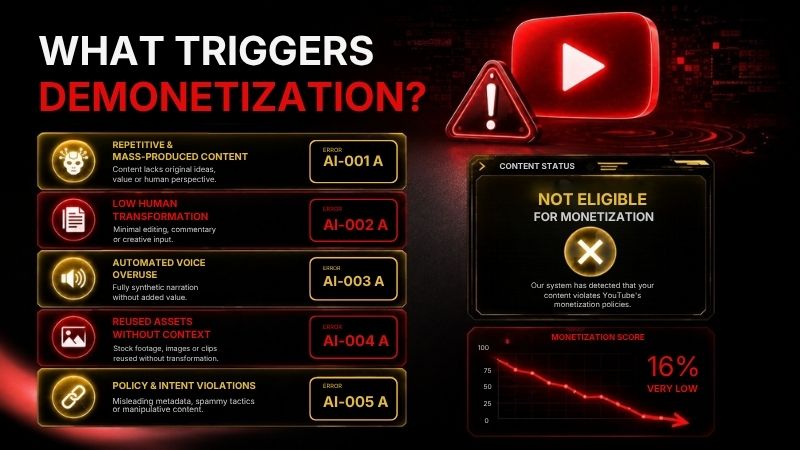
Technical Red Flags Triggering Demonetization
The algorithm will automatically disable monetization status if it detects the following signals:
- Templated Structures: Identical narrative formats and visual layouts repeated across multiple videos or channel networks.
- Unmodified Content Reuse: Aggregating existing data (or raw AI generations) without applying meaningful transformation or additional context.
- Low-Information Loops: Utilizing continuous AI-generated audio or visual loops that provide no significant information gain regarding education or entertainment.
2. Market Impact Analysis (Before vs. After 2026)
This policy adjustment standardizes content production workflows and shifts ad spend distribution across the platform.
| Operational Metric | Previous Era | Post 2026 Update |
|---|---|---|
| Production Pipeline | 100% Automated. Data extraction → AI Scripting → Text-to-Voice → Automated batch export. | Mandatory Human Intervention. Requires manual editing, specific viewpoints, and narrative pacing control. |
| Algorithmic Distribution | The algorithm prioritized upload frequency and high video volume. | Reduced reach for mass-produced content. Organic reach prioritized for high-information-value output. |
| CPM / RPM Metrics | Low, due to ad inventory being distributed across a high volume of low-quality videos. | Growth Trend. Ad spend will consolidate into policy-compliant channels, driving up bidding rates. |
Impact on CPM (Cost Per Mille) Metrics
Strategic Perspective from H2T Media Group:
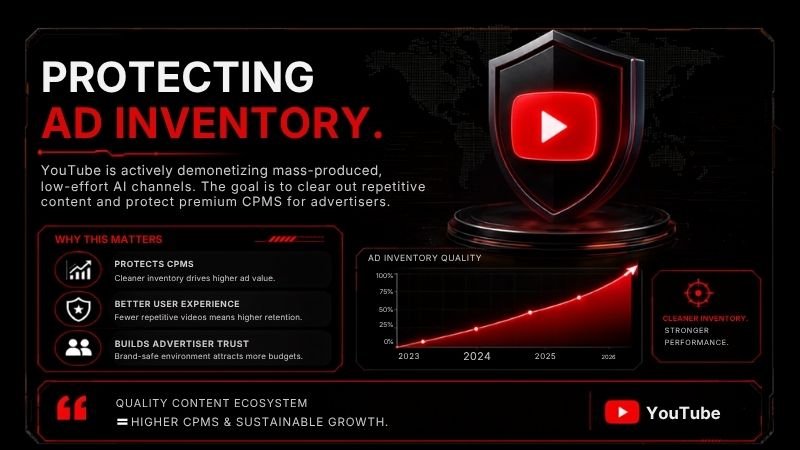
YouTube’s removal of industrialized AI channels acts as a positive lever for Agencies focused on content quality. As the ad inventory is filtered, channels that maintain policy compliance will absorb a higher concentration of ad budgets. This consolidation will directly increase CPM metrics. Instead of attempting to bypass the algorithm, businesses must adjust their production workflows to optimize profitability.
3. Operational Plan: H2T’s “Human-In-The-Loop” Framework
To prevent revenue disruption in automated channels, Media Buyers must audit and modify their production pipelines. H2T recommends the “Human-in-the-loop” Framework, which consists of 3 standard procedures:
- AI for Data Processing: Continue utilizing ChatGPT for outlining, Midjourney for visual design, or ElevenLabs for voice generation. However, treat these outputs strictly as foundational materials.
- Human for Contextual Editing: A Human Editor must actively intervene in the post-production phase. The editor is responsible for structuring the information flow, controlling the pacing, and aligning the content with the brand’s specific tone.
- Integration of Expert Value: The final video must provide specific analysis, commentary, or evaluative perspectives—elements that isolated AI prompts cannot synthesize independently.
4. Frequently Asked Questions
No, YouTube is not prohibiting AI tools like ChatGPT, Midjourney, or ElevenLabs. The policy update enforces a “Quality Over Volume” standard. It specifically targets and demonetizes mass-produced, 100% automated channels that lack human editing, rather than banning the underlying AI technology itself.
The YouTube algorithm now actively identifies and demonetizes channels based on three main violation signals:
- Templated Structures: Repetitive narrative formats and visual layouts across multiple videos.
- Unmodified Content Reuse: Publishing raw AI generations or aggregated data without meaningful transformation.
- Low-Information Loops: Continuous AI-generated audio or visuals that lack educational or entertainment value.
For policy-compliant channels, this update is a strong positive lever. As YouTube clears out low-quality ad inventory from industrialized AI channels, ad spend will consolidate into high-quality, compliant channels. This concentration of ad budgets is expected to drive up bidding rates and significantly increase overall CPM and RPM metrics.
The “Human-in-the-loop” framework, recommended by H2T Media Group, is an operational model designed to protect your revenue. It involves using AI to process foundational data (like outlines and voice generation) but strictly mandates human intervention in post-production. A human editor must control pacing, adjust the narrative context, and inject specific expert perspectives to bypass the automated filters of the YouTube Partner Program (YPP).
The YouTube monetization policy 2026 is a necessary filter to elevate platform quality. The purely volume-driven production model is no longer viable. Implementing the “Human-in-the-loop” framework is a mandatory step to audit and validate your channel networks. Keep following the YouTube category at H2T Media Group for more technical analyses and international-standard Digital Performance strategies to optimize your B2B enterprise’s ROI.

bichthao
H2T Media Group decodes every meaningful platform update for advertisers and affiliate partners across APAC, EU and North America — always with a practical "H2T take" you can act on.
More about H2T →