

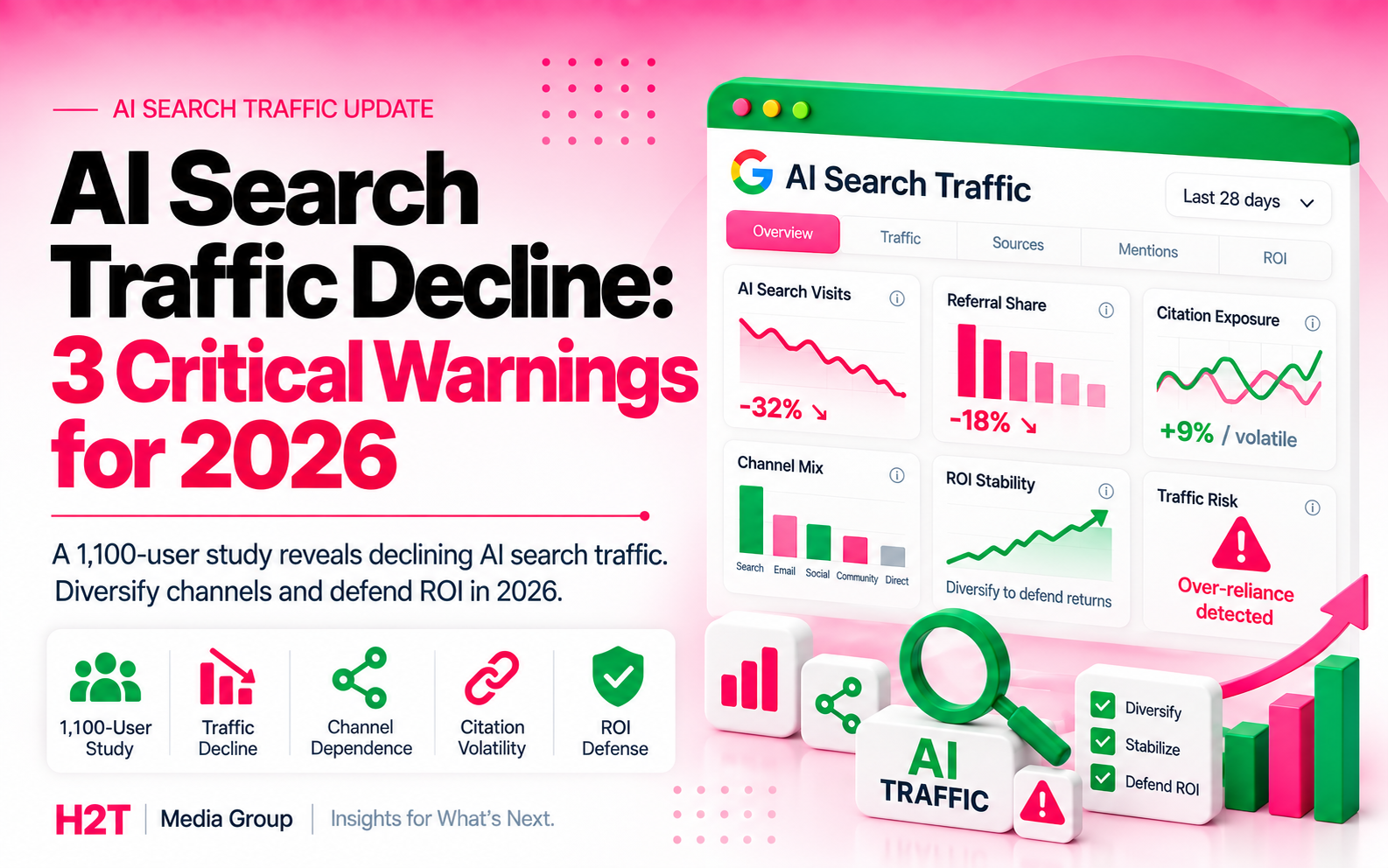
Welcome to the digital performance and search insights hub by H2T Media Group. Mitigating the steep AI Search traffic decline requires enterprise leaders to immediately transition away from algorithmic dependency, focus on generating direct branded search demand, and build diversified multi-channel acquisition pipelines. Empirical research from UPenn and Northeastern University proves that AI Search operates as an attention-retaining “Walled Garden,” causing external website click-throughs to drop by up to 45%. Below is H2T’s technical breakdown of these academic findings and the 3-phase operational blueprint needed to insulate your brand’s growth with H2T Media Group.
 Key Takeaways
The AI Search traffic decline of up to 45% has been empirically confirmed by an independent 1,100-user study from UPenn and Northeastern University.
Essential Academic Findings
- -45% Click-Out Reduction: Independent testing across 1,100 users confirms AI Search suppresses external website click-outs by 45%.
- Trust Deficit & Migration: Consumers perceive synthesized AI answers as less trustworthy, driving user migration toward alternative search engines.
- The Citation Chasing Trap: Chasing superficial AI snippet citations wastes significant content production and engineering capital.
- Direct Branded Demand: Organizations must pivot from algorithm chasing to building authentic direct branded search demand.
- Omnichannel Diversification: Diversify audience acquisition across first-party CRM, direct email, communities, and paid media.
1. Empirical Academic Findings: The Reality of 1,100 AI Search Users
Enterprise leadership must make rational capital allocation decisions in the AI search era. To do so, they must strictly separate platform public relations narratives from independent behavioral data.
1.1. The UPenn and Northeastern discovery: -45% external click-through contraction
The collaborative empirical study executed by computer scientists at the University of Pennsylvania and Northeastern University in August 2026 across 1,100 verified users exposed the actual mechanical impact of generative search:
- When AI Overviews or AI Mode interfaces render on the SERP, the statistical probability of a user executing a click-through to an external web document contracts by an average of 45% compared to legacy search layouts.
- Consumers consume the synthesized text directly within the search canvas, terminating their session without generating a single referral session for the originating publisher.
1.2. Google AI Mode as an enclosed walled garden
Within the traditional search paradigm, Google functioned strictly as a “Traffic Router”—ingesting user queries and rapidly dispatching searchers to the most authoritative external URL. Under AI Mode, the platform has fundamentally transitioned into a “Terminal Destination Hub.” The search engine extracts proprietary data, computational benchmarks, and editorial insights from external domains, compiling them into a proprietary answer to monopolize user dwell time and maximize internal ad exposures.
2. Why AI Search Cannibalizes External Clicks and User Trust
The joint university research not only documented severe traffic cannibalization; it identified an emerging crisis in user experience (UX) and information credibility.
2.1. The platform imperative for attention retention
Google’s foundational business model is anchored in the Attention Economy. Routing a user off-platform to an independent domain represents a lost opportunity to serve subsequent advertising impressions.
By delivering comprehensive, multi-paragraph synthesized summaries, the platform systematically eradicates the consumer’s requirement to visit source domains, converting the vast majority of informational search queries into zero-click dead ends.
2.2. Expanding consumer skepticism and platform migration
A critical finding from the academic dataset reveals that end-users are experiencing fatigue with synthetic answers:
- Synthesized summaries frequently strip away vital contextual nuances, occasionally introducing unverified claims and hallucinations.
- The study documented a measurable cohort of users who evaluated the AI-dominated search experience as significantly less credible, prompting active migration toward alternative engines like Microsoft Bing or DuckDuckGo to recover direct web access.
According to computer science research from the University of Pennsylvania Search Behavioral Lab, heavy-handed AI summarization is destabilizing the traditional information exchange governing the open web.
3. Redefining Organic Strategy: Ceasing Algorithmic Dependency
Enterprise leadership must acknowledge this structural reality and adapt their strategy. Continuing to invest massive budgets into optimizing for AI snippets in hopes of capturing residual clicks represents an inefficient deployment of capital.
3.1. The illusion of algorithmic favoritism
Numerous marketing departments remain trapped in an obsolete mindset: shortening articles, altering formatting, and rewriting copy purely to appease language model crawlers.
The data proves that even when an enterprise domain is cited within the top reference block of an AI Overview, the downstream click-through rate remains negligible. Expending resources to serve as an uncompensated training dataset for a system that actively cannibalizes your referral traffic is an unsustainable strategy.
3.2. Transitioning from passive citation to direct branded demand
Rather than functioning as a passive data source for AI synthesis, enterprises must pivot toward engineering Direct Branded Search Demand:
- Publish proprietary empirical datasets, primary market research, and specialized technical methodologies that language models cannot synthesize independently.
- Build commanding brand equity so that when prospective buyers face an operational problem, they search for your specific company name or navigate directly to your domain, completely bypassing intermediary AI summaries.
4. Comparative Matrix: Open Web Discovery vs. The Walled-Garden AI Search Barrier
The technical matrix below illustrates the operational divergence separating the open web search model from the contemporary walled-garden AI ecosystem:
| Evaluation Dimension | Legacy Open Web Search Model | Modern AI Search Walled Garden (2026) |
|---|---|---|
| Search Engine Function | Efficient traffic router dispatching users off-site. | Enclosed destination hub retaining attention on-platform. |
| External Click-Out Rate | Dominant volume (50% to 70% of total sessions). | Contracts by 45%; dominated by zero-click resolutions. |
| Value of Top Ranking | Generated thousands of direct organic visits daily. | Primarily delivers impressions; yields negligible click volume. |
| Consumer Navigation Path | Scanned headlines, clicked links, engaged with on-site content. | Consumes on-SERP AI summary; terminates session immediately. |
| Enterprise Strategy | Keyword targeting to capture generic informational traffic. | Direct brand building and multi-channel acquisition. |
5. The Enterprise Operational Action Blueprint by H2T Media Group
To insulate your enterprise against the ongoing AI Search traffic decline, H2T Media Group mandates the immediate execution of this 3-phase technical roadmap:
Phase 1: Forensic Traffic and Intent Auditing
- Disregard superficial impression metrics reported within Google Search Console.
- Audit Google Analytics 4 data to quantify the exact session contraction across generic Top-of-Funnel informational URLs.
- Isolate the high-intent commercial and product pages that continue to generate direct revenue, concentrating engineering resources on their performance.
Phase 2: Transition to High-Information-Gain Branded Assets
- Terminate production of generic, definitional blog posts (“What is X?”) that are 100% cannibalized by AI summaries.
- Reallocate capital toward proprietary data assets: Annual industry benchmark studies, advanced technical troubleshooting frameworks, and verified customer case studies featuring real business metrics. Transform your website into an essential destination that buyers must visit directly to access complete solutions.
Phase 3: Multi-Channel Audience Diversification
- Scale Owned Media Channels: Expand first-party email newsletter distribution, cultivate engaged professional communities across LinkedIn and Discord, and deploy private customer portals.
- Integrate Intent-Driven Paid Media: Deploy precision Google Search campaigns governed by strict Brand Controls, alongside visual Paid Social campaigns (Meta, TikTok), to capture demand directly without relying on declining organic discovery.
6. Frequently Asked Questions
The contraction is most severe across generic informational blogs, software documentation, and basic question-and-answer sites. Highly specialized B2B enterprise services and transactional e-commerce brands with strong brand recall experience significantly less disruption.
No. Completely blocking Googlebot will remove your domain from standard search indexing entirely. However, organizations should gate proprietary research, whitepapers, and customer tools behind registration portals to protect high-value intellectual property.
If your Google Search Console impressions remain stable or increase while your actual Google Analytics 4 organic sessions decline by over 20% across informational pages, your content is being absorbed by zero-click AI summaries.
Yes. Organizations should verify their technical indexing within Bing Webmaster Tools and optimize for alternative engines that maintain a healthier balance between AI assistance and direct web citations.
Research from UPenn and Northeastern confirms an irreversible reality: the AI Search traffic decline marks an architectural shift in modern search. Free, passive search traffic is over. Sustainable growth in 2026 belongs to brands that transform their domains into irreplaceable knowledge hubs, build direct customer loyalty, and control diversified acquisition channels.
To access proprietary data auditing frameworks and advanced omnichannel performance playbooks, explore our technical repository on the Insights hub at H2T Media Group. Make sure to consistently follow our dedicated SEO to master the strategies dictating brand authority across global digital search ecosystems.

bichthao
H2T Media Group decodes every meaningful platform update for advertisers and affiliate partners across APAC, EU and North America — always with a practical "H2T take" you can act on.
More about H2T →