

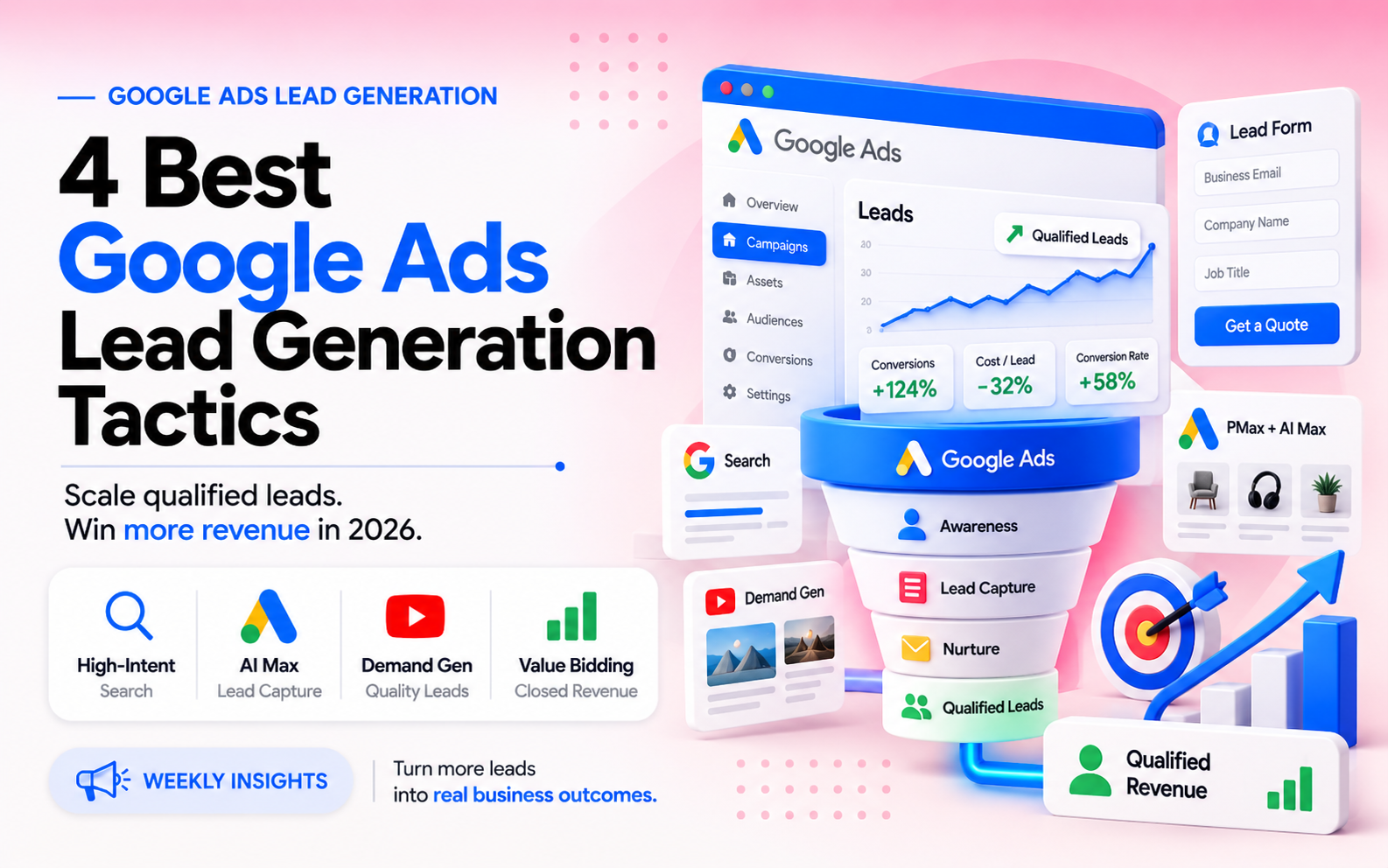
Welcome to the performance marketing insights hub by H2T Media Group. Optimizing Google Ads lead generation in 2026 requires transitioning from raw form fills to Value-Based Bidding (VBB) and server-side Offline Conversion Tracking (OCT) under Google’s Search Four framework. By feeding verified post-lead CRM signals back into Smart Bidding algorithms via Google Data Manager, B2B enterprises can neutralize low-quality lead pollution, improve sales close rates, and significantly lower true Customer Acquisition Cost (CAC).
Below is H2T Media Group’s technical analysis of the four Search Four pillars and an actionable 3-phase enterprise execution blueprint read on with H2T Media Group to scale your commercial ROAS.
 Key Takeaways
Google Ads lead generation under the Search Four framework shifts bidding optimization from raw form fills to verified CRM revenue outcomes.
Essential Facts About Search Four
- Map the complete lead journey and stream offline signals (qualified/converted leads) via Data Manager.
- Upgrade site infrastructure to Google Tag Gateway to eliminate client-side form drop-offs.
- Align Smart Bidding strategies directly with downstream business revenue rather than volume.
- Deploy AI Max for Search alongside Performance Max while maintaining rigid Brand Controls.
- Implement Demand-Led Budgets to capture high-intent conversion surges without artificial caps.
1. The Lead Quality Crisis and the Genesis of Search Four
Historically, performance marketing operations evaluated lead acquisition success using two superficial metrics: aggregate Lead Volume and Cost Per Lead (CPL).
1.1. The failure of optimizing for raw lead volume
When an ad account configures its primary conversion action as a generic “Form Submission” and deploys a Maximize Conversions strategy, the bidding algorithm executes its mathematical mandate: identifying user cohorts exhibiting the highest probability of submitting a form at the lowest marginal cost.
The operational reality:
- Accounts attract a high concentration of automated bot submissions, invalid phone numbers, and low-intent consumers.
- Inside sales teams expend hundreds of labor hours filtering unqualified contacts.
- Dashboard CPL metrics appear artificially efficient, yet true Customer Acquisition Cost (CAC) skyrockets due to collapsed sales close rates.
1.2. Steering algorithms with closed-loop commercial outcomes
Unveiled at Google Ads Rethink 2026, “The Search Four” framework systematically bridges the operational divide separating Marketing pipelines from Enterprise Sales reality.
Google’s architectural directive is clear: To dominate AI-driven auctions, organizations must train Smart Bidding algorithms to target prospects that convert into real revenue (qualified_lead and converted_lead), permanently deprecating the pursuit of cheap, unvalidated form fills.
2. Deconstructing the 4 Pillars of Google’s Search Four Architecture
The Search Four methodology unites four synchronized technical disciplines into a closed-loop acquisition ecosystem:
2.1. Pillar 1: Data Strength (Activating Offline Data Streams)
Data Strength serves as the foundational layer. Depriving machine learning algorithms of post-lead outcome data forces systems into speculative, low-quality bidding.
Enterprise execution mandates comprehensive Lead Journey Mapping:
- Streaming Post-Lead Signals: Leverage Google Data Manager to establish direct server-to-server data pipelines connecting enterprise CRMs to Google Ads. Distinctly categorize pipeline milestones: qualified_lead (leads validated by sales reps) and converted_lead (finalized commercial transactions).
- Modernizing Tag Architecture: Upgrade website tracking scripts to Google Tag Gateway (Server-Side Tagging), guaranteeing complete data resilience against client-side ad-blockers and browser privacy restrictions.
2.2. Pillar 2: Bidding Goals (Aligning Bids with Financial KPIs)
Transition account strategy from raw lead volume to Value-Based Bidding (VBB), deploying Maximize Conversion Value paired with Target ROAS.
- Assign fractional financial values across sequential pipeline milestones (e.g., Initial Form Submission = $10; Marketing Qualified Lead = $100; Final Contract Closed = $1,000).
- Smart Bidding algorithms autonomously allocate aggressive bids toward searchers exhibiting behavioral characteristics matching the $1,000 customer profile, while suppressing bids for user cohorts associated with the $10 unvalidated tier.
2.3. Pillar 3: AI Targeting & Creatives (Governed Automation)
Unify automated campaign types while enforcing strict brand safety guardrails.
- Deploy AI Max for Search alongside Performance Max: Combine Broad Match search inventory powered by AI Max with multi-channel PMax distribution to capture demand across Search, YouTube, Gmail, and Maps.
- Enforce Brand Controls: Apply comprehensive Brand Exclusion lists and account-level negative keyword libraries to restrict algorithmic exploration within verified positioning boundaries.
- Activate Native Lead Formats: Implement direct Lead Form Ads, Call Ads, and Message Ads (WhatsApp integration), allowing mobile prospects to submit inquiries directly within the search interface, completely bypassing landing page friction.
2.4. Pillar 4: Demand-Led Budgets (Dynamic Capital Allocation)
Eliminate rigid, static daily spending caps that choke campaign scaling during demand surges. B2B search volume fluctuates dynamically based on industry buying cycles:
- Deploy flexible, flighted budget architectures that empower bidding algorithms to scale daily spend during high-intent search surges and contract spend during low-intent periods.
- Anchored by Target ROAS constraints, Demand-Led Budgets allow accounts to capture 100% of profitable commercial demand without artificial intraday delivery cutoffs.
3. Technical Infrastructure: Google Tag Gateway and Offline Data Streams
Executing high-performance Google Ads lead generation requires absolute server-level tracking integrity.
3.1. Neutralizing client-side data loss via Google Tag Gateway
Standard browser-based tracking pixels suffer significant data leakage caused by browser privacy sandboxes, ad-blocking extensions, and script loading delays.
Google Tag Gateway routes event tracking through secure cloud server containers, guaranteeing that 100% of validated form submissions are captured, cryptographically hashed, and transmitted to the advertising platform.
3.2. Real-time CRM synchronization protocols
Data transmitted from enterprise CRMs to Google Data Manager must adhere to strict deterministic mapping standards:
- Capture and store the GCLID (Google Click Identifier) alongside cryptographically hashed first-party user data (Email, Phone) upon initial form submission.
- Configure automated webhooks to transmit the qualified_lead milestone from the CRM to Google Ads within 15 minutes of sales qualification. Real-time signal streaming accelerates machine learning recalibration across subsequent live auctions.
4. Technical Specifications Matrix: The Search Four Framework
The matrix below illustrates the operational mechanics and performance impact of each pillar within the Search Four architecture:
| Search Four Pillar | Core Technical Action | Primary Google Technology | Direct Operational Impact |
|---|---|---|---|
| 1. Data Strength | Map lead journey; stream CRM offline events to Data Manager. | Google Tag Gateway, Enhanced Conversions. | Eliminates junk leads; feeds verified revenue signals to AI. |
| 2. Bidding Goals | Transition to Value-Based Bidding (tROAS / Max Value). | Smart Bidding algorithmic value-scoring. | Increases sales close rates; depresses true Customer CAC. |
| 3. AI Targeting | Integrate AI Max for Search, PMax, and Native Lead Forms. | Broad Match AI, Brand Controls, Asset Studio. | Expands qualified reach; eliminates landing page bounce friction. |
| 4. Demand-Led | Implement flexible daily and flighted budget parameters. | Algorithmic auction liquidity balancing. | Captures 100% of profitable demand during peak buying cycles. |
5. The 3-Phase Enterprise Execution Framework by H2T Media Group
To transition enterprise accounts onto the Search Four framework, H2T Media Group mandates the following 3-phase technical roadmap:
Phase 1: Data Infrastructure and CRM Integration (Weeks 1–2)
- Audit existing tag architecture and deploy Google Tag Gateway via Server-Side containers.
- Establish automated API connections linking enterprise CRMs (Salesforce, HubSpot, Zoho) directly to Google Data Manager.
- Configure postback streaming for two foundational offline milestones: qualified_lead and converted_lead.
Phase 2: Bidding Strategy Restructuring (Weeks 3–4)
- Assign mathematically modeled conversion values reflecting actual sales pipeline economics.
- Transition bidding strategies from Target CPA to Maximize Conversion Value with a conservative Target ROAS floor.
- Activate AI Max on core Search campaigns while applying strict Brand Exclusion lists to safeguard proprietary brand terms.
Phase 3: Uncapping Liquidity and Scaling (Peak Operational Phase)
- Enable Demand-Led Budgets, removing artificial daily caps to permit dynamic scaling during high-intent volume spikes.
- Deploy native Lead Form Ads and Click-to-Message ad units across mobile search inventory to capture immediate consultative demand.
6. Frequently Asked Questions
Google recommends streaming at least 15 to 30 validated offline conversion events per month into the ad account to provide machine learning models with sufficient data density to model high-value user profiles accurately.
Google Tag Gateway operates via server-side infrastructure, accelerating website load speeds while preventing tracking signal loss caused by browser-level ad blockers and tracking prevention protocols.
Total unvalidated form fills may experience a moderate contraction, but the volume of Marketing Qualified Leads (MQLs), Sales Qualified Leads (SQLs), and closed revenue will expand significantly, maximizing sales team productivity.
Organizations must maintain account-level negative keyword libraries and deploy strict Brand Controls to prevent algorithms from exploring unaligned keyword themes.
Google’s “The Search Four” framework establishes a definitive operational mandate for modern performance advertising: the era of optimizing for superficial form fills has permanently ended. Success in modern Google Ads lead generation belongs to organizations that structurally integrate offline CRM milestones, deploy Value-Based Bidding models, and scale liquidity via governed AI automation. Aligning your marketing data directly with closed-loop commercial revenue represents the ultimate competitive moat for enterprise scaling.
To access proprietary CRM data integration blueprints and advanced Performance Marketing frameworks, explore our technical repository on the Insights hub at H2T Media Group. Make sure to consistently follow our dedicated Google Ads to master the tactical marketing strategies dictating success across global advertising ecosystems.

bichthao
H2T Media Group decodes every meaningful platform update for advertisers and affiliate partners across APAC, EU and North America — always with a practical "H2T take" you can act on.
More about H2T →