

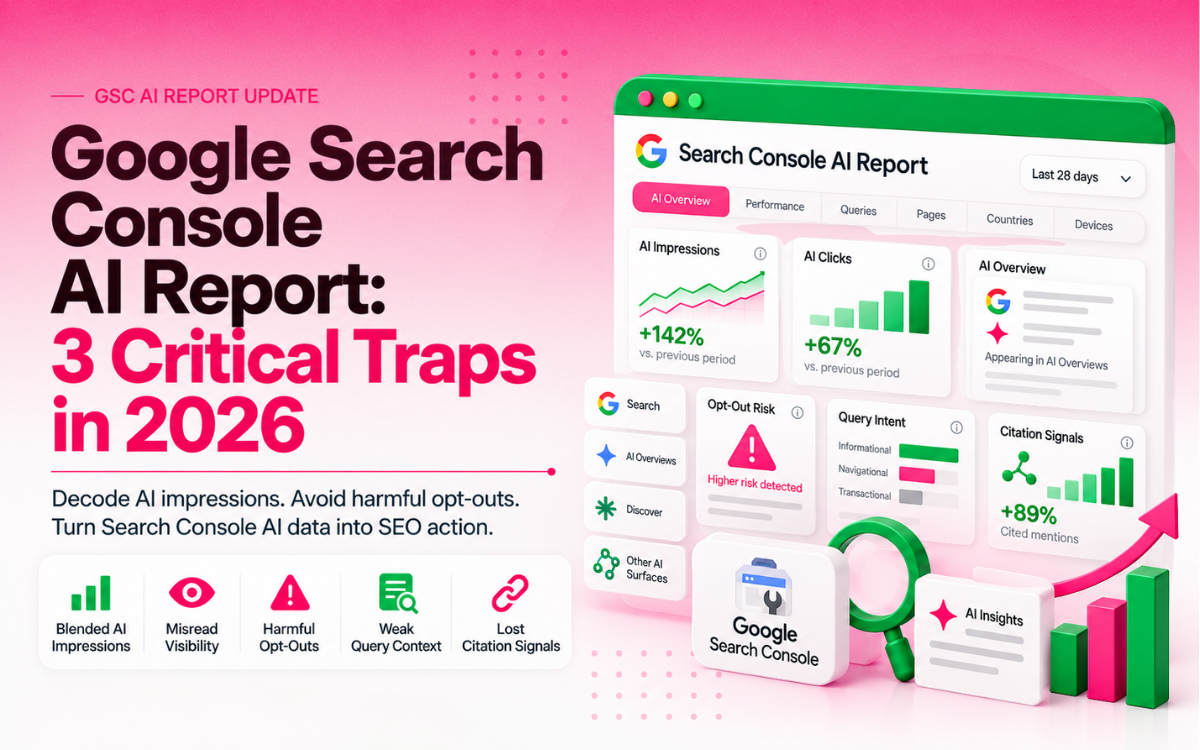
Welcome to the digital performance and technical search insights hub by H2T Media Group. Google has officially deployed its generative AI performance reporting alongside Search Generative AI controls globally across the web ecosystem. This capability is no longer an isolated laboratory experiment; it has transitioned into a permanent, native feature inside every webmaster’s Google Search Console (GSC) environment.
This rollout has triggered immediate industry anxiety because the report exclusively logs Impressions (appearances inside AI Overviews and AI Mode) while withholding traditional Clicks and granular query-level metrics. Many corporate leadership teams are reacting impulsively, attempting to execute opt-out commands to prevent Google from accessing their data. However, misinterpreting the Google Search Console AI report and severing crawler access guarantees the complete erasure of your organic footprint within modern search. This comprehensive article dissects the technical architecture of this new dataset and provides a battle-tested operational framework for 2026.
 Key Takeaways
The Google Search Console AI report is now active globally, tracking how frequently your content is cited inside AI Overviews and AI Mode.
Essential Operational Facts
- The report provides Impression tallies while systematically withholding query-level click data.
- Language models utilize your domain as an informational premise rather than serving simple blue links.
- Activating opt-out protocols permanently eliminates your brand from the generative citation carousel.
- AI impressions function as a quantitative indicator of domain entity authority in Google’s Knowledge Graph.
- Use dashboard signals to optimize structured data tables rather than executing technical blocks.
1. The Technical Mechanics of the Google Search Console AI Report
Previously, understanding whether a commercial domain was utilized to synthesize Google’s AI Overviews was entirely obscured. Marketing teams had to manually sample queries across individual SERPs.
The global introduction of the Google Search Console AI report marks Google’s formal validation of conversational AI as an independent distribution channel. This dedicated dashboard quantifies how frequently your URLs are retrieved by generative architectures, including search-integrated AI Overviews and autonomous recommendations surfaceable via Discover.
Crucially, this is Exposure Data rather than linear traffic attribution. It measures the statistical frequency with which Google’s machine learning systems utilize your proprietary content as an inferential premise to construct synthesized natural language answers for searchers.
2. Why Google Systematically Withholds Click and Query Granularity
The most debated aspect of this release among digital marketing directors is the total absence of traditional Click-Through Rates (CTR) and keyword query lists.
2.1. The non-linear dynamics of multi-turn search
Traditional search reporting operated on an absolute 1:1 ratio (One Query equals One Search Click).
Conversely, generative AI search functions within conversational, multi-turn sessions. A synthesized AI response is frequently generated by cross-referencing five sequential conversational prompts submitted by a single user. Mathematically, Google cannot attribute an isolated website impression to a singular keyword string within an evolving conversational session.
2.2. User privacy and anti-scraping governance
Withholding exact prompt strings protects two foundational engineering priorities:
- Consumer Privacy: Conversational queries frequently contain highly sensitive contextual disclosures, such as financial circumstances or personal medical details.
- Mitigating Algorithmic Manipulation: Releasing comprehensive prompt logs would allow black-hat optimization operators to reverse-engineer inferential thresholds, polluting language model reasoning with spam assets.
Therefore, providing aggregated Impressions serves as an intentional architectural decision designed to preserve generative search integrity.
3. The Opt-Out Dilemma: The Structural Cost of Blocking AI Crawlers
Simultaneously with this reporting release, Google deployed centralized Search Generative AI controls, granting site administrators the capability to opt out of generative compilation via technical directives.
Many commercial directors, frustrated by perceived zero-click cannibalization, are impulsively instructing development teams to deploy full crawler blocks via robots.txt or restrictive metadata.
3.1. The catastrophic cost of digital isolation
This represents a profound strategic mistake. When an organization activates generative opt-out controls:
- You do not stop prospective buyers from querying AI engines about your industry.
- You merely order the language model to exclude your brand entity from the verified citation pool.
When the AI engine is barred from extracting facts from your authoritative domain, it does not terminate the query; it merely queries a competitor domain to synthesize the answer. Consequently, your competitors capture 100% of the narrative within the zero-click window, while your enterprise becomes digitally obsolete.
3.2. Forfeiting high-intent downstream verification traffic
While AI Overviews satisfy immediate informational questions, high-value B2B buyers and qualified commercial prospects consistently click citation links to verify primary data before executing procurement decisions.
This citation traffic represents the highest-converting cohort in modern search. Opting out of AI access severs your primary pipeline to these educated, bottom-of-funnel buyers.
4. Data Comparison: Traditional Search Performance vs. AI Performance Reporting
The matrix below illustrates the structural operational differences between traditional search performance tracking and the new AI analytics suite:
| Technical Dimension | Legacy Search Performance Tracking | Modern GSC AI Performance Report |
|---|---|---|
| Delivery Mechanism | Displays direct, clickable blue links on standard SERPs. | Integrates data as synthesized premises within conversational answers. |
| Metric Coverage | Complete: Clicks, Impressions, CTR, and Average Position. | Restricted strictly to Impressions (Frequency of AI extraction). |
| Query Transparency | Granular reporting across distinct keyword strings. | Query strings withheld to safeguard conversational privacy. |
| Consumer Journey | Scans multiple headlines, evaluates options, clicks external URL. | Consumes synthesized resolution, clicks citations for validation. |
| Optimization Focus | Maximizing meta titles and descriptions for immediate CTR. | Structuring semantic data tables to ensure clean AI ingestion. |
According to developer documentation within Google Search Central Documentation, measurement dashboards are continuously adapting to quantify the transition toward interactive, synthesized discovery surfaces.
5. 3 Diagnostic Inquiries Before Executing Technical Interventions
Rather than reacting emotionally to fluctuating impression metrics, technical leadership must execute a structured operational audit centered on three core questions:
5.1. Which specific topic clusters trigger your AI impressions?
Examine the top-performing URLs logged within the Google Search Console AI report.
Are these impressions clustering around technical documentation, pricing matrices, or deep architectural whitepapers? Pinpointing the exact URLs favored by the AI exposes the precise subject matter areas where Google’s models recognize your domain as an authoritative entity.
5.2. Which specific content architectures does the AI favor?
Analyze the underlying structure of your high-impression URLs. You will consistently identify three common data characteristics:
- Concise, definitive introductory summaries that resolve specific problems.
- Structured comparison tables formatted with clean semantic HTML <table> markup.
- Concrete numerical figures and verifiable operational benchmarks.
This structure represents the ideal data format for language models executing multi-step logic.
5.3. Does blocking AI access undermine broader domain authority?
Consider the competitive reality: If your domain disappears from the AI summary, where does the user journey migrate?
In high-velocity commercial verticals, consistent citation within Google’s AI features validates your Entity Authority across the entire web graph. Severing this connection degrades your historical authority scores across broader organic search algorithms.
6. The Enterprise Technical Action Blueprint by H2T Media Group
To convert abstract AI impression metrics into a measurable commercial pipeline, H2T Media Group mandates the execution of this 3-step operational framework:
Step 1: Establish an AI Impression Velocity Baseline
Track weekly AI impressions across distinct product categories within GSC. Isolate volatility trends to determine whether algorithm updates are expanding or contracting your domain’s citation footprint.
Step 2: Optimize High-Impression, Low-Click Content Hubs
For URLs generating massive AI impressions with modest direct click-throughs, optimize for indirect brand conversion:
- Integrate proprietary branded frameworks and trademarked methodology names directly into the body copy.
- Embed proprietary case studies within the text. When the AI synthesizes an answer using your data, it will naturally mention your brand name as the authoritative originator of that data.
Step 3: Enforce Controlled Data Accessibility
Reject blanket opt-out implementations. Maintain open, clean crawlability for all public-facing educational, technical, and commercial assets. Reserve technical restrictions exclusively for private administrative portals, internal APIs, or gated enterprise databases.
7. Frequently Asked Questions
No. Paralleling traditional search performance reporting, generative AI metrics typically feature an operational processing latency of 48 to 72 hours before aggregating inside the dashboard.
This disparity is the natural byproduct of zero-click search behavior. The user consumes the immediate factual resolution directly inside the AI Overview. However, the minority that do click citation links possess significantly higher conversion intent.
No. Google-Extended was designed specifically to control model training inputs (such as Gemini training data), not standard search retrieval indexing. However, deploying aggressive crawler blocks risks destabilizing your general search eligibility.
Google does not provide this mapping inside GSC. Technical teams must deploy programmatic search sampling across your core seed keywords to visually observe citation triggers on live SERPs.
The data surfaced within the Google Search Console AI report represents a forward-looking strategic signal, not a negative verdict on your organic search future. The transformation of traditional click-through metrics mirrors the maturation of generative discovery. Organizations that move beyond emotional reactions, maintain open structured data access, and engineer their content to serve as the definitive factual premise for AI engines will monopolize visibility across the modern search landscape. Audit your native GSC dashboard today to base your technical roadmap on empirical reality rather than industry speculation.
To access advanced data structuring frameworks and proprietary entity attribution playbooks, explore our full technical repository on the Insights hub at H2T Media Group. Make sure to consistently follow our dedicated SEO category to master the technical strategies dictating authority across global search engine ecosystems.

bichthao
H2T Media Group decodes every meaningful platform update for advertisers and affiliate partners across APAC, EU and North America — always with a practical "H2T take" you can act on.
More about H2T →