

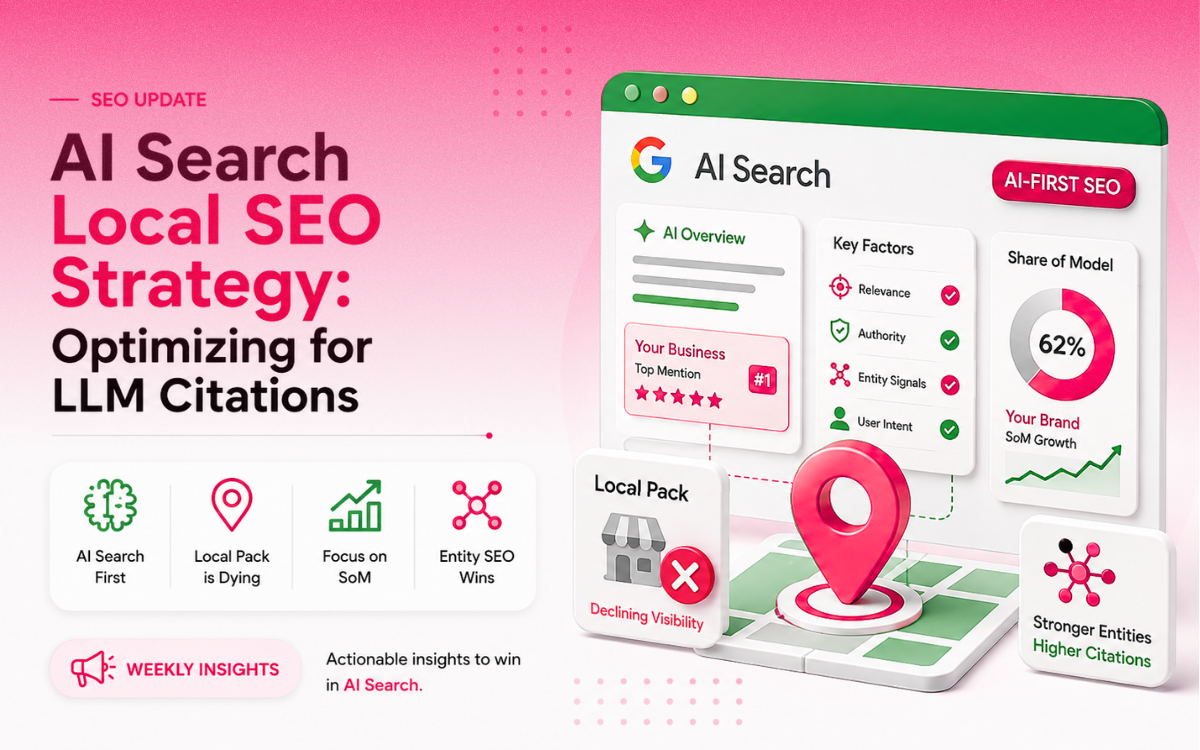
AI Search Local SEO is an essential operational requirement for enterprises to safeguard market share and adapt as user behavior transitions from traditional link-clicking to direct AI responses. To optimize for this shift, organizations must focus on standardizing Entity authority, maintaining strict NAP (Name, Address, Phone number) consistency, and implementing error-free JSON-LD structured data to ensure Large Language Models (LLMs) can easily parse and reference core data. This article from H2T Media Group provides a deep-dive analysis into the operational mechanics of AI Search, methods for tracking Share of Model (SoM), and an actionable technical roadmap; explore the insights with H2T Media Group below!
 Key Takeaways
AI Search Local SEO strategy is an immediate operational mandate for B2B and E-commerce enterprises to defend market share as user behavior shifts from traditional link-clicking to direct AI answers.
Essential Facts About This Strategy
- Definitive Recommendations: LLMs bypass enumeration, delivering one or two definitive synthesized recommendations instead of traditional top-3 local pack listings.
- Entity Authority Over Keywords: AI models evaluate knowledge graphs, localized structured data, and verifiable attributes rather than repetitive keyword density.
- NAP Consistency & Confidence Scores: Inconsistent business listings across platforms trigger hallucination safeguards, directly lowering brand confidence scores in LLM outputs.
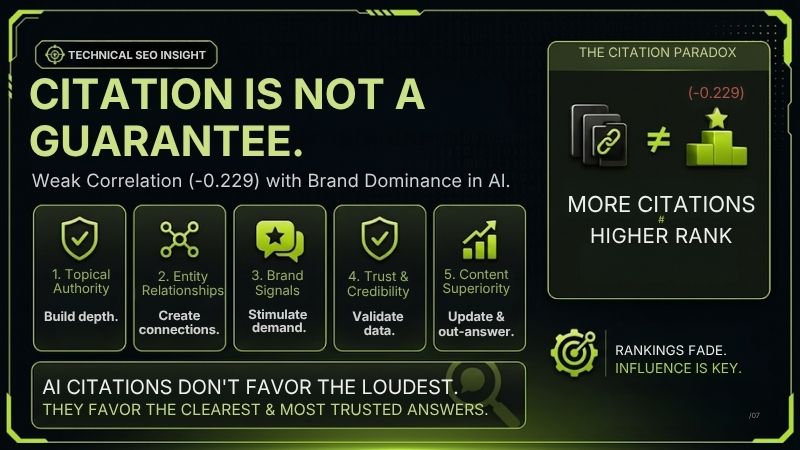
- Share of Model (SoM) Metric: Organic sessions are replaced by SoM—a primary KPI measuring brand citation frequency across simulated AI prompt cohorts.
- JSON-LD & Clean DOM: Flawless Schema Markup (Organization, LocalBusiness, Product) combined with clean semantic HTML ensures AI web crawlers accurately extract critical brand data.
1. The Era Shift and the Critical Importance of AI Search Local SEO
To accurately realign digital budgets, Chief Marketing Officers (CMOs) and Search Engine Optimization Directors must analyze the structural changes in how information distribution networks operate.
1.1. From “Multi-Option” to the “Definitive Recommendation”
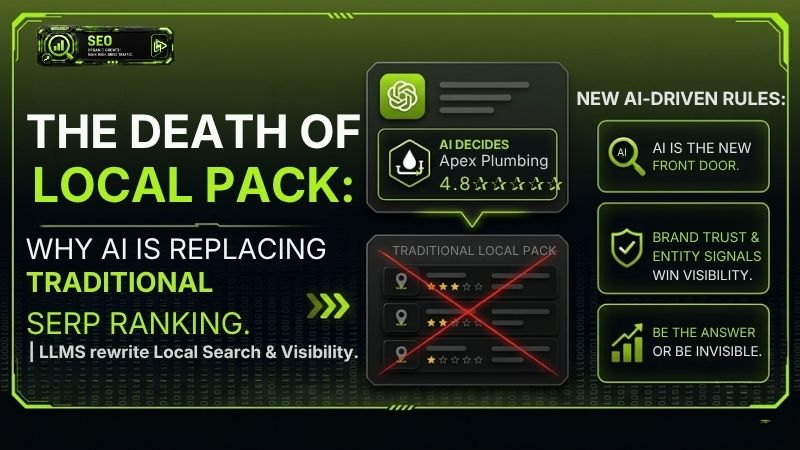
For over a decade, Google’s Local Pack served as the primary traffic generator for regional enterprises. The User Experience (UX) of this era was inherently “Multi-Option”. A user inputted a query, Google provided three selections on a map, and the user manually clicked through various websites to evaluate their options.
In the contemporary landscape, an AI Search Local SEO strategy is vital because AI does not function via enumeration. When a Chief Technology Officer (CTO) inputs a prompt: “Recommend the most secure cloud hosting provider in Ho Chi Minh City, holding an ISO 27001 certification with 24/7 support,” the LLM does not return ten blue links. It autonomously aggregates data, compares technical specifications, and returns a natural language response identifying one or two specific brands. The user completes the discovery phase without ever generating a click to your domain.
1.2. The Blind Spot of the Zero-Click Consumer Cohort
Zero-click search behavior actively neutralizes the reporting validity of traditional analytics tools like Google Analytics 4. In numerous technical deployments, organic sessions to localized landing pages have demonstrated a 30% decline, yet direct sales inquiries concurrently spike.
The rationale is straightforward: The consumer has already been thoroughly educated and persuaded by the AI interface. When they proactively contact the enterprise, they are already operating at the Bottom-of-Funnel conversion stage. If your enterprise evaluates the success of an AI Search Local SEO strategy solely based on raw website traffic, you are operating with a fundamentally flawed perspective of your revenue pipeline.
2. Core Data Extraction Mechanics: The Obsolescence of Legacy Rankings
Traditional Google indexing algorithms prioritize Keyword Density and Backlink Volume. Conversely, AI engines analyze digital domains strictly through the principles of Data Science and Neural Networks.
2.1. Entity Authority Supersedes Keyword Density
LLMs do not “read” textual content as humans do. They process “Entities” and analyze corresponding Intersecting Nodes within a massive global Knowledge Graph.
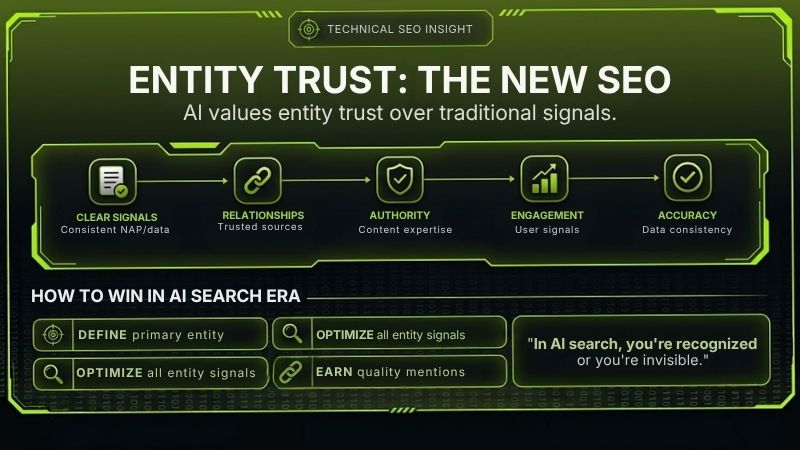
To achieve dominance in AI Search Local SEO, you cannot rely on repeating the keyword string “best software company in Hanoi.” Your website’s source code must explicitly define the brand as an Organization Entity possessing distinct, verifiable attributes: GPS Coordinates, Tax Identification Numbers, Founding Teams, and specific Product Categories. Artificial intelligence calculates your authority based on how logically your entity connects to other validated entities within the ecosystem, not by calculating repetitive keyword instances.
2.2. NAP Consistency and Algorithmic Confidence Scores
Within the framework of AI Search Local SEO, NAP (Name, Address, Phone number) constitutes your core identification dataset. AI models aggregate this localized data from hundreds of disparate sources, including business directories, social networks, and press releases.
The foundational operating principle of an LLM is to mitigate the risk of Hallucination (generating false data). If an AI scans five database platforms and detects inconsistent phone numbers or operating hours for your brand, it instantly downgrades the Confidence Score of that entity. Consequently, the AI will completely bypass your brand, instead recommending a competitor that possesses absolute NAP uniformity.
| Comparison Metric | Traditional Local SEO | AI Search Local SEO |
|---|---|---|
| Visibility Objective | Secure positions in the Top 3 Local Pack or Top 10 organic search results | Become the definitive single answer or top recommendation generated by LLMs |
| Evaluation Mechanism | Keyword density, link equity, and traditional backlink volume | Entity Authority, Knowledge Graph integration, and semantic node connections |
| NAP Data Strictness | Standard consistency across regional directories and business citations | Zero-tolerance NAP uniformity across all ecosystems to prevent AI hallucination safeguards |
| Primary KPIs | Keyword rankings, Organic Sessions, and Click-Through Rate (CTR) | Share of Model (SoM), Citation Frequency, and Direct Conversion Rate |
| Data Architecture | Basic Meta tag optimization and standard SEO-friendly content | Advanced Schema Markup (JSON-LD) and clean Semantic HTML DOM structures |
3. Measuring AI Search Local SEO Performance: Share of Model (SoM)
As the Click-Through Rate (CTR) from traditional search engine results pages depreciates in quantitative value, digital agencies must transition to an entirely new measurement architecture to prove Return on Investment (ROI).
3.1. Defining Share of Model (SoM)
Share of Model (SoM) is a quantitative metric measuring the visibility and citation frequency of your brand within the synthesized responses of generative AI. This is the ultimate KPI governing any AI Search Local SEO strategy.
Calculation Methodology: Establish a cohort of 100 simulated prompt queries directly related to commercial intent within your specific industry. Execute these prompts via the APIs of ChatGPT, Gemini, and Claude. If your brand is explicitly cited as a top-tier solution 45 times, your SoM metric is 45%. This indicator reflects the enterprise’s capacity to serve as the algorithmic “Default Answer.”

3.2. Restructuring Attribution Models
Because current AI conversational interfaces do not transmit standard UTM parameters via organic chat interactions, recording conversion attribution within AI Search Local SEO demands elevated technical configurations:
- Deploying Proxy Tracking: Configure unique URL parameters attached directly to informational nodes that only AI web crawlers parse (e.g., deeply encrypted links embedded within JSON-LD structures).
- Post-Purchase Attribution Surveys: Upgrade the customer survey mechanisms within your CRM, clearly segregating attribution options between “Standard Google Search” and “Recommended by ChatGPT/Gemini.”
4. Data Architecture: The Deciding Factor in AI Search Local SEO
Cluttered source code and ambiguous web architectures are the primary reasons AI systems refuse to extract data (Information Gain) from enterprise domains.
4.1. Reconstructing Semantic HTML and the DOM Tree
The excessive reliance on Client-Side Rendering (JavaScript) creates massive computational barriers for AI bots. In AI Search Local SEO, source code velocity and cleanliness are the deciding operational factors.
- Localized landing pages must enforce absolute hierarchical structuring via Semantic HTML. Accurately utilize <article>, <section>, and <aside> tags to signal to machine learning algorithms which content is primary and which is supplementary.
- Avoid constructing overly complex or deeply nested Document Object Models (DOM). AI crawlers prioritize parsing speed; if corporate data is obfuscated behind multiple layers of rendering code, the system will abandon the crawl.
4.2. Engineering Data Tables and FAQ Blocks
Language models exhibit an extreme systemic preference for quantitative, structured data formats.
- All technical specifications, product dimensions, and pricing matrices must be formatted utilizing traditional <table> tags rather than CSS-formatted <div> blocks.
- Establish Frequently Asked Questions (FAQ) sections directly on the page using natural language formatting. AI algorithms prioritize extracting verbatim, concise answers from these FAQ blocks to populate chat responses.
5. The H2T Technical Action Blueprint for AI Search Local SEO
To dominate this new display environment, the enterprise’s software engineering and SEO divisions must collaboratively execute the following three advanced Schema Markup deployment phases:
5.1. Deploying Organization & LocalBusiness Schema
Structured Data formatted in JSON-LD is the native communication protocol for AI. If you intend to optimize your AI Search Local SEO, you must provide precise JSON-LD scripts devoid of syntax errors.
The source code must explicitly declare critical data fields: GeoCoordinates, Global Identifiers, Operating Hours, and most importantly, the SameAs attribute (linking the entity to official social media profiles, Wikipedia, or Wikidata repositories). This protocol allows the AI to validate your entity with absolute certainty without expending inference resources.
5.2. Integrating Product & AggregateRating Schema
Within multi-location B2B or E-commerce environments, product pricing data and review ratings are the exact variables AI utilizes to execute competitive comparisons. Embedding Product and AggregateRating Schema allows machine learning models to instantly extract the brand’s median review score, transforming it into a competitive advantage when the AI synthesizes its final answer.
5.3. Managing Sentiment Analysis from Third-Party Reviews
In the context of AI Search Local SEO, online reviews function as qualitative training data. LLMs continuously scrape data from Google Maps, Trustpilot, G2, and industry-specific forums to conduct Sentiment Analysis on real user interactions. This aggregated sentiment score acts as an algorithmic multiplier, dictating whether your brand possesses sufficient authority to be crowned the “#1 Recommendation.” Administrators must respond to all reviews professionally, deploying natural language that integrates semantic keywords to continuously enrich the AI’s training data repository.
6. Frequently Asked Questions
Unlike traditional SEO that optimizes for organic links and multi-option Google Local Packs, AI Search Local SEO focuses on positioning your brand as the single, definitive recommendation synthesized directly by Large Language Models (LLMs).
LLMs rely on global Knowledge Graphs and verified entities to deliver accurate answers; any inconsistent Name, Address, or Phone (NAP) data triggers hallucination safeguards and lowers your brand’s confidence score, causing AI to bypass your business.
Share of Model (SoM) replaces traditional click-through metrics by measuring how frequently your brand is cited as a top solution across a standardized set of simulated AI prompt queries executed via ChatGPT, Gemini, and Claude.
Implementing error-free Organization, LocalBusiness, and Product Schema in JSON-LD format provides a clear, structured communication layer that allows AI crawlers to parse and validate your key operational data without computational friction.
The obsolescence of traditional search rankings makes an AI Search Local SEO strategy an indispensable imperative for enterprises seeking to safeguard their market share. By shifting from vanity traffic metrics to Share of Model (SoM) tracking and deploying a flawless JSON-LD Schema architecture, your business can secure its position as the algorithmic “default recommendation” across LLM platforms. Contact the Technical SEO team at H2T Media Group today for a comprehensive entity audit, and continue exploring deeper technical insights in the SEO category within our main Insights hub on the official H2T Media Group website!

bichthao
H2T Media Group decodes every meaningful platform update for advertisers and affiliate partners across APAC, EU and North America — always with a practical "H2T take" you can act on.
More about H2T →