

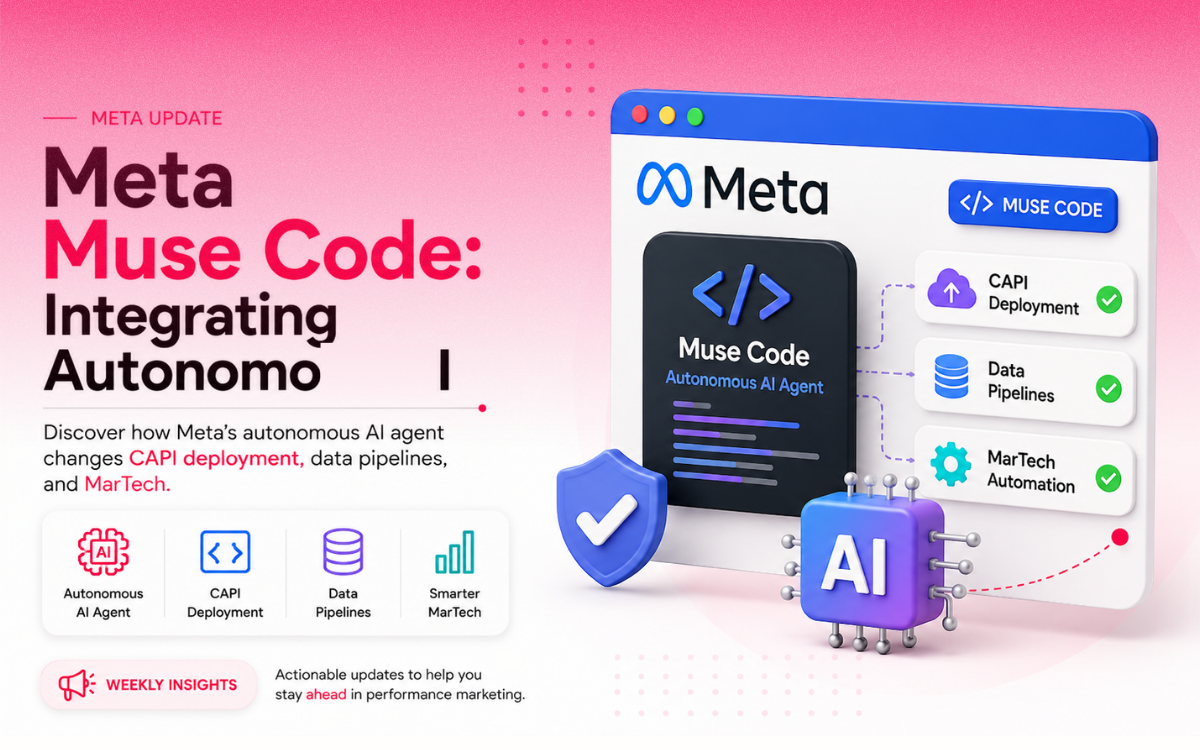
Welcome to the Meta/Facebook performance insights hub by H2T Media Group. Meta Muse Code – an autonomous Terminal Coding Agent powered by the Muse Spark 1.2 core model – has officially launched to transform how Agencies operate MarTech architecture, automate Meta Conversions API (CAPI) deployments, and build end-to-end ETL data pipelines.
If your Agency relies on traditional software engineering pipelines and seeks to eliminate latency, optimize technical costs, and ensure state recovery across long-horizon executions, your infrastructure requires an immediate strategic transition. Below is H2T’s system architecture dissection, operational framework, and human capital skill transition model. Read on with H2T Media Group to discover how to scale your engineering output and future-proof your digital marketing ecosystem.
 Key Takeaways
Meta Muse Code marks a fundamental shift from short-turn conversational AI to an autonomous Terminal Coding Agent capable of long-horizon engineering execution.
Essential Facts About This Update
- Terminal Coding Agent: Operates directly from the command line on the Muse Spark 1.2 model to autonomously plan, code, and test multi-step workflows.
- Async Background Agents: Maintains active context and gathers error logs asynchronously to execute multi-threaded tool calls with near-zero latency.
- Runtime State Recovery: Logs every action into a single source of truth, enabling flawless environmental reconstruction mid-execution if a crash occurs.
- MarTech Automation: Streamlines Meta Conversions API (CAPI) deployments and builds automated ETL pipelines to sync CRM data directly with Data Warehouses.
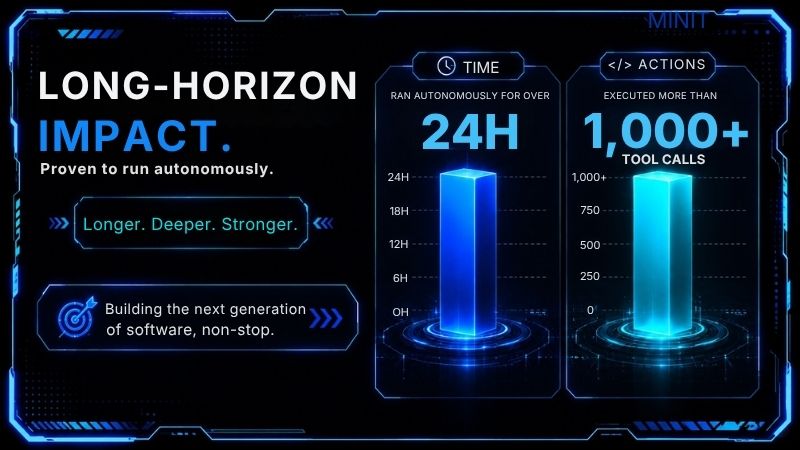
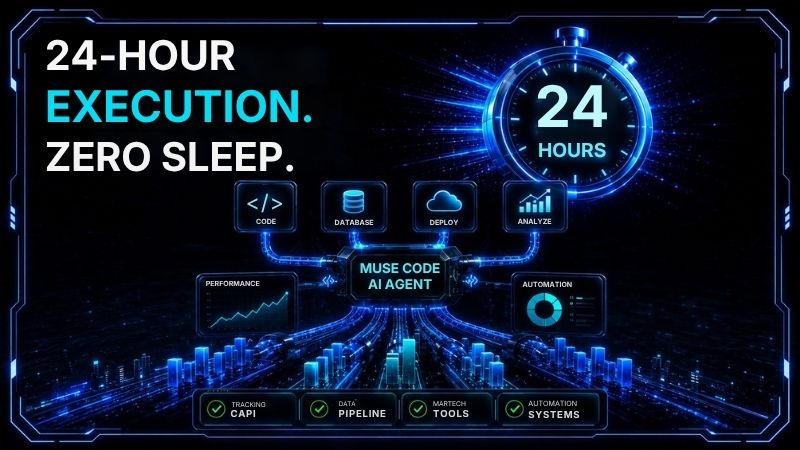
- 24-Hour Autonomous Execution: Capable of performing over 1,000 continuous tool calls without requiring human prompt intervention.
1. Technical Architecture: Shifting from Reactive Models to Long-Horizon Execution
The primary limitation of current AI coding assistants is their reliance on short context windows and continuous human prompting. Muse Code resolves this technical bottleneck by restructuring the entire operational approach, transitioning from a “Prompt-and-Response” model to a state of “Long-horizon Autonomy.”
1.1. The Muse Spark 1.2 Core Model
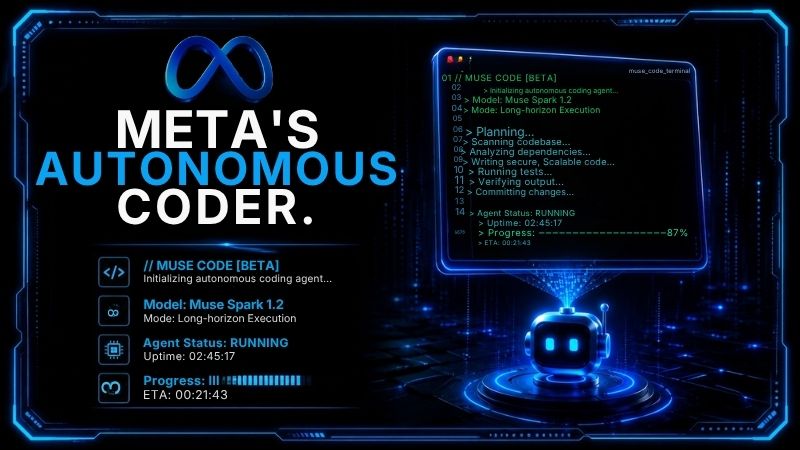
Muse Code does not rely on generalized LLMs. It operates on the Muse Spark 1.2 foundation, a model co-trained through rigorous self-improvement loops. This training methodology focuses exclusively on maximizing accuracy regarding multi-step instruction following.
Rather than generating isolated code snippets, Muse Spark 1.2 equips Muse Code with the cognitive capacity to analyze entire source code repositories, comprehend file dependencies, and execute structural modifications without destabilizing existing system functionalities.
1.2. The Terminal Coding Agent Environment
Muse Code functions as an independent entity operating directly within the terminal command line. When a user establishes a business objective (e.g., “Construct an API integration connecting CRM customer data to Meta”), the system autonomously dissects this macro-objective into hundreds of micro-tasks. It writes the code, runs automated unit tests, executes debugging protocols, and applies patches until the system operates flawlessly. This workflow completely eliminates the necessity for manual human intervention during repetitive engineering phases.
2. Technological Breakthroughs Resolving AI System Failures
Delegating autonomous decision-making to an AI system over extended periods introduces two critical technical risks: Processing Latency and System Crashes resulting in context loss. Meta has engineered distinct infrastructural solutions to neutralize these issues.
2.1. Async Background Agents
In multi-step procedural tasks, generating a new computational agent for every individual tool call creates initialization latency and forces the system to constantly reload background context. Muse Code circumvents this by utilizing “Async Background Agents.”
These sub-agents remain persistent and active throughout the entire session. They operate asynchronously in the background to gather data, analyze error logs, and maintain the overarching context window. The result is the execution of multi-threaded tool calls with near-zero latency, ensuring unbroken continuity for enterprise-scale programming tasks.
2.2. Runtime Design and State Recovery Capabilities
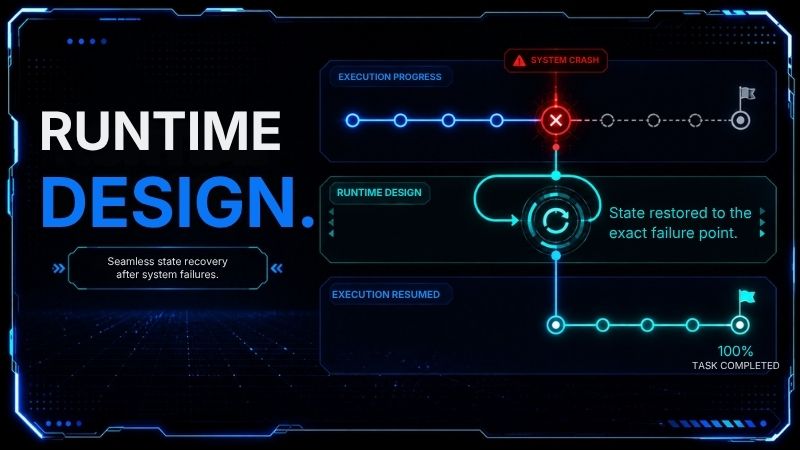
This feature defines the enterprise-grade reliability of Muse Code. The system integrates a specialized Runtime Design where every action, tool invocation, and source code modification is immutably logged into a single source of truth database.
If a server encounters a critical failure or a process times out during a 10-hour execution, Muse Code utilizes this logging repository to flawlessly reconstruct the exact environmental state from the millisecond before the failure occurred. The State Recovery function ensures that long-horizon software projects never require manual restarts due to hardware errors or network timeouts.
2.3. Extreme Testing: 24-Hour Autonomous Execution
Internal testing data from Meta provides empirical evidence of the system’s scalability. Muse Code was tasked with optimizing complex graphical processing units (GPU kernels). The system autonomously executed over 1,000 distinct tool calls, continuously compiling, testing, and modifying code for 24 consecutive hours without requiring a single supplemental human prompt. This sustained execution capability fundamentally redefines programming productivity metrics.
3. Operational Impact on Digital Agencies and MarTech Infrastructure
For advertisers and B2B enterprises, Muse Code is not merely IT news. It is an operational and financial lever, enabling Marketing teams to deploy complex technical architectures while minimizing time-to-market and capital expenditure.
3.1. Automating Meta Conversions API (CAPI) Deployment
Implementing Server-Side Tracking via the Meta Conversions API is a mandatory standard for accurate attribution in a post-third-party cookie ecosystem. However, this procedure requires expertise in cloud server configuration, data routing logic, and event deduplication parameters.
With Muse Code, a deployment process that traditionally requires weeks of developer time is compressed. A Performance Lead simply inputs the API documentation and data schematics; Muse Code will autonomously write the required Node.js or Python scripts, deploy them to AWS or Google Cloud servers, and conduct automated payload testing to ensure the data streams reaching Meta are perfectly formatted and validated.
3.2. Constructing Automated Data Pipelines and Analytics
Agile agencies must aggregate ad spend data from Meta, conversion metrics from CRMs (e.g., Salesforce, HubSpot), and behavioral data from Google Analytics into a centralized Data Warehouse to calculate exact Return on Investment (ROI).
Muse Code possesses the capability to autonomously script Extract, Transform, Load (ETL) pipelines. The system connects to third-party APIs, sanitizes raw data, restructures database tables, and routes the clean data directly into visualization tools like PowerBI or Tableau. This operates continuously 24/7, guaranteeing real-time data synchronization.
3.3. Reducing Tool Development Overhead
Agencies typically rely on outsourced vendors or expensive internal engineering teams to build custom reporting automation, Creative Asset Management software, or budget pacing tools. The introduction of Muse Code allows for the immediate reallocation of these resources. Payroll budgets can be redirected toward strategic business planning, while pure syntax writing is delegated entirely to the autonomous AI system.
4. The Skill Transition Process for Human Capital
The proliferation of “Coding Agents” like Muse Code will forcibly alter recruitment standards and performance evaluation metrics within corporate organizations.
| Human Resource Role | Previous Skill Evaluation Standard | Evaluation Standard in the Autonomous Era |
|---|---|---|
| Software Engineer | Evaluated on raw coding speed and memorization of syntax/languages. | Transitions to Systems Architect. Focuses on designing database structures, establishing security parameters, and auditing AI-generated code. |
| Performance Marketer | Setting up campaigns in the UI, conducting manual spreadsheet analysis. | Evolves into a Marketing Technologist. Requires the ability to write precise Product Requirements Documents (PRDs) for AI Agents and understand API data flows. |
| Chief Technology Officer (CTO) | Managing the daily output and sprint cycles of human developers. | Managing and optimizing Compute Resources for parallel clusters of autonomous AI agents. |
Security and Risk Management
When granting Muse Code access to corporate databases, organizations must implement strict Zero Trust Architecture protocols. Despite the AI’s programming proficiency, access privileges (API Keys, Database Credentials) must be isolated within secure Sandboxes. Human engineers will assume the role of the “Final Reviewer,” auditing the code for unintended security vulnerabilities before deploying it to the live Production environment.
5. Frequently Asked Questions
Meta Muse Code is an autonomous Terminal Coding Agent powered by the Muse Spark 1.2 model. Unlike reactive copilots that require constant human prompting, it operates directly from the command line to independently plan, write, test, and debug code for long-horizon engineering tasks.
It utilizes a specialized Runtime Design that immutably logs every action, tool call, and file modification into a single source of truth database. If a server times out or crashes during multi-hour executions, the State Recovery feature reconstructs the exact environment state and resumes execution seamlessly.
It dramatically accelerates the deployment of Meta Conversions API (CAPI), automates 24/7 ETL data pipeline construction, and reduces custom software development overhead, allowing agencies to scale technical capabilities with lower capital expenditure.
Human roles will shift toward higher-level system architecture and strategy. Software Engineers will evolve into Systems Architects auditing AI code, while Performance Marketers will act as Marketing Technologists writing precise requirement specs and managing API data flows.
In summary, the release of Meta Muse Code officially marks the transition of Artificial Intelligence from passive text generation to autonomous, long-horizon software engineering. By automating Meta Conversions API (CAPI) deployments, constructing real-time ETL data pipelines, and maintaining system state recovery during continuous 24-hour operations, this autonomous Terminal Coding Agent redefines how modern Digital Agencies manage MarTech infrastructure and optimize engineering overhead. To stay ahead of platform updates and implement actionable digital marketing frameworks, keep reading more in-depth technical analysis reports in the Meta category within the official Insights hub on the official H2T Media Group website.

bichthao
H2T Media Group decodes every meaningful platform update for advertisers and affiliate partners across APAC, EU and North America — always with a practical "H2T take" you can act on.
More about H2T →