

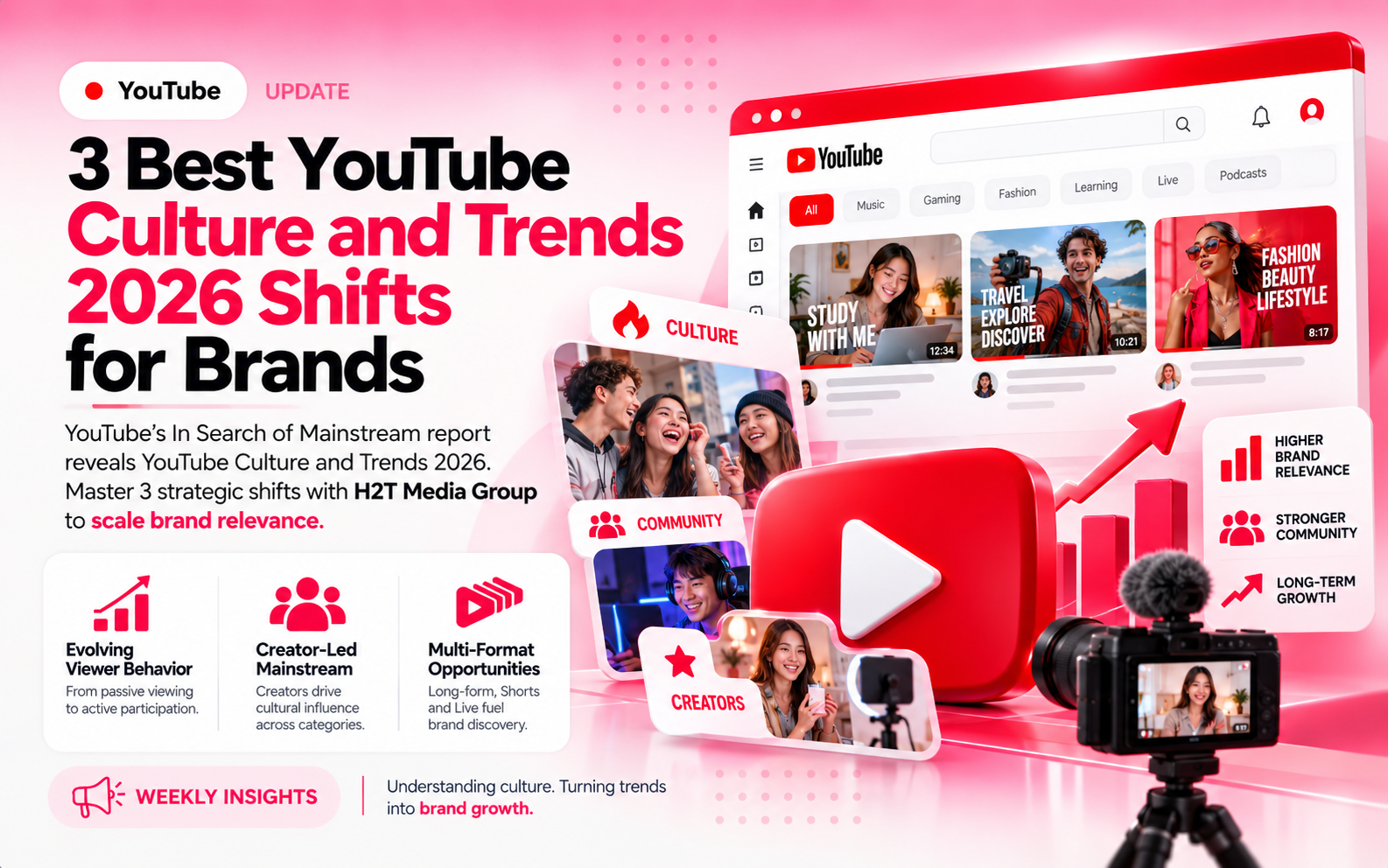
Welcome to the commercial video growth insights hub by H2T Media Group. Mastering YouTube Culture and Trends 2026 requires enterprise brands to transition from top-down broadcast commercials to bottom-up community co-creation led by digital creators. By activating omni-surface visibility, cross-demographic comprehension, and active community participation across Shorts, In-Feed, and CTV surfaces, performance media buyers can bridge subcultural storytelling with Demand Gen scaling to accelerate bottom-line conversions.
Below is H2T Media Group’s technical analysis of the three core cultural signals and an actionable enterprise execution blueprint – read on with H2T Media Group to optimize your video growth strategy.
 Key Takeaways
YouTube Culture and Trends 2026 confirms that mainstream cultural consensus is now engineered from the bottom up by digital creators and niche subcultures.
Essential Cultural Benchmarks
- Mainstream culture has evolved from centralized broadcast mandates into decentralized co-creation.
- 77% of audiences perceive digital creators as possessing cultural relevance equal to Hollywood celebrities.
- 3 core signals turn digital moments into global touchstones: Visibility, Comprehension, and Participation.
- One-way broadcast commercials are systematically displaced by creator-led community partnerships.
- Enterprises must bridge subculture storytelling with paid Demand Gen and Connected TV scaling.
1. The Redefinition of Mainstream Culture in the 2026 Digital Era
For decades, cultural consensus was strictly monopolized by centralized gatekeepers: legacy broadcast television networks, print media conglomerates, and traditional Hollywood film studios.
1.1. The NRG empirical findings: 63% of youth anchor identity in niche subcultures
Longitudinal research executed across thousands of active consumers aged 14 to 44 (with primary focus on the 14–29 demographic) demonstrates an entirely restructured social fabric:
- 63% of young consumers (aged 14 to 29) explicitly state that participating in specialized, niche digital subcultures provides a stronger sense of shared identity than traditional mass-market media events.
- Rather than gathering around a singular primetime television broadcast, modern audiences inhabit thousands of distinct digital ecosystems on YouTube: spanning independent 3D horror animation, mechanical keyboard restoration, deep-dive computational physics, and micro-genre music curation.
1.2. The dissolution of centralized media monopolies
The perceived authority gap separating traditional celebrities from native digital creators has completely dissolved:
- 77% of surveyed viewers state that YouTube creators command cultural relevance and personal influence equal to traditional A-list film actors.
- 78% of consumers evaluate viral online memes and community lore as major cultural milestones paralleling traditional sporting events like the Super Bowl.
Cultural velocity has permanently inverted: trends ignite within specialized short-form video communities, achieve critical mass through creator commentary, and subsequently permeate traditional media channels.
2. 3 Core Signals Transforming Digital Moments into Global Cultural Touchstones
According to strategic frameworks published via YouTube Culture & Trends Research, for an idea originating within a micro-community to achieve global mainstream breakthrough, the asset must activate three synchronized operational signals:
2.1. Signal 1: Omni-surface visibility
This represents the foundational distribution layer. An asset must transcend singular consumption surfaces, establishing presence across mobile vertical Shorts, desktop In-feed streams, and living-room Connected TV (CTV) environments. Algorithmic multi-format distribution enables specialized content to cross initial community boundaries and engage broader demographic clusters.
2.2. Signal 2: Cross-demographic comprehension
Visibility alone is insufficient; modern cultural assets must possess structural accessibility across diverse audience cohorts.
While originating within a specialized subculture (such as a gaming lore mechanic or a vintage aesthetics movement), the core thematic narrative must tap into universal human emotions: curiosity, humor, collective validation, or existential suspense. When an asset communicates complex niche concepts through intuitive visual language, it invites external audiences to participate without friction.
2.3. Signal 3: Active community participation
This constitutes the most vital signal governing YouTube Culture and Trends 2026. Modern digital consumers categorically reject passive spectatorship.
A cultural moment achieves true mainstream momentum only when it sparks decentralized co-creation:
- Audiences produce dynamic reaction videos, remix underlying audio tracks, replicate physical challenges, and generate custom fan art.
- Viewers author thousands of analytical comments, expanding the foundational narrative into an interconnected digital franchise.
This active community co-creation transforms a static commercial asset into a self-sustaining cultural engine.
3. Transitioning from Monolithic Broadcasting to Subculture-Led Advertising
The fragmentation of mainstream culture demands that performance marketing agencies fundamentally modernize their campaign development frameworks.
3.1. The rise of bottom-up digital franchises (Bottom-Up IP)
The most profound embodiment of this dynamic is visible in the emergence of properties like “The Backrooms”—a digital franchise that originated as an anonymous creepypasta image on a forum, was adapted into a viral 3D short-form series by a 16-year-old creator on YouTube, and was subsequently acquired by major Hollywood production studios for theatrical feature development.
Intellectual Property (IP) generation has permanently flipped: rather than corporations investing hundreds of millions to broadcast fabricated characters down to passive consumers, communities incubate authentic IP on YouTube, validating commercial demand prior to enterprise scaling.
3.2. Terminating the one-way commercial broadcast model
Enterprises that continue deploying generic, self-congratulatory corporate advertisements will experience immediate scroll-away abandonment within the first second of playback.
Dominating the 2026 media landscape requires embedding corporate value propositions natively within subcultural contexts:
- Replace single monolithic national TV commercials with five targeted creative variants co-produced with respected creators representing distinct verticals (Gaming, Sustainable Design, High-Performance Tech, Culinary Arts).
- Position the brand as an authentic enabler of the community’s ongoing conversation rather than an intrusive, irrelevant interruption.
4. Comparative Matrix: Legacy Mass Media vs. The 2026 Fragmented Cultural Landscape
The technical matrix below outlines the operational divergence separating traditional broadcast advertising from the modernized creator-led cultural paradigm:
| Evaluation Dimension | Legacy Top-Down Broadcast Media | Modern YouTube Culture and Trends 2026 |
|---|---|---|
| Cultural Genesis | Major film studios, linear TV networks, print media. | Niche subcultures, independent creators, digital forums. |
| Distribution Dynamic | One-way static broadcasting to passive audiences. | Multi-format co-creation: Shorts -> Remixes -> Deep-Dives. |
| Audience Engagement | Passive viewing; closed reception. | Active Participation: Lore expansion, reaction videos, memes. |
| Validation Metrics | Broadcast TV ratings, opening weekend box office. | Comment sentiment depth, audio remix velocity, consensus. |
| Enterprise Strategy | Procuring expensive, generic primetime ad slots. | Partnering with niche creators, scaling via Demand Gen. |
5. The Enterprise Operational Action Blueprint by H2T Media Group
To translate cultural intelligence into measurable return on ad spend (ROAS), H2T Media Group mandates the execution of this 3-phase technical roadmap:
Phase 1: Harvest Subculture Signals via YouTube Insights
Prior to finalizing creative scripts, media planning teams must interrogate YouTube Insights to identify rising micro-trends exhibiting over 50% year-over-year search and viewership growth within specific commercial categories. Extract the precise vernacular, pacing conventions, and acoustic signatures governing target subcultures.
Phase 2: Execute Co-Creation Partnerships with Authentic Category Creators
Eliminate rigid corporate scripts. Grant authorized category creators the creative autonomy required to embed your product organically within their native narrative formats. Mandate interactive call-to-action structures (encouraging community poll voting, video responses, and comment debates) to activate the critical Participation signal.
Phase 3: Programmatically Amplify Proven Assets via Paid Media
When a creator collaboration demonstrates superior organic engagement:
- Acquire direct whitelisting permissions via the YouTube Creator Partnerships API to deploy the asset as a sponsored Partnership Ad across YouTube Shorts and In-Feed inventory.
- Distribute high-definition 4K master cuts onto living room Connected TV (CTV) screens to capture multi-viewer household attention during shared co-viewing windows.
6. Frequently Asked Questions
It does not reduce potential efficiency, but it renders monolithic messaging obsolete. Segmenting media budgets across targeted creator assets addressing distinct subcultures consistently yields significantly higher aggregate conversion rates than generic national campaigns.
B2B organizations should partner with specialized technical educators, software architects, and workflow engineers. Demonstrating enterprise solutions within deep-dive technical tutorials delivered by trusted domain peers establishes immediate commercial credibility.
Yes. Collaborating with specialized micro-creators typically requires 5x to 10x less upfront capital while generating substantially deeper community trust, superior engagement rates, and higher downstream conversion intent.
Organizations should deploy YouTube Insights directly within Google Ads, cross-reference data with Google Trends, and continuously evaluate the monthly empirical reports published via the official YouTube Culture & Trends platform.
The foundational insights documented within the “In Search of Mainstream” report establish an undeniable commercial reality: Cultural authority is no longer manufactured in corporate boardrooms; it is cultivated within dynamic, highly connected digital communities. Mastering YouTube Culture and Trends 2026 provides enterprise brands with the strategic blueprint required to transcend transactional advertising, embedding their commercial offerings directly into the living cultural conversations that drive global consumer action. Organizations that align their creative production and media buying with decentralized community co-creation will command enduring brand equity and scalable commercial growth.
To access proprietary video performance playbooks and advanced multi-touch attribution frameworks, explore our technical repository on the Insights hub at H2T Media Group. Make sure to consistently follow our dedicated Catetory YouTube to master the tactical marketing strategies dictating success across global video advertising ecosystems.

bichthao
H2T Media Group decodes every meaningful platform update for advertisers and affiliate partners across APAC, EU and North America — always with a practical "H2T take" you can act on.
More about H2T →